Introduction
The Biden White House has said that “lowering prices – including the cost of high-speed internet service – is President Biden’s top priority.”
[1] To do this, the Biden Administration is attempting to leverage a COVID-19 pandemic-era program that was expanded by the Infrastructure Investment and Jobs Act of 2021. The Affordable Connectivity Program (ACP) provides a monthly payment to broadband service providers to deliver high-speed internet services to qualifying low-income households.
The White House said in May 2022 that it had “secured commitments from 20 leading internet providers… to either increase speeds or cut prices…”
[2] More recently, the White House suggested that ACP was “helping over 21 million households save over $500 million per month on their monthly internet bills.”
[3] These statements raise the question of whether the White House’s claims are true.
In this paper, I show that ACP subsidies are associated with higher prices for high-speed internet. Today, about 15 percent of U.S. households are receiving an ACP subsidy. This is associated with an increase in average monthly charges for broadband services of about 7 percent between 2022 and 2023. I also find no effect on monthly charges until the level of households receiving an ACP subsidy exceeds 6 percent and no change in the effect of ACP subsidies based on market concentration for telecommunications providers.
Another way of looking at these results is that, on average, monthly charges for broadband services have increased by about $5.48 between 2022 and 2023 because of the ACP subsidies. Therefore, broadband service providers are capturing about 18 percent of the total subsidy while passing along higher costs to all consumers. Furthermore, expanding ACP to cover 40 percent of all households would increase monthly charges by 12 percent for all consumers. In this scenario, broadband service providers would pocket almost a third of the total subsidy.
These findings are especially relevant given that ACP is running out of money and the Biden Administration has asked Congress for a $6 billion “emergency” appropriation to allow the program to continue. However, the Biden Administration has also stated that it intends to expand the program to cover nearly 40 percent of all households which would cost more than $19 billion a year.
[4] Congress should reject the request for additional funding and sunset this new temporary program as was initially envisioned when it was created during the COVID-19 pandemic.
Background on the Affordable Connectivity Program
In December 2020, Congress passed the Consolidated Appropriations Act of 2021 (P.L. 116-260) that established the Emergency Broadband Benefit Program (EBB). EBB was a temporary subsidy of up to $50 per month that was intended to help low-income households afford broadband internet services amid the pandemic when most students were still engaged in remote learning as a result of COVID-19 related school closures. The initial appropriation for the program was $3.2 billion.
In November 2021, after most schools had reopened to in-person instruction, the Infrastructure Investment and Jobs Act (IIJA or P.L. 117-58) made three significant changes to EBB. First, it eliminated the sunset of the program, which was set to coincide with the expiration of the COVID-19 pandemic. Second, it provided another $14.2 billion for the program. Third, it renamed EBB as the Affordable Connectivity Program (ACP).
Similar to its predecessor, ACP provides a monthly subsidy of $30 per month to low- income households that purchase services from participating broadband service providers. There are currently 22.6 million households enrolled in ACP (based on data from January 2024).
[5] In other words, about 15 percent of all households in the U.S. receive a subsidy.
However, the appropriation for the program included in the IIJA will soon be exhausted. The Office of Management and Budget asked for an additional $6 billion in funding for the ACP as part of a domestic emergency supplemental request sent to Congress in October 2023.
[6] However, the Biden Administration has also stated a goal to increase the number of households receiving the ACP subsidy by an additional 30 million.
[7] That would cost more than $19 billion.
[8]
Data on ACP Subsidies and Broadband Prices
Data on broadband pricing is from the Federal Communication Commission’s (FCC) Urban Rate Survey which is a sample of fixed broadband service providers in urban areas. The data provides information on the download and upload speeds of plans, usage, and monthly price (including the base charge, surcharges, and other charges included in the monthly cost of service).
[9] Data on ACP subsidy enrollment is also from the FCC.
[10]
The Urban Rate Survey is aggregated by census tract whereas the ACP enrollment data is by county. I aggregate both to the state level because the Urban Rate Survey does not have census tract identification in the public use file. Better estimates could be produced with census tract identification. As of 2020, about 268 million people (or 81 percent of the population) lived in urban areas as defined by the U.S. Census Bureau. As of last summer, about 2.8 million households in rural areas (about 15 percent of total ACP subsidy recipients) received an ACP subsidy. Therefore, the Urban Rate Survey provides data that would cover most ACP beneficiary households.
The Effect of ACP on Broadband Prices
Figure 1 shows that there is a positive association between the percentage of households receiving ACP subsidies and the increase in the average total monthly price for broadband since 2022.
[11] However, there is no statistically meaningful association between ACP subsidies and prices when the level of households receiving the ACP subsidies exceeds 6 percent. Today, about 15 percent of households across the country receive an ACP subsidy. That corresponds with an average increase of about 7 percent in the total cost of a monthly broadband subscription. However, there is some variation at the state level regarding the percentages of households enrolled in ACP. That said, roughly 90 percent of states have enough households receiving an ACP subsidy to correspond with a statistically meaningful positive change in the price of broadband.
Figure 1. Households Receiving ACP Subsidies and Broadband Costs, All Broadband Plans
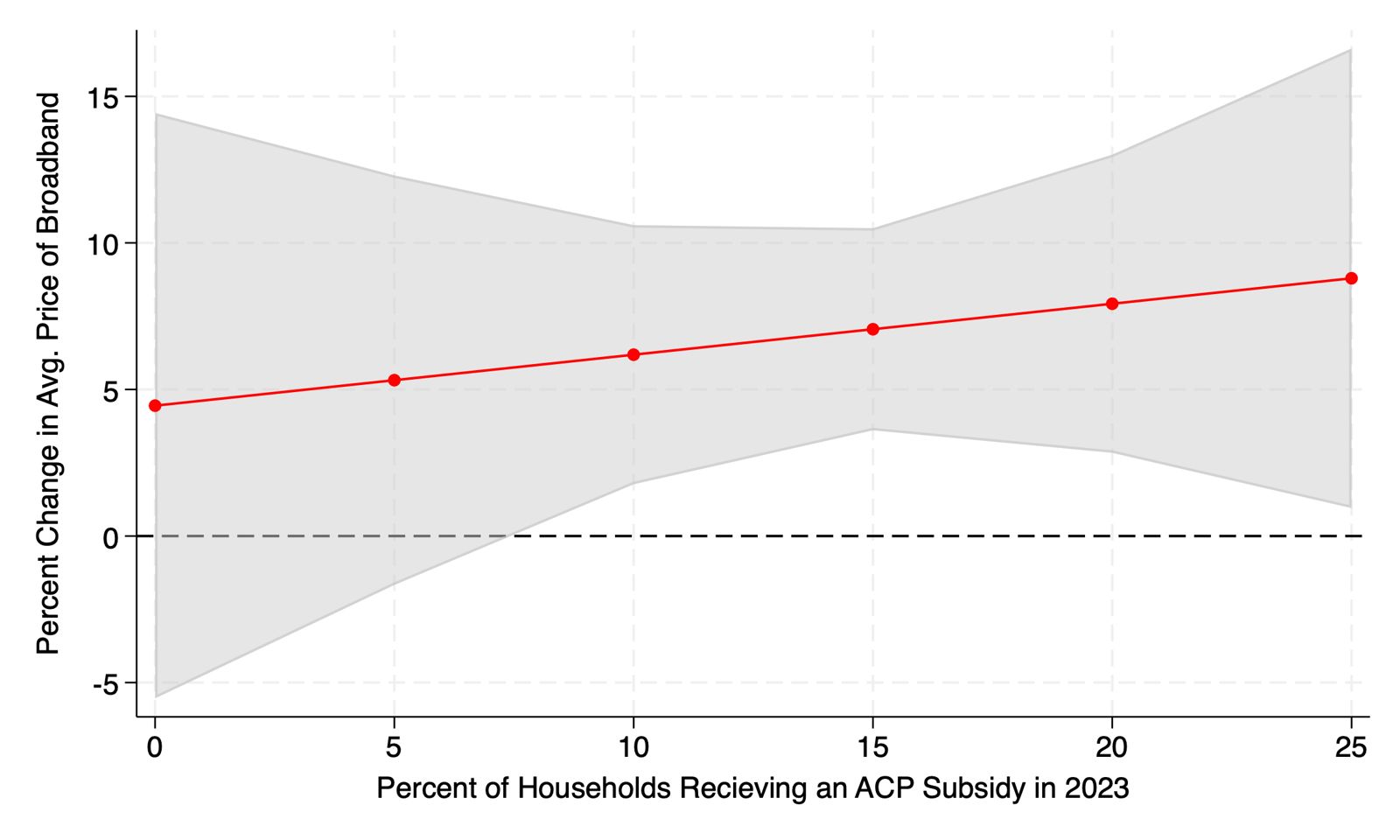 Note: Shaded area represents the 95% confidence interval.
Source: Author’s calculation using data described in the paper.
Note: Shaded area represents the 95% confidence interval.
Source: Author’s calculation using data described in the paper.
There is also some variation in the number of broadband service providers in each state. It is reasonable to assume that market concentration would influence the change in the price of broadband. For example, it is possible that higher competition would lower prices. It is also possible that fewer providers could reflect a market where companies are taking advantage of economies of scale.
Although it is difficult to determine market share using existing public data, the sampling unit includes both the provider and an urban census tract. Therefore, I approximate market share by calculating the number of census tracts within a state where a provider is offering broadband services. Including this measure does not change the results shown in Figure 1. This might suggest that, although market concentration may still be important, it does not fundamentally change the relationship between ACP subsidies and the price of broadband.
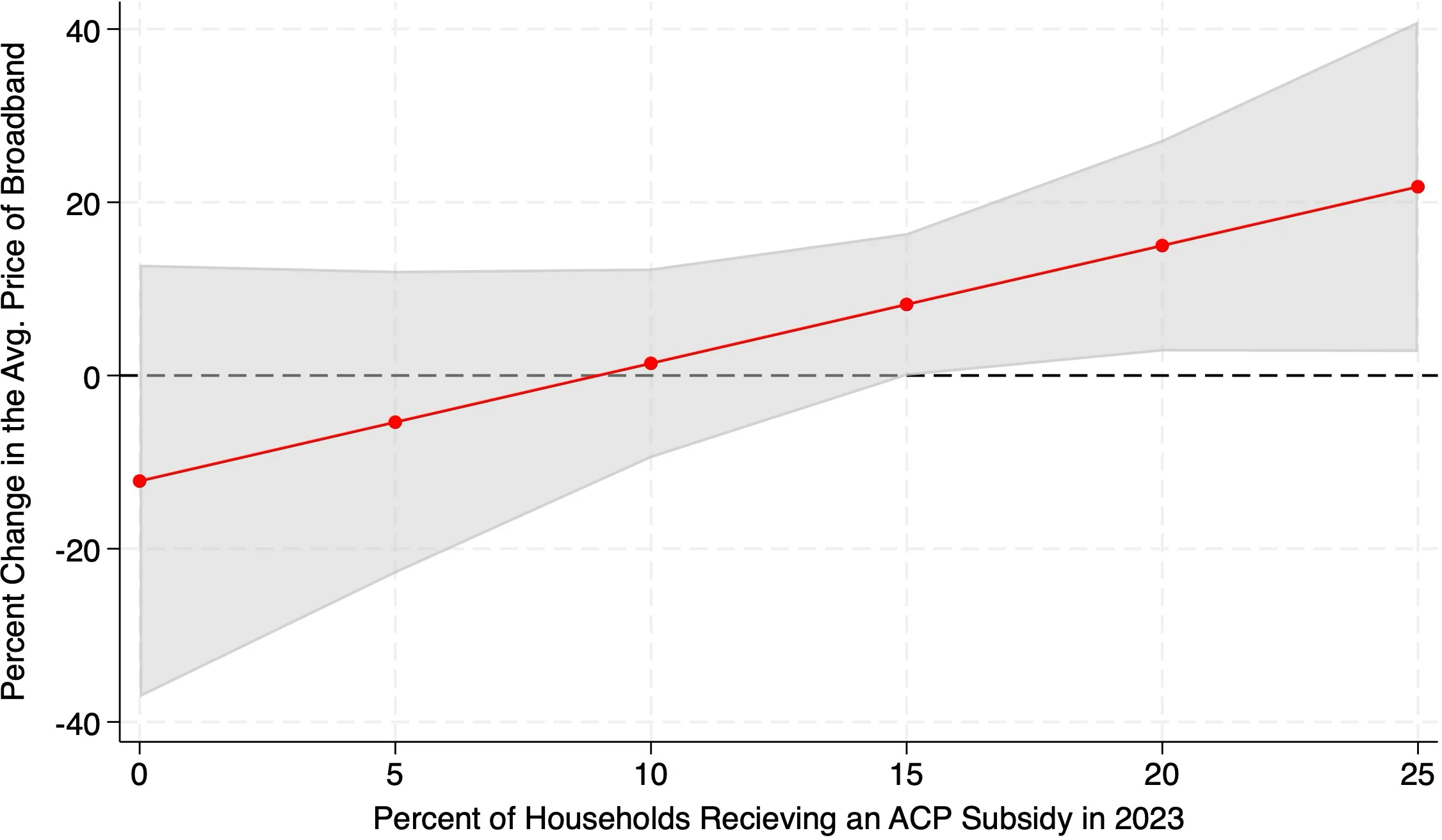
Figure 2. Households Receiving ACP Subsidies and Broadband Costs, Lower Speed Broadband Plans
 Note: Shaded area represents the 95% confidence interval.
Source: Author’s calculation using data described in the paper.
Note: Shaded area represents the 95% confidence interval.
Source: Author’s calculation using data described in the paper.
There is also variation in the type of broadband that is provided. The Federal Communications Commission finds that there is a nonlinear relationship between broadband speed and the price paid for different speeds. Figure 2 shows the relationship between ACP subsidies and prices for lower broadband speeds (measured as less than 20 Mbps in download speed). Here you can see that the proportion of households receiving an ACP subsidy is positively associated with price for lower-speed plans.
Furthermore, the change in prices is higher in states with a greater percentage of households receiving ACP subsidies relative to the price change for all plans. One possible explanation is that broadband service providers are marketing their lower- speed plans to those eligible to receive the ACP subsidy while raising the cost of these basic plans to capture larger proportions of the subsidy.
Table 1 shows the average change in price for broadband plans that is associated with a percent of households receiving an ACP subsidy. Today, the average cost of broadband is about $5.48 higher because of ACP while broadband service providers are capturing about 18 percent of the total subsidy. If 40 percent of households were enrolled in ACP, as would be the case under the Biden Administration’s plan, the average change in prices for plans would increase by about $9.39 and 31 percent of the subsidy would be pocketed by broadband service providers.
Table 1. Average Change in the Price of Broadband Associated with the ACP Subsidy at Different Levels of Household Saturation, All Plans
|
15% of Households |
30% of Households |
40% of Households |
| Price Change ($) |
$5.48 |
$7.56 |
$9.39 |
| % of ACP Subsidy |
18% |
25% |
31% |
Source: Author’s calculation using data described in the paper.
Table 2 shows the same estimates for lower-speed plans. Under higher levels of ACP enrollment, lower-speed plans will become more expensive with the broadband service providers able to capture larger portions of the total subsidy. This makes sense given that the ACP subsidy essentially operates as a floor for the prices of broadband.
Table 2. Average Change in the Price of Broadband Associated with the ACP Subsidy at Different Levels of Household Saturation, Lower-Speed Plans (Under 20 Mbps)
|
15% of Households |
30% of Households |
40% of Households |
| Price Change ($) |
$4.24 |
$15.38 |
$22.27 |
| % of ACP Subsidy |
14% |
51% |
75% |
Source: Author’s calculation using data described in the paper.
The Biden Administration has posited that ACP helps households save about $500 million per month on internet bills. However, that calculation does not include the effects of ACP on prices for broadband services. Based on the estimates provided in this report, ACP likely reduces the monthly net cost of broadband by about $380 million for households who qualify for the subsidies after adjusting for the increase in prices. However, if we factor in the price increase for all households (including ACP beneficiaries), ACP likely increases the net out-of-pocket cost of broadband that households pay by about $185 million per month or $2.2 billion per year.
[12]
Sunset the Affordable Connectivity Program
The Affordable Connectivity Program has become another welfare program that transfers federal resources to private industry. In turn, private industry captures some of the benefits while passing on higher prices to all consumers. Furthermore, the program has not even been successful in expanding high-speed internet coverage. Based on FCC’s estimates, 80 percent of ACP beneficiaries had high-speed internet before receiving the subsidy.13 The U.S. Government Accountability Office has reported an even lower success rate in expanding coverage.14
Congress should allow the ACP program to sunset when its appropriation expires within the next few months. Doing so would reduce the price of broadband coverage, thereby increasing affordability in the long run. Sunsetting the program would not only save American households on their monthly internet bills, but it would also save taxpayers from footing the bill for yet another misguided welfare program.