A Key CRA Opportunity on EVs
Environmental Protection Agency (EPA) Administrator Lee Zeldin recently
sent a waiver granted to California for its Advanced Clean Trucks (ACT) regulations to Congress for review under the
Congressional Review Act (CRA). This important step will allow Congress to roll back the harmful ACT mandate that reduces choice and increases the cost of new, heavy-duty vehicles in over 25% of the national market across 11 states.
The Costly California Waiver
California’s waiver was
granted by the Biden-Harris EPA to continue and expand the state’s Advanced Clean Trucks (ACT) Program. The ACT includes a series of stringent regulations on vehicles that mandate increasing percentages of trucks sold in California be zero-emission vehicles.
California’s
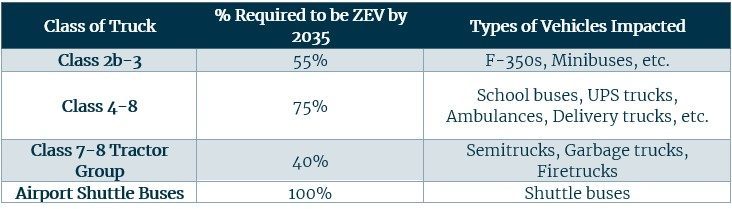
regulations mandate that manufacturers sell increasing quantities of heavy-duty vehicles classified as “zero-emission” (ZEV) through 2035. Vehicles classified as having zero emissions include fully electric vehicles (EVs) and plug-in hybrid electric vehicles.
The final percentages of zero-emission vehicles vary depending on the classification of the truck. For instance, 100% of airport shuttles are required to be zero-emission by 2035, but for school buses, the requirement is set to 75% by 2035.
Gas powered trucks and traditional hybrid vehicles do not meet California’s stringent standards and would not meet the requirements to be classified as zero-emission vehicles. The California new truck market makes up
9.5% of all new vehicle registrations in the United States. Thus, these harsh requirements would have a significant impact on the way heavy-duty vehicle manufactures and dealerships do business nationwide. Already, manufacturers are
planning to reshape their vehicle options to comply with California’s mandate.
Under the waiver, Californians would no longer have the freedom to purchase as many traditional or hybrid gas heavy-duty vehicles. Beyond limiting consumers’ choice, this poses problems in areas with insufficient infrastructure to support large numbers of electric trucks and the
larger capacity chargers many of them would require. The ACT mandate for heavy-duty vehicles also increases the cost of goods and services for Californians as they become dependent on EVs at a time when electricity prices are high and EVs are largely more expensive than traditional automotives. This expense is further passed on to consumers in other states since
40% of imported goods pass through California ports and involve heavy-duty vehicles to move and process them for national distribution.
A Carveout for California
Under the
Clean Air Act, California has a special carveout enabling the state to apply for and be granted special waivers. Unlike the other 49 states, California can receive waivers to enact its own environmental standards provided that: (1) those standards are at least as strong as the federal requirements, (2) are not arbitrary, and (3) that California can demonstrate a need for them.
If watching Californians suffer under an EV mandate was not bad enough, the ACT waiver has a snowball effect. In this case, the ACT waiver permits California to enact its own stringent regulations on vehicle emissions and opens the door for other states to adopt those standards without a separate application process.
Setting the Standard
To date,
11 states and Washington, D.C. have adopted California’s ACT standards and agreed to abide by California’s mandate for increasing numbers of zero-emission heavy-duty vehicles by 2035. Together, those states make up
25.5% of the new heavy-duty vehicle registrations in the United States.
With over a quarter of the U.S. market impacted and the potential to impact supply lines, the ACT waiver given to California imposes a significant regulatory and financial burden on Americans across the nation.
Congress Can Reverse Overregulation
Administrator Zeldin’s recent submission of the ACT waiver to Congress as a rule opens the door to remove this burden through the Congressional Review Act. If Congress votes to overturn the rule, this would effectively stop a crucial piece of California’s EV mandate from dictating what other states do.
Removing this waiver through the CRA process would ensure that a waiver or rule that is substantially the same
cannot appear again. It also removes the foundation for not only California’s heavy-duty vehicle EV standards, but also other states’ standards as well. Overturning this rule forces states who have enacted EV requirements contingent upon California’s waiver to rescind those and return to the federal guidance on emissions.
As House Majority Leader Scalise highlighted in his
CRA Targets List, this rule “has resulted in higher vehicle prices for consumers, increased costs and manufacturing complexities for automakers, and a more complicated regulatory environment.”
Congress should take advantage of this opportunity to remove the ACT waiver through the CRA process, working with the Trump Administration to overturn one of the most harmful regulations from the Biden-Harris Administration. This legislative action would certainly reinstate regulatory common sense and help eliminate California’s burdensome environmental agenda.