U.S. House of Representatives Committee on Oversight and Accountability Subcommittee on Economic Growth, Energy Policy, and Regulatory Affairs
Chairman Fallon, Ranking Member Bush, and Members of the Subcommittee, thank you for inviting me to testify.
Today, we are reviewing the economic policy of the Biden-Harris Administration. Each year, the White House Council of Economic Advisers (CEA) must submit an Economic Report of the President (ERP) providing the administration’s key economic objectives and a summary of the economic policies intended to achieve those goals.
[1] The ERP is an integral part of the budget process and is reviewed by Congress along with a Response prepared by the Joint Economic Committee.
[2]
The 2022 ERP (the first of the current administration) specified that “a core aim of the Biden-Harris Administration’s economic policy agenda is to restore the public sector as a partner in long-run growth, with a particular focus on the economy’s supply side – from physical infrastructure to the vitality of the workforce.”
[3] In other words, the key goal of the Biden-Harris Administration has been to grow the federal government. This is grounded in what the Biden-Harris Administration has called the “new Washington consensus” that considers federal investment “foundational to economic growth.”
[4]
On virtually every metric that can be measured, the Biden-Harris Administration has successfully grown the size and scope of the federal government over the past four years. After the pandemic spending surge in 2020, the annual rate of change in debt as a percent of the economy fell from its peak in April 2020 until April 2021. Since then, it has grown consistently. Between the first quarters of 2023 and 2024, debt held by the public grew from 92 to 97 percent of the economy.
[5] Meanwhile, civilian government employees are at an all-time high.
[6] State and local government hiring has made up a disproportionately large part of the job creation since 2021 due to increased federal subsidies.[7.Paul Winfree, January 22, 2024, “SLFRF: Are Federal Taxpayers Subsidizing State and Local Government Jobs?,” Economic Policy Innovation Center, at ../../blog/slfrf-are-federal-taxpayers-subsidizing-state-and-local-government-jobs/.] And new regulations finalized by the Biden-Harris Administration have cost the private sector $1.69 trillion and 312.1 million paperwork hours.[8.Dan Goldbeck, August 12, 2024, “Steady Stream of Rules Coming Down,” American Action Forum Week in Regulation, at https://www.americanactionforum.org/week-in-regulation/steady-stream-of-rules-coming-down/.]
The Biden-Harris Administration’s economic agenda is based on the foundation that public spending is the root of all jobs, income, and wealth creation. In reality, the administration’s economic policy has increased costs, contributed to inflation, restricted barriers to entry, and hindered productive capital. This has limited economic policy’s capacity to facilitate an environment conducive to widespread opportunity.
Another reason why the Biden-Harris Administration’s economic policy has largely underperformed is that it has been overly burdened by competing initiatives aimed at holding a political coalition together rather than strengthening the U.S. economy. This is reflected in new ERPeditions under the Biden-Harris Administration as well as statements made by the President’s top economic advisers (Table A1 in the appendix of this testimony shows the stated goals of economic policy as reflected in the 2022-2024 ERPs).
The pursuit of competing initiatives has spoiled top priorities of the Biden-Harris Administration. One important example has been the expansion of rural broadband through the Broadband Equity Access and Deployment (BEAD) program. The Biden-Harris White House identified the BEAD program as central to the “Bidenomics” agenda.[9.Annita Dunn and Mike Donilon, 2023, “Bidenomics is turning the page on failed trickle-down policies and transforming our economy – and it is strongly supported by the vast majority of Americans,” White House Memo to Interested Parties, at https://www.whitehouse.gov/wp-content/uploads/2023/06/WH-Dunn-Donilon-Memo-on-Bidenomics-2023.06.26.pdf] Congress appropriated $42.45 billion in 2021 to expand high-speed internet and in the summer of 2023 the Biden-Harris Administration awarded the state allocations. However, because of restrictions that the administration has placed on the awards (including attempts by the Department of Commerce to enforce rate regulation of the internet), not one household has been connected to the internet using the BEAD funds as of September 2024.[10.Brendan Carr, 2024, “A Legacy of Incompetence: Consequences of the Biden-Harris Administration’s Policy Failures.” Testimony before the U.S. House Committee on Oversight and Accountability (September 19, 2024), at https://oversight.house.gov/wp-content/uploads/2024/09/Carr-Testimony.pdf]
A better way forward would be to re-ground economic policy in areas with widespread public support. This would include pursuing full employment, low inflation, and sustainable economic growth.[11.Paul Winfree, 2019, A History and Future of the Budget Process in the United States, New York, NY: Palgrave Macmillan.] Policymakers should look to American entrepreneurship as the catalyst of innovation that creates well-paying jobs and wealth. Policymakers should also encourage competition by ensuring open access to markets, with only essential safety regulations that remain neutral and do not favor specific businesses.
Furthermore, history reveals that deregulation can produce significant gains for consumers. Particularly, when deregulation enhances transparency the scale that providers can compete on price and the quality of goods and services expands.[12.Paul Winfree, forthcoming, “The Price of Prosperity: The Cost of Living and the American Dream.”] There are, however, additional ways that policymakers can reduce costs for essential items like housing, food, and healthcare. The rest of this testimony provides areas where Congress can reduce the cost of living.
Why Inflation Has Increased Over the Past Four Years
Americans believe inflation is the most significant policy problem that we currently face. This is not surprising as it has eroded their purchasing power over the past four years.[13.Pew Research Center, May 23, 2024, Public’s Positive Economic Ratings Slip; Inflation Still Widely Viewed as Major Problem, at https://www.pewresearch.org/politics/2024/05/23/publics-positive-economic-ratings-slip-inflation-still-widely-viewed-as-major-problem/.] As of July 2024, it takes $1.20 to buy the same basket of goods and services that one could buy for only $1 in January 2021. Debates in the political sphere over the causes of this increase have included unlikely culprits, such as “price gouging” motivated by the lack of competitive markets especially in food and energy supply. However, research has shown that most of the rise in core inflation can be attributed to tight labor markets and large budget deficits.
Core inflation was, in part, motivated by tightness in the labor market as job vacancies increased relative to the unemployment rate.[14.Laurence Ball, Daniel Leigh, and Parch Mishra, 2022, “Understanding U.S. Inflation During the Covid Era,” NBER Working Paper 30613, National Bureau of Economic Research, at https://www.nber.org/system/files/working_papers/w30613/w30613.pdf.] When businesses reopened following the pandemic closures, many older workers retired while younger cohorts were slow to enter or return to the workforce.[15.The Congressional Budget Office’s March 2024 Long-Term Budget Outlook also assumes that the labor force participation rate of men between the ages of 20 and 54 will continue to fall over the next 30 years.] Research from my colleague, Rachel Greszler, reveals there are still about 2.9 million fewer workers than we would expect relative to before the pandemic.[16.Rachel Greszler, August 22, 2024, “Who are the 2.9 Million Missing Workers?,” Economic Policy Innovation Center, at https://epr-creations.github.io/epic-media/2024/08/Missing-Workers-August-Update_Greszler_08.22.24.pdf.] For example, employment among those between the ages of 20 and 24 is 3.4 percent lower while enrollment in post-secondary education is lower as well.
The reduction employment precipitated by government-imposed business closures led to a chain reaction that affected more than just the cost of living. At the macroeconomic level, the reduction in employment lowers productivity and output, which reduces the level of government revenues and increases the deficit. At the individual level, not entering the workforce after school, or continuing to expand skills by going to post-secondary school, can have profound consequences on income, economic opportunity, and even health for many years.[17.Paul Winfree, 2023, Testimony by Paul Winfree, Ph.D., Testimony to the Congressional Subcommittee on Economic Growth, Energy Policy, and Regulatory Affairs Committee on Oversight and Accountability in the U.S. House of Representatives, at https://oversight.house.gov/wp-content/uploads/2023/10/Written-Testimony-Winfree.pdf.] Furthermore, research has demonstrated that decisions not to enter the workforce are motivated, in part, by public policy that rewards non-work over work.[18.Rachel Greszler, April 22, 2024, “How 2.3 Million Missing Workers is hurting Economic Output and Increasing the Federal Budget,” Economic Policy Innovation Center, at ../../education-workforce-retirement/missing-workers-hurt-economic-output/.] In essence, this is a much larger problem than a potentially temporary increase in inflation.
Another significant cause of inflation has been increasing budget deficits. Since the first quarter of 2020, 76 percent of all additional spending has been paid for with debt while 14 percent has been paid for by printing money (see Table 1).[19.Paul Winfree, September 26, 2023, “New Debt Has Paid for 76% of Federal Spending Since 2020,” at ../../federal-budget/new-debt-has-paid-for-76-of-federal-spending-since-2020/. New research by economists at the London School of Economics has found that large fiscal stimulus enacted in 2021 can explain about a third of the inflation over the 2021-2022 period.[20.Jonathon Hazell and Stephan Hobler, 2024, Do Deficits Cause Inflation? A High Frequency Narrative Approach, London School of Economics, at https://jadhazell.github.io/website/Fiscal_Inflation_Draft.pdf.] This means that the increase in job vacancies following the pandemic closures and higher deficits fueled by government spending can explain as much as 80 percent of core inflation. Other causes of inflation since 2021 have been price volatility for energy and supply chain disruptions caused by the pandemic.[21.Laurence Ball, Daniel Leigh, and Parch Mishra, 2022, “Understanding U.S. Inflation During the Covid Era,” NBER Working Paper 30613, National Bureau of Economic Research, at https://www.nber.org/system/files/working_papers/w30613/w30613.pdf.]
Table 1. Percent of Spending Paid for with Taxes, New Debt, and Printing Money
|
Taxes |
New Bonds |
Money Creation |
| Civil War |
7% |
60% |
20% |
| World War I |
21% |
75% |
7% |
| World War II |
30% |
46% |
10% |
| Q1 2020 to Q4 2021 |
4% |
67% |
19% |
| Q1 2020 to Q3 2023 |
7% |
76% |
14% |
Source: ../../federal-budget/new-debt-has-paid-for-76-of-federal-spending-since-2020/.
Because of these factors, the Biden-Harris Administration’s Inflation Reduction Act of 2022 (IRA) likely made inflation worse by contributing to short-term deficits. According to the Congressional Budget Office (CBO), the IRA increased spending by $110 billion over the fiscal year 2022-2026 period and the deficit by nearly $60 billion. This increased the inflation that had already been caused by the American Rescue Plan Act of 2021 (ARPA). Rather than enact more fiscal stimulus, the most significant thing that policymakers can do to reduce the cost of living is to focus on policies that increase workforce participation while reducing the deficit. This will also improve economic opportunity for younger workers who are entering the labor force.
Other Ways Public Policy Has Increased the Cost of Living
There are many other ways that government policy has increased the cost of living. These policies include excessive regulation and subsidies that can protect existing businesses at the expense of new market participants, discourage the supply of necessary goods like housing, or inflate prices despite the intention of policymakers.
A good example of how the Biden-Harris Administration attempted to alleviate problems of rising costs and limited competition is their policy approach to increasing internet connectivity. Being connected to high-speed internet is vital in today’s economy and, like expansions in the railroad or highways during the nineteenth and twentieth centuries, access to the internet will help determine economic development and opportunity. But rather than reducing excessive regulations that are known to have increased prices, the Biden-Harris Administration has attempted to subsidize both the supply and demand of high-speed internet.
In an attempt to increase the supply of high-speed internet, the Biden-Harris Administration has relied on the Broadband, Equity, Access, and Deployment (BEAD) program. The Infrastructure Investment and Jobs Act (IIJA) of 2021 provided $45.45 billion “to expand access by funding planning, infrastructure deployment and adoption programs.”[22.Broadband USA, “Broadband Equity Access and Deployment Program,” Office of Public Affairs, at https://broadbandusa.ntia.doc.gov/funding-programs/broadband-equity-access-and-deployment-bead-program.] As this testimony mentions, the White House has called this program a key component of Bidenomics.
However, as of August 2024, no households have been connected to high-speed internet with the BEAD program funds. This is, in large part, motivated by the fact that the Biden-Harris Administration put additional requirements on how the money is used despite Congress’s intention that the program would act as a block grant to states. These include requirements to prioritize “justice impacted participants” and other extraneous labor regulations as well as for states to regulate the price of internet services.[23.Joe Lancaster, June 27, 2024, “Why Has Joe Biden’s $42 Billion Broadband Program Not Connected One Single Household?,” Reason Foundation, https://reason.com/2024/06/27/why-has-joe-bidens-42-billion-broadband-program-not-connected-one-single-household/.] In response to the excessive requirements, states have turned down the BEAD funds.[24.Ibid.]
To subsidize demand, the Biden-Harris Administration has pushed for the continuation of a pandemic era program called the Affordable Connectivity Program (ACP) that ended in June 2024.[25.The White House,“Get Internet,” at https://www.whitehouse.gov/getinternet/.] ACP was a subsidy for low-income households to purchase devices (e.g., computers, tablets, phones) and to subsidize their monthly internet bill by $30. However, economic theory would predict that subsidizing demand without changing supply would transfer the subsidy to the producer without helping the consumer. The price of the good or service would effectively increase.
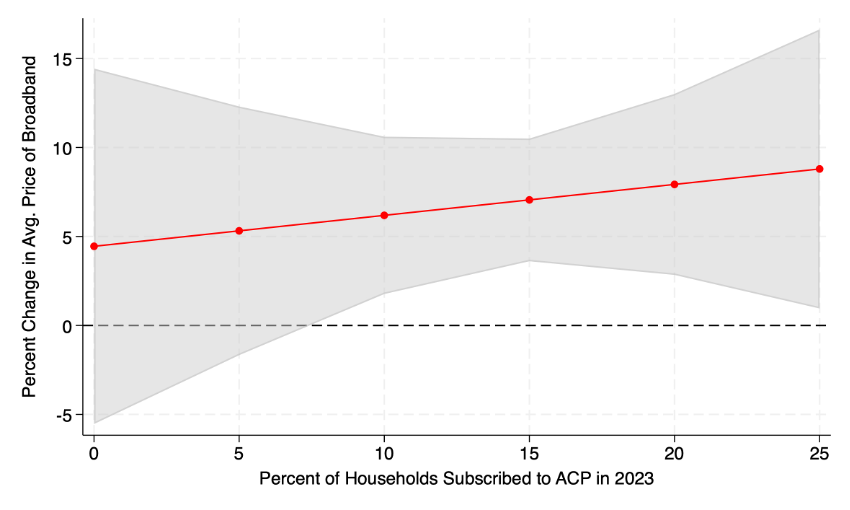
In a paper published earlier this year, I examined the effect that ACP had on prices based on differences in enrollment in ACP by geographic area. I find that there is a positive relationship between the percentage of households receiving ACP subsidies and the increase in the average total monthly price for broadband since 2022.[26.Paul Winfree, 2024, “Bidenomics Goes Online: Increasing the Costs of High-Speed Internet,” Economic Policy Innovation Center, at https://epr-creations.github.io/epic-media/2024/01/Bidenomics-Goes-Online_01.08.24-1.pdf.]
However, there is no statistically meaningful association between ACP subsidies and prices when the level of households receiving the subsidies is under 7 percent (see Figure 1). Before the program expired in May, about 15 percent of households across the country receive an ACP subsidy. That corresponds with an average increase of about 7 percent in the total cost of a monthly broadband subscription. These estimates do not change even when factoring in the market concentration of ISPs.
Figure 1. Households Receiving ACP Subsidies and Broadband Costs, All Broadband Plans
 Source: Author’s calculation using data described in Winfree (2024).
Table 2 shows the average change in price for broadband plans that is associated with a percent of households receiving an ACP subsidy. Based on estimates in Winfree (2024), the average cost of broadband is about $5.48 higher because of ACP while broadband service providers are capturing about 18 percent of the total subsidy. If 40 percent of households were enrolled in ACP, as would be the case under the Biden Administration’s enrollment proposal, the average change in prices for plans would increase by about $9.39 and 31 percent of the subsidy would be pocketed by broadband service providers.
Table 2. Average Change in the Price of Broadband Associated with the ACP Subsidy at Different Levels of Household Saturation, All Plans
|
15% of Households |
30% of Households |
40% of Households |
| Price Change ($) |
$5.48 |
$7.56 |
$9.39 |
| % of ACP Subsidy |
18% |
25% |
31% |
Source: Author’s calculation using data described in Winfree (2024).
Table 3 shows the same estimates for lower-speed plans. Under higher levels of ACP enrollment, lower-speed plans will become more expensive with the broadband service providers able to capture larger portions of the total subsidy. This makes sense given that the ACP subsidy essentially operates as a floor for the prices of broadband.
Table 3. Average Change in the Price of Broadband Associated with the ACP Subsidy at Different Levels of Household Saturation Lower-Speed Plans (Under 20 Mbps)
|
15% of Households |
30% of Households |
40% of Households |
| Price Change ($) |
$4.24 |
$15.38 |
$22.27 |
| % of ACP Subsidy |
14% |
51% |
75% |
Source: Author’s calculation using data described in Winfree (2024).
The Biden-Harris Administration has suggested that ACP helped households save about $500 million per month on internet bills. However, that calculation does not include the effects of ACP on prices for broadband services. Based on my estimates, ACP likely reduced the monthly net cost of broadband by about $380 million for households who qualify for the subsidies after adjusting for the increase in prices. But once the price increase for all households (including ACP beneficiaries) was factored in, ACP likely increases the net out-of-pocket cost of broadband that households pay by about $185 million per month or $2.2 billion per year.[27.This is calculated using estimates from this report as well as data from the FCC and the U.S. Census Bureau.]
More recently, the Harris campaign has proposed that in order to increase housing affordability they would offer a $25,000 subsidy to “help with their down payments, with a more generous support for first-generation homeowners.”[28.Harris Walz, “A New Way Forward,” Harris for President, at https://kamalaharris.com/issues/.] However, policymakers should learn from the recent experience of ACP. Given that it will be extremely difficult to substantially increase the number of homes at a rate that would keep up with an increase in the demand associated with the subsidy, such a subsidy would increase the cost of housing as it would be transferred to the seller through the purchase price of the home. If the new housing subsidy were paid for with additional deficit financing, which is almost a certainty, it would be especially inflationary making housing even less affordable.
Conclusion
The Biden-Harris economic policy agenda began as a plan to grow the size and scope of government; it has now evolved into an orchestrated effort to leverage economic policy to support the Administration’s political coalition and deliver on the subjective goals of its members. The result has been governing by “everything-bagel liberalism” – a term coined by Ezra Klein of the New York Times – or as another left-leaning journalist Matt Yglesias has written, “every policy objective, all the time, all at once.”[29.Ezra Klein, April 2, 2023, “The Problem With Everything-Bagel Liberalism,” The New York Times, at https://www.nytimes.com/2023/04/02/opinion/democrats-liberalism.html. Matthew Yglesias, April 26, 2023, “Every Policy Objective, All the Time, All at Once,” Slow Boring, at https://www.slowboring.com/p/every-policy-objective-all-the-time.]
This evolution did not happen overnight. Long-term economic policymaking has slowly eroded over the past 50 years as we’ve become accustomed to paying later for things we possess today. This is a cultural problem that goes beyond the Biden-Harris Administration’s irresponsible economic policy.
As late as the 1970s, most economic policy experts maintained that low unemployment and stable prices should be the governing objectives of policy. Imperfect as they may be, however, low unemployment and stable prices are objective qualities. We can, and do, measure both. You may not agree that the government can do much to affect unemployment or prices, however, we can determine whether unemployment is low, and prices are stable.
An issue of today is the complete lack of a consensus on economic policy. And there is no mechanism for achieving one because the economy is, generally, seen as being shaped by the inherently political government. This creates a post-modern problem where ideology, science, and collective action are combined into one confusing pot of policy choices. The “correct” economic policy becomes whatever the governing consensus dictates, and the actions are limitless because the government can create all opportunities and fix all ills.
What has been holding back the floodgates is nothing more than an old custom in the United States whereby we repay our debts, and the monetary policy system supports the value of debt through low inflation. We also ensure that fiscal programs do not threaten to tip this balance to a point where it cannot be corrected. As the past four years have shown, with the Biden-Harris Administration willing to push fiscal policy close to the breaking point, even this norm that has been maintained for the past 248 years is under threat.
Appendix
Table A1. The Economic Policy Goals of the Biden-Harris Administration
| CEA Members |
Year |
Date Published |
Core Goal of Economic Policy |
|
Rouse (Chair)
Bernstein
Boushey |
2022 |
April 2022 |
“A core aim of the Biden-Harris Administration’s economic agenda is to restore the public sector as a partner in long-run growth, with a particular focus on the economy’s supply side – from physical infrastructure to the vitality of the workforce.” (p. 23)
|
|
Rouse (Chair)
Bernstein
Boushey |
2023 |
March 2023 |
“The core of the Biden-Harris Administration’s economic agenda is building a foundation for steady, sustainable, and shared growth by increasing economic capacity.” (p. 21)
|
|
Bernstein (Chair)
Boushey
Jackson |
2024 |
March 2024 |
“Given the importance of full employment for racial equity, inequality, workers’ empowerment, and the Biden-Harris Administration’s fundamental goal of ensuring that workers have the bargaining power they need to claim their fair share of the growing economy, it is clear that maintaining tight labor markets must be an integral goal of American administrations.”
(p. 59)
“It is likely that increasing access to affordable childcare, a key policy goal of the Biden-Harris Administrations, would be associated with further improvements in the labor supply.” (p. 76)
“A central goal of the Biden-Harris Administration is an economy in which every American has access to a safe and affordable home.” (p. 163)
“By reorienting trade and foreign investment policy to center on workers, the Biden-Harris Administration’s policy agenda continues to define and elevate the standards by which trade and foreign investment are conducted, and it serves as a mechanism for achieving broader economic goals. These goals include confronting unfair trade practices, elevating labor and environmental standards, and building cooperative and beneficial economic relationships with U.S. partner countries.” (p. 174)
“The clean energy transition is under way. Its end goal is an innovative cutting-edge U.S. economy powered by cheap, reliable, and secure clean energy sources and technologies.” (p. 211)
|
Source: These statements come from the Economic Report of the President under the Biden-Harris Administration. There was no report from the Biden-Harris Administration in 2021.