Testimony
Remarks before Congress by Dr. Bill Beach on "Reducing America’s National Debt: Rooting Out Federal Waste, Fraud, and Overregulation"
May 14, 2026 · William W. Beach, D. Phil.


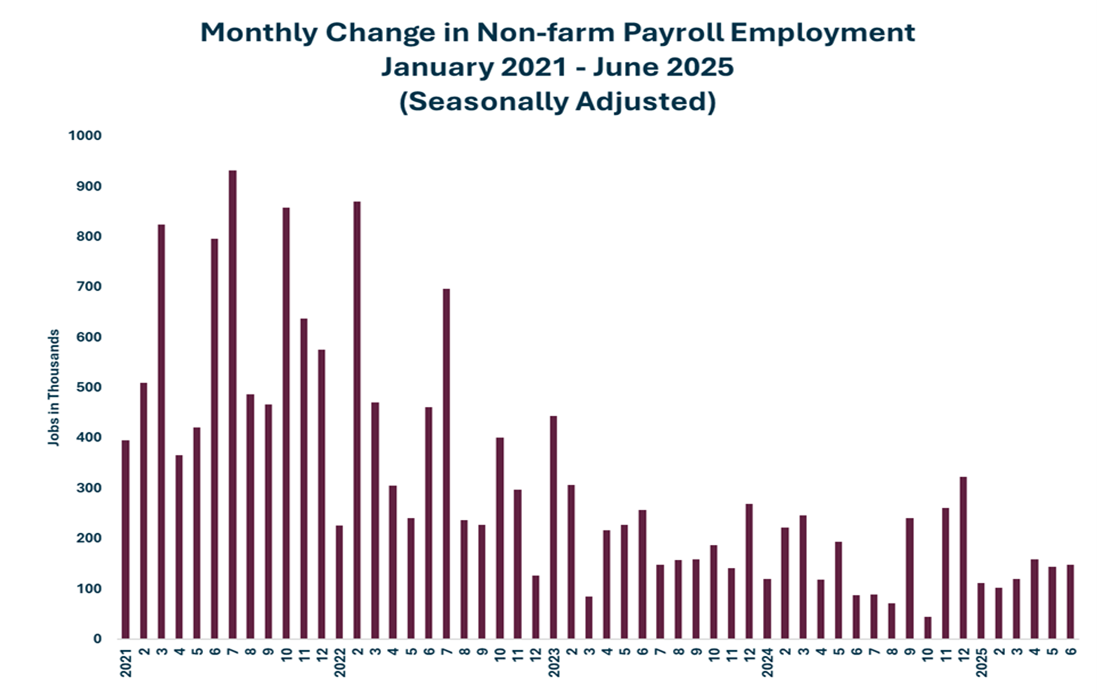 First, the big story behind the job creation total is job growth in the private sector. That number came in at only 74,000. Thus, half of today’s total job growth was due to growth in government jobs, mostly in state and local education (63,500). State and local government job growth outside of education came in at 17,300. The federal government’s employment continued to decline: -7,000 in June and -69,000 since January of this year. Within in the private sector, goods producing firms created only 6,000 jobs. Manufacturing lost jobs (-7,000), which was offset by construction job growth of 15,000. Most of the private sector job growth was in health care and social assistance (58,600) and leisure and hospitality (20,000).
The growth in these two sectors is welcome, but these sectors’ average weekly earnings are significantly below the overall average for private employees. Thus, this morning’s report could be pointing to growth in parts of the economy that looks strong but punches below its economic weight. Furthermore, most economists would worry if public sector growth continues to outperform the private side of the economy.
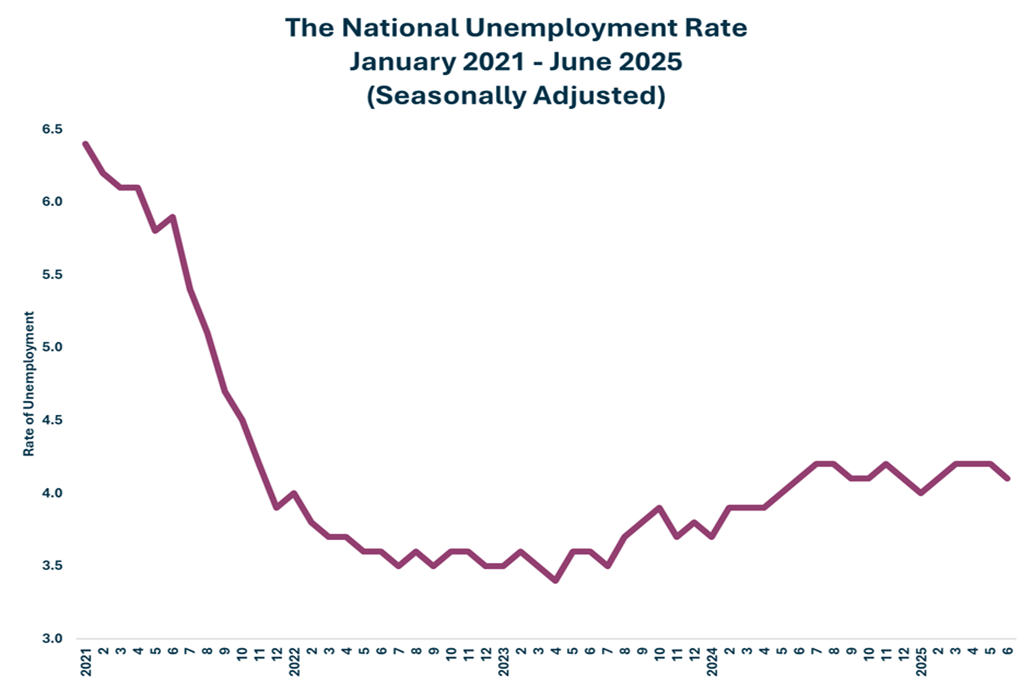
Second, the unemployment rate decline from 4.2 to 4.1 percent lays within the narrow range of 4.0 to 4.2 percent in which it has bounced for nearly two years. June’s decline, moreover, can in part be attributed to a drop in the size of the labor force, which declined by 130,000. A person needs to be in the labor force looking for work over the past four weeks to be counted as unemployed. June saw the number of unemployed drop by 222,000; which implies that about half of the rate decline is attributable to a smaller labor force. Economists want to see the unemployment rate drop because people are getting jobs, not because they are dropping out.
First, the big story behind the job creation total is job growth in the private sector. That number came in at only 74,000. Thus, half of today’s total job growth was due to growth in government jobs, mostly in state and local education (63,500). State and local government job growth outside of education came in at 17,300. The federal government’s employment continued to decline: -7,000 in June and -69,000 since January of this year. Within in the private sector, goods producing firms created only 6,000 jobs. Manufacturing lost jobs (-7,000), which was offset by construction job growth of 15,000. Most of the private sector job growth was in health care and social assistance (58,600) and leisure and hospitality (20,000).
The growth in these two sectors is welcome, but these sectors’ average weekly earnings are significantly below the overall average for private employees. Thus, this morning’s report could be pointing to growth in parts of the economy that looks strong but punches below its economic weight. Furthermore, most economists would worry if public sector growth continues to outperform the private side of the economy.
Second, the unemployment rate decline from 4.2 to 4.1 percent lays within the narrow range of 4.0 to 4.2 percent in which it has bounced for nearly two years. June’s decline, moreover, can in part be attributed to a drop in the size of the labor force, which declined by 130,000. A person needs to be in the labor force looking for work over the past four weeks to be counted as unemployed. June saw the number of unemployed drop by 222,000; which implies that about half of the rate decline is attributable to a smaller labor force. Economists want to see the unemployment rate drop because people are getting jobs, not because they are dropping out.
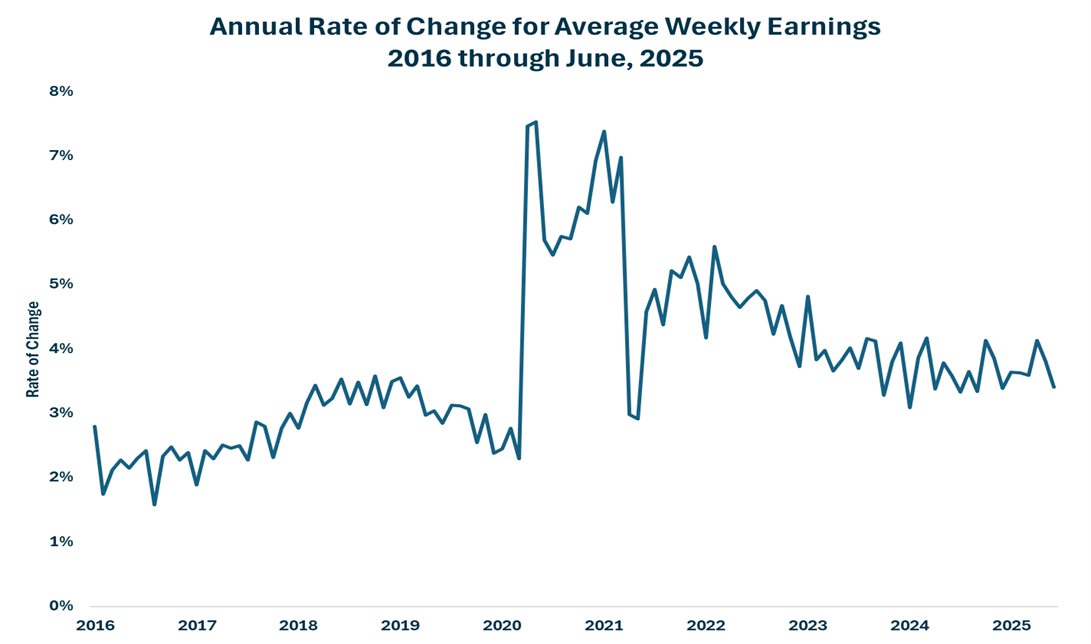
 Third, officials at the Federal Reserve will be dicing BLS’s report along these lines and one additional perspective: What happened to average wage growth. If labor markets are tightening due to declining immigration and labor quality issues, then wage growth could be a source of near-term inflation. Today’s report will not reassure the Fed, since average weekly earnings grew by a strong annual rate of 3.4 percent. That rate is likely robust enough to put upward pressure on prices. As Figure 3 indicates, the strong wage growth has persisted in a narrow range for the past year. While this growth restores worker purchasing power lost during the recent inflationary period, it could become a source of upward price growth.
 Despite these warning signs, today’s report is fundamentally good news. It is important to note that BLS revised upwards their employment estimates for April and May. April rose by 11,000 and May by 5,000. These revisions support the widespread view, including mine, that the economy is growing within normal boundaries. The total jobs number of 147,000 is well within the average growth rate of the past 12 months.
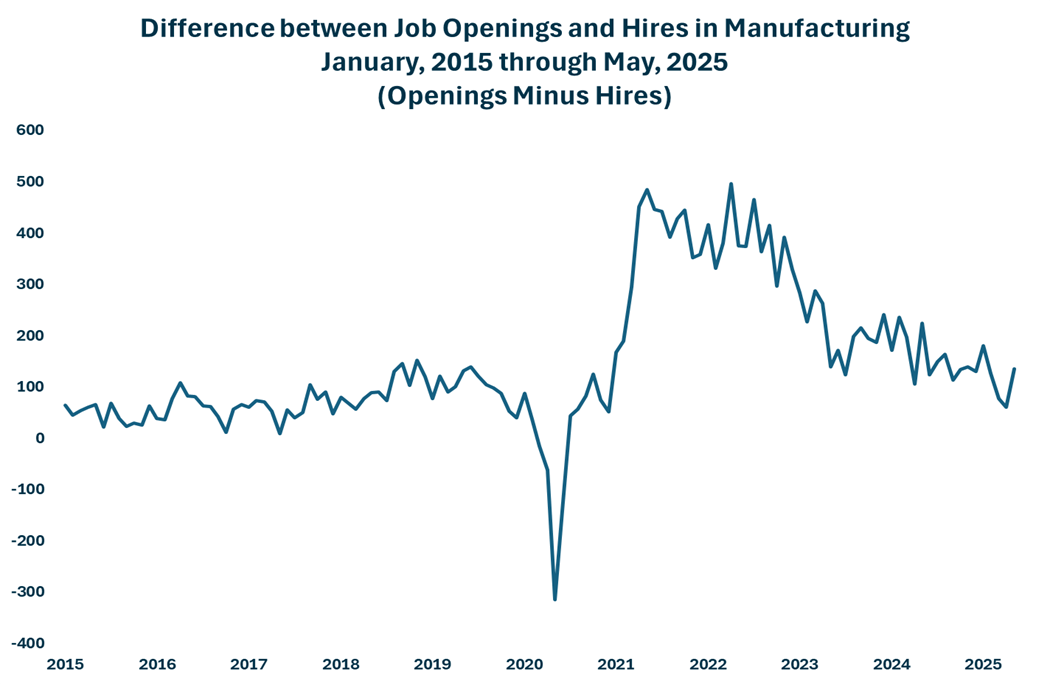
That said, there is one more labor market dimension that policy makers should watch: the gap between job openings and hires in key economic sectors. The latest report from BLS’s Job Openings and Labor Turnover Survey (JOLTS) underscores this concern, particularly in manufacturing. Overall, openings rose throughout the economy by 374,000, while hires fell by 112,000. The latest JOLTS report covers market conditions in May of this year. For manufacturing, the report shows job openings of 414,000, which is up from April’s number of 392,000. Hires for May, however, stood at 278,000, which is down from April’s level of 330,000.
While one month’s numbers may not cause concern, they underscore a trend of openings going unfilled due to lack of qualified candidates. The National Association of Manufactures’ Outlook Survey for the Second Quarter of 2025 reports that attracting and retaining qualified employees is a top concern among half of the survey’s respondents. As Figure 4 shows, the differences between hires and openings are generally higher than before the pandemic. These differences coupled with the survey results could point to a larger issue of labor quality that public policy might need to address in the near term.
Despite these warning signs, today’s report is fundamentally good news. It is important to note that BLS revised upwards their employment estimates for April and May. April rose by 11,000 and May by 5,000. These revisions support the widespread view, including mine, that the economy is growing within normal boundaries. The total jobs number of 147,000 is well within the average growth rate of the past 12 months.
That said, there is one more labor market dimension that policy makers should watch: the gap between job openings and hires in key economic sectors. The latest report from BLS’s Job Openings and Labor Turnover Survey (JOLTS) underscores this concern, particularly in manufacturing. Overall, openings rose throughout the economy by 374,000, while hires fell by 112,000. The latest JOLTS report covers market conditions in May of this year. For manufacturing, the report shows job openings of 414,000, which is up from April’s number of 392,000. Hires for May, however, stood at 278,000, which is down from April’s level of 330,000.
While one month’s numbers may not cause concern, they underscore a trend of openings going unfilled due to lack of qualified candidates. The National Association of Manufactures’ Outlook Survey for the Second Quarter of 2025 reports that attracting and retaining qualified employees is a top concern among half of the survey’s respondents. As Figure 4 shows, the differences between hires and openings are generally higher than before the pandemic. These differences coupled with the survey results could point to a larger issue of labor quality that public policy might need to address in the near term.