
Testimony
Remarks before Congress by Dr. Bill Beach on "Reducing America’s National Debt: Rooting Out Federal Waste, Fraud, and Overregulation"
May 14, 2026 · William W. Beach, D. Phil.


 A truly important aspect of work is earnings. Most of us work for the income that working provides, though surely the social and other aspects of working explain part of why we work outside of our homes. Thus, how much our incomes support the lives we want is crucial to our sense of our own and our family’s prosperity.
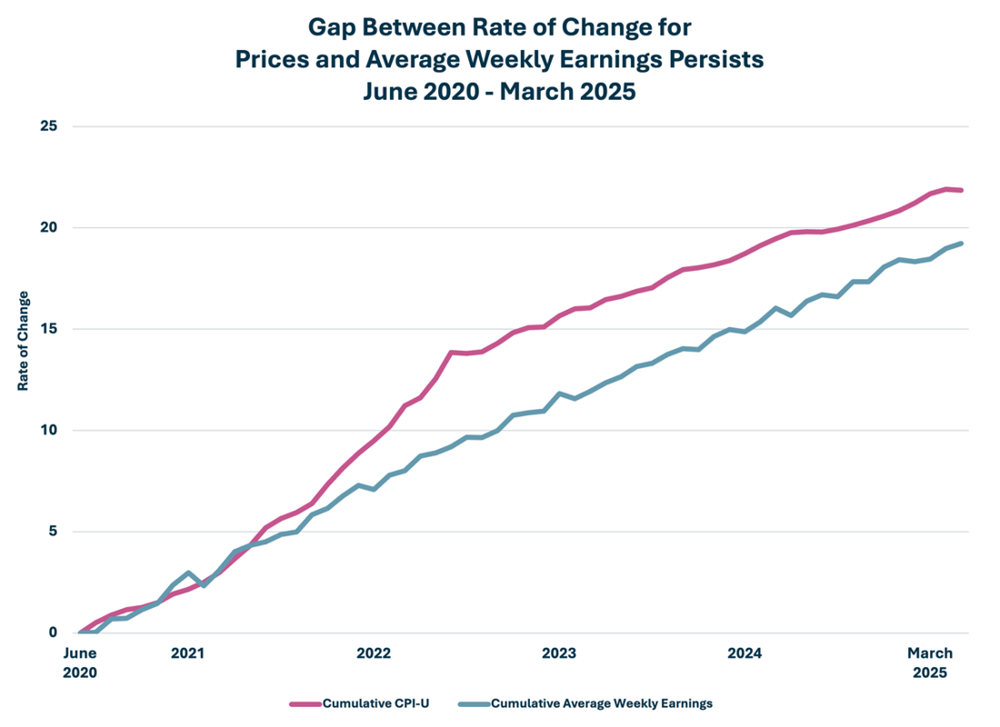
As the nearby graph shows, the steady cumulative growth in nominal average weekly earnings for private sector employees[1] has been outpaced by the cumulative growth in the Consumer Price Index (CPI all-urban series). The gap between these two series reached a height of 434 basis points in February 2023. That gap has subsided since then, but it still stands as of last month at 262 basis points.
The Bureau of Labor Statistics announced on April 9 that the CPI monthly rate for all items declined by 0.1 percent in March, thus bringing the annual rate down to 2.4 percent.[2] Earlier in the month we learned that average weekly earnings grew by 3.0 year-over-year.[3] Thus, the purchasing power gap declined by 60 basis points.
That said, the CPI’s slower pace in March was primarily due to a sharp drop in gasoline and fuel oil prices, which declined at annual rates of 9.8 and 7.6 percent respectively. BLS gives gas prices a 16 percent overall weight in the CPI, which means that the index for all items can fall even when other components are increasing, and that is exactly what happened in March.
While gas and fuel oil were sharply down, household electricity and utility gas rose: 2.8 and 9.4 percent respectively. Food prices rose 3.0 percent; shelter (rent and owner-occupied housing) rose 4.0 percent; and transportation and medical services were up 3.1 and 3.0 respectively.
If you are a worker who relies on public transportation, carpools, or walks to work, then the drop in gas and fuel oil prices probably means little to you. Indeed, once we subtract the volatile food and energy prices from the CPI, the annual rate rises from 2.4 to 2.8 percent. The Federal Reserve is unlikely to ease up on interest rates as long as the CPI is running some 40 percent above its target of 2.0 percent annual growth.
All of this means that the average worker’s struggle to regain purchasing power is ongoing and unrelenting. Either nominal earnings need to increase dramatically, or inflation needs to fall in equally dramatic fashion.
If earnings growth fails to turn up or inflation rises sharply due to economic shocks like the new tariffs, then the true victim is the quality of life we work to so hard to enjoy.
[1] Average weekly earnings are based on two series: average hourly earnings and the average work week. Including the workweek in earnings data is crucial if the goal is to reflect the real capacity of workers to keep up with price changes. If average hourly earnings rose but workweek declined, the signal from hourly earnings might falsely signal a gain in weekly earnings.
[2] Bureau of Labor Statistics, U.S. Department of Labor, “Consumer Price Index – March 2025,” USDL-25-0459 (April 10, 2025).
[3] Bureau of Labor Statistics, U.S. Department of Labor, “The Employment Situation – March 2025”, USDL-25-0452 (April 4, 2025).
A truly important aspect of work is earnings. Most of us work for the income that working provides, though surely the social and other aspects of working explain part of why we work outside of our homes. Thus, how much our incomes support the lives we want is crucial to our sense of our own and our family’s prosperity.
As the nearby graph shows, the steady cumulative growth in nominal average weekly earnings for private sector employees[1] has been outpaced by the cumulative growth in the Consumer Price Index (CPI all-urban series). The gap between these two series reached a height of 434 basis points in February 2023. That gap has subsided since then, but it still stands as of last month at 262 basis points.
The Bureau of Labor Statistics announced on April 9 that the CPI monthly rate for all items declined by 0.1 percent in March, thus bringing the annual rate down to 2.4 percent.[2] Earlier in the month we learned that average weekly earnings grew by 3.0 year-over-year.[3] Thus, the purchasing power gap declined by 60 basis points.
That said, the CPI’s slower pace in March was primarily due to a sharp drop in gasoline and fuel oil prices, which declined at annual rates of 9.8 and 7.6 percent respectively. BLS gives gas prices a 16 percent overall weight in the CPI, which means that the index for all items can fall even when other components are increasing, and that is exactly what happened in March.
While gas and fuel oil were sharply down, household electricity and utility gas rose: 2.8 and 9.4 percent respectively. Food prices rose 3.0 percent; shelter (rent and owner-occupied housing) rose 4.0 percent; and transportation and medical services were up 3.1 and 3.0 respectively.
If you are a worker who relies on public transportation, carpools, or walks to work, then the drop in gas and fuel oil prices probably means little to you. Indeed, once we subtract the volatile food and energy prices from the CPI, the annual rate rises from 2.4 to 2.8 percent. The Federal Reserve is unlikely to ease up on interest rates as long as the CPI is running some 40 percent above its target of 2.0 percent annual growth.
All of this means that the average worker’s struggle to regain purchasing power is ongoing and unrelenting. Either nominal earnings need to increase dramatically, or inflation needs to fall in equally dramatic fashion.
If earnings growth fails to turn up or inflation rises sharply due to economic shocks like the new tariffs, then the true victim is the quality of life we work to so hard to enjoy.
[1] Average weekly earnings are based on two series: average hourly earnings and the average work week. Including the workweek in earnings data is crucial if the goal is to reflect the real capacity of workers to keep up with price changes. If average hourly earnings rose but workweek declined, the signal from hourly earnings might falsely signal a gain in weekly earnings.
[2] Bureau of Labor Statistics, U.S. Department of Labor, “Consumer Price Index – March 2025,” USDL-25-0459 (April 10, 2025).
[3] Bureau of Labor Statistics, U.S. Department of Labor, “The Employment Situation – March 2025”, USDL-25-0452 (April 4, 2025).