https://www.youtube.com/live/rMHreVT4u9s?si=q-ylovCmeMxyekxK
September 20, 2023
[1]
Behind every great public policy stands reliable data that prove the policy’s greatness…or lack thereof. It is hard, I think impossible, to execute successful public policies without reliable effectiveness measurements. What would policymakers do after enacting a new law on crime if no data existed to tell them whether crime rose or fell following the law’s adoption? How useful would efforts to change food assistance programs be without data on hungry families?
The same obvious but essential relationship exists between environmentally-focused policymakers, who are supporting and leading the private sector’s moves to greener production activities and data that show if their efforts are worthwhile. The topic of this hearing, job training for a clean energy transition, is packed with measurement concepts. One might even argue that it would be pointless to make investments in green jobs development without first securing one’s data front lines.
However, there is another issue in front of this committee, and it’s a threshold one: do investments in federally sponsored job training programs produce the results that Congress intended? Do these programs actually work? Unfortunately, the answer generally is no.
Federal agencies have funded numerous studies, most famously by the consulting firm Mathematica, over many years that find little if any value coming from government run training and retraining efforts. The effects are not zero, but certainly not positive enough to justify massive allocation of public funds.
Why, generally, is this the case? The simple answer is that government is too separated from market activities to know what consumers have shifted toward and what they’ve abandoned. Government tends to train for yesterday’s product portfolio, not tomorrow’s. On the other hand, the private sector does train more successfully than not. And why? If private firms failed to follow changing consumer tastes, they would soon be out of business. One can see this very clearly in the ways businesses have shifted their workers more toward environmentally sensitive production and distribution: consumers of those products and services are demanding that shift.
Even if all job training programs worked perfectly, however, Congress would still need to measure progress toward program goals: good policy requires good data. On this front, few appreciate the challenges faced by statisticians and economists in producing those good data, in discovering the reliable, real-world signals that give meaningful feedback to policy stakeholders. For example, during the early crisis months of the Covid-19 pandemic, key Washington policymakers desperately wanted high-frequency data on business closings, layoffs, transportation usage, and, of course, infection rates. After all, the unemployment rate spiked from 4.4 percent in March to 14.7 percent in April, when 22 million people lost their jobs. The monthly reports just did not give policymakers data fast enough, but reliable daily and weekly data just did not exist.
It took the US statistical system about three months to develop and deploy high-frequency indicators on the pandemic’s many economic and social effects. We had to find ways of measuring the entire population along that population’s many segmentations. Surveys had to be designed, testing had to be done, and experts needed to wade in on how best to take survey results and generalize them for the population as a whole. Thus, by the middle of 2020, higher frequency data began to flow to policymakers that provided invaluable guidance for policy responses to the rapidly evolving pandemic.
Similar challenges face us on producing reliable estimates of green jobs. The remainder of this testimony will review these challenges, describe how the Bureau of Labor Statistics decided to resolve the technical ones ten years ago, and provide estimates of jobs and wages that fall into the BLS category of green jobs.
Let me start with BLS’s estimate of green jobs that they based on data from 2011 and that the Bureau published in 2013. While BLS’s funding issues prevented them from fielding their green jobs survey (more on this later), which would have resulted in survey-based estimates of jobs in subsequent years, they did 1) define green jobs and 2) produce estimates of the number of business establishments and wage and salary employees that met the BLS green jobs criteria. I will review both in detail later in this essay.
Before proceeding further, let me caution readers about the estimates contained in this testimony. First, identifying a job as a “green job” presents great difficulties for those producing official statistics for the government. These difficulties stem primarily from the assumptions that economists and statisticians must make when classifying an already classified job as green. Second, the estimates herein of green jobs are outdated, except for those focused on environmental occupations. The principal reason for these estimates being outdated is funding for collection and processing of green jobs data.
That said, the estimate of green jobs for 2011 (the last estimate made by BLS) stood at 3,401,279, or 2.6 percent of total employment. That was an increase of 157,746 over 2010. The private sector component of this total was 2,515,200, thus putting the public sector total at 886,080.
To arrive at this estimate, BLS counted the number of business establishments that produced Green Goods and Services. I will review how this concept was defined in a moment. The number of establishments stood at 2,112,134 out of a total of 8,900,241, or 23.7 percent of business establishments.
[2] The BLS estimates of in-scope employment was 25,861,335 out of a total of 129,311,080, or 20 percent of payroll employment. These would be workers at GGS establishments, though many would not be explicitly working in green jobs.
If these percentage were applied to today’s total of establishments and payroll employment, the equivalent in-scope establishments would be 2,678,000 and the number of payroll employees would be 32,297,000. Thus, a proportional growth in green jobs would put that number at 3,714,000. However, if we apply the 2010-2011 growth rate to each of the next 12 years, then the percentage of green job out of total employment in 2023 would be 3.3 percent, not 2.6 percent. Thus, the point estimate would be 5,294,000 jobs.
[3]
Table 1 shows BLS’s Table A from the 2013 report, which breaks down private sector green job
employment by major sector.
[4]
Table 1
2011 Private Sector Green Goods and Services Employment By Industry Sector
Table A. GGS employment by private industry sector, 2010–11 annual averages

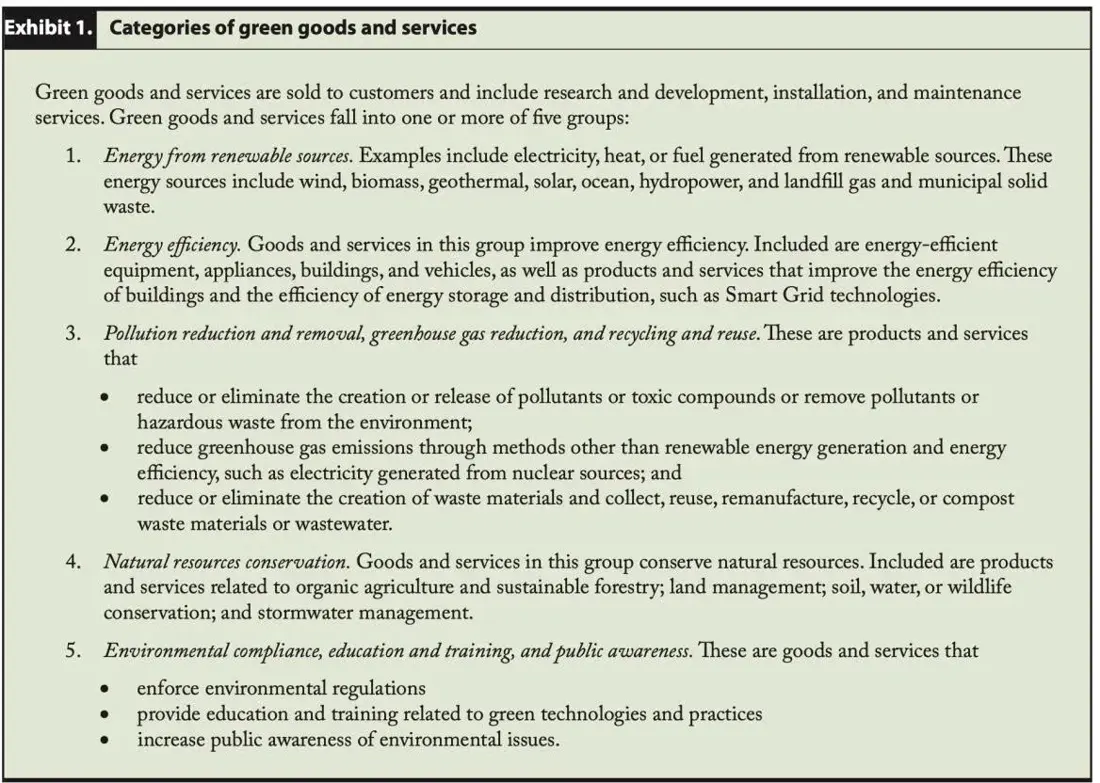
Let’s back away from these estimates and briefly examine how BLS defined Green Goods and Services. Fortunately for us, BLS took great pains to define “green jobs.” As is abundantly evident, green jobs are otherwise regular jobs that are characterized “green” by their connection to activities that enhance positive environmental outcomes. I know from interviewing BLS staff who worked on this project that they struggled long to arrive at the all- important definition. Without belaboring this point, BLS’s green job definition is:
“Green jobs are either: A. Jobs in businesses that produce goods or provide services that benefit the environment or conserve natural resources. [or] B. Jobs in which workers’ duties involve making their establishment’s production processes more environmentally friendly or use fewer natural resources.”[5]
BLS’s implementation of this definition resulted in its creation of in-scope business and, thus, in-scope employment. To illustrate the types of businesses that are “in-scope”, the Bureau produced the following exhibit, which is Table 2 of my testimony:
Table 2
Illustration of Green Goods and Services, 2013
Three final points about BLS’s work ten years ago: 1) the employment estimates are at the 6- digit NAICS level, which is quite detailed as employment estimates go, and 2) BLS produced state-level employment and occupation estimates, including ones for the District of Columbia. Finally, BLS was on the brink of fielding two surveys: one for Green Goods and Services and one Green Technologies and Practices. These surveys would have provided BLS with the source data from producing annual or more frequent publications on the number of green jobs.
So, why did all this work stop in 2013? The direct answer is the implementation of spending reductions following passage of the Balanced Budget and Emergency Deficit Control Act, as amended (also known as the Bipartisan Budget Act of 2013). Many agencies, including BLS, were asked by President Obama to reduce spending by 5 percent. The Bureau achieved this reduction by cutting all “measuring green jobs” programs.
That said, segments of the US statistical system have continued work on environmental accounting and green jobs at the international level and, most notably, within the Commerce Department’s Bureau of Economic Analysis (BEA). BEA began development in the 1990s of national environmental accounting as a supplement to its National Income and Product Accounts. Indeed, BEA published its Integrated Environmental and Economic Satellite Accounts in 1994. Controversy surrounding the methods used by BEA caused the suspension of this work. Even so, BEA continued to research environmental accounting and to participate in international efforts. Now, in 2023, it appears that this accounting work could well receive support from the administration.
[6]
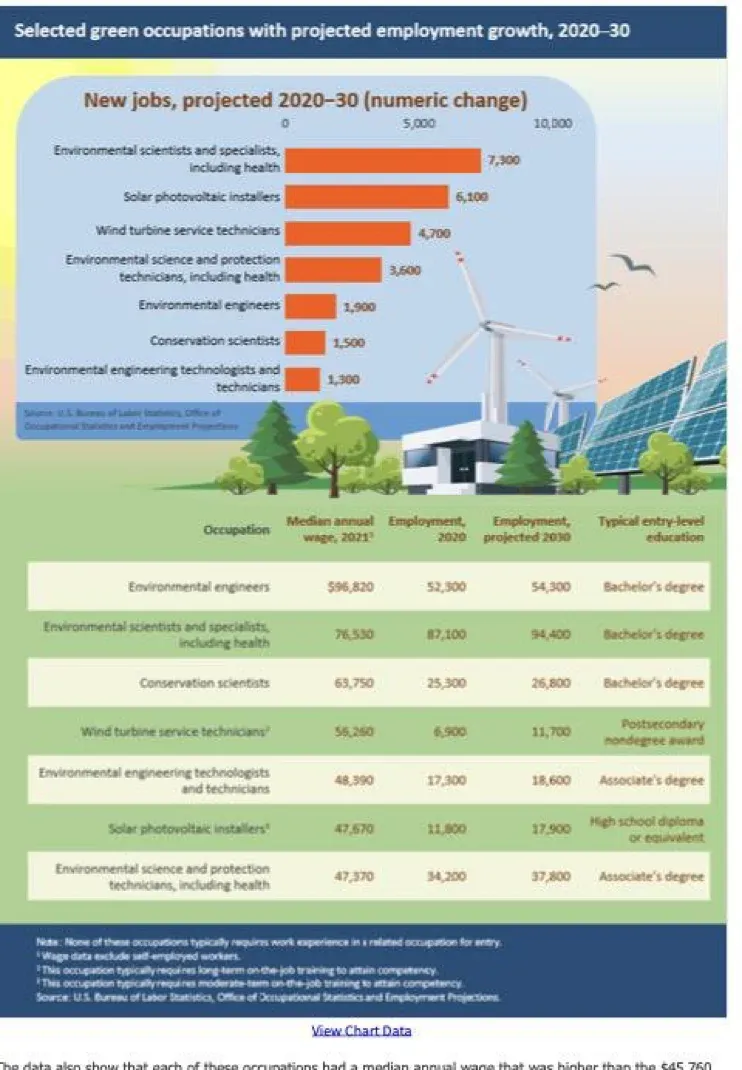
In addition to the ongoing efforts of BEA, BLS continues to publish occupational projections of jobs associated with environmental matters. Its most recent work on this is April of 2022 when it projected ten-year growth estimates for some high-paying environmental jobs. See Figure 1 below.
Figure 1
Job Growth for Selected Green Jobs, 2020-2030
[7]
Let me illustrate other approaches by mentioning one well known initiative. An ambitious and promising statistical approach combines BLS’s methodology with a more expansive definition of green jobs by the Department of Labor’s O*Net database. O*Net counts any job that will be affected by greening as a green job. Several researchers used this broader view of green jobs to construct estimates that built on BLS’s work. They found that 19.4 percent of the US workforce worked in green jobs, or a total of 27,200,000 for the year 2014. That same percentage applied to today’s larger level of non-farm employment would yield an estimate of 30,300,000.
[8]
It should be clearly evident from the range of estimates presented in my testimony (5.3 to 30.3 million green jobs) that achieving consensus on the magnitude of green jobs at any point in time needs to be led by an official statistical agency. There’s presently just too great an array of assumptions, definitions, and estimating methodologies. Indeed, the challenges are enormous, and there is no guarantee of success.
However, there’s yet another challenge: I do not need to tell this committee that Congress is faced with unprecedented fiscal problems. Indeed, this year and next may be a turning point for better or worse in Congress’s commitment to sound financial management, as I’ve documented in a recent essay for the Economic Policy Innovation Center.
[9] Thus, any funding for job training programs needs a high likelihood of success and, clearly, should be offset through spending reductions elsewhere in the budget.
Whatever direction Congress decides to take, my experience at BLS tells me that the statistical system will rise to the measurement challenges. Indeed, these efforts of the statistical agencies should encourage researchers in the private sector and the academy to expand our understanding of the economy’s move toward better stewardship our shared environment.