Testimony
Remarks before Congress by Dr. Bill Beach on "Reducing America’s National Debt: Rooting Out Federal Waste, Fraud, and Overregulation"
May 14, 2026 · William W. Beach, D. Phil.


Figure 1
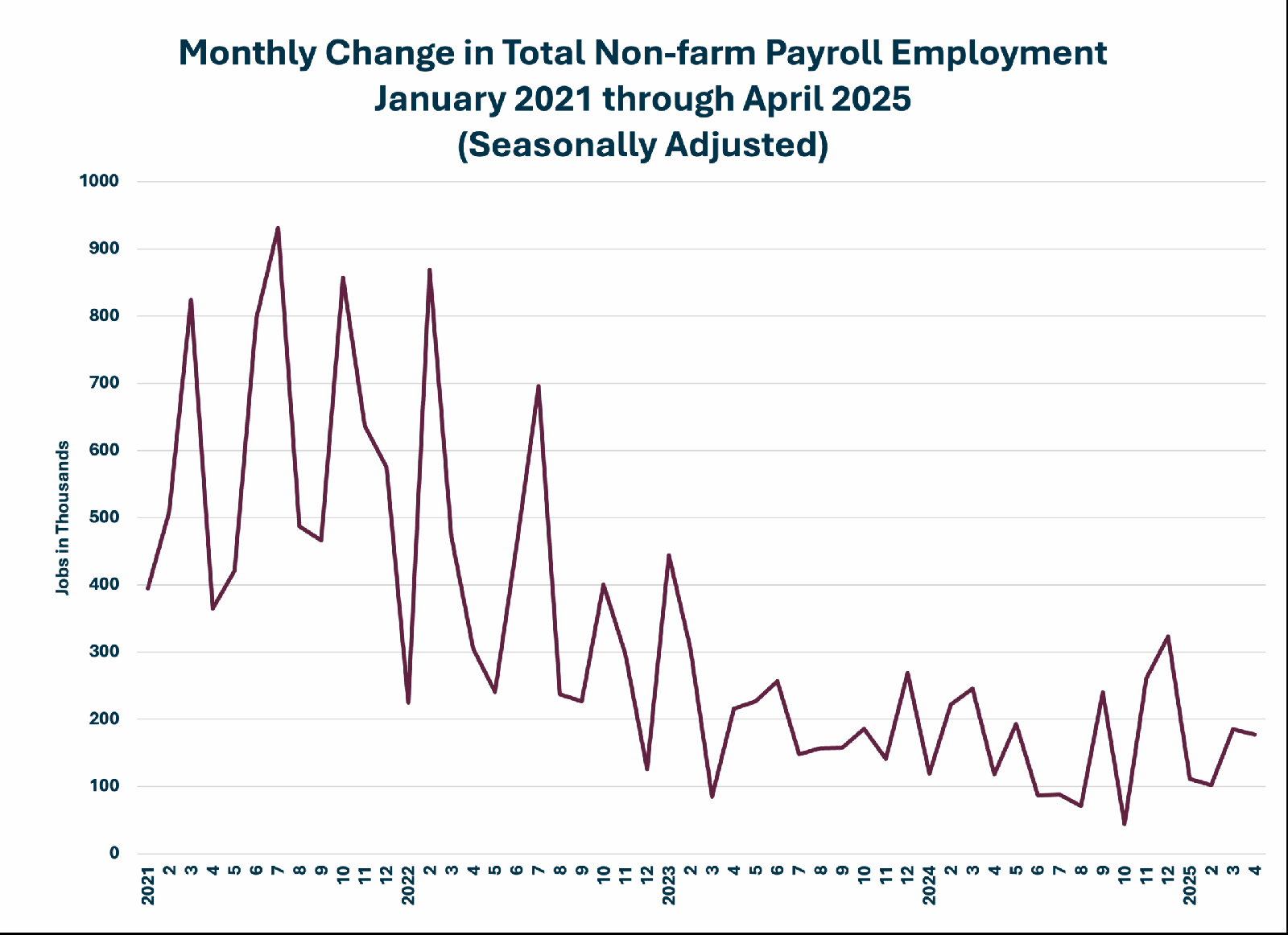 Indeed, a good place to look for insights on what changes in labor market metrics really matter is BLS’s Statistical Summary Table for the household labor force survey (the Current Population Survey). This table tells readers what changes they should focus on and what changes are not significant. In this month’s Report, only the changes in the number of people unemployed for 27 weeks or more were statistically significant. Everything else can be characterized as steady or little changed from the previous month.
One metric that did change in labor’s favor was average hourly earnings, which grew by 6 cents, or 0.2 percent, in April. That brings the annual rate of change in pay to 3.8 percent, and that’s higher than the rate of overall price growth. That means that workers continue to claw back purchasing power that they lost during the disastrous inflation of 2021 through 2023.
That said, it is noteworthy that additional survey results for the February and March samples led BLS to revise downward those two months. February jobs estimates fell by 15,000 from 117,000 to 102,000; and March fell by 43,000 from 228,000 to 185,000. BLS keeps the survey response window open for two months after the initial estimates are announced to allow businesses time to send in their survey documents. The direction of the revisions may indicate that the current trend is below that of the past twelve months.
Indeed, a good place to look for insights on what changes in labor market metrics really matter is BLS’s Statistical Summary Table for the household labor force survey (the Current Population Survey). This table tells readers what changes they should focus on and what changes are not significant. In this month’s Report, only the changes in the number of people unemployed for 27 weeks or more were statistically significant. Everything else can be characterized as steady or little changed from the previous month.
One metric that did change in labor’s favor was average hourly earnings, which grew by 6 cents, or 0.2 percent, in April. That brings the annual rate of change in pay to 3.8 percent, and that’s higher than the rate of overall price growth. That means that workers continue to claw back purchasing power that they lost during the disastrous inflation of 2021 through 2023.
That said, it is noteworthy that additional survey results for the February and March samples led BLS to revise downward those two months. February jobs estimates fell by 15,000 from 117,000 to 102,000; and March fell by 43,000 from 228,000 to 185,000. BLS keeps the survey response window open for two months after the initial estimates are announced to allow businesses time to send in their survey documents. The direction of the revisions may indicate that the current trend is below that of the past twelve months.
Figure 2
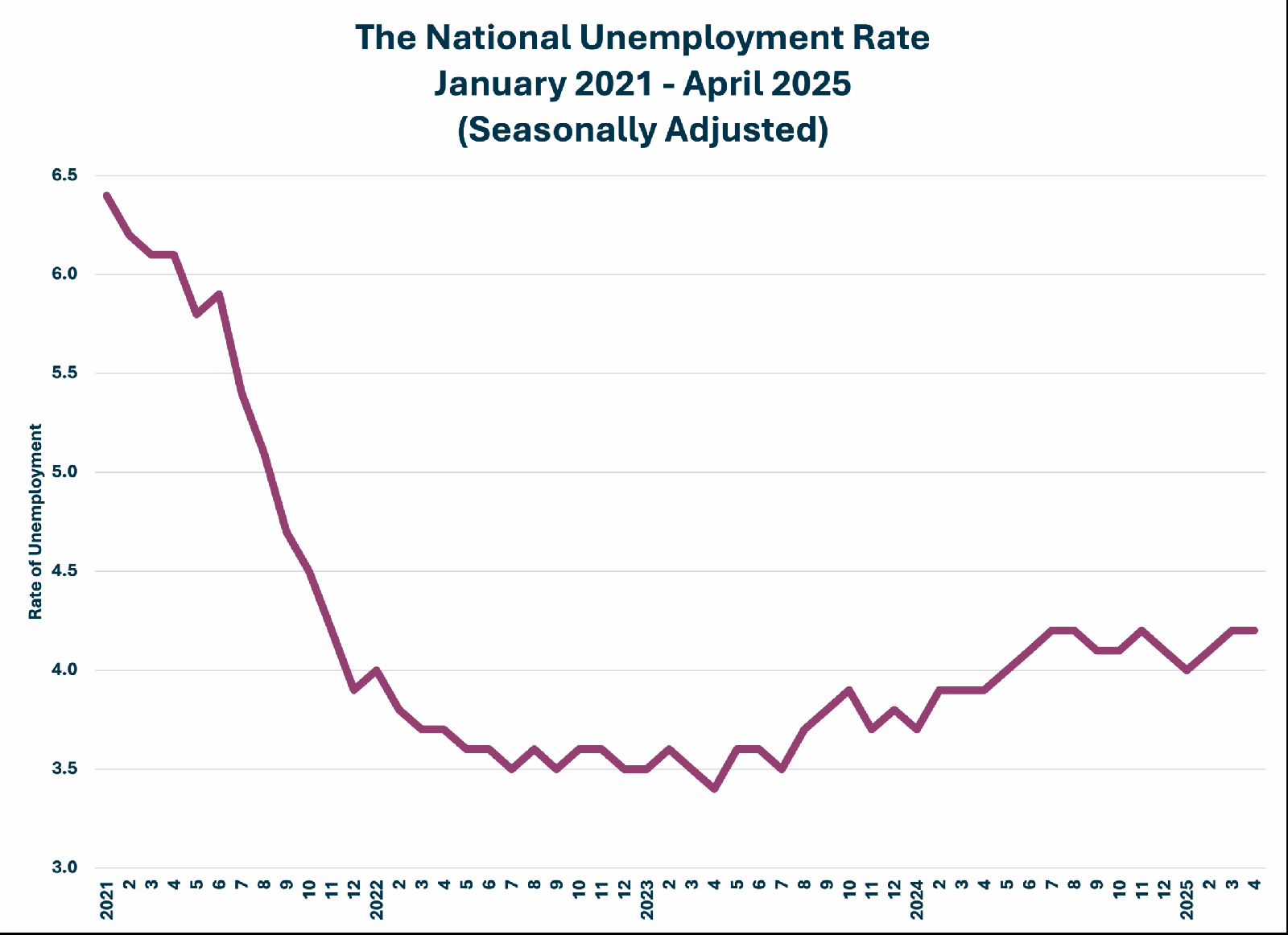
And, that slight downward change of trend is evident in the current data. The change in the unemployment rate and the population of unemployed is statistically significant on a 12-month basis: both are up. So is the unemployment rate for adult men and white workers. Job openings are down by 901,000 on a year-over-year basis. All these movements may indicate some economic slowing.
Thus, it would be wrong to agree with Officer Smidgen in saying “there’s nothing to see here, so move along.” The advance estimate on Gross Domestic Product that the Bureau of Economic Analysis issued on April 30 should temper our sanguinity: BEA announced a drop in first quarter, 2025, GDP of 0.3 percent. BLS’s downward revisions in jobs and some indication of growing unemployment seem to point in the same direction as this preliminary GDP estimate. The Administration and Congress, therefore, are right to keep their focus on building additional strength in the economy and not become complacent about the pace of job creation.Figure 3
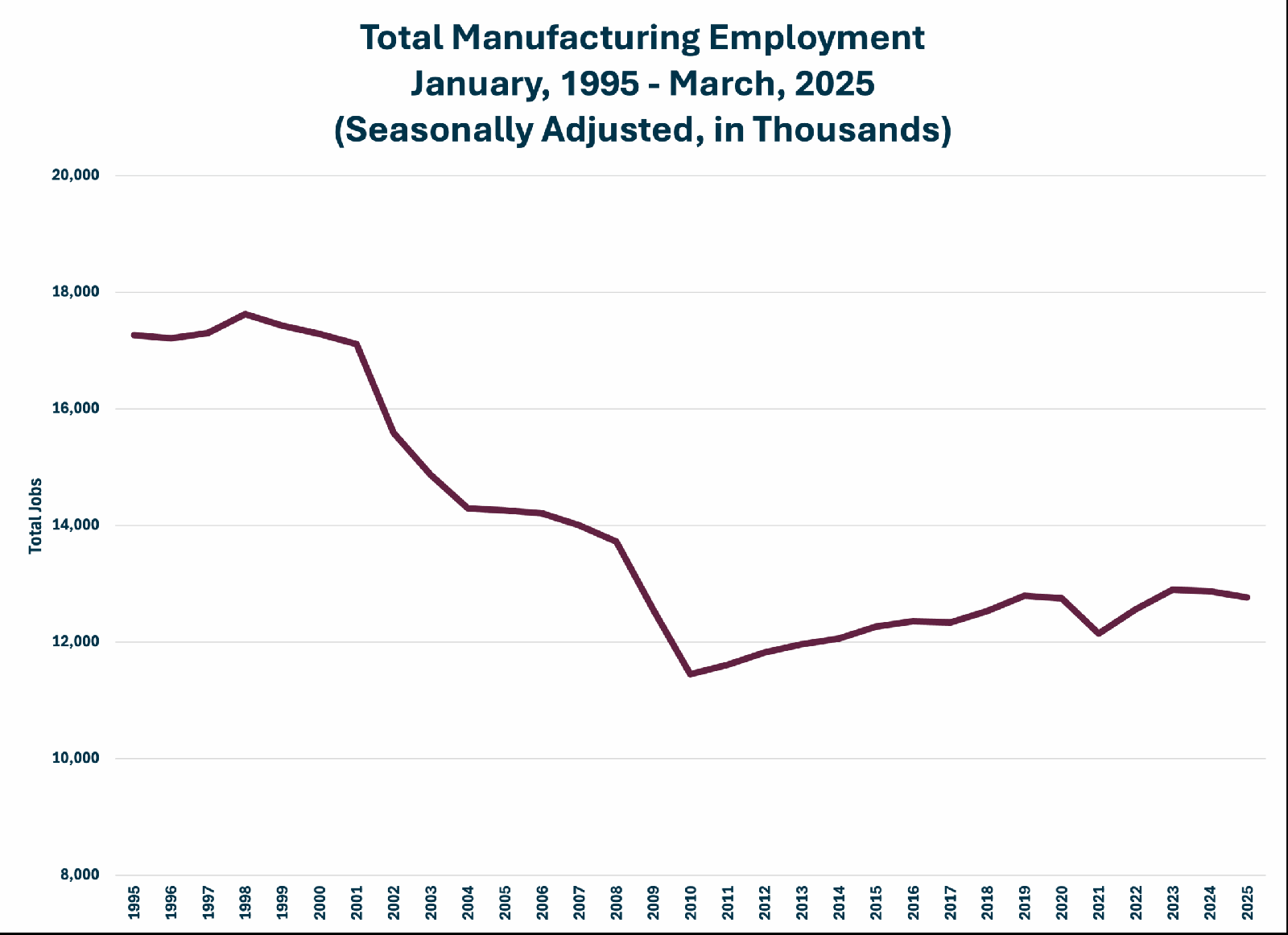 While total manufacturing employment declined steadily from 2000 through 2011, the sector has stabilized since then (the exception being the Covid years of 2020 and 2021).
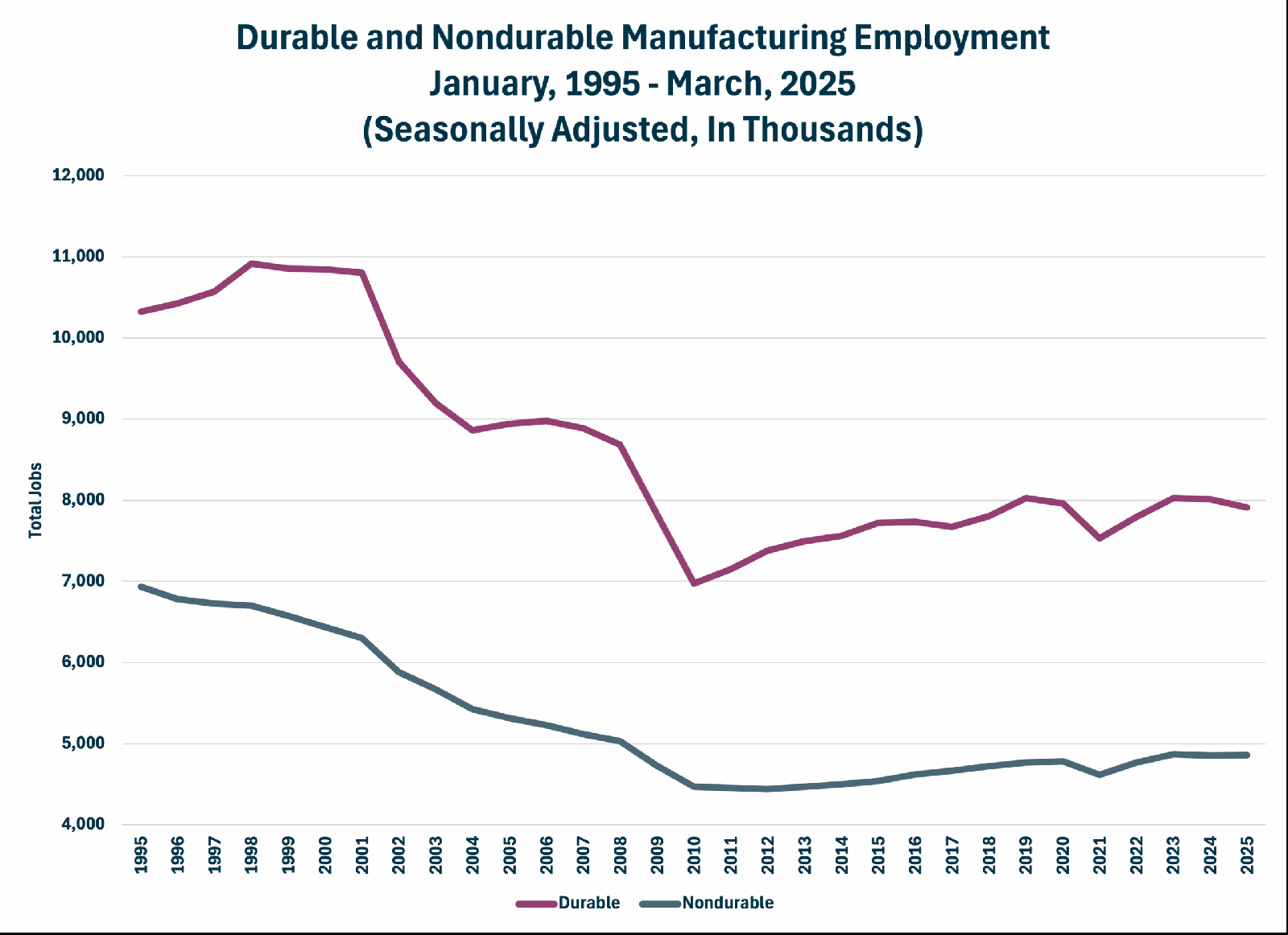
This overall picture, however, obscures differences in the employment decline and recovery between durable and nondurable manufacturing. Figure 4 shows both subsectors over the same time period as Figure 3. Note that employment in nondurable sectors recovered less robustly after 2011 than durables.
While total manufacturing employment declined steadily from 2000 through 2011, the sector has stabilized since then (the exception being the Covid years of 2020 and 2021).
This overall picture, however, obscures differences in the employment decline and recovery between durable and nondurable manufacturing. Figure 4 shows both subsectors over the same time period as Figure 3. Note that employment in nondurable sectors recovered less robustly after 2011 than durables.
Figure 4
 This stabilization of manufacturing employment may surprise some readers, especially when we understand that the recovery in U.S. manufacturing occurred during a period of rapid growth in the globalization of manufacturing output—the so-call heyday of global value chains (GVC). In brief, global value chains refer to the system that, for example, places management of a company in one country, its financing in another, and its factory work in still another. Think about a clothing company that is headquartered in New York, does all of its financial work in London, and has factories in Vietnam.
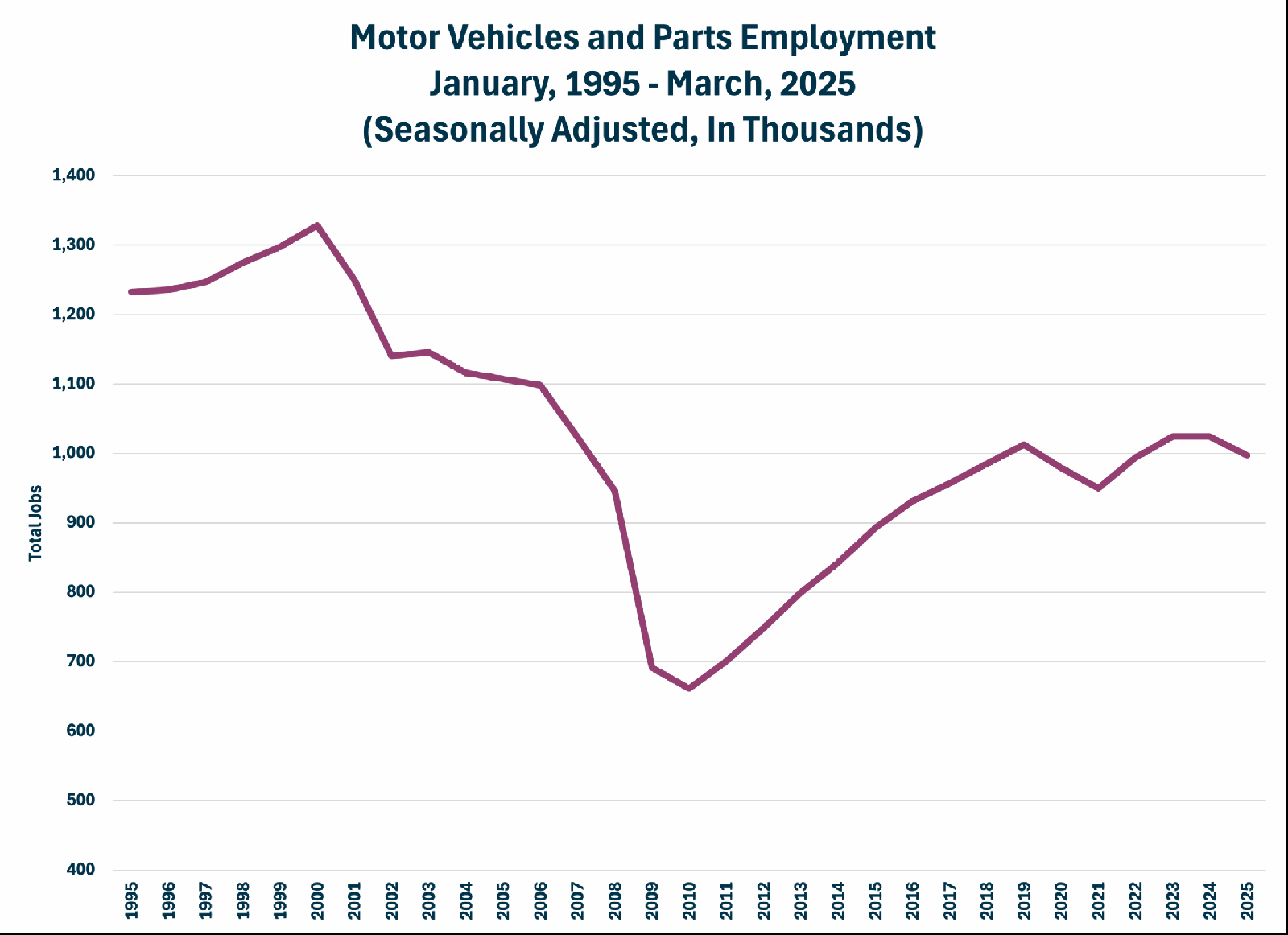
Motor vehicle and parts production is an especially good example of a sector in which GVCs are prominent. NAFTA particularly encouraged the internationalization of auto production between the U.S., Mexico and Canada. For example, one of the largest consumers of electric power generated in the U.S. are the automobile parts plants in Windsor, Canada. Parts of a car or truck are fabricated in Canada and shipped to Detroit where they join other inputs produced in Mexico for assembly in U.S. automobile factories. Figure 5 shows the trends in motor vehicle and parts employment since 1995.
This stabilization of manufacturing employment may surprise some readers, especially when we understand that the recovery in U.S. manufacturing occurred during a period of rapid growth in the globalization of manufacturing output—the so-call heyday of global value chains (GVC). In brief, global value chains refer to the system that, for example, places management of a company in one country, its financing in another, and its factory work in still another. Think about a clothing company that is headquartered in New York, does all of its financial work in London, and has factories in Vietnam.
Motor vehicle and parts production is an especially good example of a sector in which GVCs are prominent. NAFTA particularly encouraged the internationalization of auto production between the U.S., Mexico and Canada. For example, one of the largest consumers of electric power generated in the U.S. are the automobile parts plants in Windsor, Canada. Parts of a car or truck are fabricated in Canada and shipped to Detroit where they join other inputs produced in Mexico for assembly in U.S. automobile factories. Figure 5 shows the trends in motor vehicle and parts employment since 1995.
Figure 5
 Of course, many large and important manufacturing sectors did not see a recovery in the early 2000s. For example, apparel production, which was so important to U.S. workers in the first half of the 20th Century, continued to be off-shored throughout the period we are examining. Figure 6 shows the relatively steady decline in apparel jobs since 1995 and the somewhat different story of wood products employment. The firms in these two sectors often locate near one another.
Figure 6
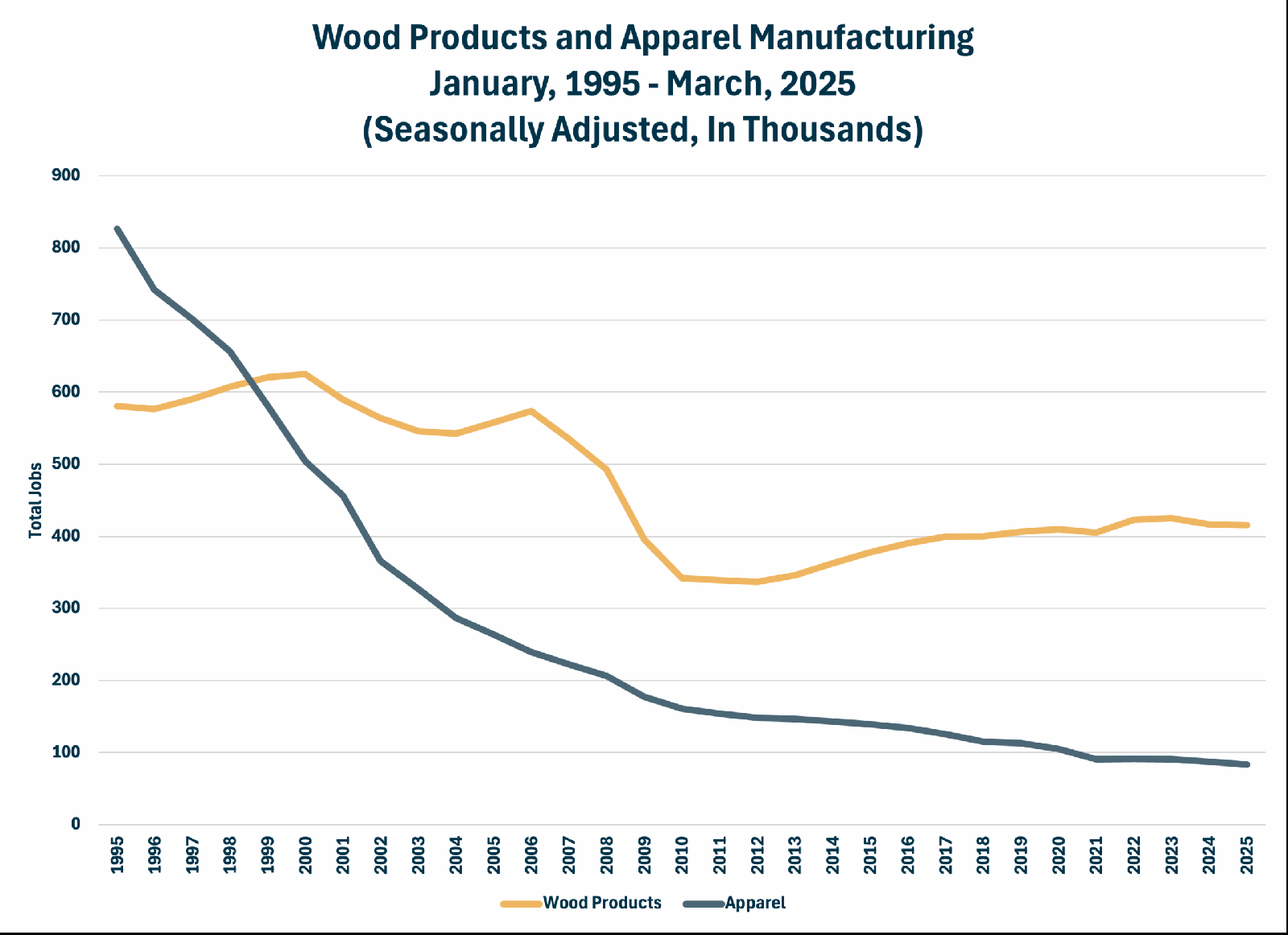
Figure 7
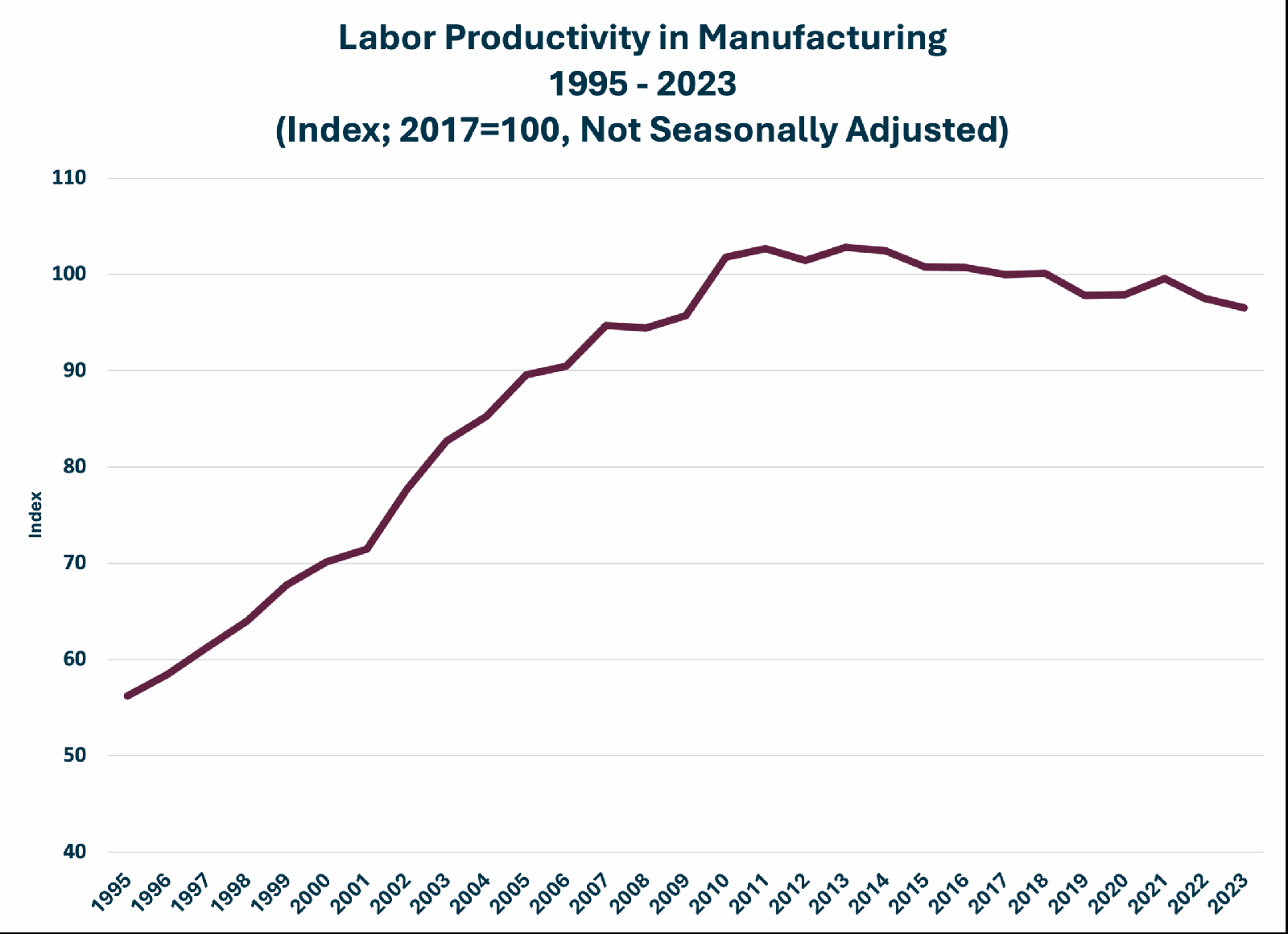
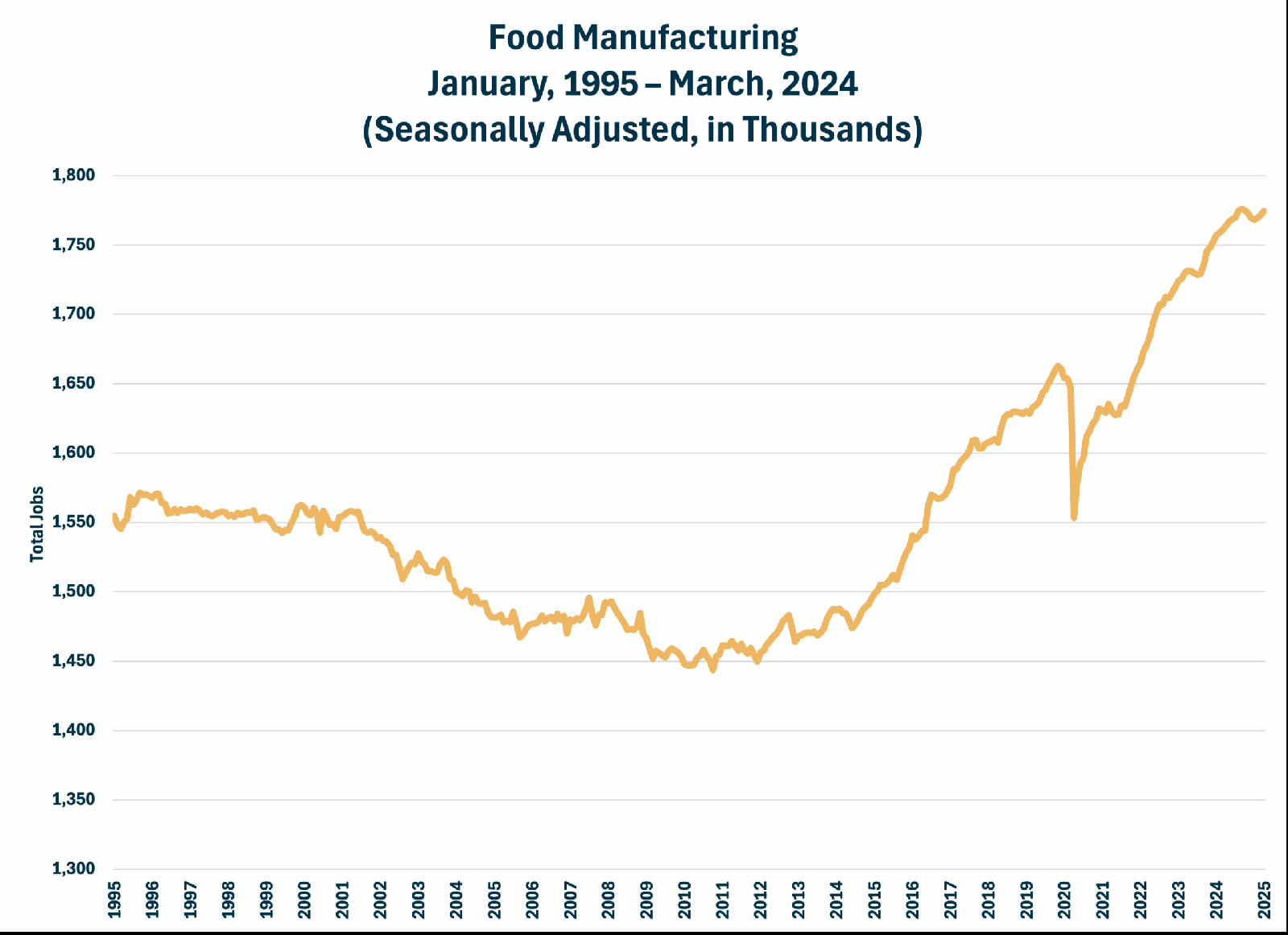 We will revisit these data from time to time to see how policies to revitalize manufacturing employment are doing. There is, however, one other dimension of the manufacturing story that should be in focus: the worrisome flatness of labor productivity in that sector. Many analysts who belittle the concern of declining manufacturing jobs often point to the output of this sector, which has been rising steadily since the employment declines began. They cite this output to make the valid point that it’s the output of manufacturing that really matters to most Americans, not the number of workers in that sector.
That would be a decisive point if the productivity of manufacturing workers was rising as steadily as output. Afterall, a worker’s rising productivity is highly related to their rising incomes, after accounting for inflation. That said, worker productivity has stalled. Figure 8 shows this flat line, which also started just about the time employment began to grow again in the sector. Just because employment is growing in a part of the economy does not imply that productivity will stall out. If anything, one would expect the opposite.
We will revisit these data from time to time to see how policies to revitalize manufacturing employment are doing. There is, however, one other dimension of the manufacturing story that should be in focus: the worrisome flatness of labor productivity in that sector. Many analysts who belittle the concern of declining manufacturing jobs often point to the output of this sector, which has been rising steadily since the employment declines began. They cite this output to make the valid point that it’s the output of manufacturing that really matters to most Americans, not the number of workers in that sector.
That would be a decisive point if the productivity of manufacturing workers was rising as steadily as output. Afterall, a worker’s rising productivity is highly related to their rising incomes, after accounting for inflation. That said, worker productivity has stalled. Figure 8 shows this flat line, which also started just about the time employment began to grow again in the sector. Just because employment is growing in a part of the economy does not imply that productivity will stall out. If anything, one would expect the opposite.
Figure 8