Testimony
Remarks before Congress by Dr. Bill Beach on "Reducing America’s National Debt: Rooting Out Federal Waste, Fraud, and Overregulation"
May 14, 2026 · William W. Beach, D. Phil.


In a recent article, The Economist asks, “Why are Americans so gloomy about their great economy?” For reasons that seem to baffle the White House (which wants more credit for the good that is happening and the economy) and pundits, a wide swath of Americans are highly concerned about how far their standard of living has fallen since prices took their dramatic upward surge in 2021.
But this economy may not seem so great if you are in the bottom two-thirds of the income distribution or if you are a wage earner regardless of income level. Indeed, the Zoomers have talked about the “silent depression”—meaning, it is harder to buy the ingredients of the American Dream today (e.g., education, transportation, housing, health care) than it has been in the past.
For family budgets, the continuing wedge between earnings and the cost of living is a main economic problem. This figure shows just how much the growth in average weekly earnings (wages and salaries) has fallen behind the overall rate of inflation as measured by the Consumer Price Index for All Urban Consumers (CPI-U). The CPI-U grew dramatically faster than average earnings over the period from June 2021 through May 2023. That said, the annual rates for the CPI-U have subsided since May.
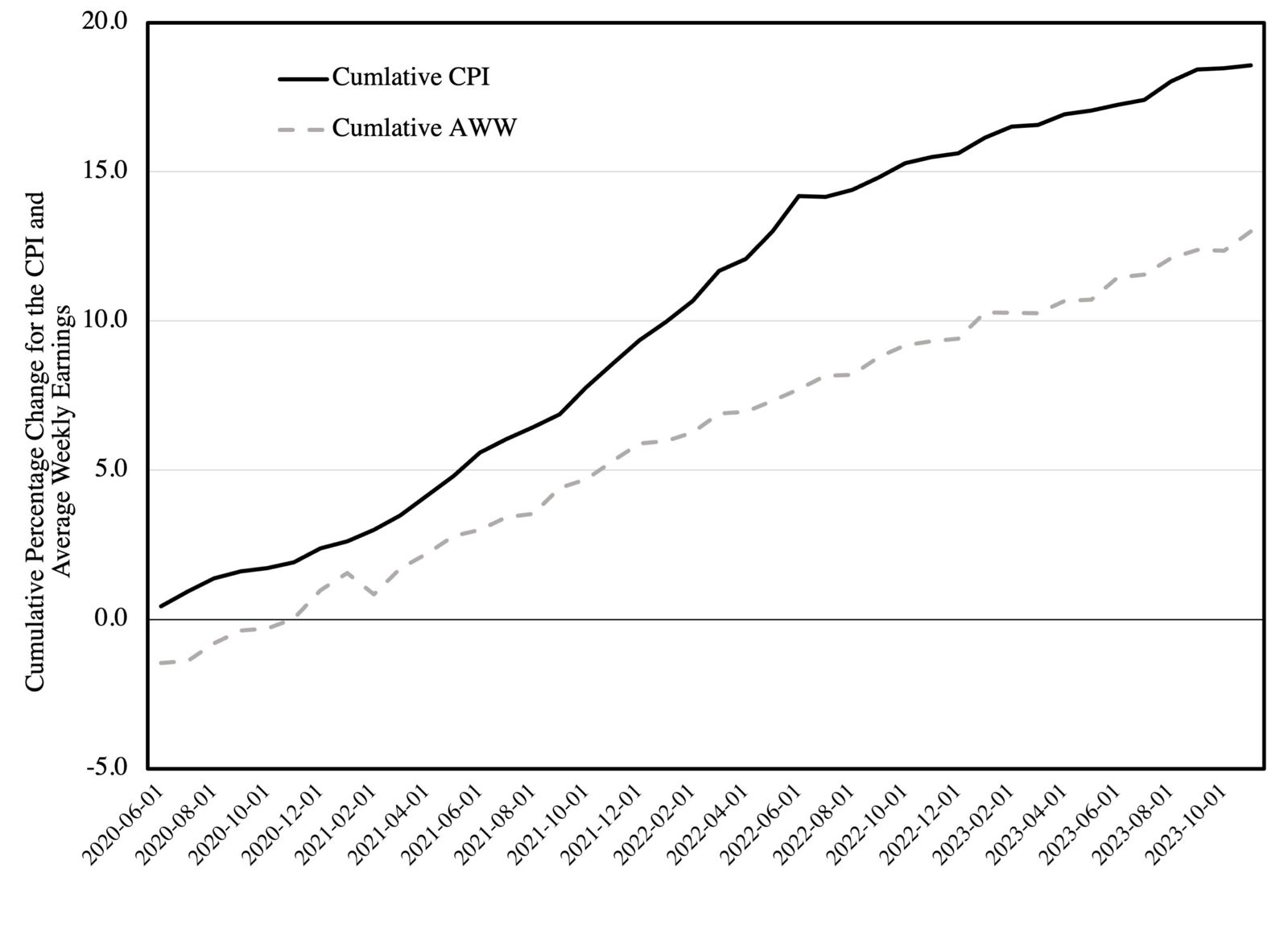
Many looking for good economic news point to those falling monthly rates, but households look at their total budgets, which have lost purchasing power even with slower CPI-U growth. This figure (which includes the latest data from December, 2023) shows the cumulative growth in both statistics. Note how much higher the general price level is relative to the level of change in average wages. This yawning gap between the cumulative growth in prices and average weekly earnings is the family budget crunch.