One of the most cited government statistics is the change in gross domestic product (GDP). Bankers, reporters, policymakers, and armchair economists
look to changes in GDP to get a sense of whether the economy is growing or shrinking or, as has been the case in the recent past, merely treading water.
Sometimes the estimates of GDP even dominate the news cycle: Think of the dramatic news stories from 2020 reporting that the economy had collapsed in April and May— only for it to come back at historic rates over that summer. Americans panicked in April only to breathe a deep sigh of relief in July because “the GDP,” whatever it is, had risen from the dead.
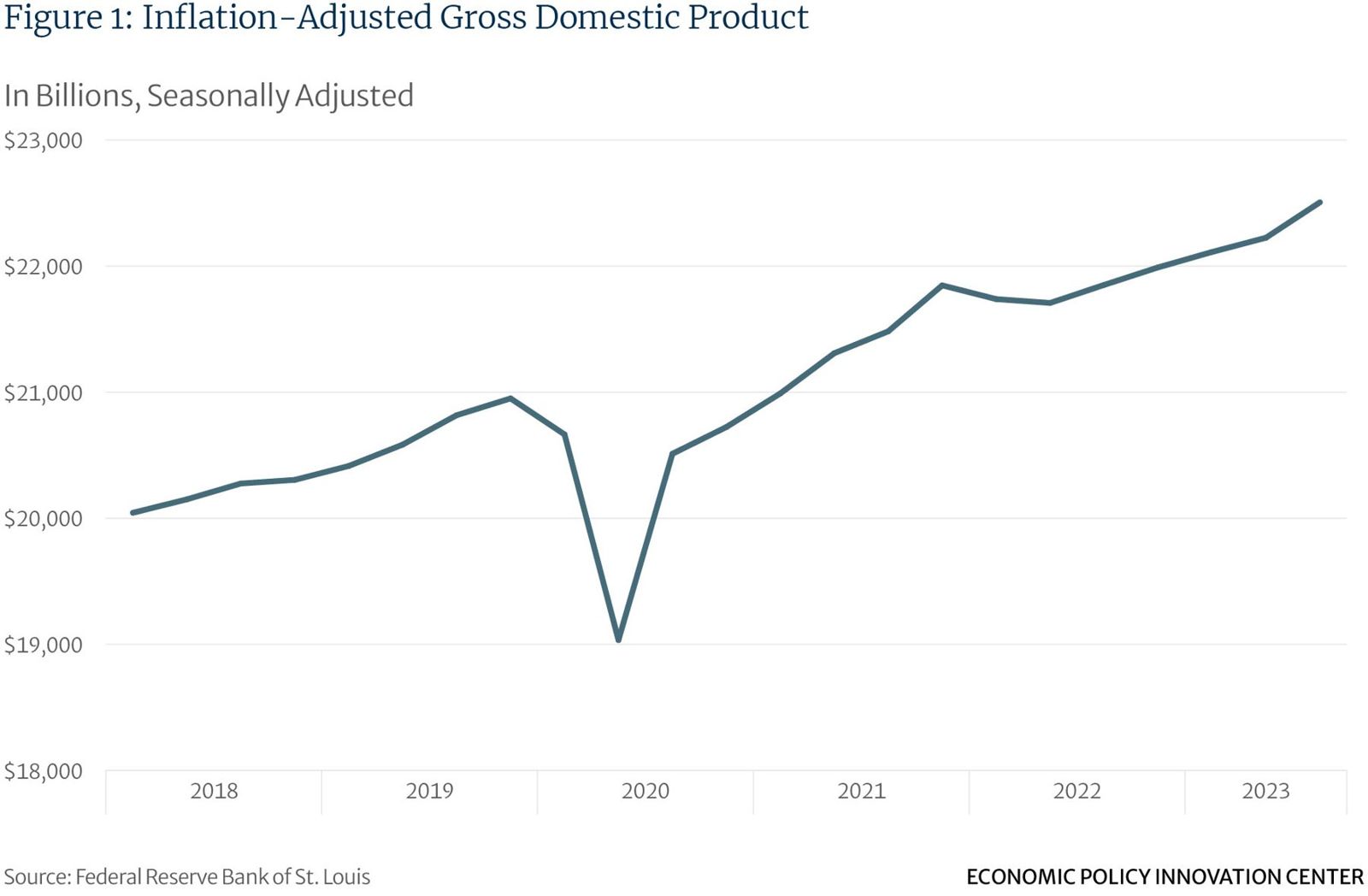
So, what is this thing whose return to economic vitality Americans so wildly celebrated in the last half of 2020?
Y=C+I+G+(X-M),where
Y = output or GDP,
C = expenditures of households,
I = investment,
G = spending by government,
X = exports of goods and services, and M = imports of goods and services.
To start with, it is
an accounting concept, which may disappoint some people. GDP is one of only a handful of major intellectual breakthroughs from the 20th century that really helps to explain the sometimes crazy economic world we live in. Without the National Income and Product Accounts (NIPA) system, which supports the estimation of GDP, policymakers and economists would have little knowledge of how the overall U.S. economy is functioning or where problems lurk that affect everyone. If one doubts this, just think how incomprehensible a large business would be without an accounting system to keep tabs of costs, profits, assets, and liabilities.
Now to the question that opened this essay: What is GDP?
GDP measures the market value of all goods and services produced for final sale within the United States in any given year. Legions of college students have pondered this definition while looking at the equation below.
Let’s unpack that sentence and the equation. First, GDP (Y in the equation) is
an estimate of the market value of goods and services, which are measured when those items are sold to consumers. That said, while you can stand near any grocery checkout line and watch sales taking place, you will never, ever see GDP. That’s because it is a
complete creation designed by economists to sum up all final or consumer sales. The assumption that these economists make is that summing up sales is a pretty good proxy for overall economic activity.
Second, GDP is
an estimate of expenditures or spending of households, businesses, and governments on goods and services measured by their market value in dollars or, as seen sometimes, inflation-adjusted dollars. The biggest component of GDP (about 67 percent) are the expenditures of households (C in the equation). Also included in “market value” of goods and services are investments made by businesses in things like factories, land, and inventories (I in the equation). Government transactions (G in the equation) also are included. These include purchases from suppliers and payments to government workers. Some transactions don’t make it into GDP. For example, if someone buys stock in a company, that purchase finally goes into GDP only when the company uses the money from the stock purchase to buy something. Thus, GDP is not the dollar value of all transactions. If you think of all the activity in the economy, that sum is likely much larger than the GDP at any point in time.
Third, GDP
measures economic activity within the United States (the X-M part of the equation). This element of the definition presents some problems for the Bureau of Economic Analysis (BEA). First, products made in the U.S. for export would logically not be included in GDP, except that some investment stands behind that production, which would be counted. Clearly, one would not count the product produced in a foreign economy as part of GDP, except that households and businesses purchase those products, thus adding to overall economic activity in this country. So, the BEA adopts a controversial fix to both problems by subtracting imports from exports. Thus, the market value of imports (M) stays out of GDP (Y), while the greater value of exports (X) over imports, when that occurs, is defined as a growth in the U.S. capital stock, thus aligning that amount to investment.
Some readers may be familiar with other estimates of the national economy, specifically gross national product (GNP) and gross national income (GNI). How do these metrics differ from GDP?
First, GNP measures the goods and services produced by labor and property supplied by U.S. residents anywhere in the world. Prior to 1991, it was the principal measure of national output, but economists always assumed it was a bit larger than the domestic U.S. economy. For example, a U.S. business that operates primarily in this country but also has offices in London would count its total output in GNP.
Second, GNI has largely replaced GNP as a broad measurement that captures income earned by U.S. labor or property outside of the country. For example, people who live very near a border of the U.S. may work in Canada or Mexico on a regular basis, and their income would be a part of GNI. Similarly, the earnings of investments made by U.S.-owned property in foreign economies also goes into GNI.
The estimation of GDP is made each calendar quarter by economists and statisticians in the BEA of the U.S. Commerce Department. The BEA produces an advance estimate, which is twice revised, whereupon it becomes final. For the “advance” GDP report for the third quarter of 2023, see here.
Most analysts and policymakers pay more attention to the change rate of GDP than to the actual amount of output or the level of GDP. That’s because they need a sense of how fast or slow the economy is growing. So, the percentage change in GDP this quarter compared to a year ago has become the favorite “metric” for those concerned about overall economic activity. Figure 2 shows quarterly data through July 2023.
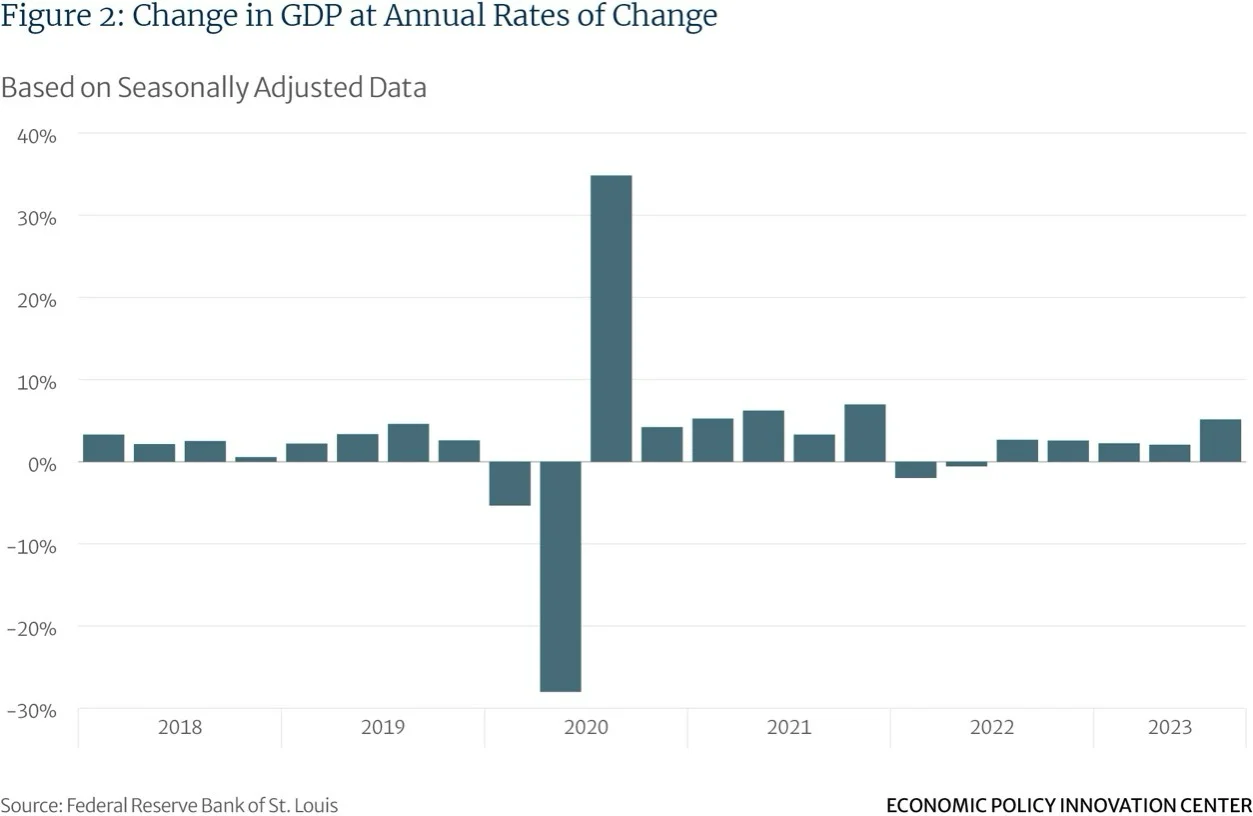
Other than the weirdness of the pandemic-induced collapse of the economy in 2020 and the recovery in 2021, the pace of U.S. economic growth is somewhere between 2 percent and 3.5 percent year after year.
When GDP dips below zero and stays there, that’s usually a recession. When it grows above 4 percent for several quarters, that’s usually called a boom. By the way, the Federal Reserve is never happy: It worries a lot about both situations.
Some people ask: Is it fair to equate the economy to GDP, and what is the normal pace of U.S. economic growth?
There are so many ways to view the economy. For instance, the total value of all physical assets (such as factories, machines, railroads, and airports) is in excess of $100 trillion. The value of human capital, that is, the value of productive skills, is likely a multiple of physical assets. Both of these metrics change regularly, but neither changes quickly enough to show if the economy is improving or declining. However, consumption of goods and services does change direction frequently depending on how people feel about the near-term future. Thus, GDP has become a widely accepted metric for “the economy.”
Given that status, what’s a good pace for GDP, one that is not too fast and not too slow?
The truthful answer is: There is no set normal pace. The annual growth of the economy depends on many things that change over the decades. For example, the aging of the population has made the economy very different from the postwar economy or that of the 1960s. Back then, more young people were starting families than today, which meant that family-centered and child-centered consumption and the building of schools dominated GDP. Now, there are fewer young families and less need for school construction. That said, the labor force is older today than in the 1950s, which means that it is more productive, since it knows more than the younger population does. Thus, there is no abstract normal pace of growth.
However, here’s what we know about the long growth path of the U.S. economy, as demonstrated in Figure 3.
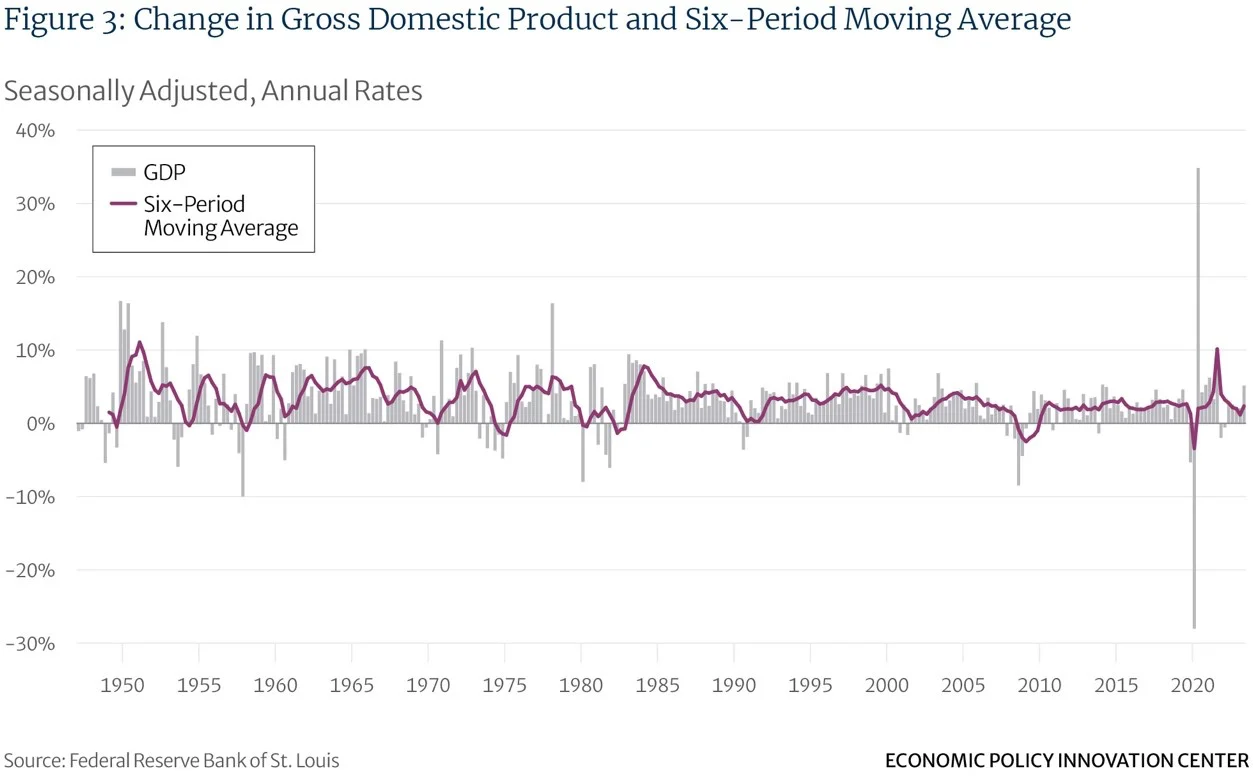
The average annual pace of GDP growth from 1948 to the present stands at 3.1 percent. When dropping the early years because demographics were so different then, the growth rate since 1990 stands at 2.45 percent. When taking this last period and leaving out the big swings of 2020 and early 2021, the growth rate is 2.52 percent.
So, it probably is best to think of a range of good outcomes: somewhere between a 2.4 percent and 3.0 percent annual rate.
It is certainly possible for the long-term growth rate to be higher than 3.0 percent, but that’s a topic best left to another paper, one that deals with how demographics, public policies, and world technological developments affect the pace of growth.