


Opening
Chairman Bost, Ranking Member Takano, and Members of the Committee, thank you for inviting me to testify today. I am here today as an expert witness on the federal budget and to provide analysis of the fiscal situation and potential improvements at the U.S. Department of Veterans Affairs (VA).The Current Debt Picture
The fiscal picture of the country is dire. The national debt sits at $39 trillion and is continuing to grow rapidly.[1] This translates to approximately $289,000 per household across America. When you add in the unfunded liabilities across Social Security and Medicare, and the added debt service costs, that total burden grows to $875,000 per household. Yes, even the veteran and active duty servicemember households. We will all suffer under this burden – be it from higher taxes in the future, greater inflation levels, or diminished attention to other critical government functions. Our massive federal debt is not a tomorrow problem; it has real impacts now. It is raising interest rates on Americans, dragging economic growth, and resulting in transfer payments that cause upward inflationary pressure on key sectors like healthcare. This includes higher costs at the Veterans Health Administration. Rather than making prudent budgeting decisions, we are still running a $1.9 trillion deficit this fiscal year (FY), and continuing on the trajectory of spending beyond our means.[2]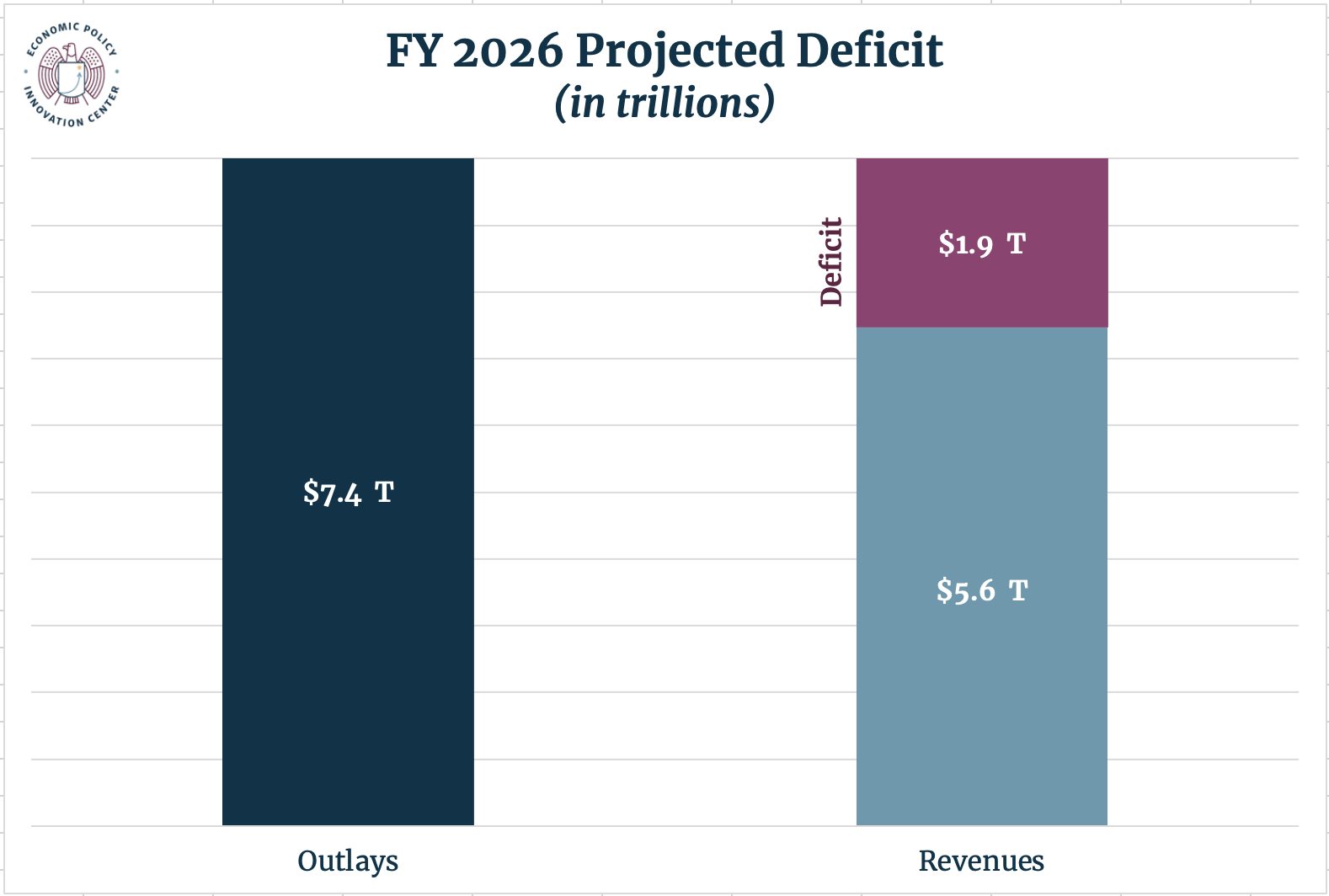
Source: Author’s chart using CBO data.
This has a direct impact on funding priorities and decisions related to veterans, but it also implicates overspending in all government programs as part of the problem.Veterans Spending by the Numbers
Federal spending on veterans comprises about six percent of projected outlays government-wide in FY 2026. This may not seem like a significant proportion, but keep in mind that every dollar spent adds to our interest cost outlays, as well. Since FY 1977,[3] total actual outlays for veterans benefits and services have grown from $18.04 billion to $377.22 billion in FY 2025.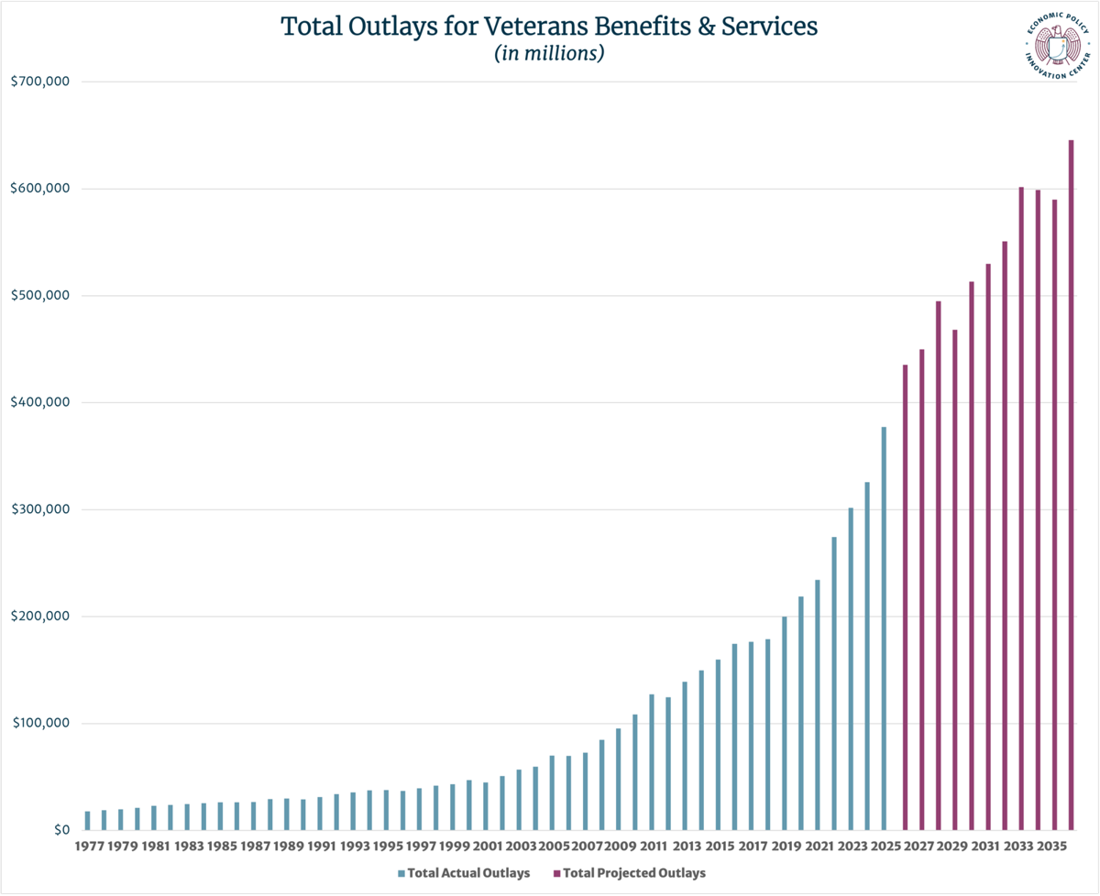
Source: Author’s chart using OMB historical tables and CBO baseline data.
The rate of growth is notable in the previous 10 years, and the Congressional Budget Office (CBO) projects this trend to worsen in the coming decade. That projection was made even before the Iran conflict. This details matters because spending on veterans is directly impacted by spending on defense, with an observable lag time between active duty-related outlays in the U.S. Department of War (DoW) budget and the shift to the veterans affairs budget.[4] CBO’s estimates in the baseline do not account for the uptick in military action related to Iran conflict. The Secretary of War’s expenditures will eventually make their way into the Secretary of Veterans Affairs’ budget. Congress should rein in unwarranted excess spending now, in preparation for veterans’ potential needs in the coming years. This recommendation is in addition to my general analysis that overall spending must be lowered given the current unsustainable trajectory. Evaluating the previous decades reveals that surging outlays have clearly transitioned from explainable spikes and valleys into a generally upward trend. Just 25 years after the start of the Global War on Terror in 2001, FY 2026 outlays are projected to be 867 percent higher.[5]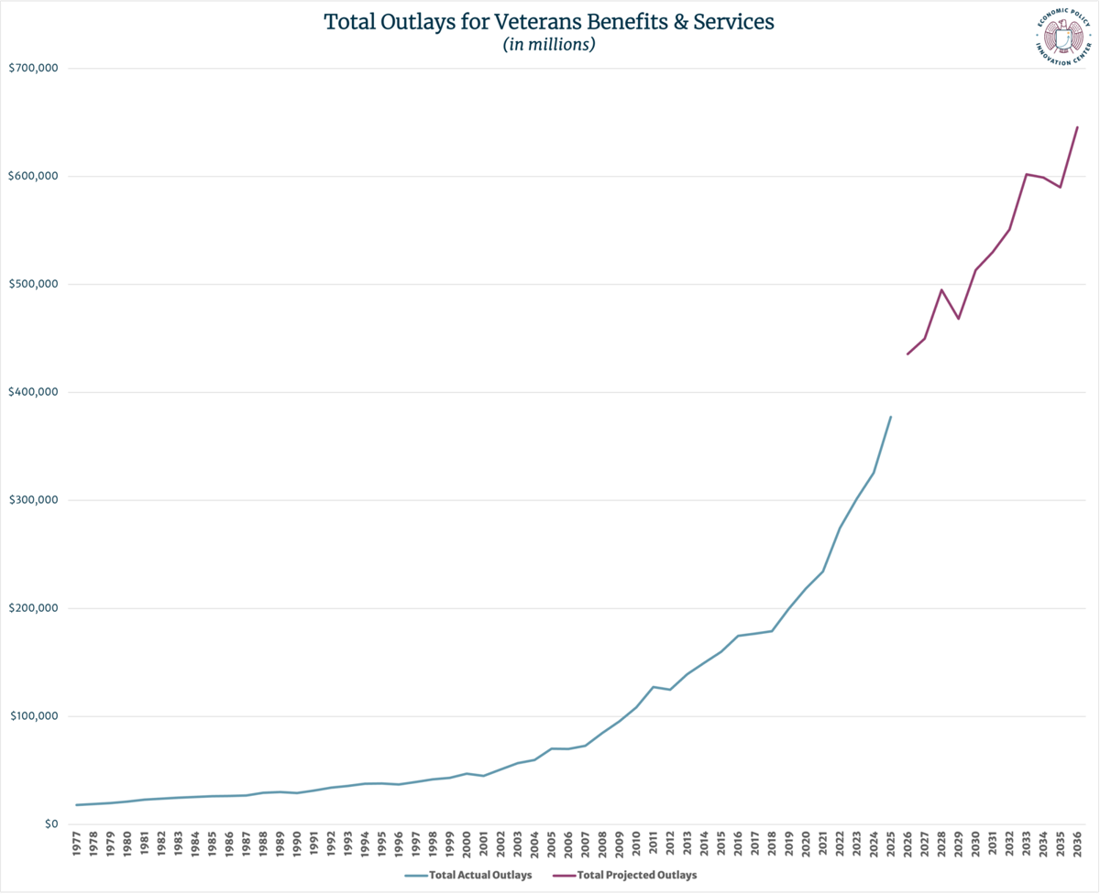
Source: Author’s chart using OMB historical tables and CBO baseline data.
Outlays continue to surge and are now well outpacing inflation. They also continue to grow even as the veteran population declines.[6] So where is this money going exactly? There are five major categories of spending within Function 700, which is Veterans Benefits and Services: (701) income security; (702) education, training, and rehabilitation; (703) hospital and medical care; (704) housing; and (705) other benefits and services. Of the total $377.22 billion going to all veterans benefits and services, more than half is spent on income security programs. The vast majority of veterans’ income security program dollars are for disability compensation and pension programs.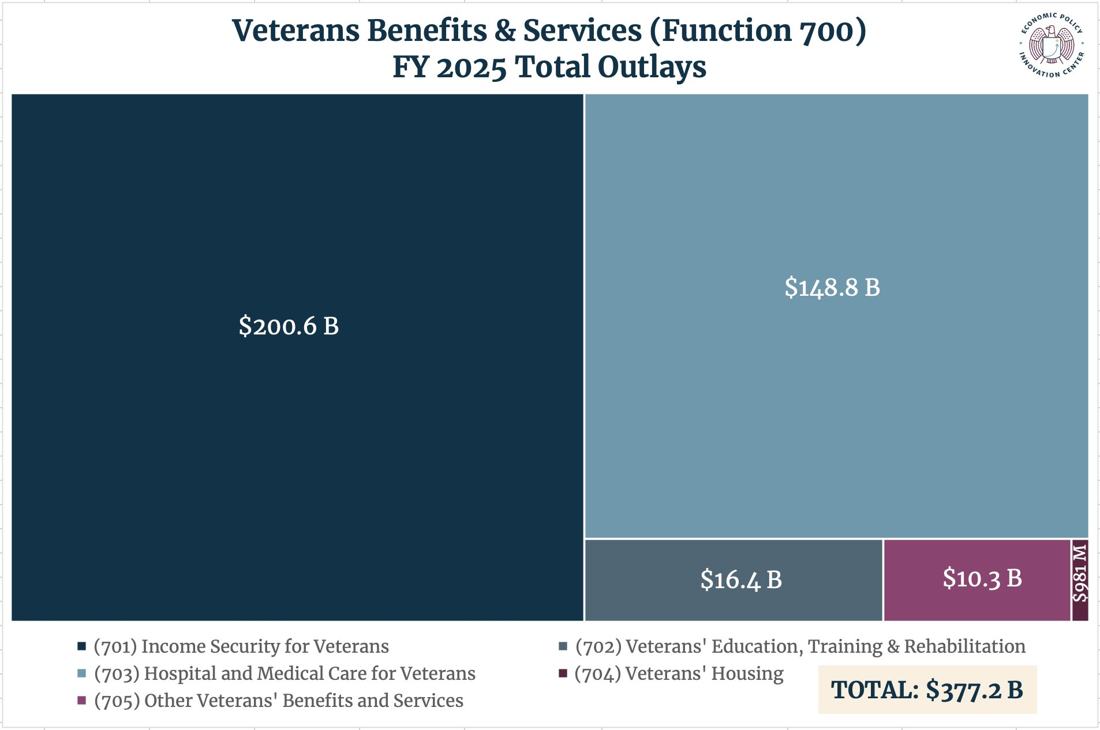
Source: Author’s chart using CBO baseline data.
This is followed by nearly $150 billion for hospital and medical care for veterans – a major indicator that broader healthcare prices are driving up spending at the VA. This is driven by a broader challenge related to government subsidization of health care in the private sector, among other inflationary pressures. Knowing how money is currently being spent in this sector is important only insofar as it is acted upon to improve outcomes without worsening the national debt crisis.The Need for Oversight and Sustained Reauthorizations
It is also worth asking if the VA’s expenditures make sense within the context of a changing veterans’ population and their shifting needs. Perhaps housing access is a bigger question now than in the past and should receive more attention. Perhaps more could be done on education and training prior to exiting active duty rather than after the fact when veterans’ futures unfortunately become merely an afterthought instead of a planned dream. Perhaps there are serious mistakes being made on leasing and construction for facilities that should be available to support veterans’ mental health but instead are bogged down in bureaucracy. These are not the challenges of the 1970s or even the 1990s. These are the challenges of today, but we are funding the system as if we are stuck in the past. I suggest there are developing problems and innovative solutions that would produce better results than simply continue to shovel money into a bonfire and pretending that can solve the very real challenges faced by America’s veterans. The issue, of course, is that without proper oversight, we will not know how to proceed. Every dollar spent in this function should be scrutinized carefully through a full reauthorization process to ensure it is indeed being used for veterans and not lost in a bureaucratic morass, wasted where it is not needed, or subject to fraud. The need is most certainly apparent given the multitude of simultaneous challenges our veterans face, and they deserve lawmakers who will be intentional and deliberate with their fates rather than agreeing to continue funding without evaluating current need or utility.Stop Rubber Stamping More Spending… and More Failures
A major part of the problem is that the mandatory (or, “autopilot”) spending side of veterans outlays has grown to 69 percent for fiscal year 2026. That means Congress as a whole is only reviewing (through the appropriations process) 31 percent of what it spends in taxpayer money each year for veterans services.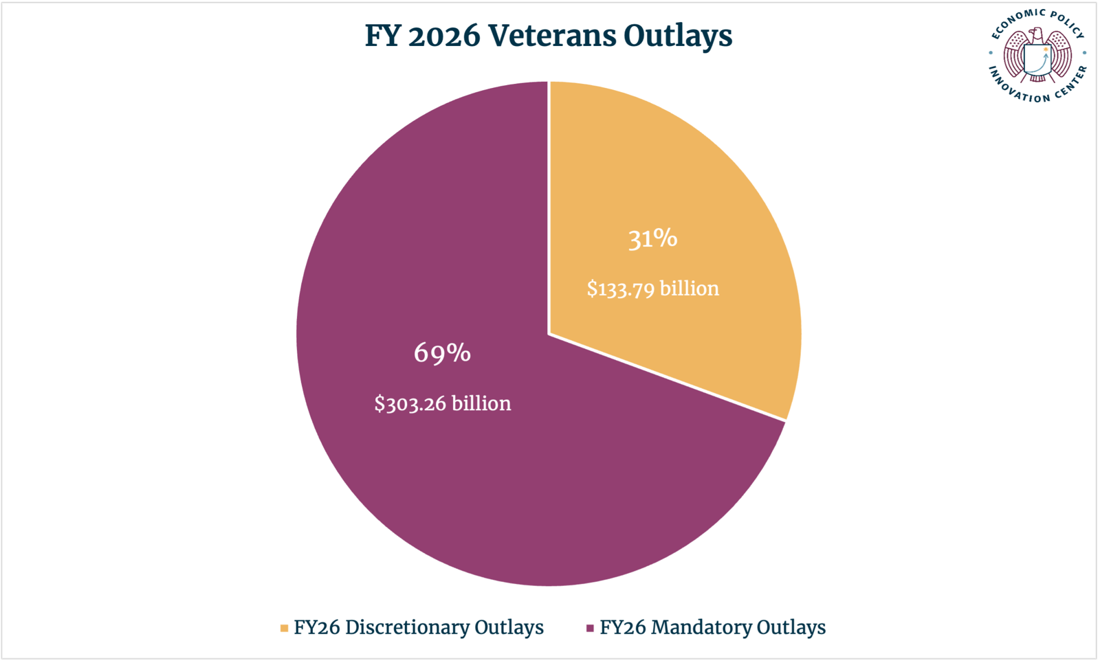
Source: Author’s chart using CBO baseline data.[7]
I am sorry to say that adding to this problem is the sustained failure by Congress to reauthorize VA programs. With unauthorized appropriations continuing on and mandatory outlays on the rise, a full review must be a priority for this committee. Without it, damage will continue to be done in a severe and direct way to veterans, as well as to all taxpayers. Unfortunately, as outlays increase, there is also a higher risk of fraud, waste, and abuse. Without regular, sustained review from this committee, there are greater chances of non-essential spending supplanting true need. For example, Senator Rand Paul’s annual Festivus Report wastebook uncovered $1 million wasted by the VA on forcing ferrets to consume alcohol in a “forced binge.”[8] That million would certainly have been better spent elsewhere or not at all. The Government Accountability Office (GAO) recently released its latest High-Risk List report, and named the VA multiple times.[9] One such highlight is “Managing Risks and Improving VA Health Care,” which GAO finds to be insufficient and risky, having added it to the high-risk list in 2015. VA health care has remained on the list for over a decade, with GAO writing in its most recent report:“We have identified challenges with VA’s ability to provide timely, cost-effective, and quality care. We added VA health care to the High-Risk List in 2015 with five areas of concern: (1) ambiguous policies and inconsistent processes, (2) inadequate oversight and accountability, (3) information technology (IT) challenges, (4) inadequate training for VA staff, and (5) unclear resource needs and allocation priorities. Since our last high-risk update, VA has continued to face system-wide challenges in overseeing patient safety and access to care, hiring critical staff, and meeting future infrastructure needs.”Of serious concern is GAO’s call out of scheduling challenges for VA patients, particularly for mental health appointments. GAO goes on to provide detailed recommendations for improvement and assess progress that has been made – which is evidently lacking in most areas since their prior recommendations. Congress could certainly use GAO’s work to inform a robust review of inefficiencies and misaligned priorities during a proper reauthorization effort. Another indicator of oversight through reauthorization is available through the PaymentAccuracy.gov portal. VA only comprises six percent of the entire federal budget, but it is responsible for the fourth highest outlays to designated susceptible programs behind the U.S. Department of Health and Human Services, the Social Security Administration, and the U.S. Department of War. In FY 2025, the VA’s susceptible program outlays totaled $201 billion to its seven susceptible programs.[10] Improper payments will not be addressed without Congressional intervention.