It's no secret that the greatest concern for most Americans is the cost of living. The wave of inflation that began in 2021, coupled with higher interest rates, has made it harder for millions of families to make ends meet.
The last thing anyone in Washington should be considering is a tax hike that would directly soak more than 90% of households while raising prices for many necessities.
Unfortunately, there is growing momentum behind a push to enact a national tax on vehicle miles traveled (VMT). A variety of special interest groups claim that this would be necessary to maintain important infrastructure. While the form of the VMT could range from annual mileage checks to active monitoring with transponders, the goal would be to generate tens of billions in tax revenue per year.
Sections 13001 and 13002 of 2021’s
Infrastructure Investment and Jobs Act created VMT “pilot” programs at both the state and federal levels, including $15 million in grants for states to run VMT experiments. In other words, taxpayers have funded government research into implementing new taxes.
The supposed justification for a VMT is that the
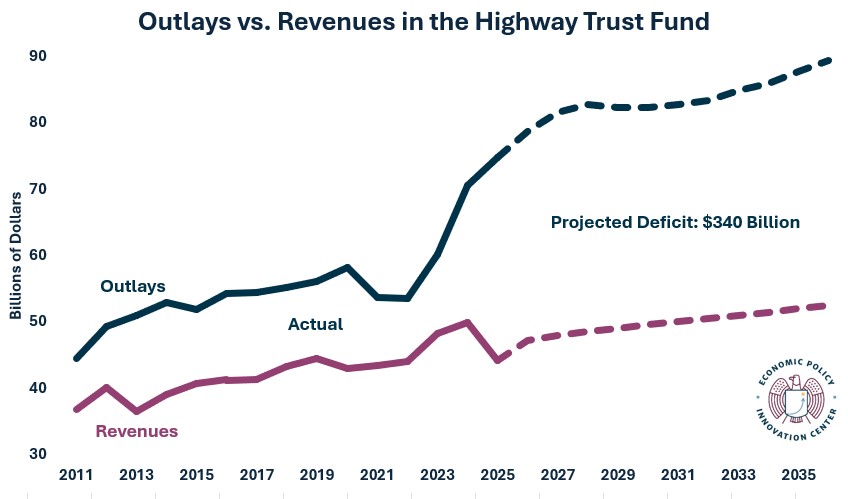
Highway Trust Fund (HTF), which supports the interstate highway system using federal gas tax revenues, is running on empty. Decades of deficits have led to a series of
bailouts funded by adding to the national debt.
Based on current spending trends, the HTF is expected to run out of money in fiscal year (FY) 2028 and could require an infusion of more than $100 billion just to get through FY 2031. However, while the HTF's finances do need a fix, the root of the problem is too much spending rather than a failure to tax.
Before Congress even considers imposing a VMT, which would make it more expensive to travel and increase shipping costs on nearly every consumer good, they should address the roughly
30% of HTF spending that is diverted from core highway and bridge projects and programs.
The largest diversion, roughly 20% of highway fund spending, is siphoned into mass transit. Not only is transit unrelated to the HTF's purpose, but it also receives far more funding than is justified by its usage (less than 5% of daily commuter trips).
Billions of dollars more are diverted into programs for electric vehicle
charging infrastructure, "climate resilience," bike lanes, hiking trails, ferry boats, and more. These projects are local responsibilities and should be funded at the state local level, but state and local officials prefer
"free" money from Uncle Sam, ignoring that the gross national debt is
rapidly approaching $40 trillion.
While the current session of Congress is highly unlikely to enact a VMT, they could set the stage for one if they fail to address HTF's deficits. The longer the overspending and deficits persist, the harder it will be to avoid this new means of milking the public. If legislators want to reduce the pressure for a new cost-increasing tax, there are many reform options they can pursue in the upcoming Highway Bill:
- Reducing overall spending, with a focus on reducing spending diversions.
- Reducing mandates on states, which increase construction costs and force them to participate in wasteful programs.
- Expanding the use of Private Activity Bonds, which are a far more cost-effective way for the federal government to support adding new highway capacity.
- Giving states more flexibility to fund highway infrastructure themselves and reduce their dependence on the federal government.
Americans are taxed enough already. Congress can put the VMT scheme onto an exit ramp by tackling wasteful and inappropriate spending.