As America’s citizens and legislators consider how to address the federal government potentially hurtling over the
fiscal cliff, it is urgent to examine where Washington funnels public resources.
One such area is federal aid to state and local governments. A multitude of federal programs and bureaus exist to funnel tax dollars to other levels of government.
Trends in State and Local Government Financing
From fiscal year 2000 to 2023, federal aid to state and local governments rose by an inflation-adjusted 137%. Although temporary spikes after the 2008 financial crisis and the 2020 pandemic were followed by relative declines, the long-term trend is growth.
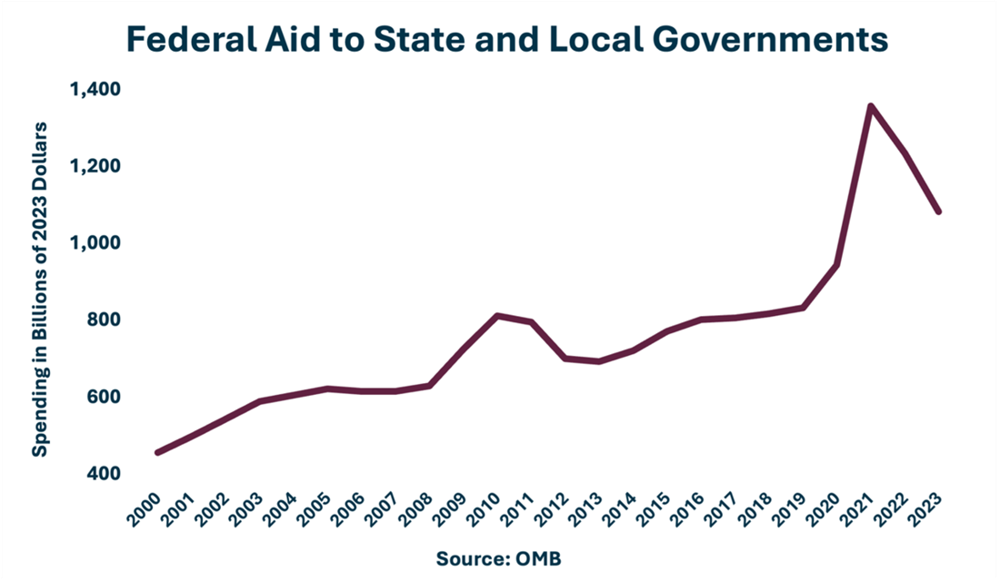
It is sometimes argued or implied that state and local governments lack the financial heft of Uncle Sam when it comes to raising the revenue needed to provide essential public services, thus justifying federal assistance.
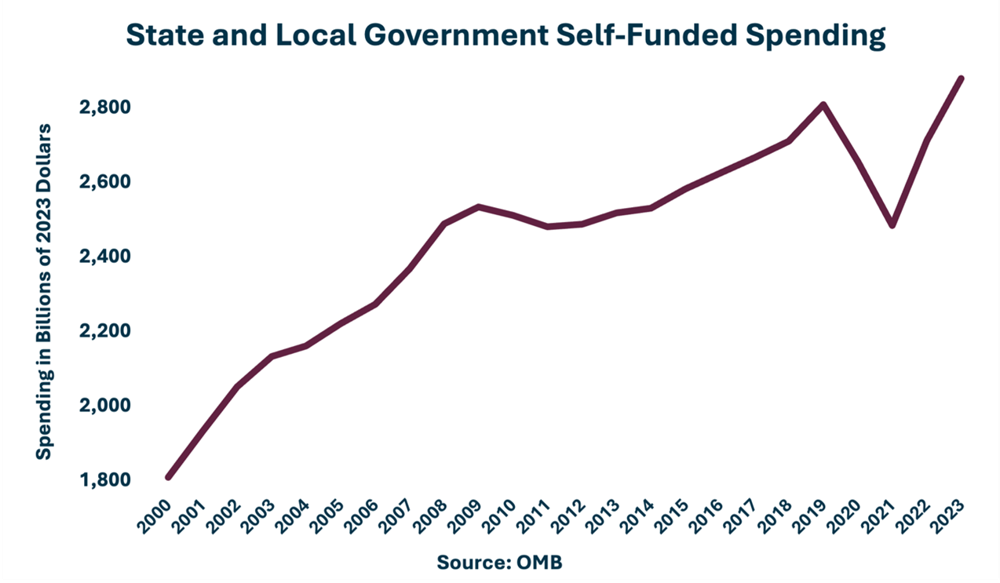
However, from fiscal year 2000 to 2023, self-funded state and local spending increased by 59% after adjusting for inflation. This undermines the notion that state and local governments are starved of resources.
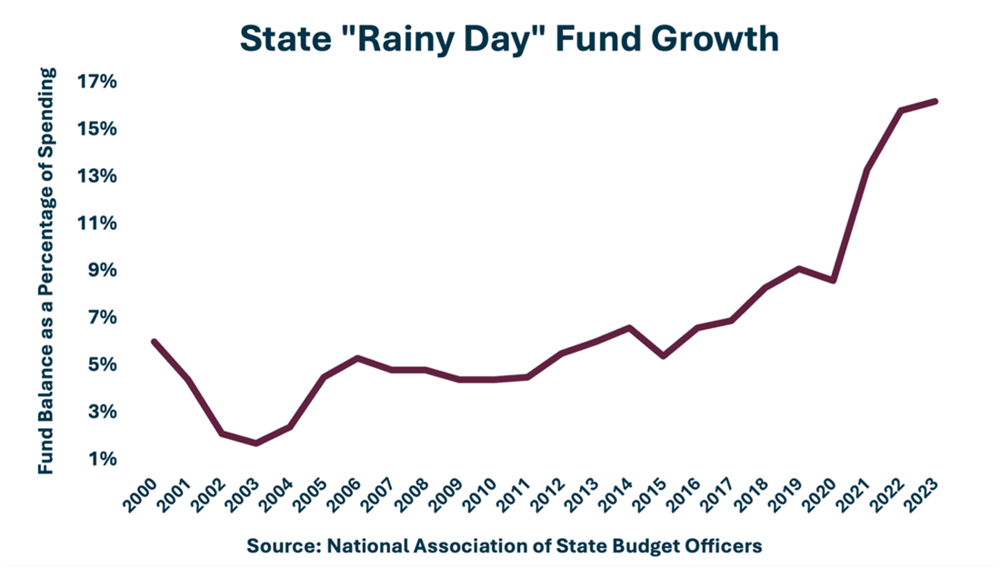
Another sign of relatively robust state government finances is the growth of so-called “rainy day” funds. This trend escalated as a result of excessive federal handouts during the pandemic, notably the
slush fund signed by President Biden in 2021.
Despite the ability of state and local governments to self-fund, the rapid escalation of federal transfers means that the federal share of state and local spending has increased from 20.1% in fiscal year 2000 to 27.3% in fiscal year 2023.
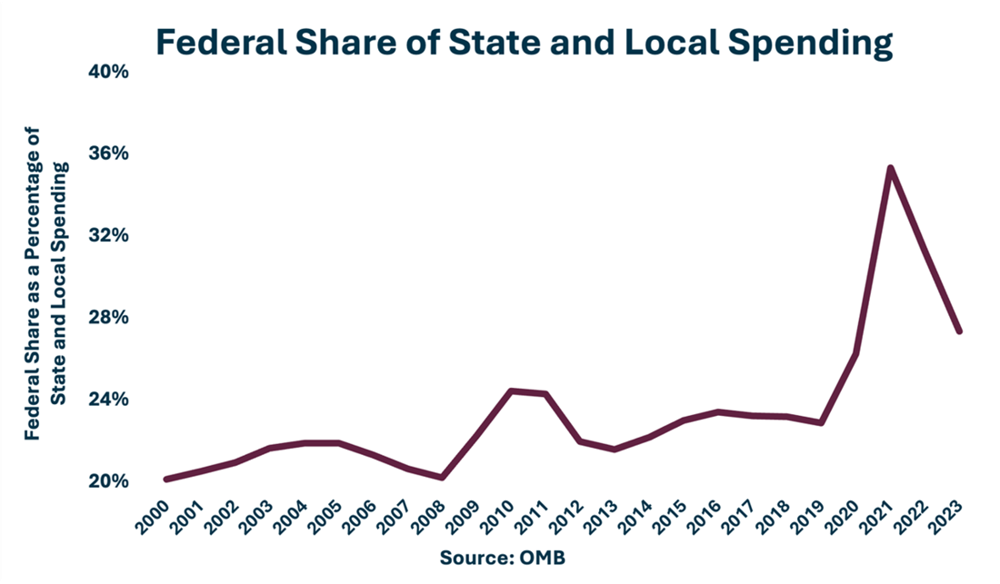
Merely reducing the share of federal transfers to the level of 2000 would have saved $285.6 billion in 2023 alone. Further, since many federal programs encourage additional state and local spending, reducing the federal share would also reduce the total amount of spending, leading to even greater savings.
The Illusion of “Free” Money
Congress faces constant pressure from a variety of special interests to maintain or increase federal spending. State and local governments are perhaps the most powerful special interests of all, given the number of people they employ and the political heft of local officials. Attempts to reduce handouts are often stopped in their tracks by complaints that it would mean sending less “back home.”
Additionally, state and local politicians have a strong incentive to lobby for federal funding, since they are not held accountable for federal taxes or the national debt. Federal funding thus appears “free” to them.
However, the country can no longer afford to tolerate this “free money” illusion.
With the
gross federal debt now $36.2 trillion, structural deficits approaching $2 trillion per year, skyrocketing interest costs on federal debt, and medium-term bankruptcies
looming for Social Security and Medicare trust funds, the trend of rising federal handouts to state and local governments is unsustainable.
Further, the cost of “free” federal funds for state and local governments shows up in the form of elevated
inflation, higher
borrowing costs that are putting homes out of reach for millions of families, and the existential threat of a national
debt spiral. Constituents in every state and district pay a heavy price for excessive federal spending.
This year, Congress has an opportunity to make an overdue correction. The budget reconciliation process can enable reforms to welfare programs such as Medicaid and food stamps, which account for most intergovernmental transfers. Fiscal year 2026 appropriations will be an opening to address funding that benefits bureaucrats.
Now is the time to crack down on welfare for state and local governments.