The American Rescue Plan Act (ARPA) provided $350 billion for a new, temporary program administered by the U.S. Department of the Treasury called the Coronavirus State and Local Fiscal Recovery Fund (SLFRF). The SLFRF was intended to provide money to state, local, territorial, and tribal governments to support their response to the pandemic and to help with recovery.
A significant motivation for the SLFRF was to replace state and local tax revenue based on the assumption that these governments would experience shortfalls like those experienced during previous recessions.<br />However, the reduction in state and local revenues never materialized to the extent Congress anticipated at the time of enactment. Rather, state rainy day funds have doubled, and state budgets increased more during the pandemic than in any year since 1979. State and local revenues have also increased by 24% since the pandemic began.
Through September 2023, there have been $210 billion in obligations made by state and local governments from their SLFRF allotments. Excluding money reserved for territories and tribal governments, about $120 billion in SLFRF funds remains unobligated.
SLFRF Adopted Budget and Obligations through September 2023
| Expenditure Category |
Adopted Budget |
Obligations |
| Revenue Replacement |
$106 billion |
$94 billion |
| Negative Economic Impact |
$74 billion |
$62 billion |
| Infrastructure |
$31 billion |
$23 billion |
| Public Health |
$24 billion |
$19 billion |
| Public Sector |
$9 billion |
$7 billion |
| Premium Pay (Public Sector) |
$3 billion |
$3 billion |
| Administration |
$3 billion |
$2 billion |
| Total |
$250 billion |
$210 billion |
Source: EPIC using data from the U.S. Department of the Treasury.
This unobligated $120 billion could be clawed back by Congress to be utilized instead as an offsetting rescission for other priorities, given that the COVID-19 pandemic has long ended.
The farther away from the pandemic the SLFRF obligations get, the more likely the funds are to be used for purposes unrelated to the original Congressional intent of the law. This is evident based on Treasury’s recent push for local nonprofits and governmental entities to use the funds for non-pandemic efforts such as “investing in long-term affordable housing projects.”
State and Local Government Obligation Rate from June to September 2023
| Expenditure Category |
3-Month Obligations |
"Percentage Change |
| June to September" |
| Revenue Replacement |
$4 billion |
4% |
| Negative Economic Impact |
$2 billion |
3% |
| Infrastructure |
$4 billion |
21% |
| Public Health |
$1 billion |
6% |
| Public Sector |
* |
* |
| Premium Pay (Public Sector) |
* |
* |
| Administration |
* |
* |
| Total |
$12 billion |
6% |
Note: *Less than $1 billion.
Source: EPIC using data from the U.S. Department of the Treasury.
Between June and September 2023, state and local governments obligated about $12 billion from their SLFRF allocations. This includes $4 billion in “revenue replacement” which, according to the U.S. Government Accountability Office (GAO), “provides recipients with the most flexibility in their use of SLFRF awards and streamlined reporting requirements” relative to the other allowable spending categories.
Cumulative State and Local Government Obligations Since 2021
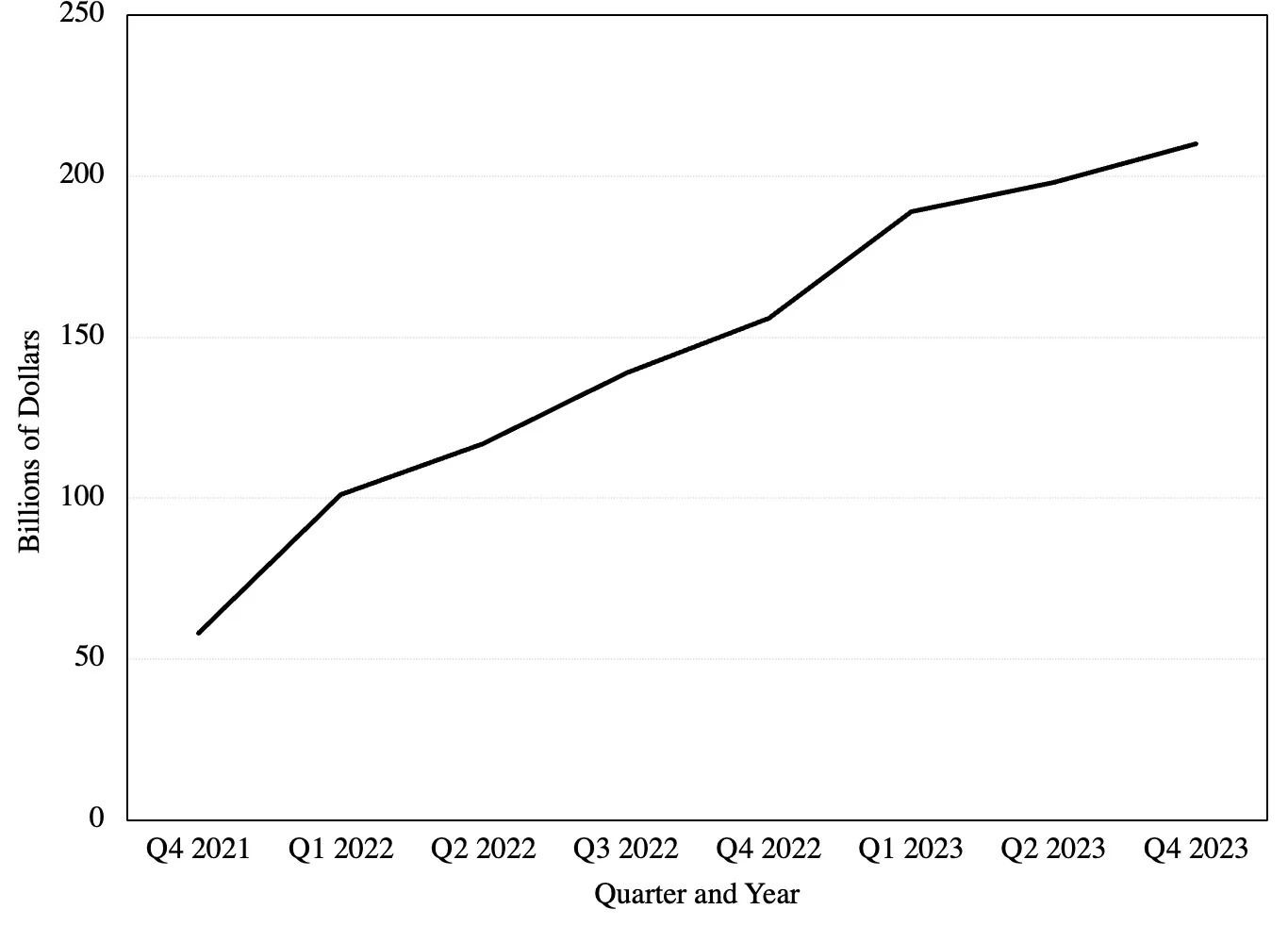 Source: EPIC using data from the U.S. Department of the Treasury.
Given that “revenue replacement” was ultimately not a necessary expenditure based on actual state and local revenues, Congress should consider removing this option for future SLFRF obligations.