Testimony
Remarks before Congress by Dr. Bill Beach on "Reducing America’s National Debt: Rooting Out Federal Waste, Fraud, and Overregulation"
May 14, 2026 · William W. Beach, D. Phil.

Analyzing the Erosion of U.S. Fiscal Space

That exigencies are to be expected to occur, in the affairs of nations, in which there will be a necessity for borrowing. That loans in times of public danger, especially from foreign war, are found an indispensable resource, even to the wealthiest of them. Alexander Hamilton, Report on Public Credit, 1790The creditworthiness of a nation is essential to its sustainability. This principle has remained central to the financial position of the United States government since its founding. As the government’s fiscal and monetary policy has evolved, as well as the economic position of the U.S. within a global economy, the factors that affect its ability to attract investment and manage debt have changed as well. However, the idea remains the same: having the capacity to borrow money in times of extraordinary need is essential to the very existence of a nation. Related to this point is that the U.S. has benefited enormously from the position of having Treasury bonds serve as the principal risk-free asset in the world. In this capacity, Treasurys store value and serve an essential role in both domestic and international transactions. This means that, in times of crises, the demand for Treasurys increases which makes them more valuable. However, this standing is jeopardized by fiscal imbalance and slow economic growth. Guaranteeing that Treasurys continue to serve in this role as the world’s premier risk-free asset has economic benefits for American citizens during periods of both economic growth and recessions. One way to estimate the potential borrowing capacity of a nation is through a measure called fiscal space. Estimates of fiscal space can provide a way for policymakers to gauge the amount of public debt (as a percentage of the economy) that a nation can accumulate without being limited by market access. In a basic sense, it is the nation’s credit limit. A nation’s fiscal space is influenced by its institutional stability, fiscal record, economic growth potential, fiscal commitments (e.g., spending and revenue projections), trade openness, interest rates on safe and other assets, and adverse fiscal events. Typically, estimates of fiscal space assume that policymakers will react to changes in the public debt and other influencing factors.[4] These reactions may also differ depending on the level of debt.[5] Studies have indicated that the amount of fiscal space typically increases as the economy grows and as a nation maintains a sound fiscal record.[6] Fiscal space typically decreases as interest rates on government debt increase; it also decreases as the size of adverse fiscal events become larger.[7] Before the COVID-19 pandemic, many countries experienced an increase in fiscal space. This included the United States, where the OECD estimated that fiscal space increased because of very low real interest rates. However, this increase was offset by additional debt burden and lower potential economic growth. Interest rates and potential growth are the most important factors driving fiscal space. However, increasing debt brought on by fiscal imbalance (i.e., when spending growth exceeds revenue growth) increases risks associated with financial stability. This can affect interest rates for safe assets, including Treasurys. Furthermore, this imbalance will erode existing fiscal space. At some point, this rate of erosion could become so significant that the rate of potential growth cannot keep pace with growing debt. If this happens, interest rates will increase, and debt will grow exponentially as a percentage of the economy thus triggering a debt spiral.
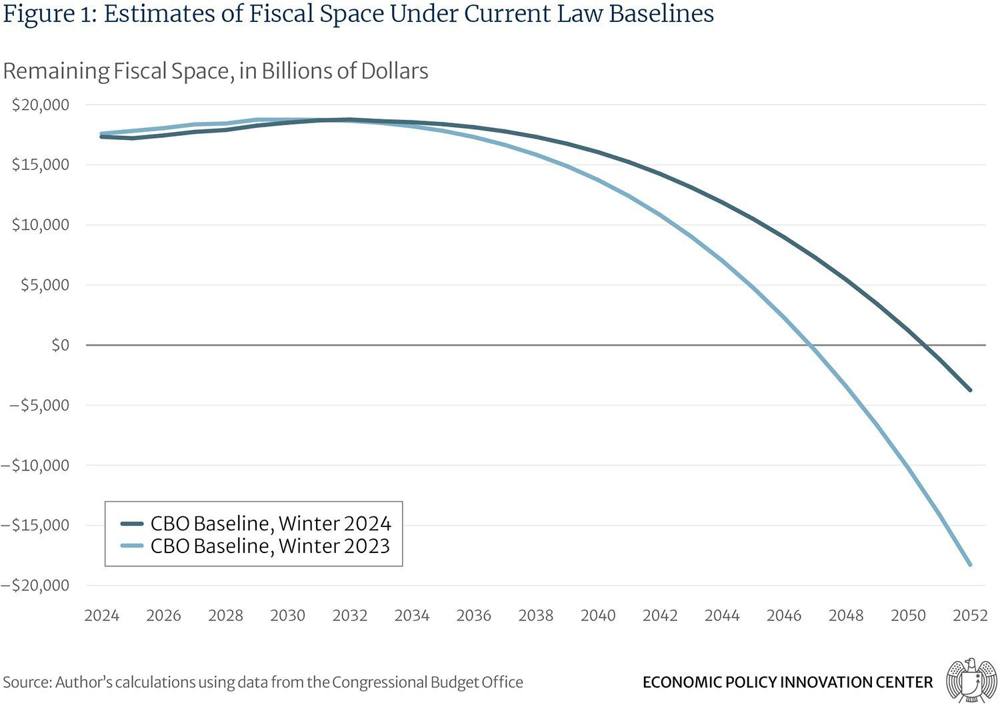 Figure 1 shows the comparison of projected fiscal space in February 2024 relative to this time last year under the CBO long-term baseline. This analysis uses the same method of calculating fiscal space as Winfree (2023) which is based on methods used by Ghosh et al. (2013) and explained in Botev et al. (2016).[11] In the short-term, there is marginally less fiscal space but there is additional fiscal space over the entire period from 2024 to 2053 compared to last year. This is consistent with CBO’s baseline revisions summarized in the last paragraph.
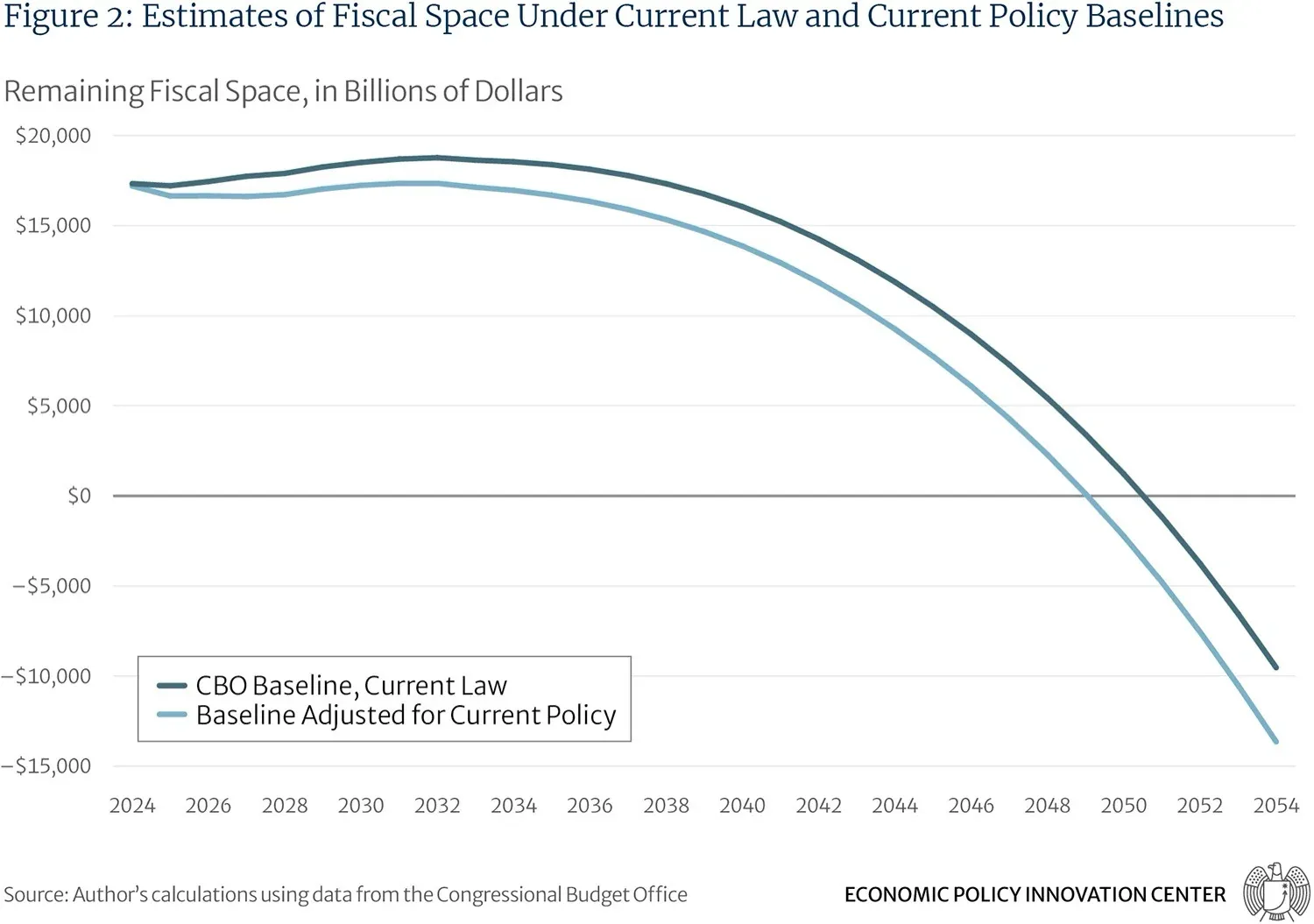
These estimates are sensitive to a number of factors including that CBO is required to project spending and revenues under “current law.” However, current law assumes that many unpopular policies will phase in (e.g., pharmaceutical price controls) and popular policies will phase out (e.g., marginal tax rate cuts). Figure 2 shows the difference between current law (i.e., what would happen if the law were to remain unchanged and program sunsets remain in place) and current policy (i.e., what would happen if fiscal policy remained relatively unchanged compared to the time of publication of this paper).[12] I find that maintaining current policy would erode fiscal space about two years earlier than under current law.
Figure 1 shows the comparison of projected fiscal space in February 2024 relative to this time last year under the CBO long-term baseline. This analysis uses the same method of calculating fiscal space as Winfree (2023) which is based on methods used by Ghosh et al. (2013) and explained in Botev et al. (2016).[11] In the short-term, there is marginally less fiscal space but there is additional fiscal space over the entire period from 2024 to 2053 compared to last year. This is consistent with CBO’s baseline revisions summarized in the last paragraph.
These estimates are sensitive to a number of factors including that CBO is required to project spending and revenues under “current law.” However, current law assumes that many unpopular policies will phase in (e.g., pharmaceutical price controls) and popular policies will phase out (e.g., marginal tax rate cuts). Figure 2 shows the difference between current law (i.e., what would happen if the law were to remain unchanged and program sunsets remain in place) and current policy (i.e., what would happen if fiscal policy remained relatively unchanged compared to the time of publication of this paper).[12] I find that maintaining current policy would erode fiscal space about two years earlier than under current law.
 The estimates are also sensitive to macroeconomic factors that could look very different in the future. These include potential growth, migration, and trade. For example, the CBO baseline assumes that net migration will have a significant impact on the labor force and potential growth over the next several decades. Between 2024 and 2033, CBO now predicts an additional 7.4 million people aged 16 and above in the U.S. population relative to last year.[13] Roughly 80 percent of that increase is because of higher-than-anticipated levels of migration and the remainder is driven by lower mortality estimates because of COVID-19. This amounts to about 5.2 million more people in the labor force by 2033, and significantly higher population growth through the next three decades despite falling fertility rates.[14] Modifying immigration policy to restrict net migration would substantially affect potential growth and reduce projected fiscal space.
The openness of an economy to trade can also increase the amount of available fiscal space. For example, trade openness may lower the levels of required fiscal stimulus to achieve the same economic effects during adverse fiscal events through exchange rate depreciation, which increases export competitiveness.[15] Therefore, trade policies that limit market access would reduce fiscal space directly and indirectly by reducing potential growth.
Both the current law and policy baselines also assume that the U.S. will not experience an adverse fiscal event in the future. These events might include recessions, wars, or pandemics. Figure 3 shows the sensitivity to fiscal space associated with a relatively short-lived adverse event that leads to persistently higher spending in the future.[16] For this analysis, I assume that the event will occur in 2027. Furthermore, I compare two different levels of fiscal response associated with the Great Recession and the COVID- 19 pandemic.
The estimates are also sensitive to macroeconomic factors that could look very different in the future. These include potential growth, migration, and trade. For example, the CBO baseline assumes that net migration will have a significant impact on the labor force and potential growth over the next several decades. Between 2024 and 2033, CBO now predicts an additional 7.4 million people aged 16 and above in the U.S. population relative to last year.[13] Roughly 80 percent of that increase is because of higher-than-anticipated levels of migration and the remainder is driven by lower mortality estimates because of COVID-19. This amounts to about 5.2 million more people in the labor force by 2033, and significantly higher population growth through the next three decades despite falling fertility rates.[14] Modifying immigration policy to restrict net migration would substantially affect potential growth and reduce projected fiscal space.
The openness of an economy to trade can also increase the amount of available fiscal space. For example, trade openness may lower the levels of required fiscal stimulus to achieve the same economic effects during adverse fiscal events through exchange rate depreciation, which increases export competitiveness.[15] Therefore, trade policies that limit market access would reduce fiscal space directly and indirectly by reducing potential growth.
Both the current law and policy baselines also assume that the U.S. will not experience an adverse fiscal event in the future. These events might include recessions, wars, or pandemics. Figure 3 shows the sensitivity to fiscal space associated with a relatively short-lived adverse event that leads to persistently higher spending in the future.[16] For this analysis, I assume that the event will occur in 2027. Furthermore, I compare two different levels of fiscal response associated with the Great Recession and the COVID- 19 pandemic.
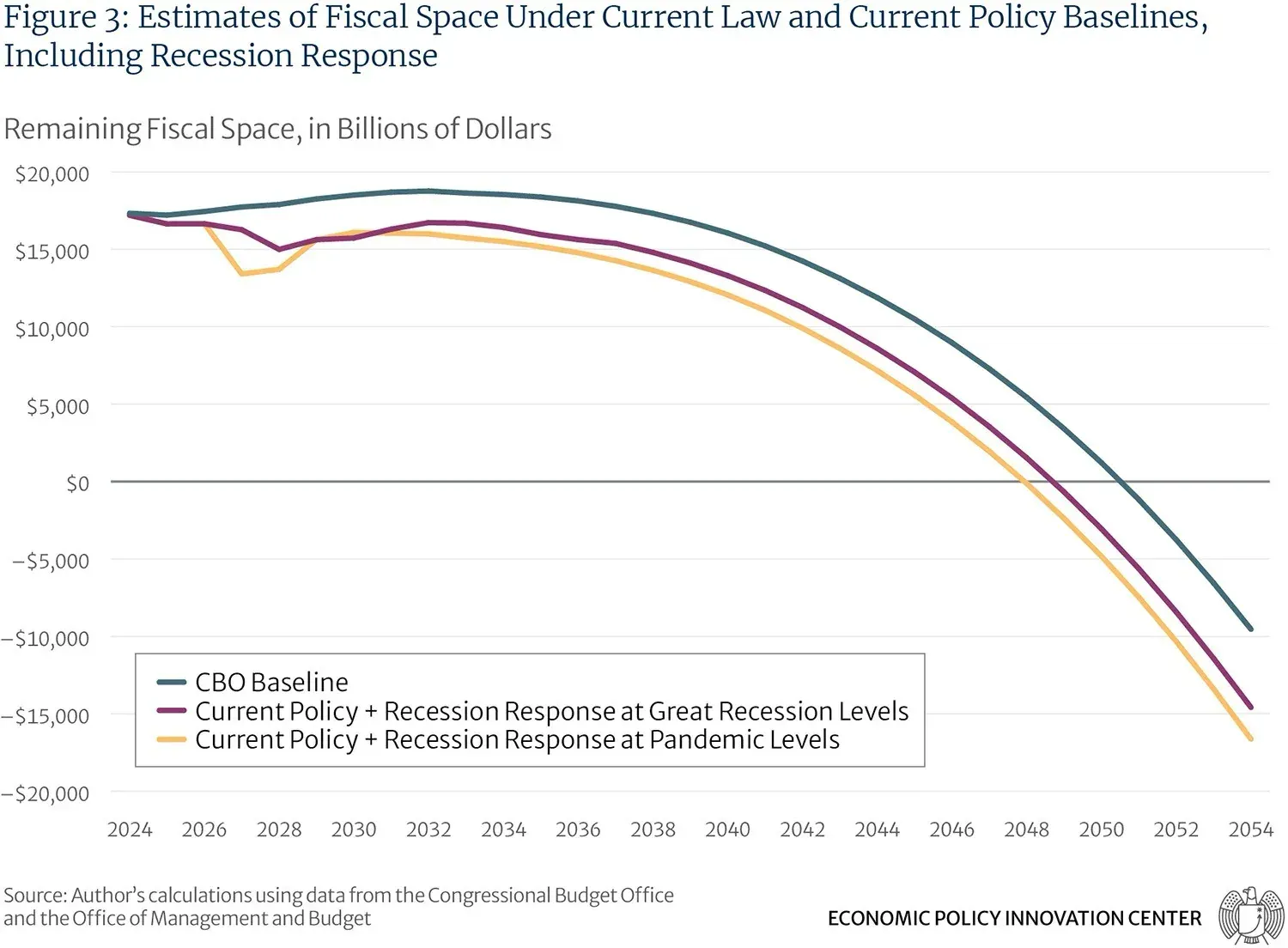 The comparative paths reflected in Figure 3 have several implications. The bright side is that a single, significant adverse event does not fundamentally change the timeline for which the amount of fiscal space will be eroded. That said, with each event, there will be a marginal erosion of additional fiscal space. The problem is that the erosion of fiscal space will soon accelerate to a point where the accumulation of debt will consistently outpace economic growth.
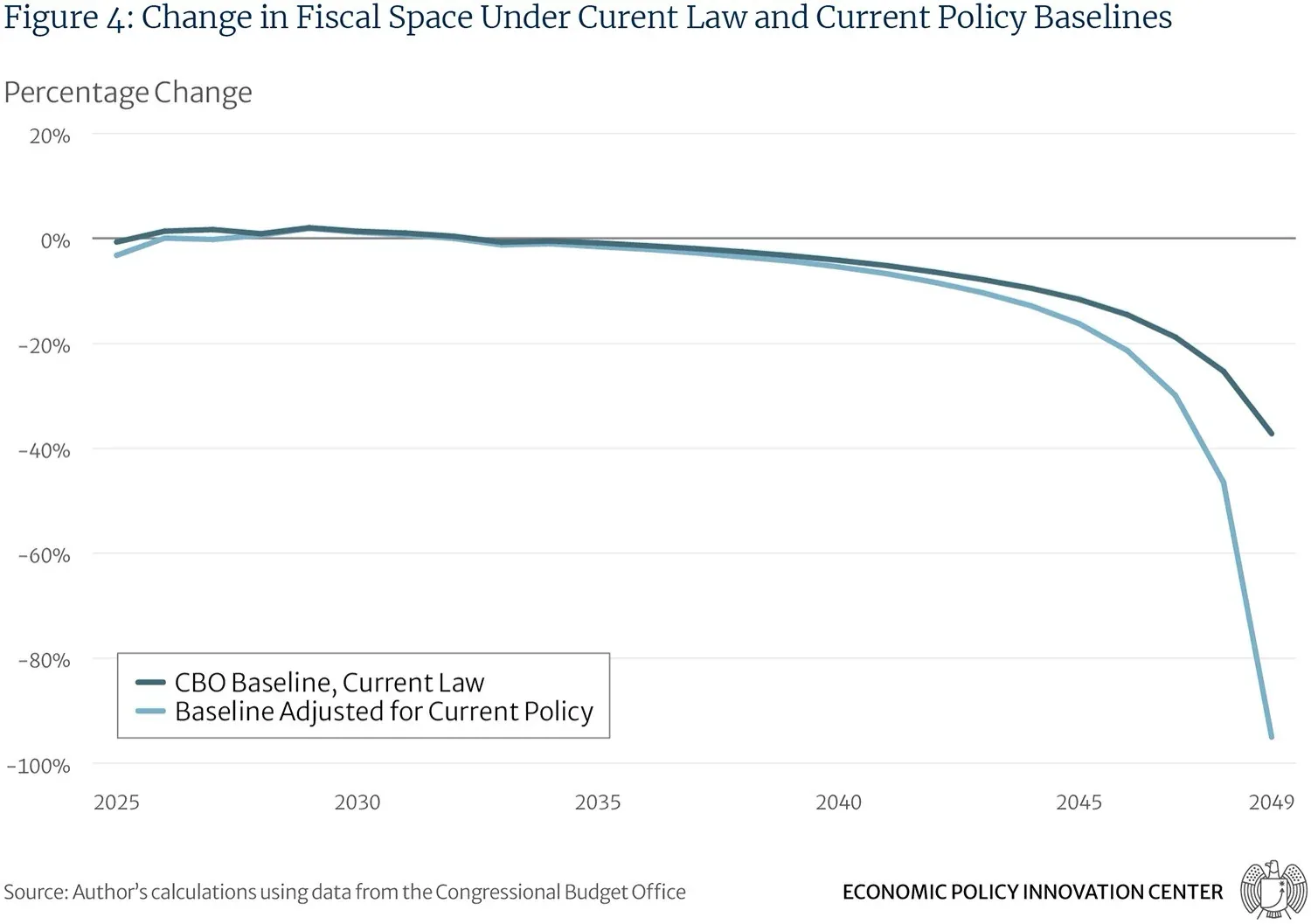 Figure 5 shows the sensitivity of the beginning of the debt spiral to projections of future interest rates. For example, if interest rates were 50 basis points higher relative to CBO’s current law baseline, the debt spiral would begin in 2030. However, if interest rates were much higher (e.g., this figure shows projected fiscal space when interest rates are 150 or 200 basis points higher), the debt spiral would begin almost immediately.
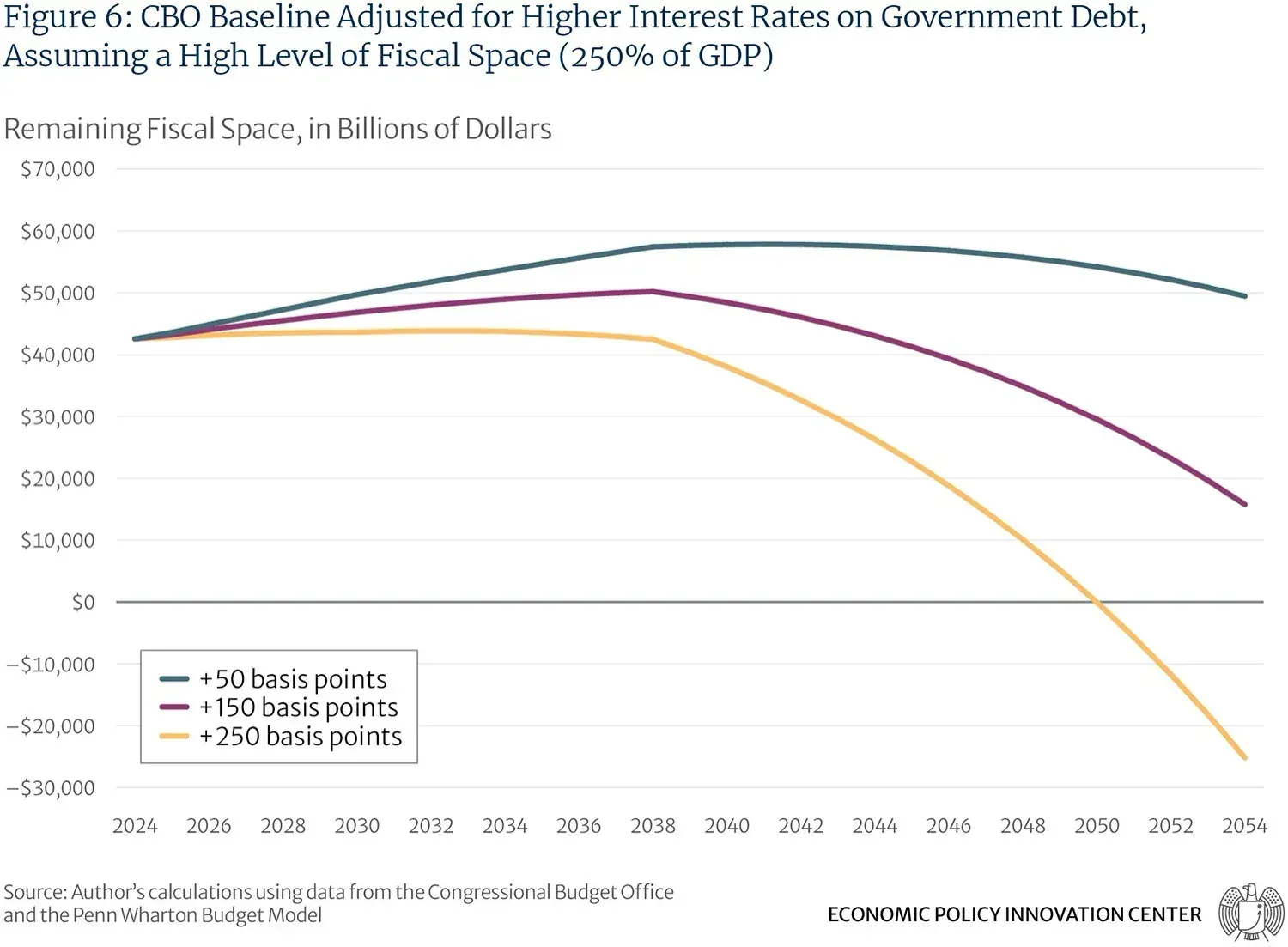
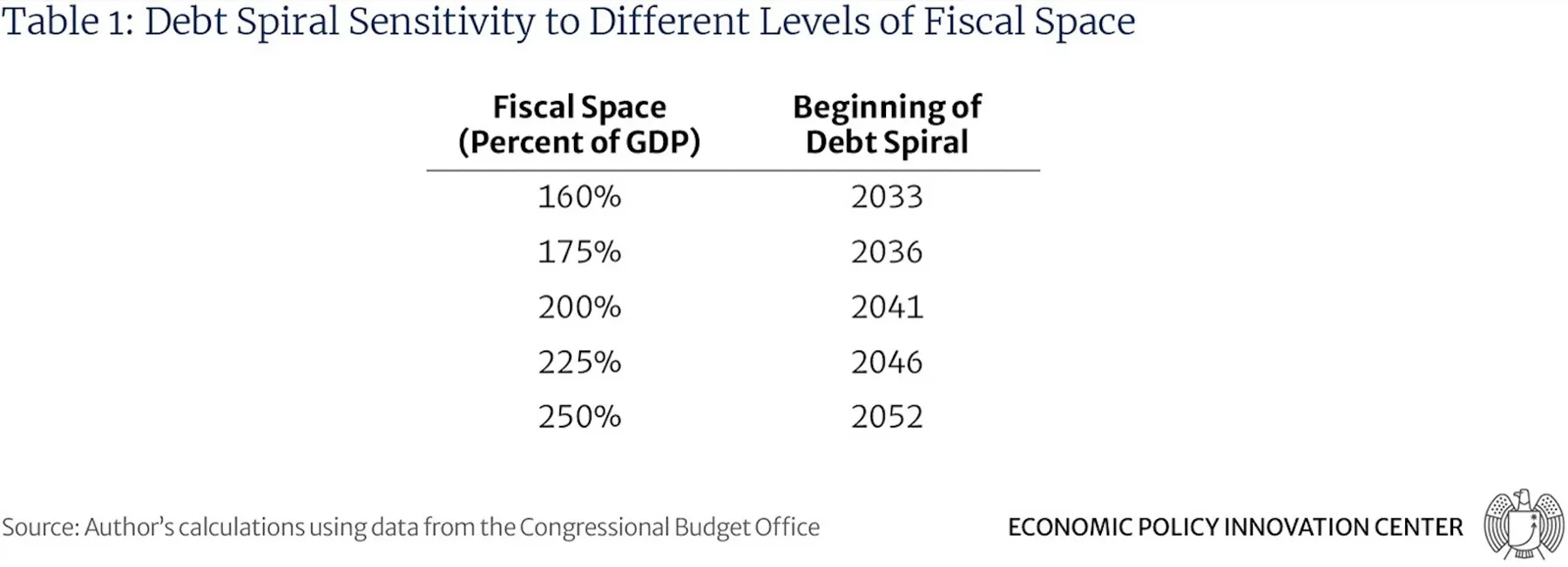
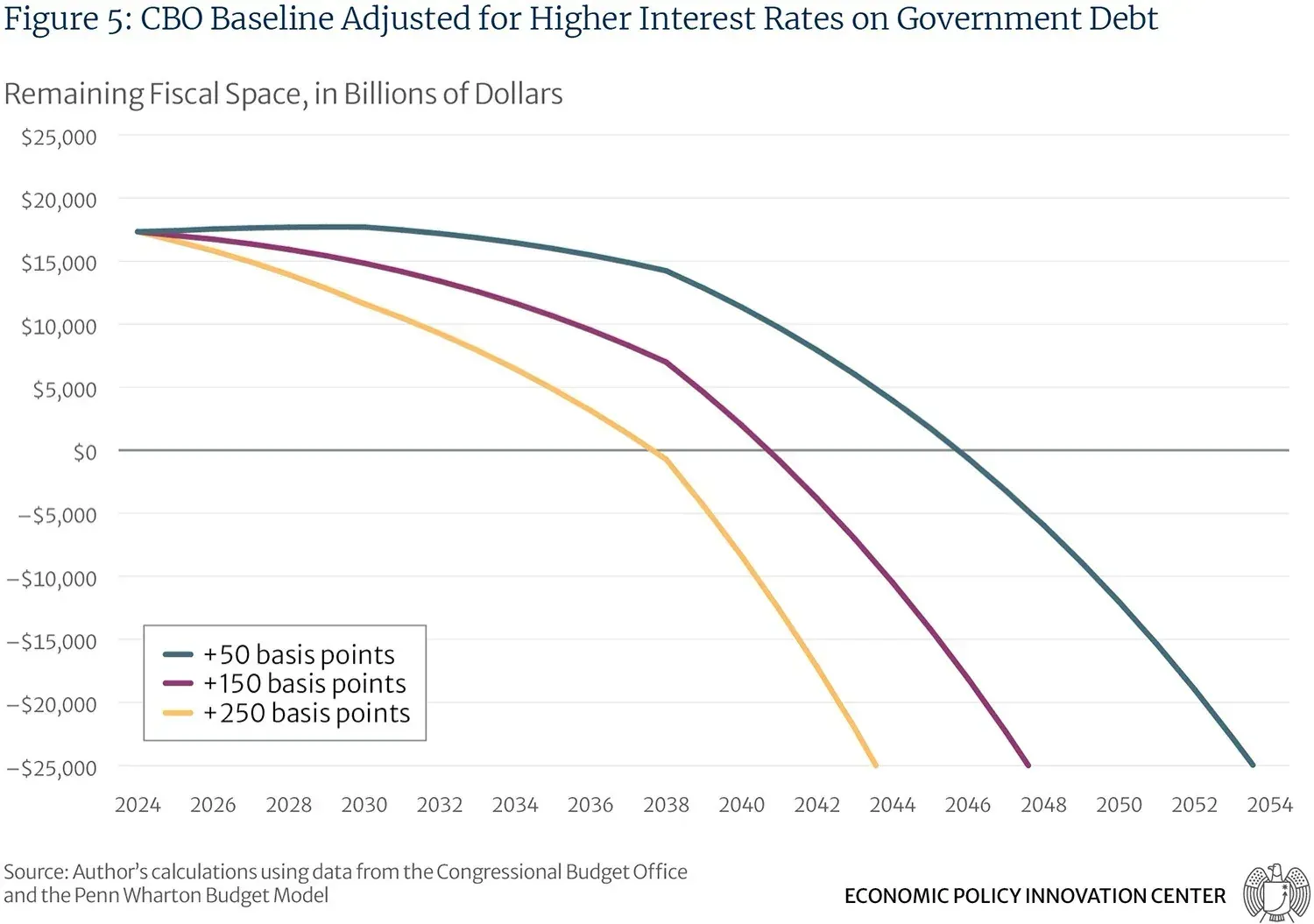 Figure 6 shows an alternative scenario where there is a significant amount of fiscal space (i.e., 250 percent of GDP). Under this scenario, an increase in interest rates relative to the baseline assumptions would still trigger a debt spiral by the late 2030s. Table 1 shows the projected years for when the debt spiral would begin under historically low interest rates. Even under a scenario with historically low interest rates and high fiscal space, there will be a debt spiral within the next 30 years.
 The estimates of fiscal space erosion are sensitive to several factors. As this paper has noted, the two most important variables influencing fiscal space are potential growth and interest rates. Under CBO’s long-term baseline, real GDP growth averages 2 percent over the next 10 years but then decreases to 1.6 percent by the end of the 30 years.[17] Instead, if real GDP growth averaged 2.4 percent over the next 30 years, economic growth would make up for enough of the erosion so as not to trigger a debt spiral over the same period. This also implies that the economy would be about 10 percent larger over the next 30 years compared to projections.