Introduction
Federal funding for the interstate highway system revved up with the Federal-Aid Highway Act of 1956.
[1] This law created the Highway Trust Fund (HTF) and linked it to the federal gas tax. Initial construction across the 48 continental states lasted through 1992, and the federal gas tax has been flat since 1993.
What could have been a straightforward policy success has instead become a cautionary tale of special interest handouts and irresponsible spending – a problem that is now endemic throughout the federal government.
Congress has created an assortment of programs to be financed by the HTF that were either tenuously connected or entirely unconnected to highways and has increased subsidies for state and local government responsibilities. Although President Eisenhower criticized this “damaging precedent” as it emerged,
[2] it quickly became the standard operating procedure for Highway Bills.
Non-highway programs, most of which fund the desires of urban area governments, were not coupled with taxes on users of non-highway infrastructure projects. This meant that drivers were subsidizing non-drivers and that gas tax revenue was supporting an inflated amount of spending.
Eventually, gas tax revenue was unable to keep up with rising spending demands. Congress has enacted $271 billion in deficit-financed general fund transfers since 2008 to maintain HTF spending.
[3]
According to the Congressional Budget Office (CBO), at current spending levels the HTF will exhaust its remaining balance by fiscal year (FY) 2028 and require an additional $295 billion in bailouts through FY 2036.
[4] In the context of the federal government’s dire budget outlook,
[5] endless HTF bailouts are unsustainable, as are broader attempts to increase the federal share of state and local spending.
Highway Programs & Diversions
At its core, the HTF exists to ensure the functionality of America’s highways. This includes activities such as maintaining road surface quality, addressing the structural integrity of bridges, ensuring sufficient throughput capacity, improving safety performance, and administering the network.
While the interstate highway system is national in scope, many HTF programs focus on projects of merely local or regional concern. Examples of this include mass transit, the Ferry Boat Program, the Metropolitan Planning Program, grants for Native American tribes, and the Transportation Alternatives Program.
In addition to dedicated HTF programs for diversions outside the interstate system, there has been an expansion of questionable projects eligible for financing by core highway-focused programs. “Highway” funding for local road projects such as sidewalk improvements is inappropriate. Federal funding of local responsibilities would be problematic under normal circumstances and is highly inappropriate in a time of high and rising federal deficits and a crumbling HTF.
The 2021 Infrastructure Investment and Jobs Act (IIJA) added another dimension to HTF spending diversions: left-wing ideological projects. The so-called “Green New Deal” movement was the impetus behind billions in spending, and programs premised on identity politics also received a funding share.
Out of $74.6 billion
[6] in HTF obligations
[7] during FY 2024,
[8] roughly $22.4 billion went towards diversions outside the interstate highway system.
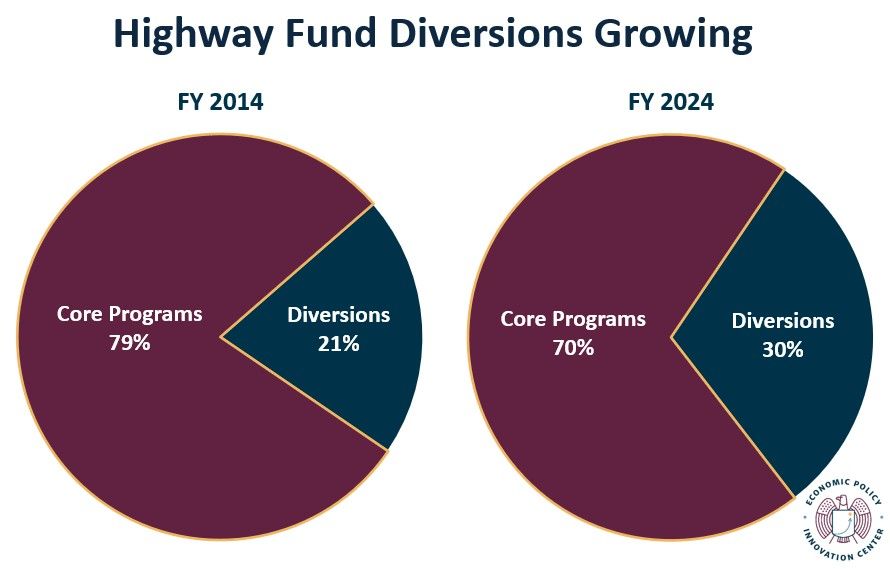
[9] That means 30.1 percent of HTF spending was diverted to programs and projects that should not be part of the fund.
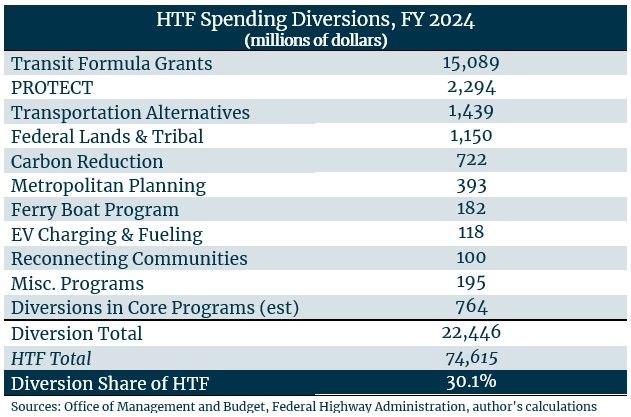
Diversionary HTF spending has increased rapidly in both absolute and relative terms. In FY 2014, diversions consumed roughly $10.4 billion, or 20.9 percent of the HTF.
[10]
Mass Transit Account
The Surface Transportation Assistance Act of 1982 divided the HTF into the Highway Account and the Mass Transit Account. The Mass Transit Account funds several programs, the largest of which is the Urbanized Area Formula Grants (UAF) program.
[11] Most UAF funding is provided directly to transit agencies or city governments, though states oversee funds for urban areas with less than 200,000 people. State of Good Repair grants, the next largest program, function similarly.
[12] Both programs focus on capital costs such as heavy maintenance and construction, while transit agencies are generally responsible for operational costs.
Federal funding for mass transit became a Highway Bill spotlight issue in 1982, when a group of urban Democrats demanded that Congress dedicate a share of revenue from a gas tax hike to transit.
[13]
The insertion of transit into the HTF broke a foundational principle from 1956. Since the fund primarily benefitted drivers by expanding and improving highways and bridges, it was funded by a gas tax paid by drivers. However, transit users do not pay into the HTF, meaning that since 1982 drivers have subsidized transit users.
Transit funding in the HTF came during a period when transit was rapidly losing its share of commuting trips, dropping from 12.6 percent in 1960 to 6.2 percent in 1980. Transit’s commuting share stabilized around 5 percent through the 2010s before dropping again during the COVID-19 pandemic.
[14]
As of 2024, transit’s share of commuting only recovered to 3.7 percent, much smaller than its 20 percent share of HTF spending.
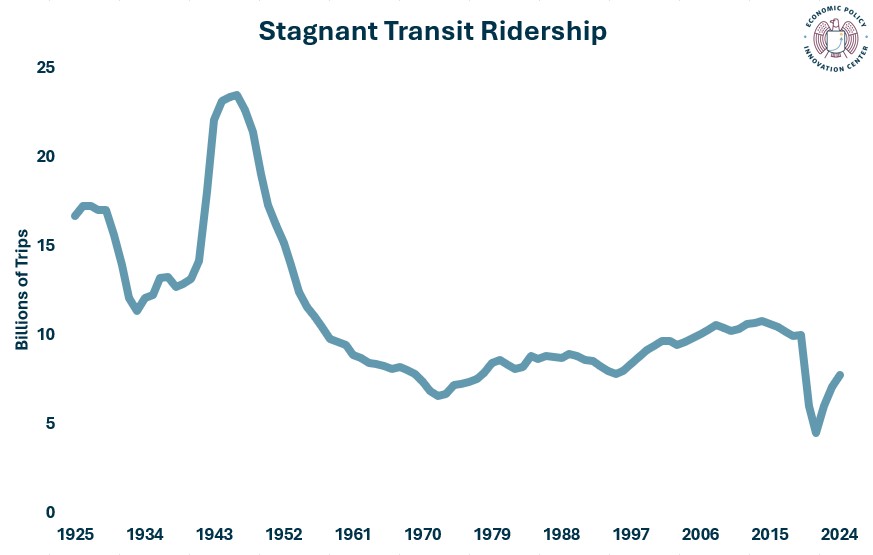
[15] Total transit ridership peaked in 1946 and is now roughly one-third of that level despite population growth of more than 140 percent over the last 80 years and the introduction of federal subsidies.
[16]
Policymakers should understand that in most of the country public transit functions as a highly inefficient jobs program rather than a valuable public utility. The bulk of transit system operational spending goes towards labor costs. Compensation costs per employee are now well over $100,000 per year at most major transit agencies.
[17] For San Francisco’s system, the FY 2026 budget has $763 million in compensation costs for 3,760 operating employees, or $203,005 per employee.
[18]
An obscure 1964 federal law makes it difficult for transit agencies to reform labor costs,
[19] and heavy federal subsidization of transit capital projects encourages questionable system expansions that require additional workers to operate. Thus, while the federal government does not generally subsidize transit labor costs directly, it does contribute to the problem of transit labor cost inflation.
Transit’s share of HTF spending is heavily influenced by the New York City metropolitan area, which has the nation’s highest density urban core and per capita transit ridership by a significant margin.
[20] Mass transit’s share of the HTF is excessive relative to national ridership and is highly disproportionate for the roughly 94 percent of Americans who live outside the New York City metro area.
Providing greater flexibility in the share of HTF spending that can only be used for transit would be a reasonable compromise, allowing low-transit states to better focus taxpayer resources on what works for them.
Green New Waste
The IIJA created programs that were part of the broader left-wing “Green New Deal” policy initiative. Some programs, focused on energy production or environmental concerns such as drinking water, are wholly unrelated to transportation and thus should not be part of a Highway Bill. However, other new programs are funded by the HTF or are part of the Department of Transportation (USDOT), meaning they could be included.
The IIJA created environmentally oriented programs within the HTF, notably the Promoting Resilient Operations for Transformative, Efficient, and Cost-Saving Transportation (PROTECT) program, the Carbon Reduction Program (CRP), and the Charging and Fueling Infrastructure (CFI) program. Along with programs relating to wildlife and ports, these programs consumed $3.3 billion of the HTF in FY 2024.
[21]
The CFI program is a rare example of federal government mismanagement leading to less spending rather than more. The IIJA authorized a combined $700 million for CFI in FYs 2022 and 2023, but USDOT obligated only $1 million over that period. This increased to $118 million in FY 2024 out of an authorized $500 million. Of approved projects, many were prone to ideological bias such as fixating on racial demographics.
[22]
The CRP is both duplicative of earlier HTF programs and has a track record of funding boondoggles. For example, a $961,000 grant to San Bernardino County in California produced a barely distinguishable difference in a small section of sidewalk, some of which was undone shortly thereafter.
[23]
The PROTECT program leverages concerns about “climate change” to fund projects related to natural disaster and inclement weather risks. However, mitigating such risks was already a longstanding aspect of infrastructure development and thus does not justify spending increases. Claims that there has been a recent trend of more and stronger hurricanes making landfall are heavily flawed.
[24] “Resilience” initiatives such as PROTECT are ultimately an attempt to justify additional federal funding for state and local governments.
Congress would be justified in eliminating these IIJA-created programs, and authorizing committees should be aware that even a single reauthorization could lead to programs being considered a permanent part of future Highway Bills, resulting in tens of billions of dollars in waste down the road.
Other HTF Diversions
The Transportation Alternatives (TA) program is a carve-out from the larger Surface Transportation Block Grant (STBG) program focused on projects of local concern.
[25] These include sidewalks, bike lanes, trails, historic preservation, and scenic overlooks. TA represents a confluence of policy flaws: federal funding of local responsibilities, turning the HTF into an unfocused slush fund, and forcing states to use HTF funds on lower-value infrastructure.
Unfortunately, the dilution of the HTF’s Highway Account is not limited to the TA program. Even the National Highway Performance Program (NHPP) and the STBG, the largest sources of funding for the interstate system, regularly fund projects unrelated to highways. In addition to bicycle and pedestrian infrastructure, NHPP and STBG funds can be used for beautification, historic building preservation, archaeological planning and research, and mass transit.
Advocates for transit funding encourage states to “flex” Highway Account program funds to transit.
[26] This is possible either directly through broad project eligibility rules in programs, or indirectly by flexing funds between highway programs with transit as the final destination.
[27] From FY 2021 through FY 2023, states transferred more than $5 billion in Highway Account funds to transit.
[28] In November 2024, Pennsylvania Governor Josh Shapiro “flexed” $153 million of funds from future highway projects to bail out the Philadelphia region’s transit agency.
[29]
Legislators should note that while there are many ways for Highway Account funds to leak away from roads and bridges, states have little ability to reallocate transit funds towards highways. This imbalance is especially striking given that the Transit Account already receives excessive funding relative to transit’s share of transportation usage.
The IIJA also created the Reconnecting Communities program, which is premised on addressing racial grievances from generations ago by destroying highway infrastructure and pulls funding from the Highway Account.
[30]
Rising Pressure for Transportation Tax Hikes
The HTF faces a $340 billion deficit over the next decade due to overspending.
[31] While Congress has bailed out the HTF several times, this is becoming increasingly unsustainable due to the deterioration of the federal government’s finances.
[32]
Some transportation organizations and policy groups have either directly called for a federal vehicle miles traveled tax (VMT) or have signaled indirect support by referencing the need for a new HTF revenue source. A VMT would either be used to replace the federal gas tax or be layered on top of it. In either scenario, VMT backers consistently state that the goal is increasing revenue to maintain HTF spending.
This line of thought has several flaws:
- It ignores that the largest factor in HTF deficits is the steady growth of spending, including for diversionary programs. Increasing HTF revenue would primarily serve to protect low-value diversions rather than highways.
- It fails to consider the many ways in which the federal government could abuse a VMT. The Obama and Biden Administrations embraced local governments that imposed anti-driving “road diets” on citizens,[33] and a VMT could enable the federal government to use variable rates on the times and locations of driving trips to micromanage driving nationwide.
- It assumes that the federal government must maintain a significant role in financing transportation infrastructure. In fact, reducing the federal role would lead to many efficiencies.[34]
There is not a current push in Congress to enact a VMT. However, if the next Highway Bill maintains elevated spending levels, calls for a federal VMT will likely rise to a fever pitch in the next few years. Legislators who oppose the concept should recognize that getting spending under control is the best way to stop it.
This does not mean that legislators should ignore the question of how to finance the interstate highway system. For example, Congress could consider enacting an annual fee on electric vehicles (which do not currently pay into the HTF) or increase the ability of state governments to self-fund highway projects.
[35]
Opportunities for a Stronger Highway Bill
To set the Highway Bill on the right path, Congress should:
- Reduce overall spending to be more in line with HTF revenue while enacting reforms below to increase the per-dollar value for states.
- Eliminate programs created by the IIJA that are wasteful and inappropriate.
- Provide more flexibility for states regarding how much they must spend on carve-out programs by increasing transferability within the Highway Account.
- Streamline the variety of projects eligible for HTF funding. While flexibility is ideal, there must be reasonable guardrails on what the federal government funds.
- Reduce the share of HTF funding delivered through “discretionary” grant programs and focus on formula-based funding. Grant programs require additional bureaucratic expense at all levels of government.
- Increase regulatory flexibility, especially relating to labor policy mandates. Current infrastructure labor rules act as a de facto ban on non-unionized construction contractors, reducing competitiveness in right-to-work states.
- Provide more flexibility regarding the share of HTF funding that must go towards transit. This would involve giving state governments control over a larger share of Transit Account funding and allowing a portion of funds to be flexed into Highway Account programs. Such changes could be linked to formulas based on factors such as long-term transit ridership levels to better rationalize transit funding. Congress can consider pairing this with greater flexibility in how transit agencies use transit formula funding, with the Transit Funding Flexibility Act (H.R. 5024) providing an example.
Finally, Congress should consider the use of budget reconciliation for enacting the funding portions of the Highway Bill. This would require changing the budgetary treatment of the HTF and delinking the HTF from the appropriations process.
Pursuing a Highway Bill through reconciliation would be a departure from the status quo. However, such a change would not be arbitrary. Instead, it would be a response to decades of left-wing legislators and interest groups abusing the “must-pass” nature of the Highway Bill to milk taxpayers (especially drivers), along with ongoing maximalist demands regarding the level of funding for wasteful diversionary programs.
Last year, Congress recognized that long overdue reforms to fight fraud and abuse in welfare programs could only occur through reconciliation.
[36] While it would be better to enact Highway Bill reforms on a bipartisan basis, the ideal of bipartisanship should not be used as a shield for endless waste. The American economy is suffering the consequences of unsustainable deficit spending.
A new Highway Bill can address flaws in the trust fund while delivering vital deficit reduction. Diverting 30 percent of the highway fund to wasteful and inappropriate uses is astonishingly dysfunctional, and tens of billions per year is substantial even by the standards of the federal budget.
It is time for leaders to fight back against highway robbery.
[1] Public Law 84-627.
[2] “Statement by the President,” The White House, April 16, 1958,
https://www.eisenhowerlibrary.gov/sites/default/files/research/online-documents/interstate-highway-system/1958-04-16-statement.pdf (accessed April TK, 2026).
[3] Ali Lohman, “The Highway Trust Fund’s Highway Account,” Congressional Research Service, June 3, 2025,
https://www.congress.gov/crs-product/R48472 (accessed April TK, 2026).
[4] Congressional Budget Office, “Highway Trust Fund Accounts,” February 2026,
https://www.cbo.gov/system/files/2026-02/51300-2026-02-highwaytrustfund.pdf (accessed April TK, 2026).
[5] Matthew Dickerson, “CBO Baseline for FY 2026 Projects Rising Spending, Higher Revenues, and Growing Debt,” Economic Policy Innovation Center, February 11, 2026,
../../federal-budget/cbo-baseline-for-fy-2026-projects-rising-spending-higher-revenues-and-growing-debt/.
[6] Office of Management and Budget, “Technical Supplement to the 2026 Budget: Appendix,”
https://www.govinfo.gov/content/pkg/BUDGET-2026-APP/pdf/BUDGET-2026-APP.pdf (accessed April TK, 2026).
[7] An obligation of contract authority is distinct from budget authority or outlays. See Robert Kirk, “Federal Highway Programs: In Brief,” Congressional Research Service, February 7, 2022,
https://www.congress.gov/crs-product/R47022 (accessed April TK, 2026).
[8] FY 2024 is the most recent year with program-level spending data for the Highway Trust Fund.
[9] While the availability of data on large projects does provide some guidance to the public, it is next to impossible to determine the exact volume improper spending in the HTF, especially with billions of dollars per year spent on FHWA’s nebulous “other” project category. See Federal Highway Administration, “Highway Trust Fund Transparency and Accountability Reports,”
https://www.fhwa.dot.gov/transparencyact/Highway_trust_Fund_transparency_and_Accountability_Reports.htm (accessed April TK, 2026).
[10] Office of Management and Budget, “Technical Supplement to the 20166 Budget: Appendix,”
https://www.govinfo.gov/content/pkg/BUDGET-2016-APP/pdf/BUDGET-2016-APP.pdf; Federal Highway Administration, “FHWA FY 2015 Budget,”
https://www.transportation.gov/sites/dot.gov/files/docs/FHWA-FY2015-Budget-Estimates.pdf (accessed April TK, 2026).
[11] Federal Transit Administration, “Urbanized Area Formula Grants,”
https://www.transit.dot.gov/funding/grants/urbanized-area-formula-grants-5307 (accessed April TK, 2026).
[12] Federal Transit Administration, “State of Good Repair Grants,”
https://www.transit.dot.gov/funding/grants/state-good-repair-grants-5337 (accessed April TK, 2026).
[13] Jeff Davis, “Reagan Devolution: The Real Story of the 1982 Gas Tax Increase,” Eno Center for Transportation, May 27, 2015,
https://www.enotrans.org/etl-material/reagan-devolution-the-real-story-of-the-1982-gas-tax-increase-2 (accessed April TK, 2026).
[14] American Public Transportation Association, “2026 Public Transportation Fact Book: Appendix A,” April 2026, https://www.apta.com/news-research/about-the-industry/public-transportation-fact-book/ (accessed April TK, 2026).
[15] Bureau of Transportation Statistics, “Commute Mode,”
https://www.bts.gov/browse-statistical-products-and-data/state-transportation-statistics/commute-mode (accessed April TK, 2026).
[16] 2026 Public Transportation Fact Book: Appendix A.
[17] David Ditch, “Public Transit: Bloated Compensation Highlights Excessive Subsidization,” Heritage Foundation, July 22, 2021,
https://www.heritage.org/transportation/report/public-transit-bloated-compensation-highlights-excessive-subsidization (accessed April TK, 2026).
[18] San Francisco Bay Area Rapid Transit District, “FY26 Adopted Operating and Capital Budget,” August 2025,
https://www.bart.gov/sites/default/files/2025-09/FY26%20Adopted%20Budget%20Memo_FINAL_1.pdf (accessed April TK, 2026).
[19] Marc Joffe, “Federal Department of Labor Halts California Transit Grants Over Public Pension Dispute,” Reason Foundation, November 29, 2021,
https://reason.org/commentary/federal-department-of-labor-halts-california-transit-grants-over-public-pension-dispute/ (accessed April TK, 2026).
[20] “2025 Public Transportation Fact Book.”
[21] “Technical Supplement to the 2026 Budget: Appendix.”
[22] Sarah Wagoner, “IIJA Funds Wasteful Community Charging Infrastructure,” Economic Policy Innovation Center, February 18, 2026,
../../federal-budget/iija-funds-wasteful-community-charging-infrastructure/.
[23] Gadai Bulgac, “The Million-Dollar Sidewalk Slab and Other Carbon Reduction Boondoggles,” Economic Policy Innovation Center, February 3, 2026,
../../federal-budget/the-million-dollar-sidewalk-slab/.
[24] Joe D’Aleo and Kevin Dayaratna, “Keeping an Eye on the Storms: An Analysis of Trends in Hurricanes Over Time,” Heritage Foundation, December 2, 2024,
https://www.heritage.org/energy/report/keeping-eye-the-storms-analysis-trends-hurricanes-over-time (accessed April TK, 2026).
[25] Federal Highway Administration, “Transportation Alternatives,”
https://www.fhwa.dot.gov/environment/transportation_alternatives/ (accessed April TK, 2026).
[26] TransitCenter, “Want to Use Highway Dollars for Transit? These Places Already Do,” November 29, 2022,
https://transitcenter.org/want-to-use-highway-dollars-for-transit-these-places-already-do/ (accessed April TK, 2026).
[27] Ryan Levandowski, “Flexible Federal Funding Opportunities for State and Local Clean Transportation Investments,” Georgetown Climate Center, February 23, 2023,
https://www.georgetownclimate.org/blog/federal-transportation-funding-flexibility.html (accessed April TK, 2026).
[28] Kira McDonald and Emmett Hopkins, “How are Transportation Dollars Flowing in Your State?,” Climate and Community Institute,
https://sociospatialclimate.shinyapps.io/fhap-flexes/ (accessed April TK, 2026).
[29] John Cole, “Shapiro Directs $153m in Federal Highway Funds to Stop SEPTA ‘Death Spiral’,” Pennsylvania Capital-Star, November 22, 2024,
https://penncapital-star.com/transportation-infrastructure/shapiro-directs-153m-in-federal-highway-funds-to-stop-septa-death-spiral (accessed April TK, 2026).
[30] Gadai Bulgac, “Racist Roads,” Economic Policy Innovation Center, February 19, 2026,
../../federal-budget/infrastructure-grants-to-ideological-nonprofits/.
[31] David Ditch, “Highway Bill Reauthorization,” Economic Policy Innovation Center, January 27, 2026,
../../federal-budget/highway-bill-reauthorization/.
[32] Paul Winfree, “The Fiscal Red Line: How Close is the U.S. to Its Borrowing Limit?,” Economic Policy Innovation Center, January 17, 2025, ../../federal-budget/the-fiscal-red-line-how-close-is-the-u-s-to-its-borrowing-limit/.
[33] David Ditch, “Road to Nowhere: How Biden and Congress Detour Highway Funds,” Heritage Foundation, April 5, 2022,
https://www.heritage.org/transportation/report/road-nowhere-how-biden-and-congress-detour-highway-funds (accessed April TK, 2026).
[34] David Ditch and Nicolas Loris, “Improving Surface Transportation Through Federalism,” Heritage Foundation, November 12, 2019,
https://www.heritage.org/transportation/report/improving-surface-transportation-through-federalism (accessed April TK, 2026).
[35] “Highway Bill Reauthorization.”
[36] David Ditch, “Comparing Historic Welfare Reforms: 1996 and 2025,” Economic Policy Innovation Center, July 10, 2025,
../../social-programs/comparing-historic-welfare-reforms-1996-and-2025/.