Introduction
Most federal programs related to surface transportation are bundled into a package commonly referred to as the Highway Bill. The most recent iteration of the Highway Bill, 2021’s Infrastructure Investment and Jobs Act (IIJA),
[1] is set to expire on September 30, 2026. Authorizing committees in both the House and Senate are working on legislation to extend the Highway Bill programs, though it is unclear when they will move forward on bill markups and votes.
The IIJA was a $1.2 trillion package that combined traditional surface transportation programs with left-leaning priorities such as electric vehicle (EV) infrastructure and “equity”-obsessed social engineering.
[2] The bill’s sponsors referred to the dramatic spending increase as a “once-in-a-generation investment,” signaling that spending in subsequent years would not continue at the elevated levels.
[3]
Unfortunately, the budgetary baseline that Congress uses to inform its decisions is biased in favor of ever-higher spending.
[4] In the case of the IIJA, even though its spending is set to expire at the end of fiscal year (FY) 2026, the Congressional Budget Office (CBO) assumes that IIJA spending levels will continue in FY 2027 and beyond. As a result, a new Highway Bill that retains the overall spending of the IIJA might be touted as “budget neutral” even if it results in hundreds of billions of dollars in deficit spending.
Legislators face tremendous pressure to keep the gravy train rolling. Groups such as state and local governments, construction contractors, and unions representing government transportation workers all lobby for maximal Highway Bill spending. The American public is also broadly supportive of spending on infrastructure, especially for roads and bridges.
However, this does not absolve Congress of its duty to act responsibly. Representatives should be cautious about spending and cognizant of longstanding Highway Bill flaws that the IIJA exacerbated. This report provides three principles for decision making that can guide Congress to policy solutions and result in a Highway Bill that delivers for Americans of today and tomorrow alike.
Highway Bill Principle 1: Spend what is needed for national priorities, not what is requested by “stakeholders”
The Highway Trust Fund (HTF) was created by the Federal Aid Highway Act of 1956, which levied a nationwide tax on gasoline to fuel the fund.
[5] Although the interstate highway system was completed in 1992, spending from the HTF was not reduced, especially as Congress added new non-highway programs. Congress did stop hiking the federal gas tax in 1993, but it has steadily increased HTF spending, leading to a series of deficit-funded bailouts.
[6] While the IIJA created new temporary programs funded outside the HTF, the HTF remains the centerpiece of the Highway Bill.
A substantial portion of HTF spending is of local rather than national concern.
The largest non-interstate aspect of the HTF is the Transit Account, which funds mass transit systems in urban areas based on population. Despite public transit providing only a small portion of surface transportation usage (e.g. 3.5 percent of commuter trips),
[7] and despite transit ridership having been stagnant for the last three decades,
[8] the Transit Account has an outsized share of HTF spending, typically between 18% and 20% under current law.
[9] Further, transit agencies and riders do not pay into the HTF, meaning that drivers have cross-subsidized transit users for decades.
The HTF’s Highway Account also suffers from diversions into non-interstate projects. These ought to be the responsibility of state and local governments, yet there is a growing and unsustainable trend of Washington picking up the tab.
[10]
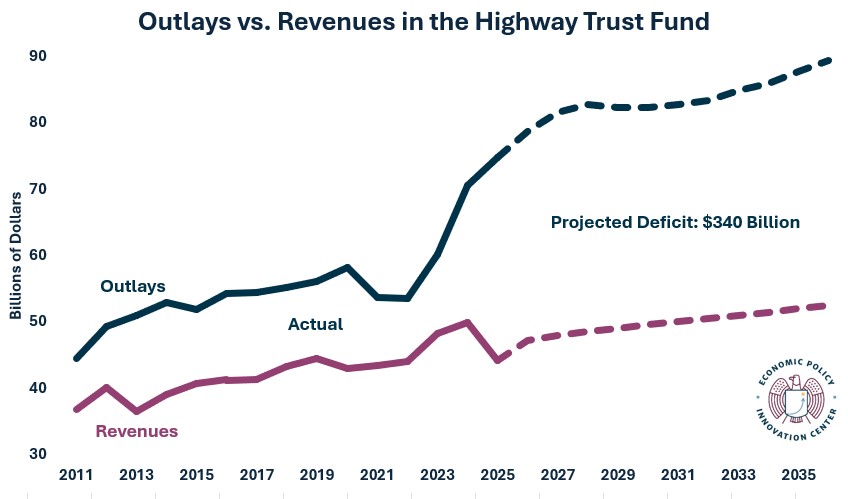
The CBO estimates that the gap between the HTF’s spending and receipts will be $340 billion from FY 2026 through FY 2035, exhausting available funds in FY 2028 and requiring $295 billion in general fund transfers to maintain current spending levels over the period. A five-year extension of IIJA spending through FY 2031 would require a $121 billion general fund bailout.
[11]
With the federal government speeding towards a debt crisis,
[12] Congress must prioritize Highway Bill spending on the interstate highway system. Lobbyists who demand more spending for their preferred niche of the Highway Bill should not be given priority over true national priorities and the nation’s economic health.
Highway Bill Principle 2: Stop Funding Wasteful Boondoggles
The amount of value generated by infrastructure is based on how much it is used rather than how much it costs to build and operate. A positive example is the interstate highway system, which facilitates trillions of dollars in economic activity by allowing the rapid movement of people and goods, far exceeding its costs.
In contrast, the nation is littered with federally subsidized boondoggles that were sold as promoting economic development but marred by delays, cost overruns, and disappointing ridership. California’s High Speed Rail project has infamously cost tens of billions of dollars since its approval in 2008 yet is still years away from service.
Similarly, transit agencies count on federal funds from the Highway Bill to bankroll questionable expansion projects. Maryland’s Purple Line transit rail project is 6 years behind schedule and $3 billion over budget, while Honolulu’s transit rail project is 11 years behind schedule and approaching a $5 billion budget overhang.
[13] With transit ridership down in absolute terms over the last decade despite expansions in many metro areas, such projects should be understood as a jobs program and political patronage rather than a valuable public service.
The IIJA created dozens of programs based on the “Green New Deal” agenda that subsidize electric vehicle (EV) manufacturing and charging stations, electric buses, hydrogen energy, “direct air capture,” and more. Sub-programs such as Communities Taking Charge Accelerator allowed cities and universities to partner with activist groups such as GreenLatinos and People for Mobility Justice.
[14] Green New Deal programs cost tens of billions of dollars without providing measurable environmental benefits.
[15]
The IIJA also used buzzwords such as “environmental justice” (a concept combining elements of Critical Race Theory and environmentalism) and “equity,” which provided the Biden Administration with an opening to generate a thicket of ideological regulatory mandates on infrastructure projects.
[16]
When the cost of a government-funded infrastructure project exceeds the economic value generated by the service it provides, the project is economically destructive. Inputs such as labor, materials, and especially capital would have gone to better use if left in the private economy. Individuals and businesses are careful to seek investments with a strong likelihood of success because they are using their own money, while legislators are often more interested in the political value of ribbon-cutting ceremonies because they are using other people’s money.
Highway Bill Principle 3: States should have flexibility on spending, revenue, and regulations
“Free” federal funds for state government infrastructure projects come with a cost.
- Washington requires spending on a variety of marginal programs, regardless of what is needed or practical for a state. These include the Congestion Mitigation and Air Quality (CMAQ) and Transportation Alternatives programs, which fund local projects ranging from streetcars to bike lanes to hiking trails. Federal funding distorts decision making by local officials, who might think twice if they had to cover a project’s full cost from their own budgets. These programs also distort the HTF because users of local projects do not pay into the fund.
- Washington hampers the ability of states to utilize funding sources for infrastructure projects, in particular direct user fees such as tolls.[17] Limits on the amount of Private Activity Bonds (PABs) hamper another financing method.
- Washington has added regulatory requirements to federally funded projects that increase the cost of labor, materials, and bureaucracy.[18]
Although Congress has added modest tweaks such as allowing states to transfer a portion of spending between highway programs and some exceptions to the tolling prohibition, the Highway Bill status quo has entirely too much micromanagement. This creates unnecessary friction and violates the principle of federalism.
A general shift towards flexibility would benefit right- and left-leaning states alike, allowing them to prioritize spending based on their best judgment, tailor solutions for each state’s unique needs, and reducing red tape that leads to waste and delays. Loosening Washington’s grip would allow more infrastructure to be built faster and at less cost.
Principled Highway Bill Policies
Reduce Total Spending from the IIJA Level.
The Committee for a Responsible Federal Budget estimated in 2021 that the IIJA would add $400 billion to federal deficits, not including interest costs, despite a handful of questionable “pay-fors” included in the package.
[19] Extending IIJA spending levels without substantive offsets at a time when interest rates are considerably higher than in 2021
[20] would be budgetary malpractice.
Congress should consolidate Highway Bill spending into a smaller number of high-value programs and apply savings to deficit reduction to the greatest extent possible. Relevant committees should also prepare for using the reconciliation process if too many legislators demand a continuation of unsustainable spending levels. Driving America down the road to bankruptcy would be an unacceptable price to pay for passing a new Highway Bill.
Eliminate “Green New Deal” Subsidies.
IIJA-created programs relating to subsidizing low-carbon energy and vehicles should not become a permanent part of the Highway Bill landscape.
Give States Greater Flexibility to Focus on Core Highway Programs.
Funding for mass transit, the Transportation Alternatives program, the CMAQ program, metropolitan planning, Reconnecting Communities, and more, subsidize local and regional government responsibilities.
[21] If removing these programs proves impossible, a compromise would be to allow states to redirect a substantial portion of these funds back into core highway and bridge programs, which are a genuine national priority.
Notably, the Surface Transportation Block Grant program allows states to use Highway Account funds on mass transit projects,
[22] whereas the Transit Account funds cannot be repurposed for highways no matter how little a state or region uses transit. Accordingly, giving states control of a portion of Transit Account formula funds and allowing states to shift some of these funds into highway programs would be an equitable solution.
Reduce Bureaucracy and Red Tape.
Competitive and “discretionary” grant programs were a significant aspect of the IIJA. Unfortunately, these programs require additional bureaucratic expense at all levels of government, often adding millions of dollars to the cost of a project and delaying final completion. Any new Highway Bill should reduce the funding share of such programs and focus on formula-based funding.
Dozens of federal regulations impose substantial costs on infrastructure projects and transportation agencies, reducing their value to taxpayers and imposing one-size-fits-all mandates on all 50 states. These include:
- The Davis-Bacon Act, and Project Labor Agreements for projects of sufficient size. These undermine Right to Work laws at the state level and increase labor costs.[23]
- Domestic sourcing requirements for materials and equipment.
- Disadvantaged Business Enterprise program goals that can act as a requirement for de facto identity-based discrimination in contracting. While the Trump Administration is reforming the program, Congress should still eliminate it.[24]
- Section 13c of the Urban Mass Transportation Act of 1964, which prevents public transit agencies from reforming unsustainable labor costs. This provision was sold as protecting employees of private transit businesses whose routes were taken over by local governments. That scenario has been irrelevant for decades.[25] While this does not directly implicate Highway Bill spending, rescinding Section 13c would be worth tens of billions of dollars to transit agencies over the long term at zero cost to the federal government.
The Highway Bill provides the best opportunity to reduce these regulatory burdens.
Give States More Options for Highway Financing.
One of the reasons why state governments heavily lobby federal representatives for more Highway Bill spending is because many states have limited options to maintain and improve their road networks due to federal barriers to financing.
The 1956 Highway Bill prohibited states from implementing tolls on new highways built with HTF support, creating a two-tier system where the oldest highways (concentrated in eastern states) can be tolled while all other highways cannot. As a result, some states (especially in the west and Midwest) overly rely on gas tax revenues to pay for highways. This is especially problematic as EVs and hybrids grow as a share of the nation’s vehicle fleet. Congress should end age-based highway financing discrimination.
Private investment offers another way for states to fund highway infrastructure. However, federal policy creates an uneven playing field. While there is no limit to tax-exempt municipal bond issuance, the federal government caps PABs at a total of $30 billion in allocated value.
[26] Although reining in the total cost of the municipal bond tax exemption would be ideal, increasing or removing the PAB limit would enhance fairness and be more cost-effective on a dollar-for-dollar basis than a comparable amount of federal grant spending.
[27]
Conclusion
Congress should use the forthcoming Highway Bill to increase the value of federal infrastructure spending while reducing deficits and empowering states. This would provide sustainable financing for the interstate highway system, boosting America’s economy for generations to come.
[1] Public Law 117-58.
[2] David Ditch, “6 Troubling Leftist Wins in $1.1 Trillion Infrastructure Bill,” The Daily Signal, August 10, 2021,
https://www.dailysignal.com/2021/08/10/6-troubling-leftist-wins-in-the-1-1-trillion-infrastructure-bill/ (accessed January 27, 2026).
[3] Senate Committee on Environment and Public Works, “Bipartisan Infrastructure Law,”
https://www.epw.senate.gov/public/index.cfm/bipartisan-infrastructure-law (Accessed January 27, 2026).
[4] Matthew Dickerson, “The Myth of the Current Law Baseline: Keeping Spending High is a Policy Choice,” Economic Policy Innovation Center, November 28, 2023,
../../federal-budget/the-myth-of-the-current-law-baseline-keeping-spending-high-is-a-policy-choice/.
[5] Public Law 84-627.
[6] David Ditch, “Improving Surface Transportation Through Federalism,” Heritage Foundation Backgrounder, November 12, 2019,
https://www.heritage.org/transportation/report/improving-surface-transportation-through-federalism (accessed January 27, 2026).
[7] United States Census Bureau, “Commuting / Journey to Work,”
https://www.census.gov/acs/www/about/why-we-ask-each-question/commuting/ (accessed January 27, 2026).
[8] Randal O’Toole, “$1.8 Trillion for Nothing,” The Antiplanner, November 4, 2025,
https://ti.org/antiplanner/?p=23379 (accessed January 27, 2026).
[9] Congressional Budget Office, “Highway Trust Fund Accounts,” February 2026,
https://www.cbo.gov/system/files/2026-02/51300-2026-02-highwaytrustfund.pdf (accessed February 17, 2026).
[10] David Ditch, “Welfare for States: Unnecessary, Unaffordable Federal Handouts,” Economic Policy Innovation Center, March 24, 2025,
../../federal-budget/welfare-for-states-unnecessary-unaffordable-federal-handouts/.
[11] “Highway Trust Fund Accounts.”
[12] Paul Winfree, “The Fiscal Red Line: How Close is the U.S. to Its Borrowing Limit?” Economic Policy Innovation Center, January 17, 2025, ../../federal-budget/the-fiscal-red-line-how-close-is-the-u-s-to-its-borrowing-limit/.
[13] David Ditch, “The Battle Against Infrastructure Boondoggles,” Economic Policy Innovation Center, August 5,2025, ../../federal-budget/the-battle-against-infrastructure-boondoggles/.
[14] Joint Office of Energy and Transportation, “Communities Taking Charge,”
https://driveelectric.gov/communities-taking-charge (accessed January 27, 2026).
[15] Deborah Collier, “Biden Hits Gas Pedal on Wasteful Spending,” Citizens Against Government Waste, December 11, 2024,
https://ccagw.org/biden-hits-gas-pedal-wasteful-spending/ (accessed January 27, 2026).
[16] David Ditch, “Funding Leftism, Making Power Grabs,” Heritage Foundation Backgrounder, April 18, 2024,
https://www.heritage.org/budget-and-spending/report/funding-leftism-making-power-grabs-the-biden-administrations (accessed January 27, 2026).
[17] Federal Highway Administration, “Federal Highway Tolling Programs,”
https://www.fhwa.dot.gov/ipd/fact_sheets/tolling_programs.aspx (accessed January 27, 2026).
[18] David Ditch, “Road to Nowhere: How Biden and Congress Detour Highway Funds,” Heritage Foundation Backgrounder, April 5, 2022,
https://www.heritage.org/transportation/report/road-nowhere-how-biden-and-congress-detour-highway-funds (accessed January 27, 2026).
[19] Committee for a Responsible Federal Budget, “Infrastructure Plan Will Add $400 Billion to the Deficit, CBO Finds,” August 5, 2021,
https://www.crfb.org/blogs/infrastructure-plan-will-add-400-billion-deficit-cbo-finds (accessed January 27, 2026).
[20] Federal Reserve Bank of St. Louis FRED, “Market Yield on U.S. Treasury Securities at 10-Year Constant Maturity,”
https://fred.stlouisfed.org/series/DGS10 (accessed January 27, 2026).
[21] “Improving Surface Transportation Through Federalism.”
[22] Federal Highway Administration, “Surface Transportation Block Grant Program,”
https://www.fhwa.dot.gov/specialfunding/stp/ (accessed January 27, 2026).
[23] Sean Higgins, “Counterpoint: Davis-Bacon Requires Pork Spending, Costs Taxpayers Billions,” Competitive Enterprise Institute, October 19, 2023,
https://cei.org/opeds_articles/counterpoint-davis-bacon-requires-pork-spending-costs-taxpayers-billions/ (accessed January 27, 2026).
[24] David Ditch, “Why the Trump Administration is Fighting Discrimination in Transportation Contracting,” Economic Policy Innovation Center, October 7, 2025,
../../federal-budget/why-the-trump-administration-is-fighting-discrimination-in-transportation-contracting/.
[25] Marc Joffe, “Federal Department of Labor Halts California Transit Grants Over Public Pension Dispute,” Reason Foundation, November 29, 2021,
https://reason.org/commentary/federal-department-of-labor-halts-california-transit-grants-over-public-pension-dispute/ (accessed January 27, 2026).
[26] U.S. Department of Transportation, “Private Activity Bonds,”
https://www.transportation.gov/buildamerica/financing/private-activity-bonds (accessed January 27, 2026).
[27] Robert Poole, “Congress Needs to Remove the Cap on Private Activity Bonds for Public-private Partnership Infrastructure Projects, Reason Foundation, January 15, 2025,
https://reason.org/commentary/congress-remove-cap-on-private-activity-bonds-for-public-private-partnership-projects/ (accessed January 27, 2026).