The lapse of appropriations on October 1, 2025, led to a partial “
shutdown” of the federal government. This touched off heated debates on many subjects, including
spending levels, healthcare subsidies, and whether various parts of the federal government are truly “
essential.”
Shortly after the shutdown began, the federal Department of Transportation (DOT) brought another topic into the spotlight: discriminatory practices by state and local transportation agencies in how they award contracts for infrastructure projects. The DOT announced that it was freezing funding for high-profile projects in
New York and
Chicago pending the completion of administrative reviews – and the reviews were on hold due to the shutdown.
House and Senate Democratic Leaders Hakeem Jeffries (D-NY) and Charles Schumer (D-NY)
complained that the announcements were political retaliation from President Trump. Yet when placed in context, the administration’s moves are part of a series of events that could lead to positive changes for American infrastructure policy.
“Disadvantaged Business Enterprises” and “Race-Conscious Means”
Congress created the Disadvantaged Business Enterprise (DBE) category for transportation infrastructure contracts in the
Surface Transportation Assistance Act of 1982 (Highway Bill) and established a goal of having DBEs receive 10% of transportation funding. DBEs are
defined as small businesses whose majority owners are “socially and economically disadvantaged,” meaning women and racial minority groups.
State and local transportation agencies have significant leeway in how they establish their own three-year DBE
goals:
“Section 26.41(c) states that recipients are neither authorized nor required to set overall or contract goals at the 10 percent level, or any other particular level, or to take any special administrative steps if their goals are above or below 10 percent.”
However, “Quotas or set-asides are prohibited” to increase DBE funding. This was explicitly established in a DOT issued a
rule in 1999 governing DBEs. The rule also provided definitions for important terms:
- Race-neutral is a measure that is “used to assist all small businesses.”
- Race-conscious is a measure that “is focused specifically on assisting only DBEs.”
Federal guidance called for the “maximum feasible” attainment of DBE goals through “race-neutral” means, and that if this proves insufficient then transportation agencies could use “race-conscious” means.
A standard “race-conscious” approach is for a government agency to issue contract-level requirements for DBE involvement in a project, which in turn means that a large (or “prime”) contractor must spend a certain amount with DBE subcontractors.
It is worth noting that the 1999 rule includes several quotes from contemporaneous legislators who criticized the DBE program as establishing de facto quotas. The Clinton Administration’s opinion was that DBE plans and “race-conscious” methods were not quotas and did not violate the Constitution.
“Race-Conscious” Dominates “Race-Neutral” in DBE Plans
A review of current DBE plans from several state and local transportation agencies makes it clear that “race-conscious” actions are central to meeting DBE goals.
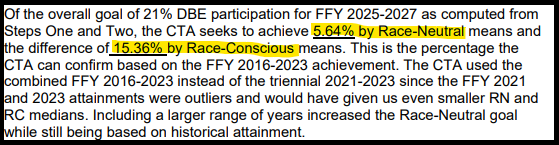
For example, the Chicago Transit Authority’s
DBE plan for fiscal years 2025 through 2027 shows that “race-neutral means” will only achieve a small portion of its overall DBE goal of 21%, and that the remainder will require “race-conscious means.”
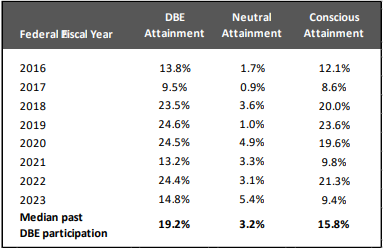
The Los Angeles County Metropolitan Transportation Authority’s
plan shows that in recent years “conscious attainment” has far outweighed “neutral attainment.”
The Philadelphia area’s transit agency
DBE plan expects “conscious” policies to have a far larger impact than “neutral.”

Washington D.C.’s transit
DBE plan is similar:

New York State’s
DBE plan has an even smaller share for “race-neutral”:

Even if DBE plans do not contain explicit race- or identity-based quotas, they clearly point to de facto quotas, as “conscious” efforts have outsized shares of DBE goals.
Ending Government-Sanctioned Discrimination in Contracting
The inclusion of DBE goals in the 1982 Highway Bill came at a time when so-called “affirmative action,” or discrimination on behalf of minority groups, was a widespread practice. In 1978, Supreme Court
blessed affirmative action (but not racial quotas) in college admissions. The Court reaffirmed the position in
2003.
Thankfully, this type of discrimination is receiving the scrutiny it deserves. The Supreme Court’s 2023 ruling in
Students for Fair Admissions v. Harvard marked a turning point, with a 6-3 majority striking down Harvard’s “race-conscious” admissions policy.
In September 2024, the District Court for the Eastern District of Kentucky ruled on the case of
Mid-America Milling Co. v. U.S. Department of Transportation. The plaintiffs argued that the federal DBE program created unfair competition based on identity characteristics, violating the Fifth Amendment’s protection of equal treatment under the law. The court agreed with the plaintiffs, saying that the government failed to provide evidence of governmental discrimination against each of the minority groups covered under DBE rules and that the DBE program had “no logical end point.” While the ruling led to a narrow order related to specific contracts that the plaintiffs were bidding on, the reasoning applies to the DBE program broadly.
Adding to these rulings, President Trump’s Executive Orders
14151 and
14173 call for the elimination of various types of identity-based discrimination such as racial preferences. Subsequently, the Departments of Justice and Transportation analyzed the federal DBE regime and concluded that significant aspects of it are unconstitutional. In June 2025, the U.S. Solicitor General
wrote to House Speaker Mike Johnson about this development.
On October 3, 2025, the DOT issued an
interim final rule on the DBE program and a related program for airport concessions. The DOT has new certification standards seeking to prevent (rather than condone) identity-based discrimination in government infrastructure contracting, and there will be reevaluations for participants based on the new standards.
The DOT’s announcement of administrative reviews for projects in New York and Chicago is thus part of a sequence of events. While the shutdown fight has brought the conflict regarding DBE goals and “race-conscious” contracting to the fore, the Trump Administration did not create it overnight.
In addition to the DOT’s efforts to prevent unconstitutional discrimination against contractors, legislators should also take actions of their own.
- Section 11101(e) of the 2021 Infrastructure Investment and Jobs Act (Highway Bill) reauthorized the DBE program. Congress can amend or rescind this language at any time.
- With Highway Trust Fund program authority expiring in 2026, Congress will likely seek to pass a new Highway Bill. This is another opportunity to address the DBE problem, ideally affirming the Trump Administration’s findings that identity-based discrimination is a violation of Americans’ rights and either ending or overhauling the DBE program.
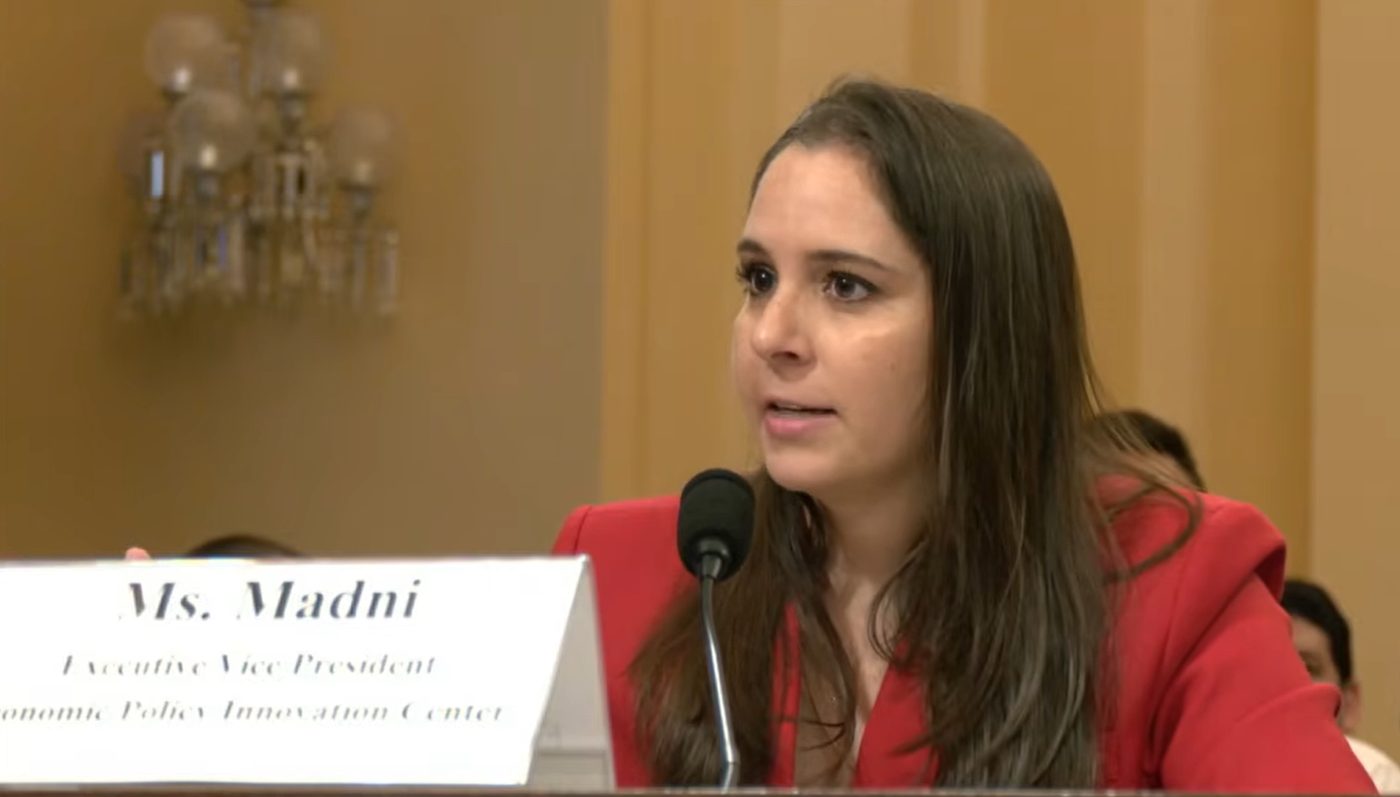
- Committees should hold hearings to shine a light on instances of government-promoted discrimination. The House Committee on Government Oversight and Accountability’s hearing on June 25, 2025 is an example.
The U.S. Constitution enshrines the right of Americans to not suffer from arbitrarily unequal treatment by the government. Eliminating discrimination caused by the DBE program would be a step in the right direction.