Among the deadlines facing the current session of Congress is the expiration of surface transportation programs on September 30, 2026. This includes both the traditional “highway bill” and additional funding passed in the
Infrastructure Investment and Jobs Act (IIJA) of 2021.
Legislators have an opportunity to patch longstanding flaws with federal surface transportation policy and refocus infrastructure spending on genuine national needs.
Highway Trust Fund
The bulk of federal involvement in surface transportation takes place through the Highway Trust Fund (HTF). The federal government sends nearly all HTF funds to state governments, who in turn use funds in accordance with federal mandates such as programmatic set-asides and strict labor regulations.
Historically, the HTF was funded by the federal gasoline tax, with states receiving
formulaic allocations based on their share of gas tax receipts.
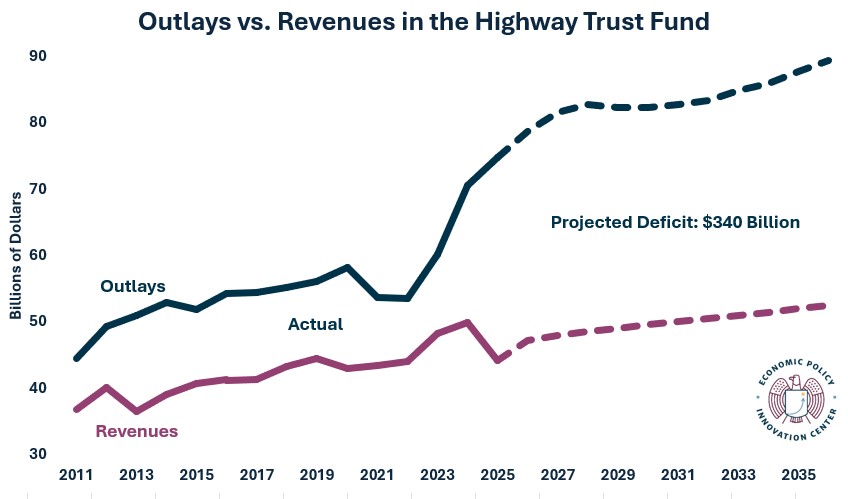
Even though the work of building the interstate highway system was completed in 1992, HTF spending has increased at a much faster rate than gas tax receipts. As a result, the HTF’s balance was depleted and since 2008 has required $271 billion in a series of deficit-financed bailouts to remain solvent.
Deficit Doldrums: Costly Diversions & The IIJA
The primary reason for the HTF’s now-chronic deficits is the volume of non-highway programs that Congress has created. About 30% of HTF funds are diverted for other non-highway purposes.
The largest diversion is the
Transit Account. The federal government mandates a set amount of funding for public mass transit even in low-density states, despite transit users not paying into the trust fund.
Washington also mandates that states use a portion of
Highway Account funds for
programs devoted to non-highway projects such as bike paths and hiking trails. Removing non-highway spending diversions would be a significant step towards HTF solvency while also reducing federal involvement in
state and local responsibilities.
Legislators should also be aware that the IIJA has warped the Congressional Budget Office (CBO) baseline for
HTF spending. Although the IIJA was sold as a “generational investment” (one-time increase), the CBO baseline assumes that IIJA funding levels will continue indefinitely.
This has turned HTF’s formerly manageable deficits into a yawning chasm. CBO projects a $340 billion deficit for the HTF from 2027 through 2036. A five-year reauthorization at current levels would require a $121 billion deficit-financed bailout. As such, attaining full HTF balance without tax hikes will require both reining in non-highway diversions and returning highway spending to pre-IIJA levels.
Regulatory Burdens
In addition to micromanaging how states use their HTF funds, the federal government imposes regulations that make it harder and more costly to build, maintain, and finance surface transportation systems. For example:
- The Davis-Bacon Act is an antiquated mandate for de facto unionized wages on federally funded projects, making it difficult for non-union contractors to offer bids. This artificially inflates construction costs, especially in right-to-work states, at a scale of billions of dollars per year.
- A provision in a 1964 transit law, along with subsequent interpretation by the Department of Labor, makes it nearly impossible for transit agencies to adjust excessive compensation costs.
- Highways built with federal support are barred from using tolls. This forces states to rely on gas taxes to finance their share of highway spending. The reliance on gas taxes is complicated by the rise of hybrids and electric vehicles.
Regulatory reform would allow Congress to provide a trade: fewer burdens in exchange for smaller subsidies, allowing a new focus on core needs. With the federal government facing unsustainable debt,
handouts to state governments must be reined in.
Congress should use all
legislative tools at hand to address the many problems facing surface transportation policy and the HTF’s insolvency. Draining the transportation swamp would mean completing needed projects faster and funding fewer boondoggles.