On October 1, 2025, the federal government entered a “
shutdown” due to a lapse in appropriations. This caused much consternation in Washington, DC, home to the largest number of federal agencies and bureaucrats. As with previous shutdowns, there has been interest in how much of the federal apparatus is affected.
Legislators should reconsider the size and scope of the federal government in light of the distinction between essential and non-essential work outlined below.
Maintaining Functions & Retaining Employees
Some programs and bureaus are fully funded outside of regular appropriations, meaning they can continue operating during a shutdown. Other federal functions are maintained based on a
handful of factors, including:
- If “a statute or court order expressly authorizes or requires an agency to obligate funds in advance of appropriations.”
- If “suspension of that subject function would prevent or significantly damage the execution of the other lawfully continuing functions.”
- If “the subject function addresses emergency circumstances such that the suspension of the function would imminently threaten the safety of human life or the protection of property.”
- If “the subject function is necessary to discharge the President's Constitutional duties and powers.”
Federal agencies produce
shutdown plans to identify which activities are essential based on the above criteria, and in turn which workers are essential or non-essential to perform those duties.
Different presidential administrations produce different shutdown plans. However, the Trump and Biden Administration plans have many similarities.
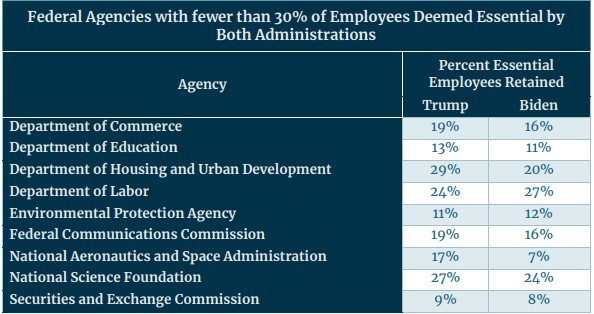
The tables below compare shutdown contingency plans of the Trump Administration and the Biden Administration with respect to shares of federal employees deemed essential by both administrations.
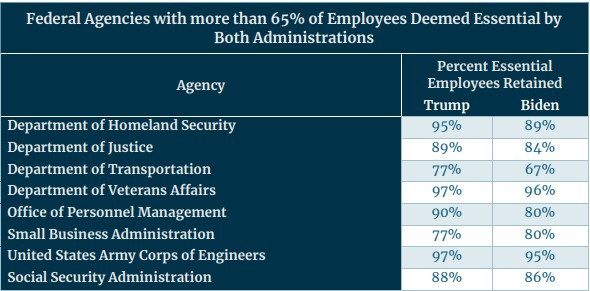
In addition to the high-retention agencies above, all non-civilian military personnel on active duty continue to report during a funding lapse.
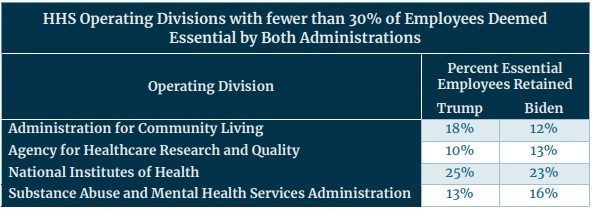
There are also published plans for many bureaus nested within agencies. For example, while both administrations retain most employees in the US Department of Health and Human Services (HHS) during a shutdown, there is significant variance between HHS Operating Divisions. The table below lists HHS Operating Divisions that have retention levels below 30 percent in both administrations.
Congress Should Streamline Non-Essential Federal Activity
The federal government is unmanageably large.
- The Federal Program Inventory lists 2,623 discrete programs. In turn, these programs are operated by a maze of hundreds of agencies and bureaus, many of which Congress has not reauthorized in decades (if ever).
- While final fiscal year 2025 budgetary numbers are not yet available, based on the most recent data, federal spending was likely greater than $7 trillion and the deficit close to $2 trillion.
- The gross national debt is on pace to breech the $38 trillion mark before the end of the 2025 calendar year. The combined unfunded liabilities for Social Security and Medicare are more than twice as large as the debt.
- The Legislative Branch, tasked with authorizing and overseeing the federal government (along with addressing concerns from more than 340 million constituents) accounts for less than 1% of federal civilian employment and roughly 0.1% of all federal spending.
- The immense effort required by Congress to pass appropriations for the entire bloated federal government makes it more difficult to do so in a timely fashion, increasing the likelihood of shutdowns.
An unwillingness to prioritize essential federal responsibilities not only threatens to move the government over the fiscal red line, but also leads to the degradation of governance as a whole. The general sense that there is no meaningful limit on federal activity breeds a political culture that encourages
lobbyists and
state officials to curry favor with Congress in exchange for taxpayer-funded handouts.
There is a correlation between whether an agency or bureau has a low level of employees deemed essential and whether said agency or bureau’s functions are wasteful or could be better managed by civil society or
state and local governments.
For example, the US Department of Education has
utterly failed in its stated mission of improving educational outcomes, and has instead caused a flourishing of non-teaching bureaucrats at all levels of government. Education is not an essential area of federal activity (as demonstrated by the Biden Administration only deeming 11% of its employees essential). Congress should eliminate the department, as President Trump has
directed by Executive Order, and return educational prerogatives to the states.
It should go without saying that shutdown plans ought not be the sole determining factor regarding whether to continue or phase out an area of federal activity. Some wasteful bureaus and programs are unaffected by federal shutdowns because their funding does not flow from annual appropriations. Nearly 40% of the federal workforce (more than 861,000 employees) at major agencies
are financed by autopilot “mandatory” funding or multi-year appropriations. Rather, shutdown plans provide Members of Congress with another perspective on the federal government when deliberating
appropriations and reauthorizations.
Congress should soberly consider how many federal bureaus and programs are truly essential, and how many primarily exist for political patronage or out of a desire to have Washington elites micromanage aspects of American life. Taxpayer dollars should then be prioritized to match those determinations.
Removing non-essential and wasteful parts of the federal government would reduce deficits, focus attention on core responsibilities, and improve the nation’s democratic health. Congress should begin this work as soon as possible.