As part of the
annual spending process, the House and Senate Appropriations Committees consider adjustments to thousands of spending accounts. The most important input comes from members of Congress, such as through the
request portal for the House of Representatives.
Most of the requests that appropriators receive are to increase spending, with much less input identifying low-priority federal activities to cut or eliminate. Given the perilous state of federal finances this is unsustainable.
There is a good case to be made for reducing or eliminating broad swaths of non-defense discretionary accounts for the sake of lowering deficit spending. That said, it is also vital for fiscally responsible members to provide a strong policy rationale, since every line item is zealously guarded by entrenched special interests.
Savings Principle #1: Return to Obama’s Last Spending Level
The final appropriations spending level set during the Obama administration was for FY 2017. While that year’s omnibus package was not signed until May 2017, negotiations to set the “toplines” took place while Obama was still in office.
Non-defense discretionary budget authority was capped at
$518.5 billion for FY 2017. Adjusted for changes in GDP, the FY 2025 level would have been about $663 billion.
Congress instead approved a FY 2025 non-defense appropriations level of
$708 billion. This was $45 billion — or nearly 7% — above the adjusted level of FY 2017 and was even higher after accounting for
budget gimmicks. While some of this difference was a result of
benefit expansions for veterans, many other programs and agencies have received increases relative to growth of the economy.
Since the FY 2025 full-year appropriations
bill text did not include complete account-by-account funding numbers, the
first and
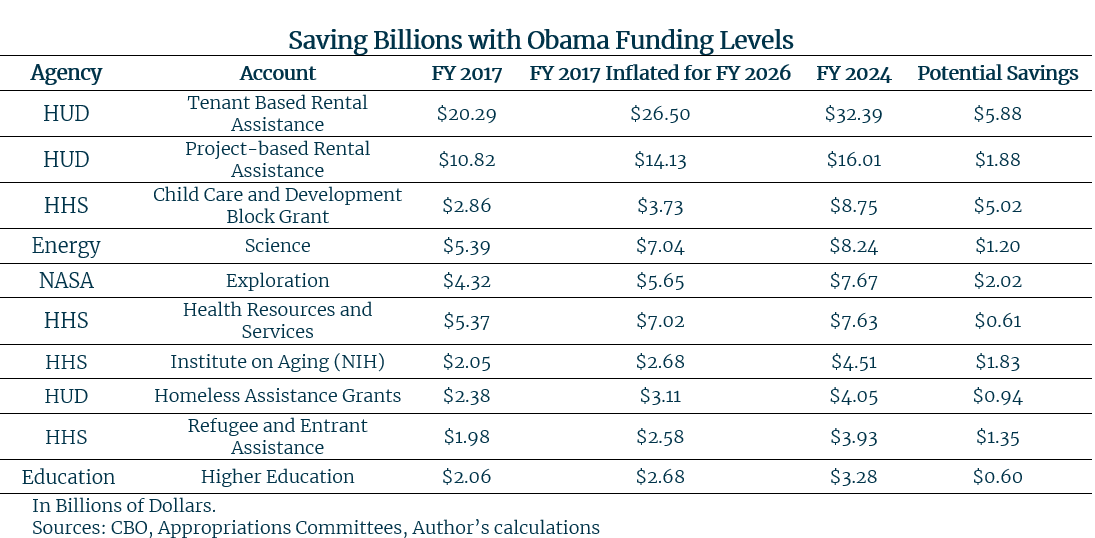
second FY 2024 spending packages can act as a reference for identifying whether a given account has received excessive increases beyond the
FY 2017 level.
For FY 2026, an appropriate adjustment from FY 2017 would be 30.6%. The following table shows how this can allow for savings compared to FY 2024.
Savings Principle #2: Defunding the Left
For much of the last decade, many American institutions become thralls to leftist manias such as critical race theory, DEI, gender ideology, fatalistic environmentalism, and fighting purported “misinformation.”
During the Biden administration, grant programs for scientific research, foreign aid, education, public health, and culture were abused for the
promotion of leftist ideology. As an
investigation by the Senate Commerce Committee revealed, the National Science Foundation alone doled out billions of tax dollars along these lines.
Thankfully, the Trump administration has used a combination of
executive orders and the Department of Government Efficiency to halt the funding of ideological grants.
Congress must also hold agencies to account. Bureaucracies that eagerly embraced the Biden administration’s radical agenda must not be trusted with anywhere near the same amount of tax dollars.
Academia has been exposed as a breeding ground for ideological contagions. Subsidies such as Pell grants are almost entirely captured by universities, as demonstrated by the
rapid increase in tuition prices. In addition, most research grants go to universities, and the federal government provides exorbitant “
indirect cost” plus-ups. This provides fungible financial resources that indirectly benefit Marxist academic centers.
So-called “non-governmental organizations” are another beneficiary of federal grants. A sizeable portion of such groups have radical agendas and
nakedly partisan leadership, making federal support a form of political corruption.
“Cultural” agencies such as the
Corporation for Public Broadcasting, the National Endowments for the Arts and the Humanities, and the Institute of Museum and Library Services have long track-records of promoting leftist agendas.
In Washington’s big-spending culture, there is an implication that flat funding for an agency or program is a “moderate” outcome.
That mindset is myopic. Forcing Americans to provide tens of billions of dollars in annual support for leftist institutions inside and outside of government is an act of intolerable bias. A truly “moderate” amount of federal support for leftism would be zero.
Savings Principle #3: Reduce Welfare for States and Non-Americans
While federal revenues have steadily grown, its resources are still limited. In a time of unsustainable deficits, it is urgent for legislators to reduce spending in areas that are not proper federal responsibilities.
One example is programs that give grants for state and local government duties such as social services, sewers and drinking water, non-interstate road infrastructure, region-specific disaster preparedness, community amenities, and more.
These are
welfare programs for states. Reducing such deficit-financed handouts (which appear “free” to local politicians) would force other levels of government to determine whether these projects are truly worth paying for.
Foreign aid also deserves more scrutiny from Congress than it typically receives. Hundreds of billions in spending over the course of decades has failed to lure developing nations to America’s side in contentious United Nations votes and has failed to produce prosperity in countries that receive the most aid.
Open-ended welfare for nations has the same corrosive effects as poorly designed welfare programs for individuals: dependency, counterproductive incentives, and fostering resentment on both sides.
In contrast, America’s private charitable donations
lead the world. Washington should promote charity as a replacement for federal spending, both at home and abroad.
By utilizing these three savings principles in the FY 2026 appropriations process, Congress can save hard-earned tax dollars and remove the most destructive aspects of the federal government. It would also send a signal to the American people that their concerns about a bloated, out-of-touch federal government are being heard.