As the House and Senate seek an agreement on final spending levels for
fiscal year (FY) 2025 appropriations, it is important for legislators to know where things stand and how to avoid budget-busting gimmicks that marred fiscal year 2024.
Continuing Resolution & The FRA Caps
The
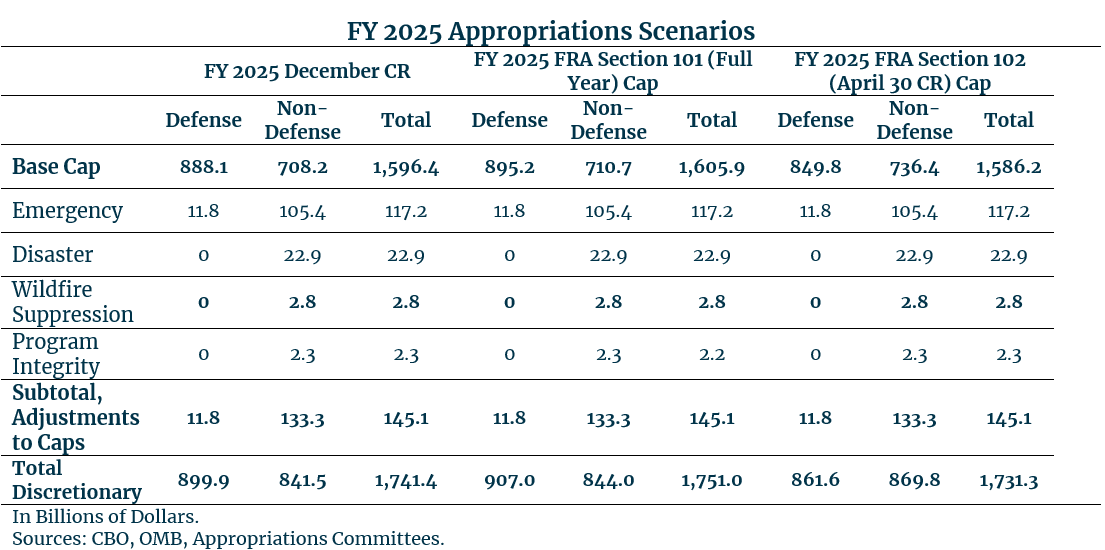
second CR, passed in December, authorized FY 2025 appropriations to continue through March 14, 2025. Annualized, it funds defense at $888.1 billion and non-defense at $708.2 billion for a total of $1.596 trillion.
The current full-year limit for FY 2025 appropriations was set through Section 101 of the
Fiscal Responsibility Act (FRA) of 2023. It allows up to $895.2 billion for defense and $710.7 billion for non-defense, a total of $1.606 trillion.
Section 102 FRA contains a mechanism for discouraging a full-year CR. If there is a short term CR in place as of April 30, that will trigger new spending limits, with a much lower defense cap of $848.8 billion and a higher non-defense limit of $736.4 billion. This would be enforced through an across-the-board sequestration by the President. Congress can avoid this by passing compliant full year appropriations (including a full year CR) before April 30.
FY 2025 Funding Exempted from Caps
To date, Congress has approved $145.1 billion in discretionary funding for categories that are
exempted from spending caps. $140.1 billion is designated as emergency or disaster spending. Of that, $110 billion was approved in the
December CR, largely in response to Hurricane Milton. The remainder is for wildfire suppression and program integrity activity.
While the size of these exemptions is significant, they broadly align with how Congress has handled appropriations for genuine natural disasters and related emergencies in recent years.
However, there is a dark side to spending cap exemptions: they are subject to abuse.
Beware of Gimmicks
Although the FRA set a limit on FY 2024 discretionary BA at $1.59 trillion, a
full accounting shows that spending was much higher due to a variety of legislative maneuvers.
First, there was a “side deal” to the FRA agreement (cut behind closed doors) to include tens of billions of
improper emergency designations. This means labeling portions of standard appropriated activity as an emergency to reduce the amount that counted against the FRA caps. Though the final FY 2024 packages contained a smaller amount of fake emergency designations than the original side deal, the gimmick still increased spending by $12.5 billion.
Second, appropriators heavily used Changes in Mandatory Program Spending (
CHIMPs) gimmicks. When an appropriations bill rescinds or adjusts spending in the mandatory category, it is counted as negative budget authority (BA) for scorekeeping purposes. Proper CHIMPs reduce outlays and are thus a budget-neutral offset. Some of the FY 2024 CHIMPs were genuine spending cuts, such as reducing an
IRS slush fund.
However, there were also gimmick CHIMPs that did not reduce outlays and thus led to more deficit spending. This is because empty BA (BA that will not result in outlays) was exchanged for new BA that will create outlays. The best example of this was rescinding a phony “
nonrecurring expenses fund,” which was created in the FRA for the express purpose of being a gimmick.
Third, FY 2024 appropriations contained rescissions to appropriated spending from previous years. As with CHIMPs, rescinded discretionary BA creates room for new BA under the caps. And as with gimmicked CHIMPs, these rescissions were “cuts” to unused BA that were unlikely to ever be spent, meaning the net result was a larger volume of outlays and higher deficits.
The FRA was initially celebrated as an overdue fiscal responsibility measure. However, in FY 2024 the excessive use of budget gimmicks undermined its effect on total spending.
The Senate Appropriations Committee’s initial drafts of the
FY 2025 spending bills included multiple instances of each of the gimmicks above, adding tens of billions in spending above the FRA caps. Congress must avoid this in its final FY 2025 legislation.
To help reduce gimmicks, Congress should amend
Section 402 of the Budget Act to require published CBO scores of appropriations legislation. This would
provide vital transparency.