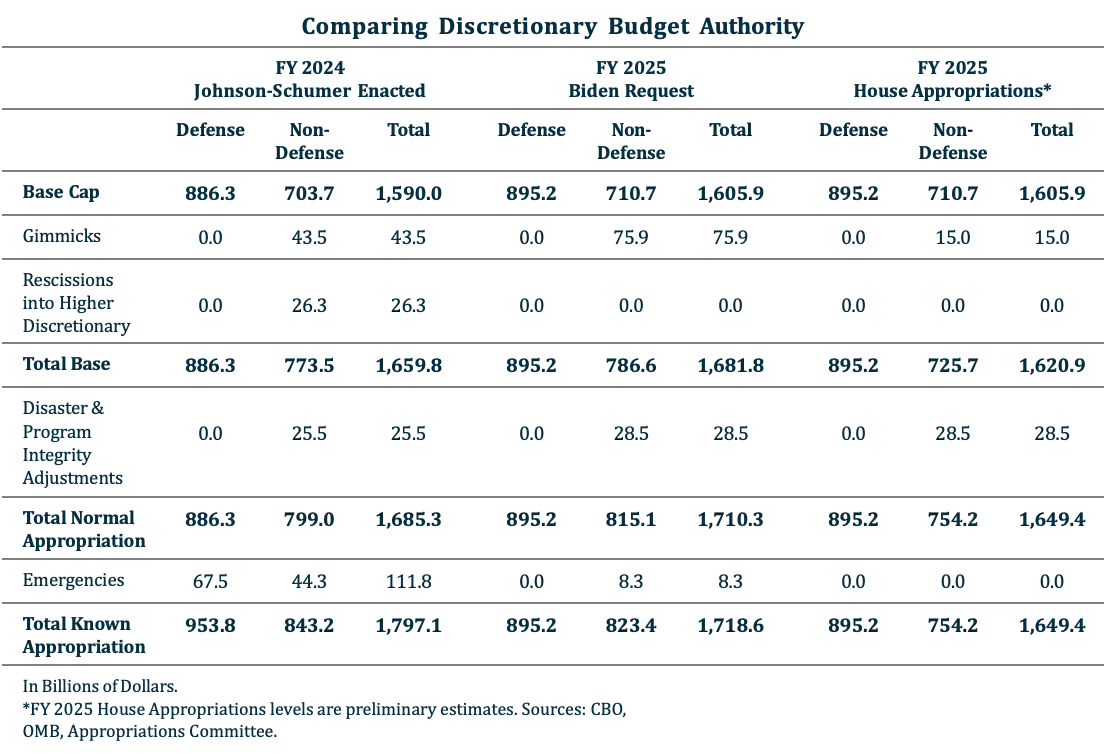
President Biden’s budget request would exceed the Fiscal Responsibility Act (FRA) spending caps in fiscal year 2025 with $75.9 billion in gimmicks to increase non-defense discretionary spending. This is meant to rekindle the
Johnson-Schumer “side-deal” gimmicks that increased FY 2024 non-defense discretionary spending by $69 above the FRA cap.
The House has
indicated it intends to limit the use of gimmicks in FY 2025. The Senate has not yet released its FY 2025 appropriations levels.
Biden Budget Doubles Down on Irresponsible Gimmicks
| Gimmick |
Increase in Non-Defense Spending |
| Base Funds Designated as Emergency |
23.2 |
| No-Outlay Changes in Mandatory Spending Programs (CHIMPs) |
41.5 |
| Commerce Nonrecurring Expenses Fund Rescission Gimmick |
9.6 |
| Score TSA Fees as Discretionary |
1.6 |
| Subtotal, Gimmicks for Higher Discretionary BA |
75.9 |
In Billions of Dollars.
Source: OMB.
Gimmick
CHIMPs in the President’s budget request include provisions related to the Crime Victims Fund, Children’s Health Insurance Program (CHIP), and the Child Enrollment Fund Contingency Fund, as well as rescinding funds from the Commerce Nonrecurring Expenses Fund (NEF). These policies do not achieve any actual reductions in outlays but are allowed to offset higher discretionary spending. In other words, the offsets only exist on paper, but the spending continues.
The President’s budget request proposes $23.2 billion in spending on base activities that would be designated as an emergency for the purpose of spending above the non- defense cap. The budget includes so-called “shifted base” funding for programs such as Migration and Refugee Assistance and foreign aid. This would allow the President not to count that $23.2 billion in shifted base programmatic funding against the cap.
In addition to the gimmicks listed in the table above, President Biden is requesting another $8.3 billion in emergency funding for his crisis at the border.
House Appropriations Committee Intends to Limit Gimmicks.
In contrast, House Appropriations Committee Chairman Tom Cole
stated, “The bills written by this Committee will adhere to law set by the Fiscal Responsibility Act—with no side deals—and focus resources where they are needed most.”
Not all 12 of the House appropriations bills are available yet, so a comprehensive analysis is not possible at this time. It is anticipated that the bills will include about $15 billion in CHIMPs, a level that would be consistent with the
CHIMPs caps in place for FY 2019 through 2021 and generally used in recent years prior to FY 2024.
Scoring Transparency Is Needed for Appropriations Bills.
Appropriations bills have become loaded with scoring gimmicks that make it difficult to understand exactly how much is being spent.
Appropriations bills are the most important legislation affecting federal spending considered by Congress on a regular basis. Despite this, CBO
does not provide formal cost estimates on the regular appropriations bills.
That is because a loophole in
Section 402 of the Budget Act carves out appropriations bills from the requirement that CBO prepare cost estimates.
To fix this problem, Representative Glenn Grothman has introduced
H.R. 7584, the Appropriations Transparency Act, to close the loophole. Requiring full cost estimates on appropriations bills from Congress’s non-partisan official scoring agency would be an important step towards transparency and uniformity in understanding the fiscal implications of discretionary spending legislation.