

President Joe Biden released his budget request for fiscal year (FY) 2025 this week, more than a month after the statutory deadline.
Biden’s record on spending and deficits has been reckless, with actual FY 2023 spending coming in nearly $1 trillion higher than the Congressional Budget Office projected when President Biden took office.
The FY 2025 budget request would double down, promising higher taxes, higher spending, and to put the government in charge of more of the everyday aspects of people’s lives. It proposes more of the same failed Bidenomics that has driven inflation higher, making American families worse off.
Here is what you need to know about Biden’s budget request:
Historically High Spending and Taxes
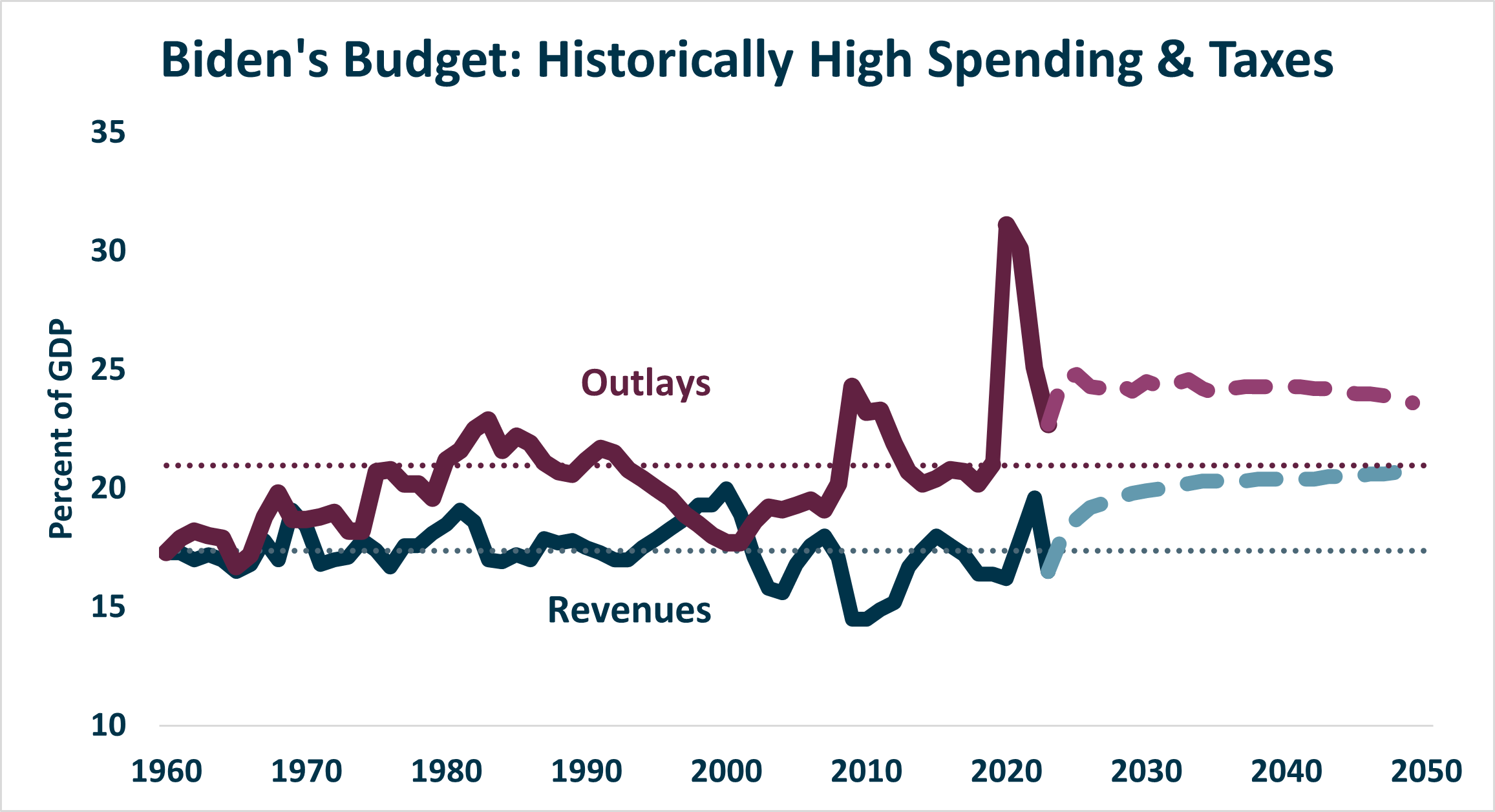
Biden’s budget request proposes historically high levels of government spending and tax revenues.
Outlays would average 24.4 percent of GDP over the FY 2025-2034 period. Spending would remain elevated above the historical average of 21 percent of GDP, resulting in the longest sustained period of elevated spending in American history.
Despite the Administration’s assumptions of slow but stable economic growth and relatively low unemployment, under Biden’s policy proposals, government spending would remain at Great Recession levels for the foreseeable future.
President Biden proposes to take tax revenues to levels never experienced in America. Taxes would rise well above the 50-year average level of revenues of 17.4 percent of GDP.
Over the FY 2025-2034 period, Biden’s budget would impose taxes that average 19.7 percent of GDP. In the last century, tax revenues have reached this level only three times. The American economy has never sustained taxes at these levels. The tax policies Biden is proposing are simply unprecedented.
By 2046, revenues would exceed the record high level of revenues as a percent of GDP set in 1944 during the height of World War II. Unlike the post-war period where spending and taxes quickly fell, Biden proposes to keep pushing tax revenues higher and higher.
Despite these extraordinarily high tax revenues, the budget would never balance, driving debt even higher.
$1.7 Trillion of Higher Spending
Biden’s budget request proposes $1.694 trillion in higher spending over the FY 2025-2034 period. This comes on top of the federal government’s already unsustainable baseline spending trajectory and would drive annual outlays above $10 trillion by FY 2033.
Many of the budget’s proposals would create and expand programs that insert Washington into some of the most personal aspects of our daily lives and trap people into dependency on the government, such as turning the Child Tax Credit into a universal cash allowance, expanding Obamacare subsidies even for the wealthy, and creating a “free” preschool program that costs taxpayers $200 billion.
Even President Biden’s proposals to "reduce the cost of health care" would increase federal spending by $470 billion. Federal health spending is already unsustainable, and these proposals would make it worse.
$5 Trillion of Higher Taxes on Families and American Employers
Biden is proposing $4.951 trillion in new taxes over the FY 2025-2034 period.
Many of these tax increases would be squarely focused on small businesses, who would face hundreds of billions in new tax liabilities.
Biden’s proposal to increase corporate taxes would mean the tax rate on U.S. based employers would be higher than the tax rate imposed by the Chinese Communist Party on businesses. Of course, workers and consumers ultimately bear much of the burden of business taxes, with labor shouldering an estimated 70 percent or more of the corporate tax.
Despite rhetoric about preventing tax increases on people earning less than $400,000, the Biden budget includes no concrete proposals to avoid the expiration of the Tax Cuts and Jobs Act that is looming next year.
Interest Costs Skyrocketing
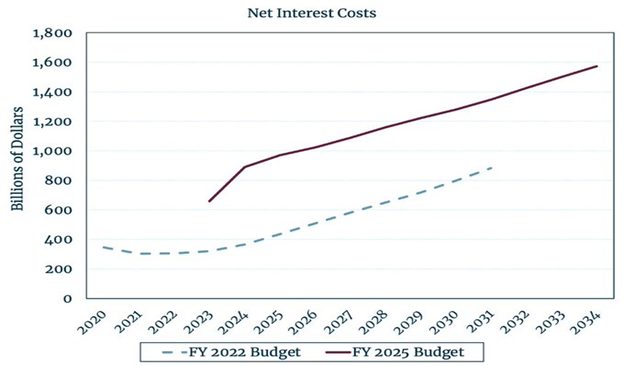
Interest payments on the debt would skyrocket under Biden’s budget. In FY 2024, interest costs are projected to reach $889 billion, even more than we would spend on national defense.
By 2034, interest costs would be $1.485 trillion, 126 percent higher than the $658 billion spent in FY 2023.
Even compared to Biden’s first budget, net interest spending will have increased by $4.4 trillion (or about $485 billion per year) between 2023 and 2031, based on OMB's projections.
On to Congress
Despite the proposed higher taxes, higher spending, and bigger government plans, the President’s budget request is not law. Congress should adopt more responsible policies as they develop and vote on the FY 2025 budget resolution and appropriations bills for next year.
Of note, the House Budget Committee has already marked up their budget resolution; in fact, they did so before President Biden’s tardy request was released. And unlike the Biden Budget, the House budget resolution would put spending on a more sustainable trajectory.