

Analysis
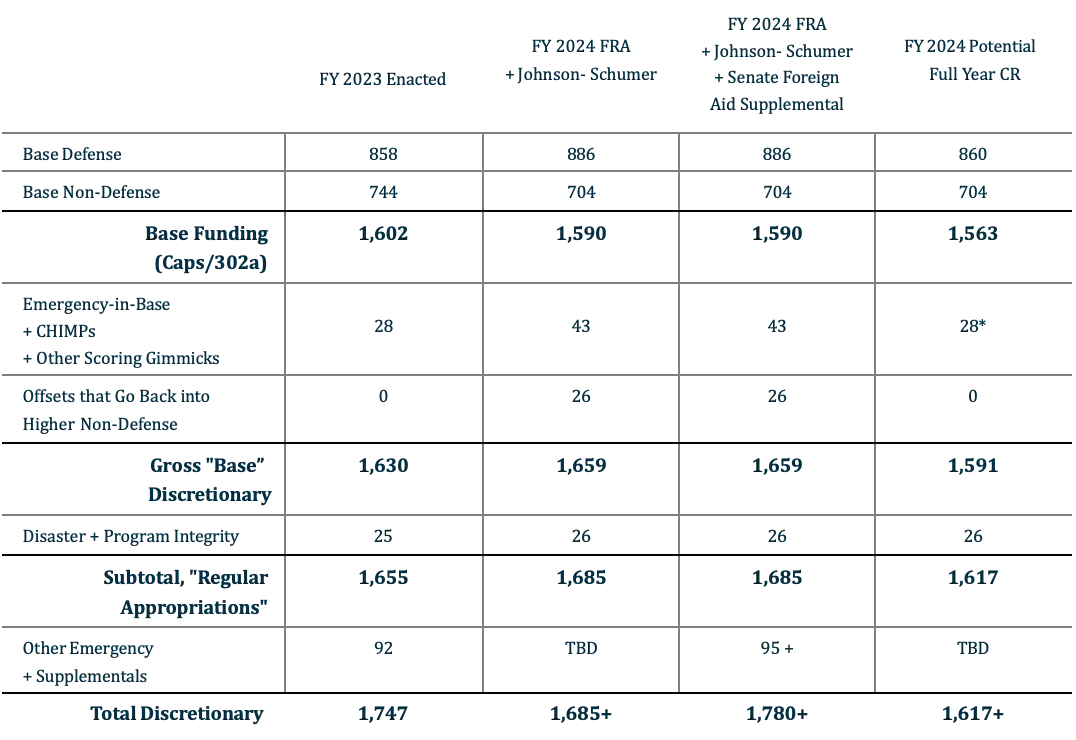
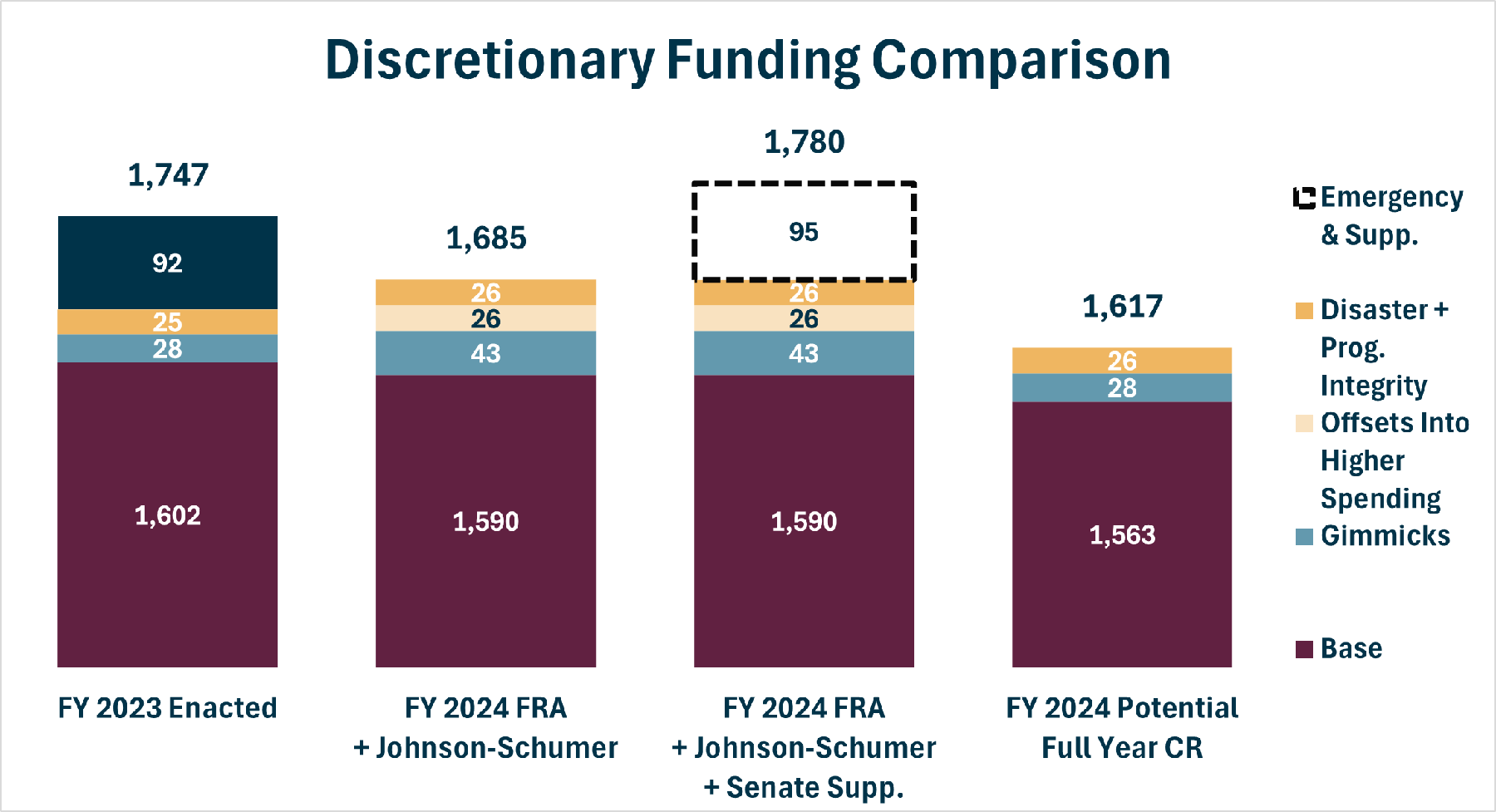
Congress has yet to agree on FY 2024 appropriations levels and policies. Legislative options under discussion include: 1) a package written to the Johnson-Schumer levels that adds tens of billions to the Fiscal Responsibility Act non-defense levels; or 2) a full year continuing resolution (CR). Also under consideration is a large supplemental foreign aid package. The table and chart below compare these options with the enacted FY 2023 Omnibus. Enacting a full year CR without an unpaid-for supplemental would be the most fiscally responsible of these options, as well as providing an increase in defense funding.Table 1. Total Discretionary Spending for FY 2023 and FY 2024 (Billions of Dollars)
 *Estimated based on FY 2023 enacted. + Represents potential for future supplementals, such as for natural disasters. Sources: Congressional Budget Office, Office of Management and Budget.
A full year CR would keep total discretionary spending about $130 billion below FY 2023. Under a full year CR, regular defense would be $1.4 billion higher, while regular non-defense would be $40 billion less than FY 2023, because a full year CR would enforce the Fiscal Responsibility Act cap on base non-defense spending of $703.7 billion, without side deals or other supplementals.
Enacting an omnibus at the Johnson-Schumer levels would keep total discretionary spending $63 below the FY 2023 level. However, these savings are entirely attributable to the FY 2023 supplemental appropriations, primarily for Ukraine aid. The Johnson-Schumer agreement would take regular defense appropriations about $28 billion and regular non-defense appropriations about $1 billion higher than FY 2023.
*Estimated based on FY 2023 enacted. + Represents potential for future supplementals, such as for natural disasters. Sources: Congressional Budget Office, Office of Management and Budget.
A full year CR would keep total discretionary spending about $130 billion below FY 2023. Under a full year CR, regular defense would be $1.4 billion higher, while regular non-defense would be $40 billion less than FY 2023, because a full year CR would enforce the Fiscal Responsibility Act cap on base non-defense spending of $703.7 billion, without side deals or other supplementals.
Enacting an omnibus at the Johnson-Schumer levels would keep total discretionary spending $63 below the FY 2023 level. However, these savings are entirely attributable to the FY 2023 supplemental appropriations, primarily for Ukraine aid. The Johnson-Schumer agreement would take regular defense appropriations about $28 billion and regular non-defense appropriations about $1 billion higher than FY 2023.
 Speaker Johnson and Senate Majority Leader Schumer reportedly reached a "side-deal" to increase non-defense discretionary spending $69 above the statutory cap specified in the Fiscal Responsibility Act.
Table 2. Johnson-Schumer Agreement (Billions of Dollars)