
PLEASE NOTE: This site is an archival resource, no longer updated as of June 1, 2026. Current questions: The Fiscal Lab.
The Federal Budget: Spending, Taxes, and Debt

IRS Enforcement Spending Has Not Reduced the Deficit

Enforcement Outlays Exceed Revenue Collections, Increasing the Deficit

Introduction

  • The Internal Revenue Service has a $57.8 billion slush fund meant to enhance enforcement of the tax code, provided by the Inflation Reduction Act. This was supposed to reduce the deficit by increasing revenues more than the new spending.
  • However, the additional IRS funding has increased the deficit. Every $1 of new revenue from the enforcement efforts has cost taxpayers $1.04.
  • The IRS has collected just 18 percent of the revenues projected by the Congressional Budget Office.
  • The CBO must fix its incorrect modeling of the return on investment to tax enforcement, and Congress should rescind the IRS slush fund.

The Inflation Reduction Act’s IRS Slush Fund

The Inflation Reduction Act (IRA) of 2022 provided the Internal Revenue Service (IRS) a $79 billion slush fund to increase enforcement of the tax code. The Fiscal Responsibility Act of 2023 and the fiscal year (FY) 2024 appropriations bills rescinded $21.6 billion of the funds, leaving $57.8 billion in enhanced funding for the IRS on top of normal discretionary appropriations. Supporters of the IRS funding claimed it would reduce the deficit by increasing tax collections greater than the cost of tax enforcement efforts and hiring new IRS agents. The Congressional Budget Office (CBO) estimated that the IRA as enacted would increase revenues by $180.4 billion because of enhanced enforcement activities.[1] The IRS even more dramatically over-estimated revenue collections, releasing a report stating that “As enacted, the IRA would raise $561 billion over FY 2024–2034.”[2] However, actual data shows these revenue projections have not come to reality.

Tax Collections from the IRS Slush Fund Have Not Reduced the Deficit

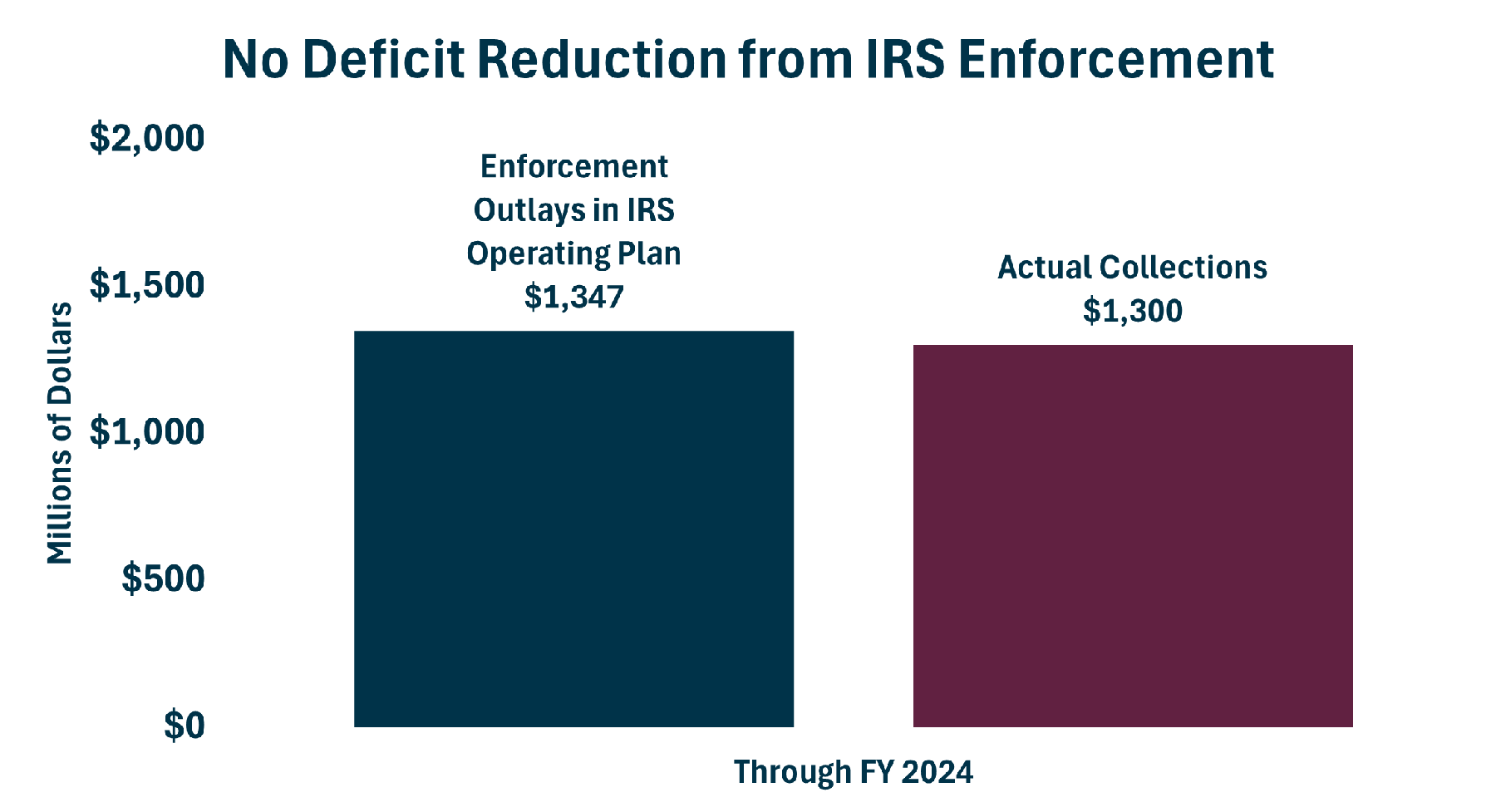
On September 6, 2024, the IRS and the U.S. Department of the Treasury announced that a total of $1.3 billion had been collected under the IRA enforcement initiatives.[3] The IRS’s 2024 Strategic Operating Plan projected that outlays for the enhanced enforcement funding would total $1.347 billion by the end of FY 2024. The IRS added more than 4,000 new full-time agents focused on enforcement with these funds.[4] This means that by the end of FY 2024, the initiative meant to reduce the deficit has actually resulted in a higher deficit.

Chart 1

IRS Collections And Outlays Through 2024 11.2.2024

Source: IRS

This means that every $1 of new revenue collected from the IRA’s enhanced enforcement efforts cost taxpayers $1.04. In addition to the $1.347 billion spent on enforcement activities, the IRS also planned to have spent $9.4 billion through FY 2024 on operations support, business systems, taxpayer services, energy programs, and a direct file study. In total, the IRS planned to spend $10.7 billion of IRA funds by the end of FY 2024, compared to just $1.3 billion in actual revenue collections.

Actual Collections Fall Short of CBO Projections

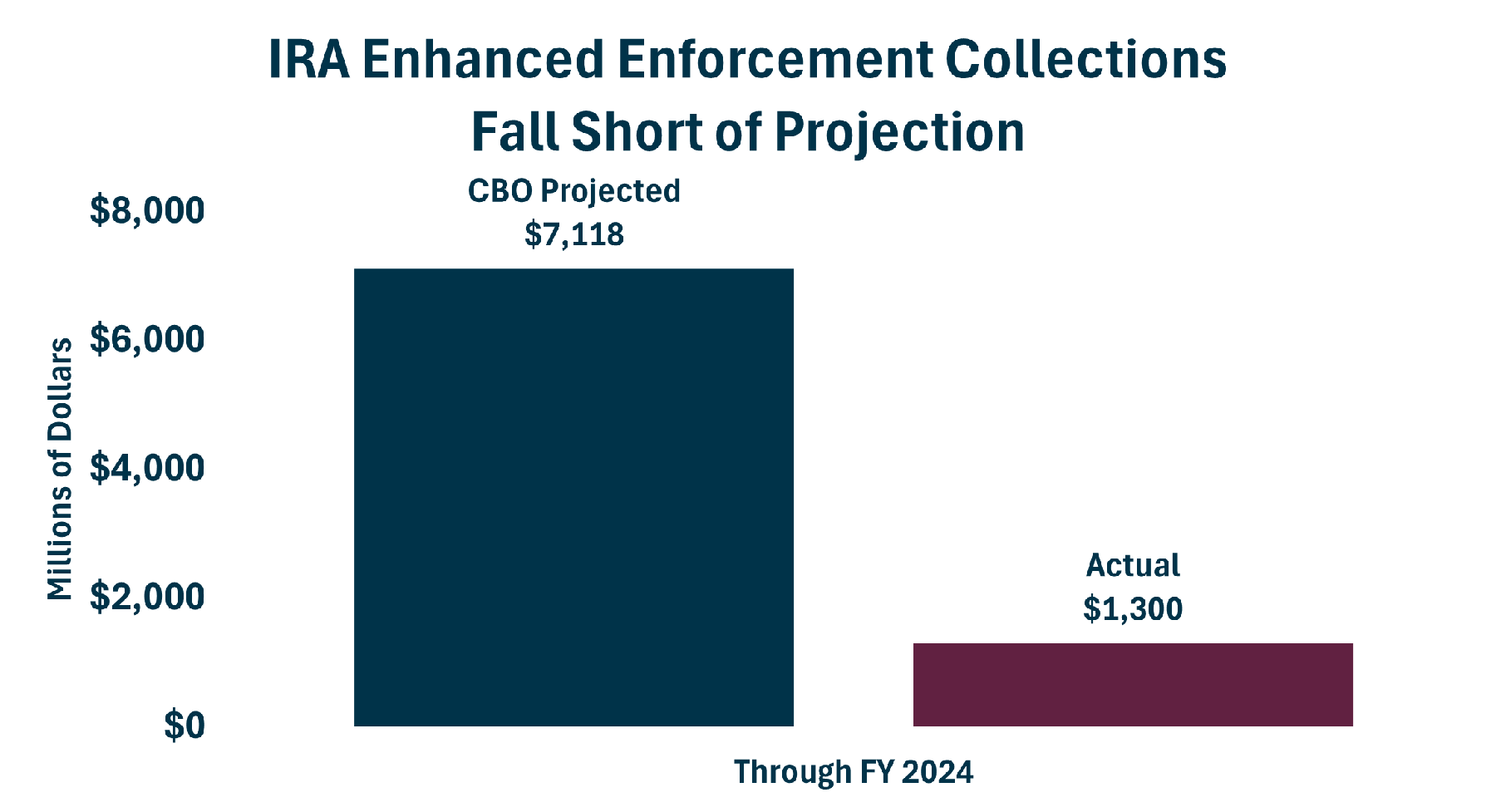
The CBO projected that the enhanced IRS resources would result in $7.118 billion in higher revenues by the end of FY 2024.

Chart 2

Actual IRS Collections Vs Projection Through 2024 11.2.2024

Sources: CBO, IRS

However, the increase in collections reported by the IRS and Treasury was just $1.3 billion, $5.8 billion less than the CBO’s projection. Actual revenue collections came in at just 18 percent of the CBO’s projection. The IRS fell 82 percent short of the projected collections.

The CBO’s IRS Enforcement Model is Wrong

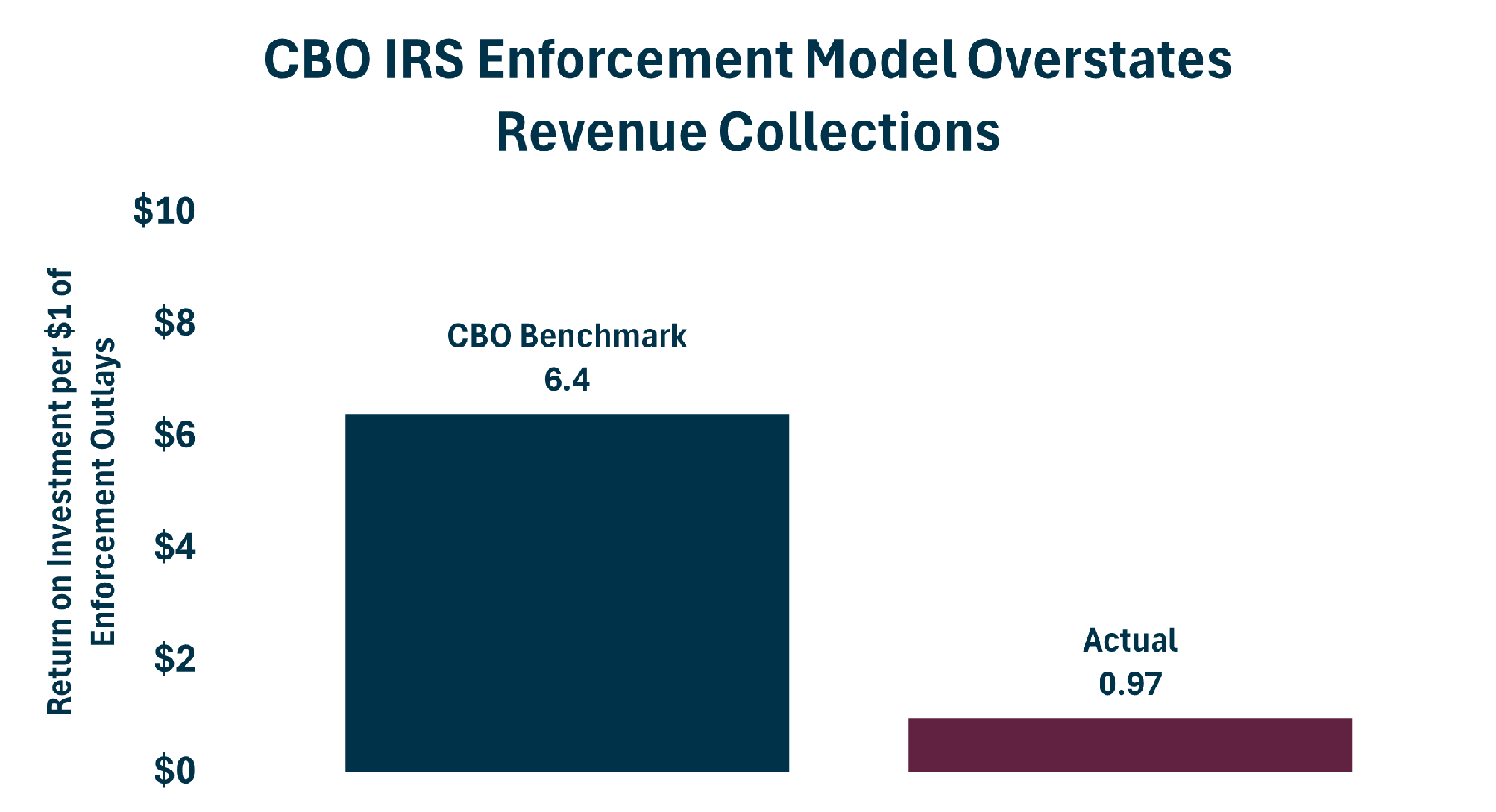
The mistaken projections by the CBO stem from faulty models that assume an unrealistically high return on investment (ROI) for every dollar spent on tax enforcement. The CBO’s benchmark ROI estimate for IRS enforcement spending is 6.4, meaning it assumes that every $1 spent on enforcement would raise $6.4 in new revenues. The CBO assumed “ROIs ramp up over three years as new IRS staff are trained and become fully productive: Returns are roughly 25 percent of the benchmark ROI in the first year, about 75 percent of the benchmark in the second, and 100 percent of the benchmark in the third.” That translates to an estimated ROI of about 1.6 in FY 2023 and 4.8 in 2024. Even with the ramp up built into the assumptions, the actual collections fell far below the projected ROI levels. The CBO also makes smaller adjustments to the assumed ROI based on diminishing returns to additional enforcement activities, adaptations to the IRS’s activities, investments in taxpayer services and systems modernization, and voluntary taxpayer compliance. The CBO “anticipates that the IRS would prioritize the enforcement activities that it expects would have the highest average return.” According to the CBO’s analysis, “the IRS estimated that at its most productive, $1 of spending on enforcement activities would result in $5 to $9 in revenues over time.”[5] However, the actual observed ROI is much less than the CBO’s model projects. According to the IRS’s 2024 Strategic Operating Plan, outlays for the enhanced enforcement funding total $1.347 billion by the end of FY 2024. With $1.3 billion in collections through FY 2024, the actual ROI for enforcement spending is just 0.97 – notable, this is below 1. An ROI of less than 1 demonstrates that each $1 on enforcement spending brings in less than $1 in new revenues.

Chart 3

IRS Collections ROI 11.2.2024

Sources: CBO, IRS

The CBO Must Fix its Model

After two years of evidence, it is clear that the CBO’s modeling of the return on investment from IRS enforcement is wrong. Through FY 2024, the IRS has collected just 18 percent of the revenue increases projected by the CBO. Instead of reducing the deficit, every $1 of new revenue from the IRA enforcement efforts cost taxpayers $1.04. The CBO’s flawed modeling has significant policy implications. If Congress rescinds the IRS slush fund, the CBO’s broken model would assume that the deficit would increase as the revenue collections foregone would exceed the reduction in spending. However, the data shows that the actual deficit impact of rescinding IRS funding would likely be negligible, or even beneficial. Rescinding the IRS slush fund is a key policy priority for the 119th Congress, particularly within the context of a reconciliation opportunity. It is important for the CBO to fix its model and release a revised, more accurate estimate for Members of Congress to consider as they work on a pro-growth reconciliation package.   [1] Congressional Budget Office, “Estimated Budgetary Effects of Public Law 117-169,” September 7, 2022, https://www.cbo.gov/system/files/2022-09/PL117-169_9-7-22.pdf (accessed November 5, 2024). [2] Internal Revenue Service, “Return on Investment: Re-Examining Revenue Estimates for IRS Funding,” Publication 5901 (2-2024), Catalog Number 94564D, February 2024, https://www.irs.gov/pub/irs-pdf/p5901.pdf (accessed November 5, 2024). [3] U.S. Department of the Treasury, “U.S. Department of the Treasury, IRS Announce $1.3 Billion Recovered from High-Income, High-Wealth Individuals Under Biden-Harris Inflation Reduction Act Initiatives,” September 6, 2024, https://home.treasury.gov/news/press-releases/jy2562 (accessed November 5, 2024). [4] Internal Revenue Service, “IRA Strategic Operating Plan Annual Update Supplement,” Tables 3 and 4, May 2024, https://www.irs.gov/pub/irs-pdf/p3744a.pdf (accessed November 5, 2024). [5] Congressional Budget Office, “How Changes in Funding for the IRS Affect Revenues,” February 29, 2024, https://www.cbo.gov/publication/59972 (accessed November 5, 2024).

Author

Matthew D. Dickerson

Matthew D. Dickerson

Director of Budget Policy

Matthew D. Dickerson is Director of Budget Policy at the Economic Policy Innovation Center (EPIC). Dickerson is recognized as an expert on fiscal policy issues, including the budget, appropriations, and entitlement reform. His articles have been featured in the Wall Street Journal , the Miami Herald , National Review , the Sacramento Bee , the Washington Times , the Baltimore Sun , The Hill , the Washington Examiner , and other outlets. Prior to joining EPIC, Dickerson served as Senior Policy Advisor on the staff of the House Budget Committee, where he helped lead development of the fiscal year 2024 budget resolution. He has a dozen years of experience on Capitol Hill, including as a senior staffer with the Republican Study Committee (RSC), the caucus of conservatives in the House of Representatives. Under four different RSC chairmen, Dickerson held senior level roles including Policy Director and Senior Policy Staff. Additionally, he served as Legislative Director and other policy positions for the late Congressman C.W. Bill Young (R-FL), a former Chairman of the powerful House Appropriations Committee. During his tenure at The Heritage Foundation, Dickerson was Director of the Grover M. Hermann Center for the Federal Budget. In this capacity, he oversaw a team of budget analysts and economists researching diverse subjects including spending, entitlements, budget process, tax, labor, pensions, and infrastructure issues. He has also been a Policy Manager at Americans for Prosperity, where he supervised a team of fellows and analysts covering a variety of federal and state policy issues. Dickerson is a graduate of the College of William and Mary in Virginia and holds a Bachelor of Arts in Government and History.

More from Matthew D. Dickerson →

← All work