Each year, the Social Security trustees publish a report detailing the finances of the Old Age and Survivors Insurance (OASI) program and the Disability Insurance (DI) program. Social Security was conceived as a self-financing system in which each generation’s payroll contributions would be saved to pay for its own future benefits. Instead, it has evolved into a pay-as-you-go model in which today’s workers fund today’s retirees. This arrangement shares many characteristics with a Ponzi scheme.
With older generations wondering if they will continue to receive their entire Social Security benefits and younger generations overwhelmingly believing Social Security will not be there for them when they retire, this report provides an overview of
the 2025 trustees’ report and what it means for Americans young and old.
Social Security Will Be Insolvent in Eight Years, in 2033
Social Security’s OASI trust fund (which covers retirement and survivors’ benefits, but not disability insurance) will be exhausted in 2033—just eight years from now. At that point, Social Security can only pay out as much in benefits as it collects in Social Security taxes.
The trust fund is what keeps Social Security’s financing separate from other government spending. This separate financing was important because workers’ Social Security taxes were meant to fund future benefits. Despite separate accounting, policymakers have consistently borrowed from Social Security’s trust fund to pay for other government spending. This means that the trust fund consists not of actual money, but of IOUs the federal government issued to the trust fund. For the past 15 years, Social Security has been paying out more in benefits than it collects in taxes and cashing in on the IOUs to cover the difference. By definition, this erodes the trust fund’s balance. Trust fund IOUs will run out in 2033, at which point Social Security’s only resources will be its incoming payroll taxes.
The Law Will Requires 23 Percent Benefit Cuts Without Reforms
The Social Security trustees estimate that, when the trust fund runs dry in 2033 and Social Security cannot spend more than it collects, payroll taxes will cover only 77 percent of scheduled benefits, leading to 23 percent benefit cuts. These cuts will apply to all Social Security recipients, regardless of their age or income. For the average Social Security beneficiary, a 23 percent benefit cut will equal about $5,300 less per year.
Everyone From Generation X to Generation Beta Will Never Receive a Single Full Benefit
In 2033, today’s oldest members of Generation X will reach Social Security’s normal retirement age of 67—the same time that the trust fund is exhausted and benefits will be reduced assuming no changes in the law. That means that if policymakers do not reform Social Security, no one from Generation X through Generation Beta and beyond will receive a single full Social Security benefit.
Sustaining Social Security Would Require Huge Tax Hikes
According to the trustees, maintaining current benefit levels would require policymakers to immediately raise taxes by 3.65 percentage points, from 12.4 percent to 16.05 percent. For a median household with $80,600 in earnings, that would amount to an extra $2,900 per year, and a total of $12,900 per year in Social Security taxes. If policymakers wait until Social Security runs out of money, the payroll tax would have to rise to 16.7 percent, or $13,500 per year in Social Security taxes for the median household.
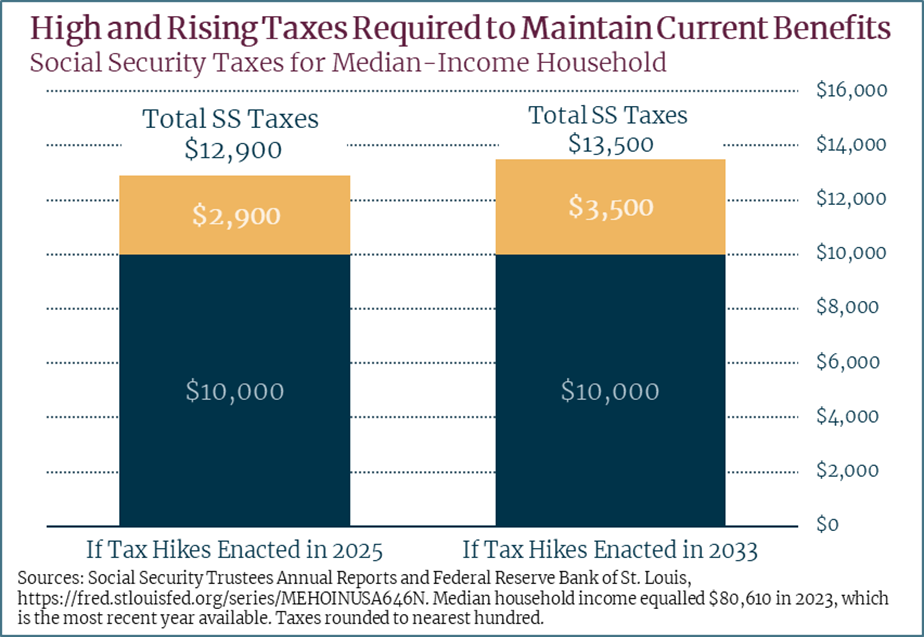
Social Security started out as a 2.0 percent tax and its founders said that the program would never take more than 6.0 percent of workers’ paychecks. Today, it takes more than twice that at 12.4 percent. Continuing to pay scheduled benefits would require taxes to eventually reach almost three times the originally intended rate.
Social Security’s Shortfall Equals $25.1 Trillion
Social Security’s shortfall, or unfunded obligation, represents the amount of additional money that would be necessary to maintain the current level of benefits for the next 75 years. Social Security’s shortfall increased by $2.5 trillion in 2025, to $25.1 trillion.
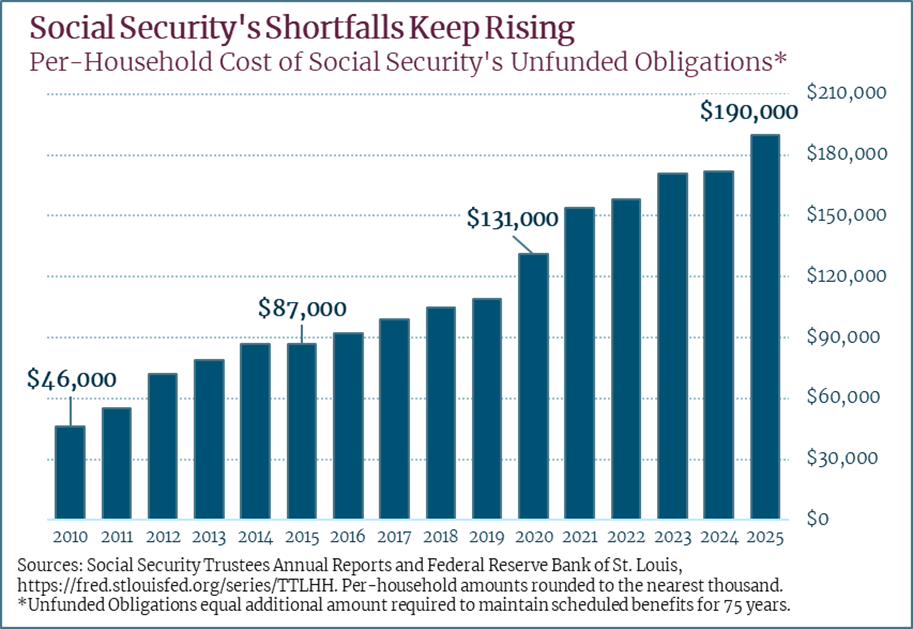
Social Security’s shortfall equals $192,000 for every household in America. This is $19,000 more than just one year ago, and a four-fold increase since 2010 when Social Security’s shortfall amounted to $46,000 per household.
Recent Legislation Exacerbated Social Security’s Shortfalls
At the end of 2024, Congress passed and President Biden signed into law the so-called “Social Security Fairness Act,” which reinstated windfall benefits to individuals who worked in jobs that were exempt from Social Security taxes. While a correction to the Windfall Elimination Provision and Government Pension Offset were needed, eliminating these provisions entirely resulted in
unfair and inaccurate benefits that will exacerbate Social Security’s shortfalls by about $200 billion over the next 10 years and will cause the trust fund to become insolvent about six months earlier in 2033.
U.S. Fiscal Space and Social Security Insolvency Could Collide
The federal government’s fiscal trajectory is unsustainable. EPIC President Paul Winfree has cautioned about America’s declining fiscal space and
recently noted, “unless the growth in spending is meaningfully reduced, it is very possible that the federal government could enter a debt spiral by the early-2030s.” That would mean that the federal government runs out of fiscal space around the same time that Social Security’s trust fund runs dry in 2033. When fiscal space runs out, the federal government will lose its ability to borrow money at reasonable interest rates, and it will be too late for policymakers to choose measured and rational spending reductions. This means that potential short-term fixes like a general fund transfer become extremely costly and could further erode confidence in our ability to fund future debt obligations.
Social Security Reform Can Make the Program Stronger and Improve Fiscal Space
Every year that policymakers wait to confront Social Security’s impending insolvency, the costs of reform rise, making it harder to preserve current Social Security benefits for those who need them most. Meanwhile, the federal government’s rising debt threatens not only America’s future, but its ability to respond to domestic risks such as a recession, or international threats from abroad.
Social Security reform is not only possible; it is—politics aside—economically and fiscally advantageous. By curbing Social Security’s excess growth, focusing on its intended purposes, and allowing a personal wealth-building component, Social Security can become solvent and stronger. According to the Penn Wharton Budget Model, a smaller and more targeted Social Security program could increase long-term GDP by
5.3 percent (while a larger program would
reduce GDP by 1.0 percent). This would translate into a gain of about $4,000 per year in median household income across the United States.
Moreover, addressing Social Security reform now would signal to bond markets that the United States is willing to address its fiscal imbalances. This could reduce borrowing costs and expand the federal government’s fiscal space, providing immediate leeway to address potential economic shocks and international threats as well as give additional time to enact common sense and measured reductions in federal spending.