Categorical eligibility allows a person to automatically be eligible for a welfare program based on their receipt of another welfare program.
In the Food Stamp program, a household can qualify if they first receive Supplemental Security Income (SSI), Temporary Assistance for Needy Families (TANF), or a state General Assistance (GA) benefit. Categorical eligibility means the household does not need to follow the normal Food Stamp eligibility rules.
Broad-Based Categorical Eligibility (BBCE) Loophole
Broad-based categorical eligibility (BBCE) allows households to be deemed eligible for Food Stamps by being provided a nominal TANF “benefit,” such as an informational pamphlet or access to an 800 number.
These nominal, non-cash TANF “benefits” were deemed permissible and encouraged by regulation and guidance from the Clinton and Obama Administrations.
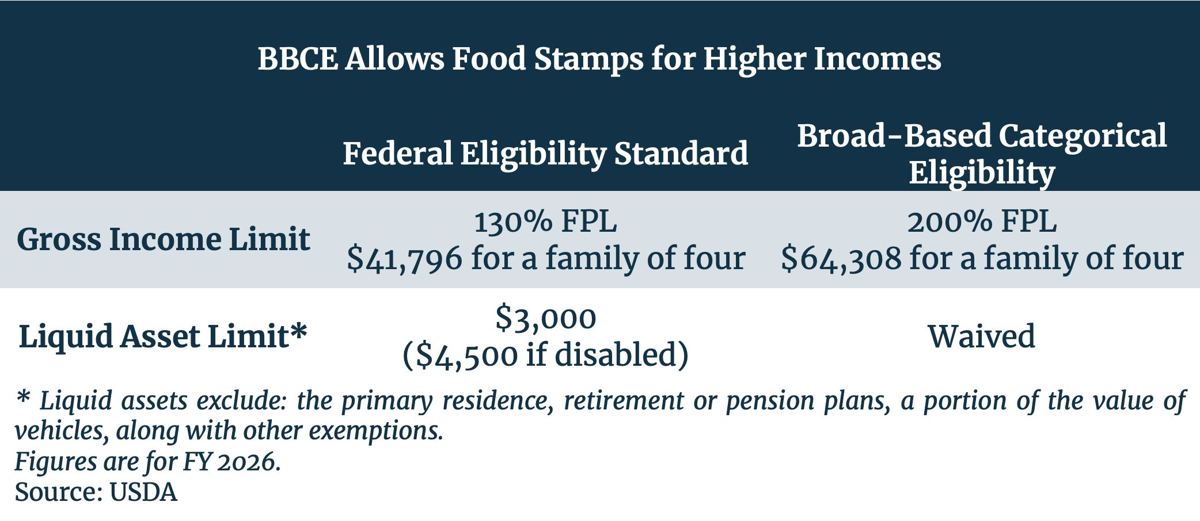
Under the BBCE regulations, states can completely waive the asset test, waive the net income test, and increase the gross income limit to 200 percent of the federal poverty level (from 130 percent of FPL). Even
millionaires can qualify for Food Stamps thanks to the categorical eligibility loophole.
Only Seven States Follow the Federal Standards for Food Stamps
44 states (including Washington, D.C.) do not follow the federal rules for Food Stamp eligibility and
instead use BBCE.
Millions Get Food Stamps Despite Not Meeting the Federal Eligibility Rules
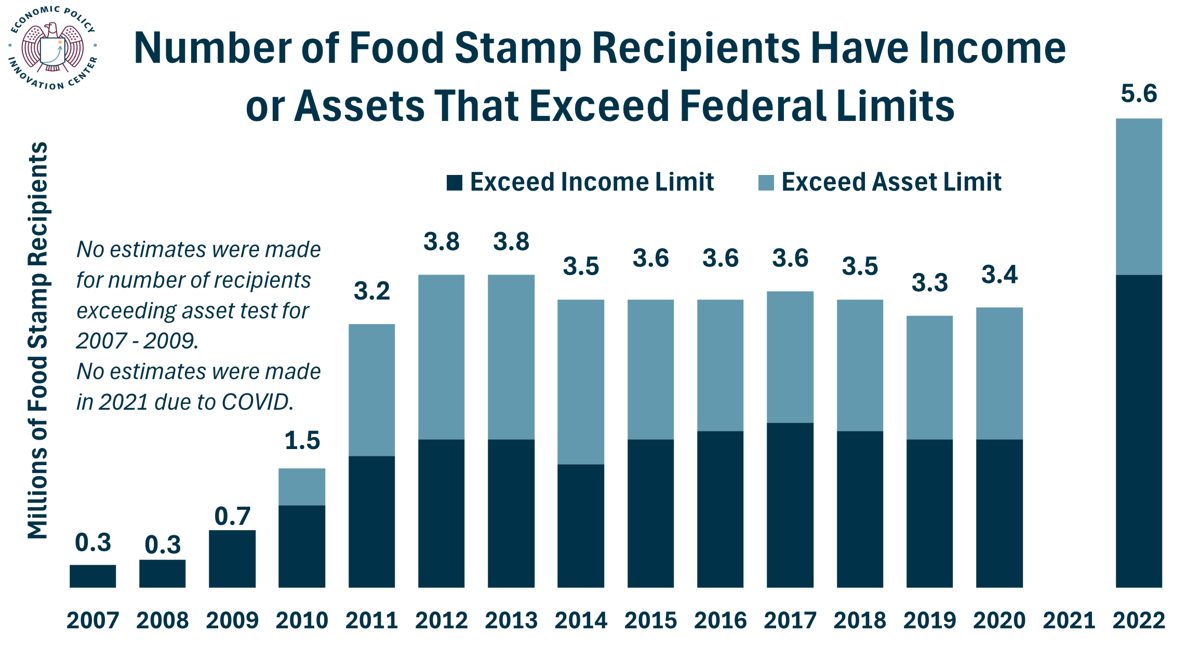
Millions of individuals receive Food Stamps despite not meeting the federal eligibility rules. Although these individuals have income or assets above the limits, they can enroll in Food Stamps due to categorical eligibility.
When states use categorical eligibility, they do not have to collect or verify detailed information about the assets owned by Food Stamp applicants. As a result, no one knows exactly how many people are getting Food Stamp benefits despite failing to meet the federal eligibility standards.
A
report for the USDA estimated that 5.6 million individuals were made eligible by BBCE and received Food Stamps, but “did not meet the Federal SNAP income or resource rules” in FY 2022, equivalent to 14 percent of total enrollment.
The cost of categorical eligibility is projected to exceed $100 billion over the next decade by the
Foundation for Government Accountability.
Categorical Eligibility Can be Used to Hide Improper Payments
Categorical eligibility makes it easier for states to report lower improper payment rates by avoiding enforcement of the federal Food Stamp eligibility rules.
When states use categorical eligibility, they do not have to verify the assets owned by applicants. States have more flexibility in verifying gross income, as they can increase the maximum limit above the federal 130 percent of the FPL standard. States can also disregard the net income test. These lost check points create room for fraud.
The
USDA Office of Inspector General (OIG) reported that the use of BBCE “significantly understated the SNAP error rate since BBCE recipients’ eligibility was not assessed during the [quality control] reviews.”