America’s Food Stamp program was created to serve needy individuals, not fund groceries for millionaires.
Yet in Minnesota, a retired millionaire qualified for food stamps – and it wasn’t a mistake.
Thanks to a loophole called Broad-Based Categorical Eligibility (BBCE), states can provide food stamps to individuals with an unlimited amount of assets. The BBCE policy essentially allows any state that adopts it to eliminate the federal asset limits for food stamps.
Since its expansion in the early 2000s, 40 states have adopted this policy and eliminated asset limits entirely.
This fraudulent policy directs resources away from the truly needy population food stamps were designed to serve and should be eliminated by Congress.
How the BBCE Loophole Opens the Door to Abuse
Under federal law, individuals may qualify for food stamps if they meet a certain income limit and an asset limit of up to $4,500.
The BBCE policy offers states a workaround to bypass federal limits by letting them also grant eligibility to individuals authorized for cash and “non-cash” benefits from other welfare programs, such as Temporary Assistance for Needy Families (TANF).
The potential for abuse begins with a state’s broad discretion in defining who qualifies for “non-cash” benefits.
Categorical eligibility was originally designed to deliver food stamps to families receiving cash assistance from welfare programs without making them go through additional eligibility tests.
But in 1999 the Clinton administration allowed states to extend food stamp eligibility to individuals qualified to receive TANF-funded “non-cash benefits” as well. States are less inclined to have stricter eligibility requirements for non-cash benefits considering they are less costly than cash benefits.
Federal rules give states major leeway to determine TANF-funded non-cash service eligibility. Some TANF services do not even require need-testing. The state simply has to claim that the service achieves one of four vague goals related to reducing poverty, two of which can technically be applied to any person in a state.
Shockingly,
the Congressional Research Service (CRS) admits that non-cash TANF services “are potentially available to a state’s entire population.”
Because states can confer eligibility of non-cash benefits without an asset test, they essentially bypass the federal asset limits for food stamps.
So, an individual that may have little to no income – but millions of dollars in assets – can qualify for a TANF-funded benefit under a state’s broad eligibility requirements and, in turn, receive food stamps.
The Loophole in Practice
For perspective, consider our example based on a true story that shows how Minnesota could use the BBCE loophole to grant food stamps to millionaire Scott.
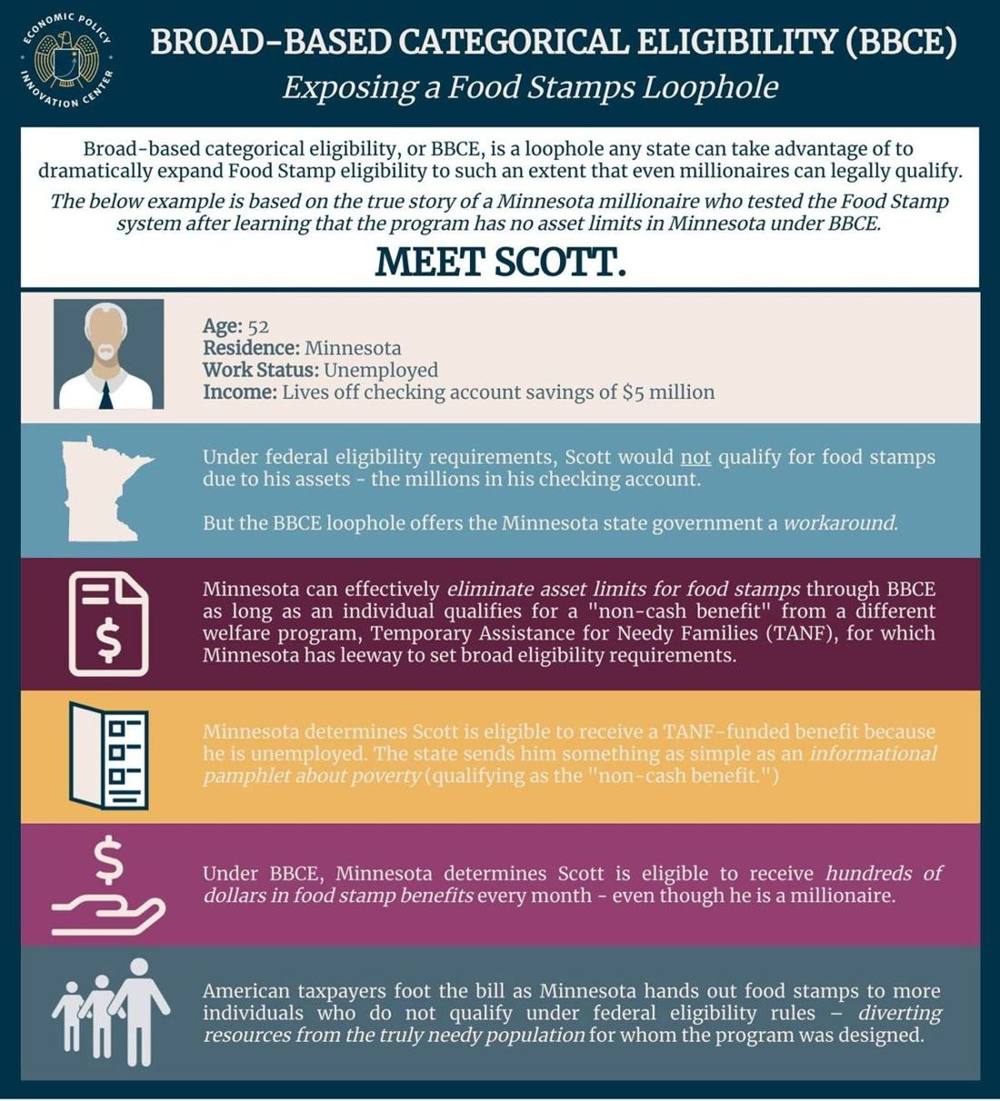
Mr. Rob Undersander, a retired millionaire from Minnesota, discovered that his state’s food stamp application ignored assets. He applied as an experiment to see if someone like him would qualify. Soon after, he was receiving hundreds of dollars in food stamps per month.
He urged Minnesota to close this loophole back in 2019, but the state legislature failed to act.
Sadly, Mr. Undersander is not the only recipient of food stamps with significant assets.
In 2023, the
Foundation for Government Accountability found that more than one in five food stamp recipients have $100,000 or more in assets, and 5.4 million recipients exceed either the federal income or asset limits.
Washington Sees the Issue, Yet the Policy Lingers
The worst part of it all is that the federal government has acknowledged for the past decade that the policy invites abuse, yet it has remained in place.
The government’s own official watchdog,
the Government Accountability Office (GAO), sounded the alarm almost 12 years ago admitting BBCE can undermine program integrity.
Years later the policy was referred to as “an embarrassment” by Representative Dusty Johnson (R-SD) in a
U.S. House Agriculture Committee Oversight hearing.
Congress Should Direct Resources to the Truly Needy
Representative Ben Cline (R-VA) has introduced a bill titled “
No Welfare for the Wealthy Act of 2025.” This would set the common-sense rule that all food stamp recipients meet the program’s federal income and asset requirements. It really is as straight forward as that.
The six states that do not use this fraudulent loophole – Alaska, Arkansas, Mississippi, South Dakota, Tennessee, and Wyoming – should keep up the good work in maintaining Food Stamp program integrity and encouraging human dignity through
self-sufficiency.
The Food Stamp program in its proper form helps lift Americans out of poverty and protects children by providing a temporary safety net. The BBCE loophole distorts that and drives resources away from the truly needy population the program was originally designed to serve.
It’s baffling policies like BBCE that betray the trust of American taxpayers. The government has debated fixing this for long enough – it’s time for Congress to pass legislation and end the loophole.