Op-Ed
CBO: One Big Beautiful Bill Grows the Economy, Cuts Taxes & Slows Welfare Spending
February 12, 2026 · David Ditch

 Source: U.S. Department of Agriculture.
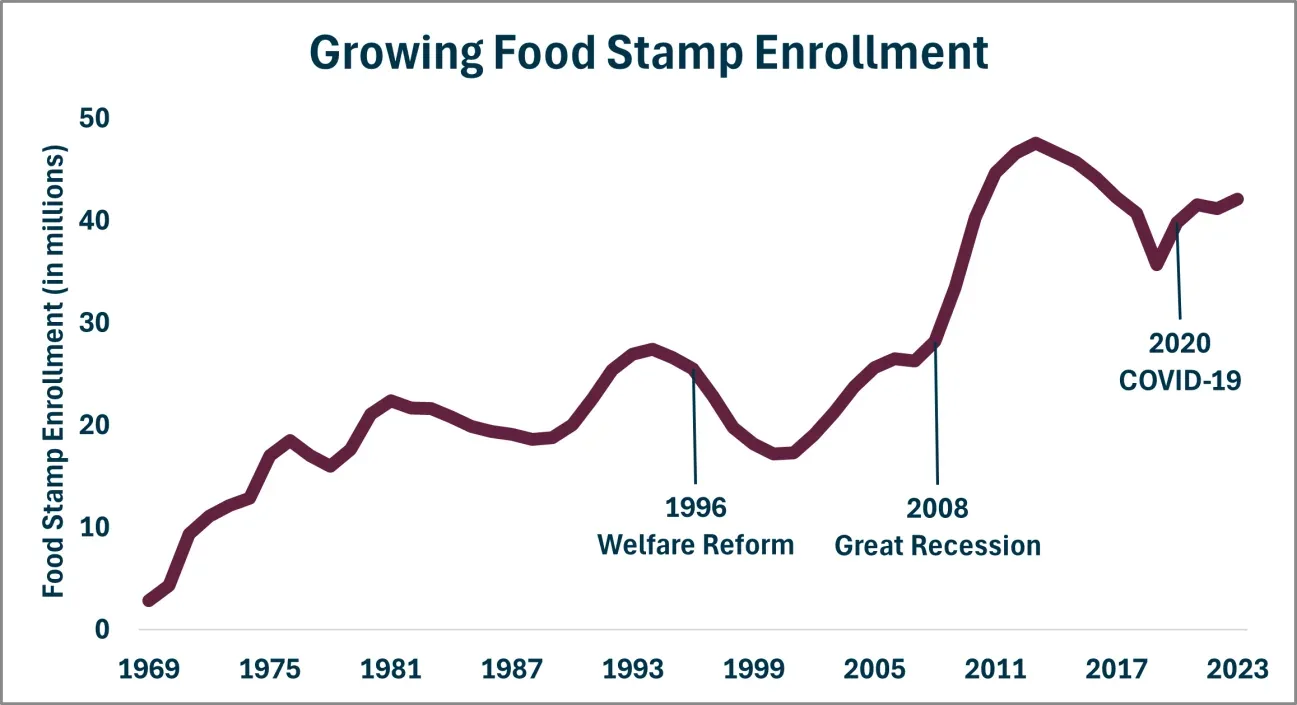
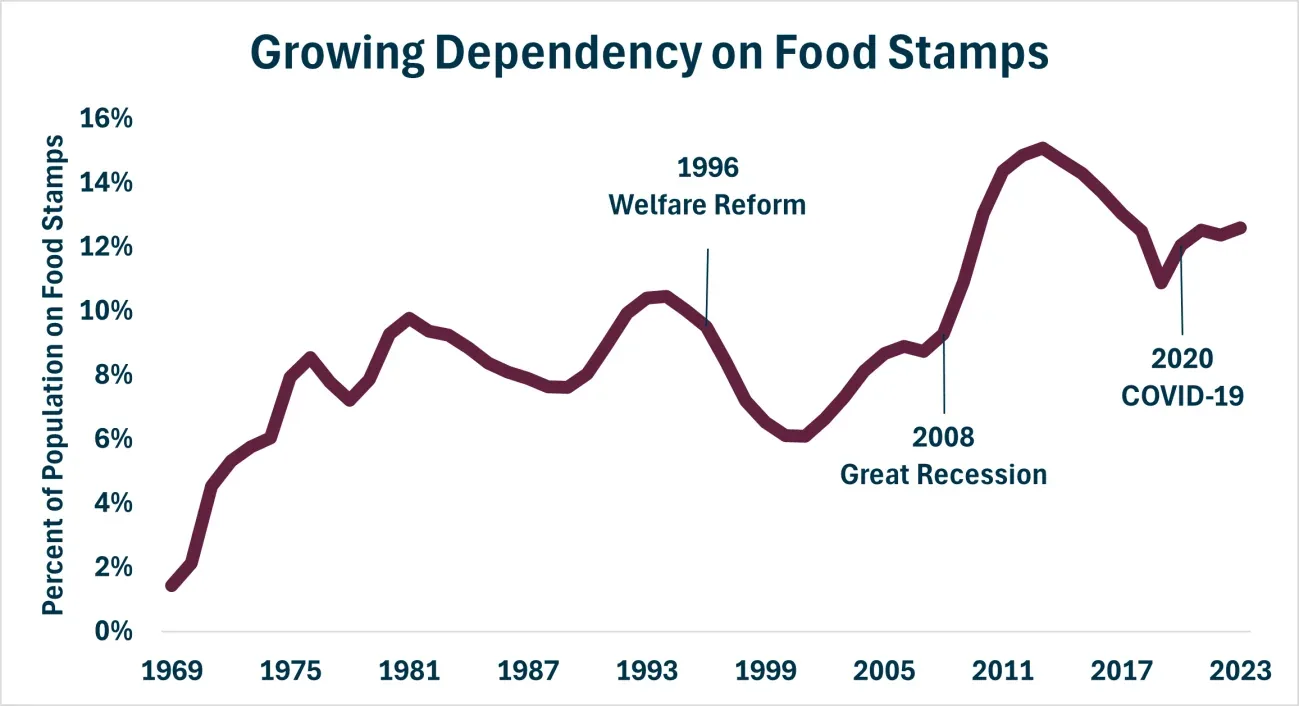
As the number of people receiving food stamp benefits has increased, the percentage of the U.S. population enrolled has also increased. In fiscal year 2023, 12.6 percent of the total U.S. population received food stamp benefits. This is more than double the 6.1 percent in FY 2001. In FY 2013, a record high of 15.1 percent of Americans received food stamps.[4],” retrieved from FRED, Federal Reserve Bank of St. Louis, https://fred.stlouisfed.org/series/POP (accessed February 1, 2024).]
Chart 2
Source: U.S. Department of Agriculture.
As the number of people receiving food stamp benefits has increased, the percentage of the U.S. population enrolled has also increased. In fiscal year 2023, 12.6 percent of the total U.S. population received food stamp benefits. This is more than double the 6.1 percent in FY 2001. In FY 2013, a record high of 15.1 percent of Americans received food stamps.[4],” retrieved from FRED, Federal Reserve Bank of St. Louis, https://fred.stlouisfed.org/series/POP (accessed February 1, 2024).]
Chart 2
 Source: U.S. Department of Agriculture.
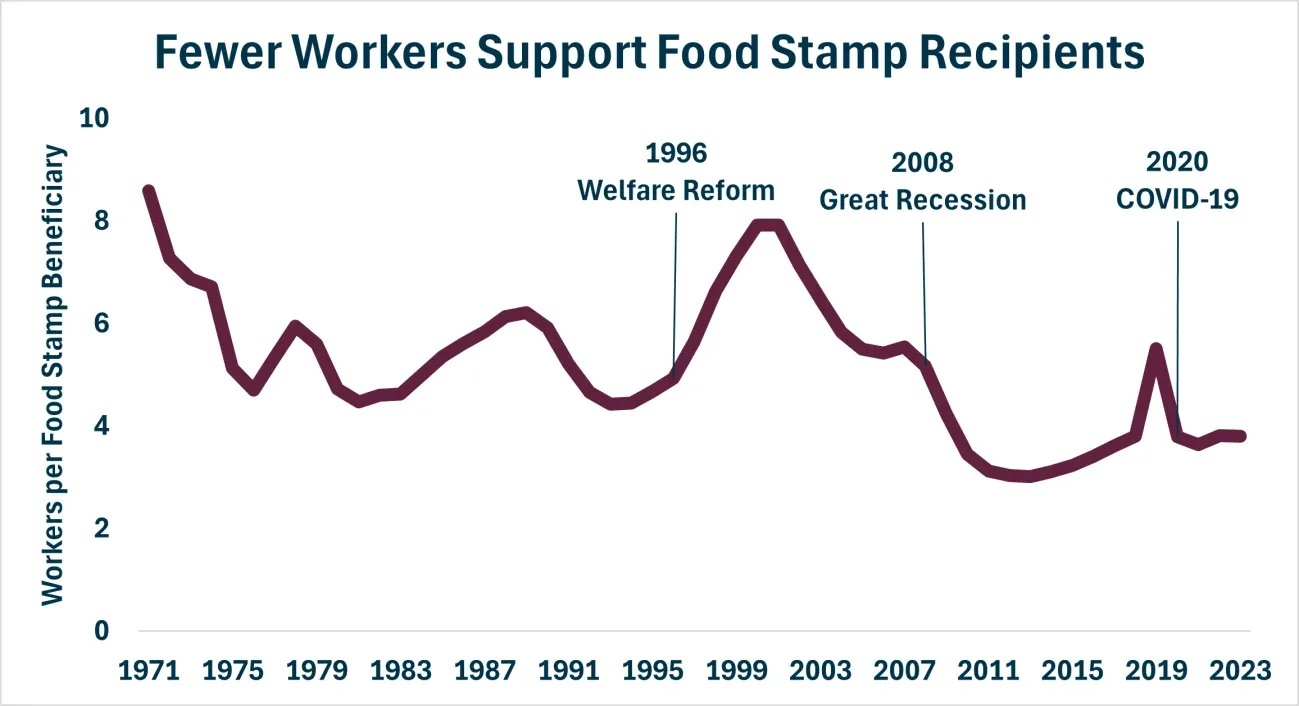
Growing food stamp enrollment has led to fewer workers throughout the economy paying taxes and supporting each welfare recipient. In FY 2023, there were just 3.8 workers for each food stamp recipient. Between FY 1971 and 2000, the economy averaged
5.7 workers for each food stamp recipient.[5],” retrieved from FRED, Federal Reserve Bank of St. Louis, https://fred.stlouisfed.org/series/LNU02000000 (accessed February 2, 2024).]
Chart 3
Source: U.S. Department of Agriculture.
Growing food stamp enrollment has led to fewer workers throughout the economy paying taxes and supporting each welfare recipient. In FY 2023, there were just 3.8 workers for each food stamp recipient. Between FY 1971 and 2000, the economy averaged
5.7 workers for each food stamp recipient.[5],” retrieved from FRED, Federal Reserve Bank of St. Louis, https://fred.stlouisfed.org/series/LNU02000000 (accessed February 2, 2024).]
Chart 3
 Sources: U.S. Department of Agriculture and Bureau of Labor Statistics.
 Source: U.S. Department of Health and Human Services.
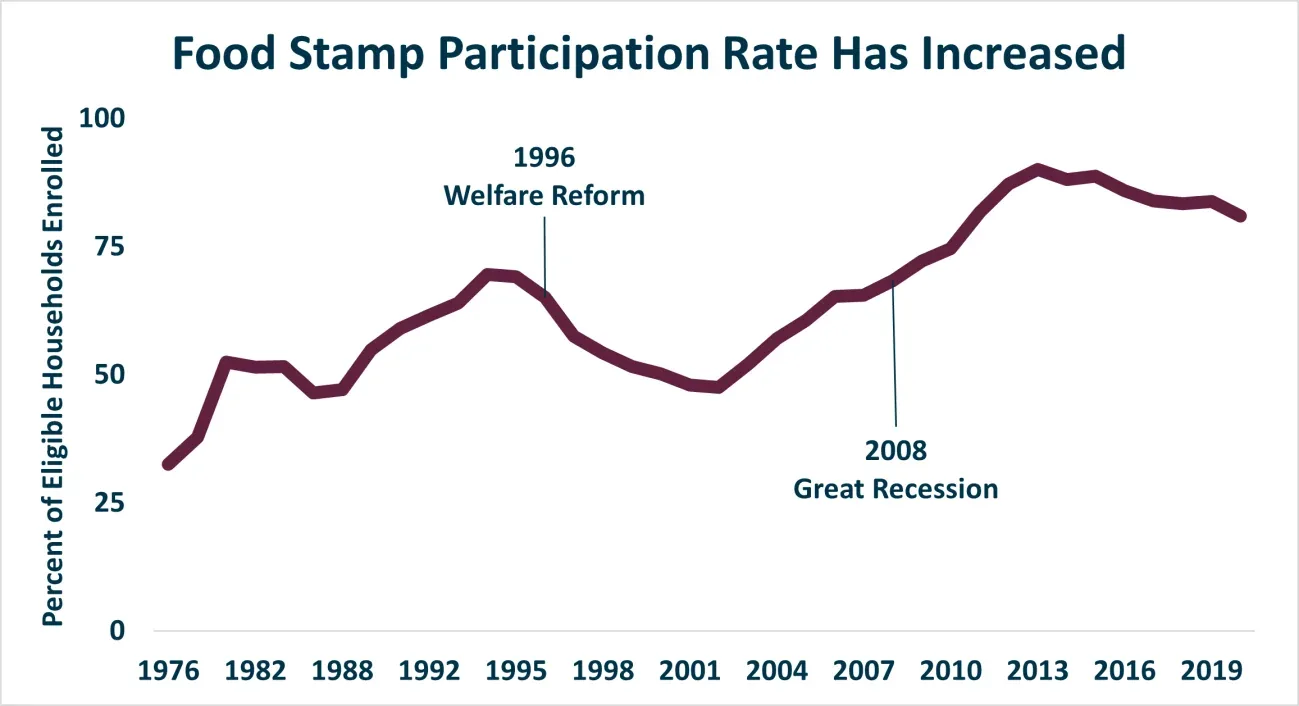
The growth in the food stamp participation rate accelerated rapidly after the enactment of the 2002 Farm Bill signed by President George W. Bush, despite relatively low unemployment and a growing economy at the time. Growth continued through the enactment of the 2008 Farm Bill and President Barack Obama’s 2009 stimulus law, with the participation rate peaking in 2013 and only modestly receding thereafter.
According to Veronique de Rugy of the Mercatus Center, the 2002 Farm Bill expanded eligibility to non-citizens, increased benefits, and made enrollment easier. Further easing of eligibility requirements and higher benefits were included in the 2008 and 2009 laws.[7] The expanded use of work requirement waivers and other loopholes such as categorical eligibility and waiving asset tests promoted higher enrollment.[8] The Center on Budget and Policy Priorities attributes the growth in the participation rate to several factors, including easing enrollment and renewal procedures, higher benefit levels, additional awareness about the program, reduced stigma for collecting welfare benefits, and increased outreach to eligible populations.[9]
The U.S. Department of Agriculture (USDA) summarizes the causes for higher participation and enrollment in food stamps since 2002 as the result of the Great Recession and the slow economic recovery, increased eligibility for noncitizens and immigrant children, expanded vehicle asset test exclusions, increased benefit allotments, work requirement waivers, and sustained increases in outreach about the program.[10]
The Obama Administration ramped up food stamp promotion efforts, even spending millions on a campaign that encouraged “food stamp parties” and making Keynesian- style claims about the stimulus multiplier effects of increasing benefit receipt to push enrollment.[11] Both the Bush and Obama administrations partnered with the Mexican government “to promote nutrition assistance programs — notably food stamps — among Mexican Americans, Mexican nationals and migrant communities in America.”[12] Notably, the food stamp participation rate in California – home to about 1 in 10 food stamp recipients nationwide – grew 22 percentage points between 2007 and 2015.[13]
The Biden Administration has continued these efforts, with a USDA official writing that the agency “highly encourages states to consider requesting waivers of the [able-bodied adults without dependents (ABAWD)] time limit and to use discretionary exemptions as appropriate.”[14]
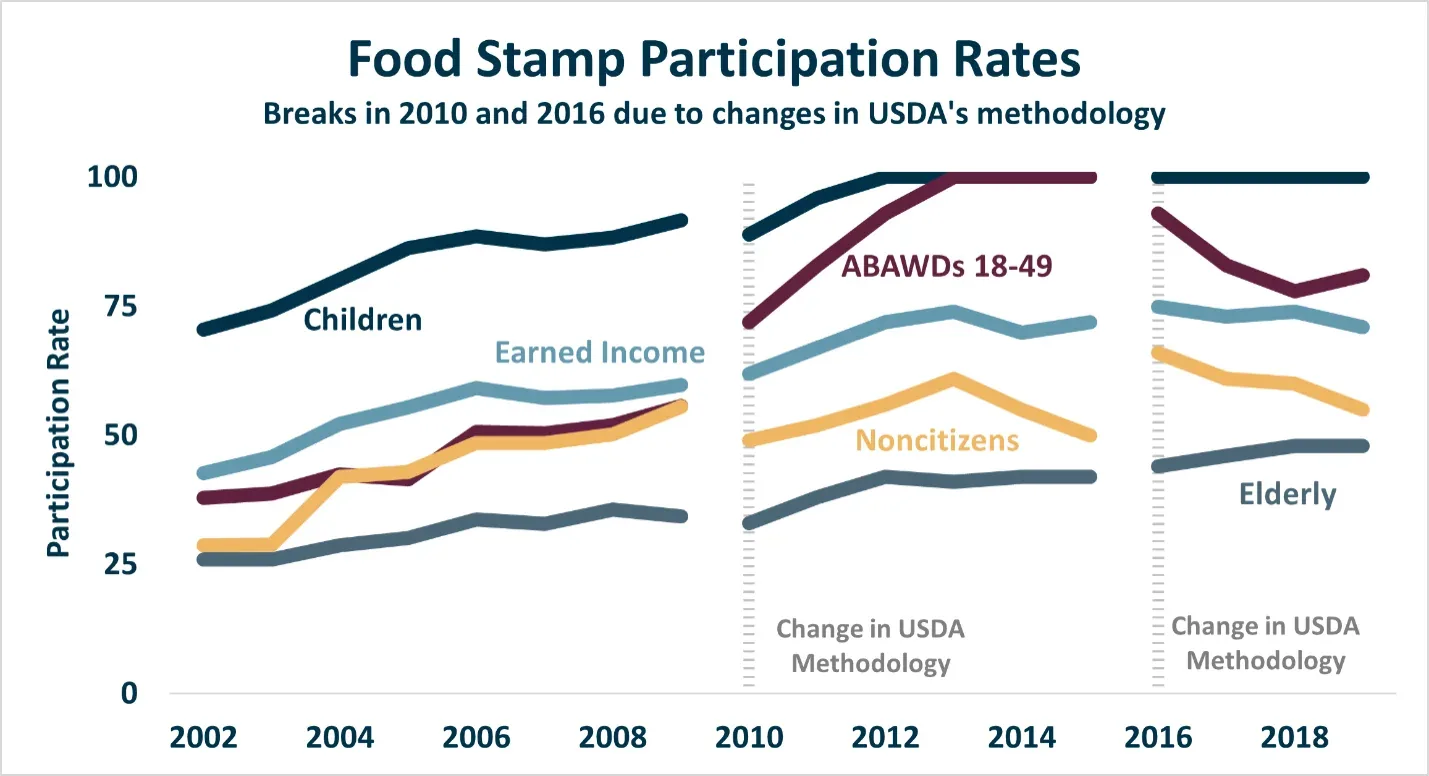
These efforts have led to significant increases in participation rates for certain types of food stamp recipients.[15] Most notable is the growth in the participation of able-bodied adults without dependents (ABAWDs) aged 18 to 49 (the population that is supposed to be subject to work requirements as a condition for receiving benefits). In 2002, 37.9 percent of eligible ABAWDs received food stamp benefits.[16] By 2013, virtually all eligible ABAWDs were participating in the program.[17] In 2019, 81 percent of eligible ABAWDs received food stamp benefits, despite a robust economy and a low unemployment rate.[18]
A higher proportion of eligible noncitizens have also received food stamp benefits in recent years, growing from 28.7 percent in 2002 to 55.6 percent of eligible noncitizens in 2009.[19] In 2019, 55 percent of eligible noncitizens received food stamps.[20]
Virtually all eligible children (a reported 100 percent in 2019) now receive food stamp benefits.[21] This is an increase from 2002, when 70.5 percent of eligible children received food stamps.[22]
Chart 5
Source: U.S. Department of Health and Human Services.
The growth in the food stamp participation rate accelerated rapidly after the enactment of the 2002 Farm Bill signed by President George W. Bush, despite relatively low unemployment and a growing economy at the time. Growth continued through the enactment of the 2008 Farm Bill and President Barack Obama’s 2009 stimulus law, with the participation rate peaking in 2013 and only modestly receding thereafter.
According to Veronique de Rugy of the Mercatus Center, the 2002 Farm Bill expanded eligibility to non-citizens, increased benefits, and made enrollment easier. Further easing of eligibility requirements and higher benefits were included in the 2008 and 2009 laws.[7] The expanded use of work requirement waivers and other loopholes such as categorical eligibility and waiving asset tests promoted higher enrollment.[8] The Center on Budget and Policy Priorities attributes the growth in the participation rate to several factors, including easing enrollment and renewal procedures, higher benefit levels, additional awareness about the program, reduced stigma for collecting welfare benefits, and increased outreach to eligible populations.[9]
The U.S. Department of Agriculture (USDA) summarizes the causes for higher participation and enrollment in food stamps since 2002 as the result of the Great Recession and the slow economic recovery, increased eligibility for noncitizens and immigrant children, expanded vehicle asset test exclusions, increased benefit allotments, work requirement waivers, and sustained increases in outreach about the program.[10]
The Obama Administration ramped up food stamp promotion efforts, even spending millions on a campaign that encouraged “food stamp parties” and making Keynesian- style claims about the stimulus multiplier effects of increasing benefit receipt to push enrollment.[11] Both the Bush and Obama administrations partnered with the Mexican government “to promote nutrition assistance programs — notably food stamps — among Mexican Americans, Mexican nationals and migrant communities in America.”[12] Notably, the food stamp participation rate in California – home to about 1 in 10 food stamp recipients nationwide – grew 22 percentage points between 2007 and 2015.[13]
The Biden Administration has continued these efforts, with a USDA official writing that the agency “highly encourages states to consider requesting waivers of the [able-bodied adults without dependents (ABAWD)] time limit and to use discretionary exemptions as appropriate.”[14]
These efforts have led to significant increases in participation rates for certain types of food stamp recipients.[15] Most notable is the growth in the participation of able-bodied adults without dependents (ABAWDs) aged 18 to 49 (the population that is supposed to be subject to work requirements as a condition for receiving benefits). In 2002, 37.9 percent of eligible ABAWDs received food stamp benefits.[16] By 2013, virtually all eligible ABAWDs were participating in the program.[17] In 2019, 81 percent of eligible ABAWDs received food stamp benefits, despite a robust economy and a low unemployment rate.[18]
A higher proportion of eligible noncitizens have also received food stamp benefits in recent years, growing from 28.7 percent in 2002 to 55.6 percent of eligible noncitizens in 2009.[19] In 2019, 55 percent of eligible noncitizens received food stamps.[20]
Virtually all eligible children (a reported 100 percent in 2019) now receive food stamp benefits.[21] This is an increase from 2002, when 70.5 percent of eligible children received food stamps.[22]
Chart 5
 Source: U.S. Department of Agriculture.
Data from the USDA also shows that lower income individuals participate at a higher rate than those with higher incomes who are also eligible for food stamp benefits. Nearly all of those eligible for food stamps with earnings at or below the poverty line receive benefits, while less than half of those eligible with earnings above the poverty line choose to enroll.[23]
Source: U.S. Department of Agriculture.
Data from the USDA also shows that lower income individuals participate at a higher rate than those with higher incomes who are also eligible for food stamp benefits. Nearly all of those eligible for food stamps with earnings at or below the poverty line receive benefits, while less than half of those eligible with earnings above the poverty line choose to enroll.[23]
 Source: Office of Management and Budget.
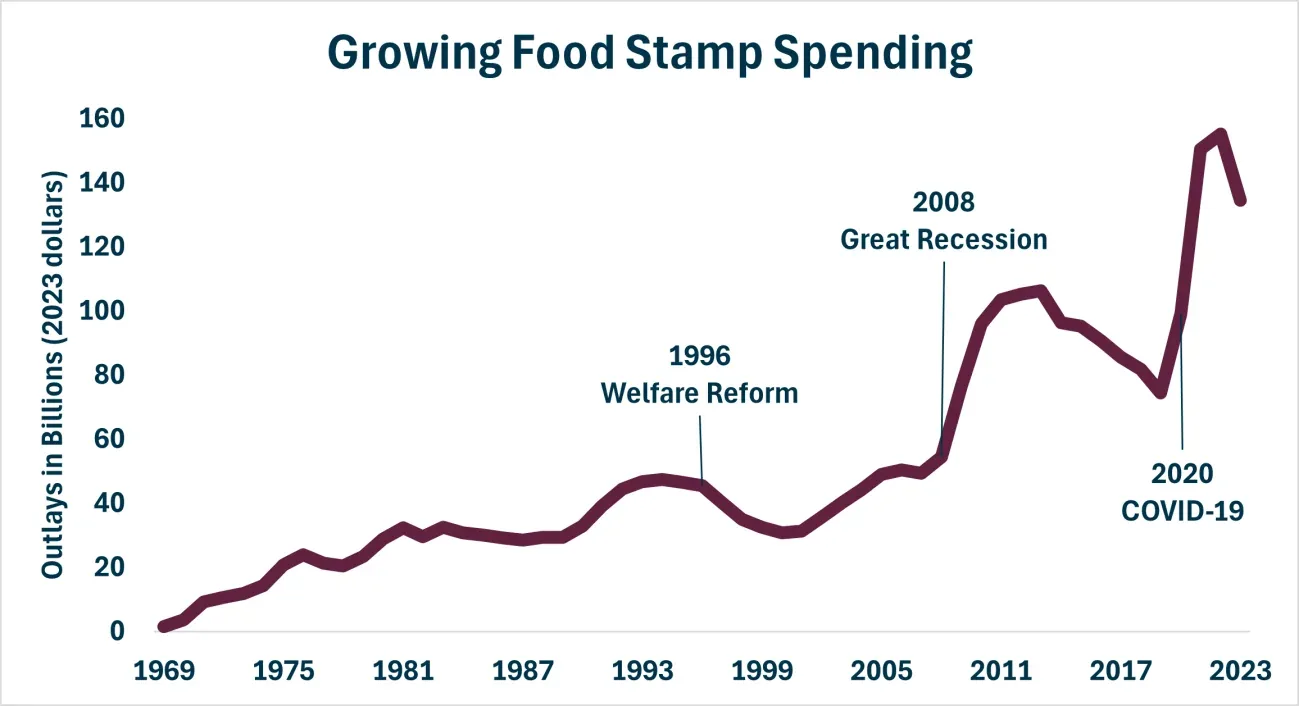
The trend in food stamp outlays shows significant spikes in 2009 and 2020. This is due to two related factors: 1) increased enrollment in the wake of the Great Recession and the COVID-19 pandemic and government shutdowns of the economy; and more significantly, 2) major increases in benefit payments and eligibility enacted by Congress and the USDA.
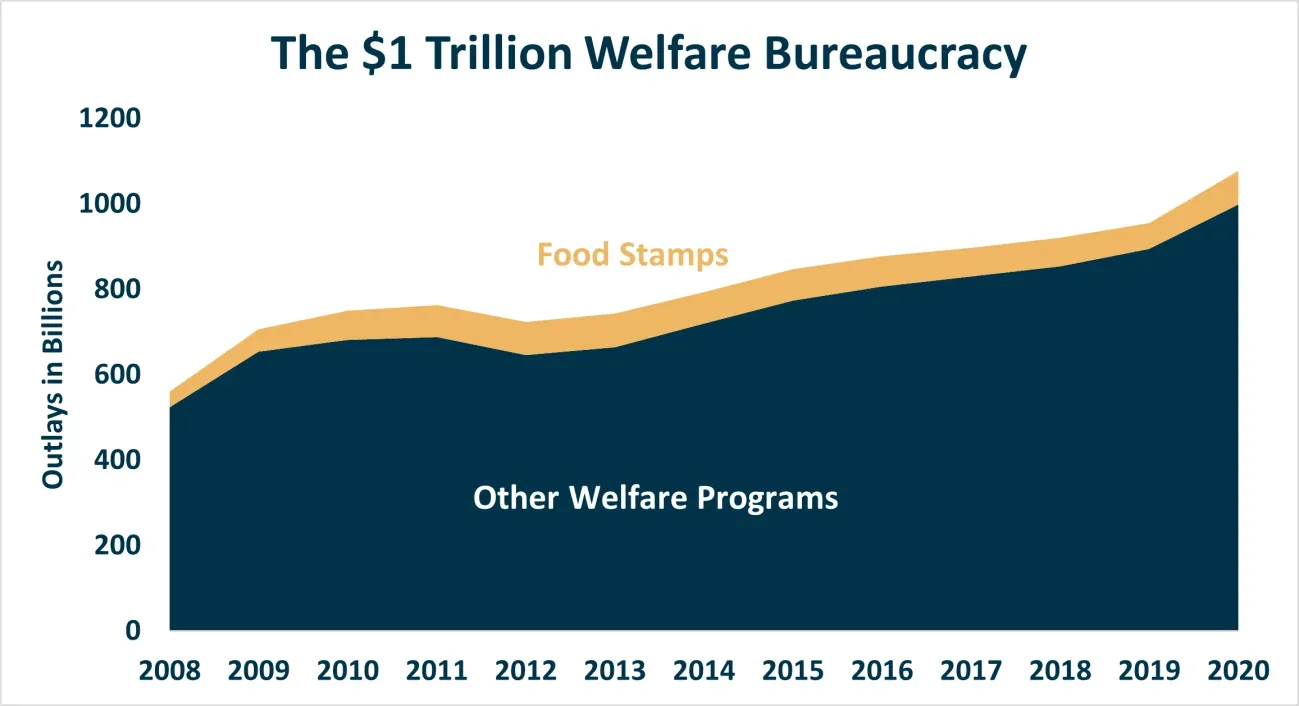
The food stamp program is just one of more than 80 welfare assistance programs funded by the federal government. In 2019, the government operated 11 other food assistance programs in addition to food stamps, with those additional programs costing taxpayers more than $31 billion.
According to the Congressional Research Service, the total cost of welfare programs for low-income individuals exceeds $1 trillion annually.[25] Robert Rector and Jamie Hall of the Heritage Foundation have calculated that in 2018, government-provided cash, food, housing, medical, education, and other social services benefits exceeded $65,000 per poor family with children.[26] This web of the welfare bureaucracy can trap people in dependence, discourage work, undermine families and communities, and fail to deliver sustainable results for the people who need a hand up.
Chart 7
Source: Office of Management and Budget.
The trend in food stamp outlays shows significant spikes in 2009 and 2020. This is due to two related factors: 1) increased enrollment in the wake of the Great Recession and the COVID-19 pandemic and government shutdowns of the economy; and more significantly, 2) major increases in benefit payments and eligibility enacted by Congress and the USDA.
The food stamp program is just one of more than 80 welfare assistance programs funded by the federal government. In 2019, the government operated 11 other food assistance programs in addition to food stamps, with those additional programs costing taxpayers more than $31 billion.
According to the Congressional Research Service, the total cost of welfare programs for low-income individuals exceeds $1 trillion annually.[25] Robert Rector and Jamie Hall of the Heritage Foundation have calculated that in 2018, government-provided cash, food, housing, medical, education, and other social services benefits exceeded $65,000 per poor family with children.[26] This web of the welfare bureaucracy can trap people in dependence, discourage work, undermine families and communities, and fail to deliver sustainable results for the people who need a hand up.
Chart 7
 Source: Congressional Research Service.
 Source: USDA
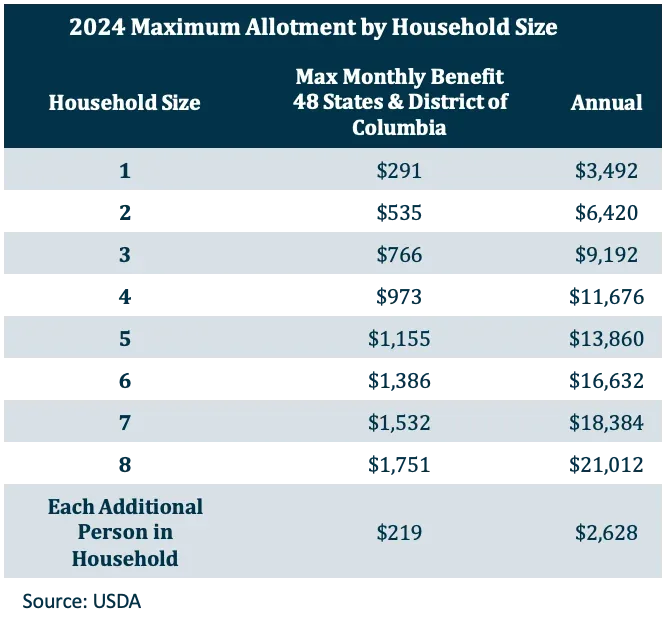
The maximum food stamp allotment for a household of four people is equal to the “Thrifty Food Plan” for a “reference family” of an adult man, an adult woman, and two children. The Thrifty Food Plan is meant to represent the cost of “a nutritious, practical, cost-effective diet prepared at home.”[29] Maximum allotments are higher in Alaska, Hawaii, Guam, and the U.S. Virgin Islands.
In FY 2024, a household of four people could receive a maximum monthly food stamp allotment of $973, equating to an annual benefit of $11,676.[30]
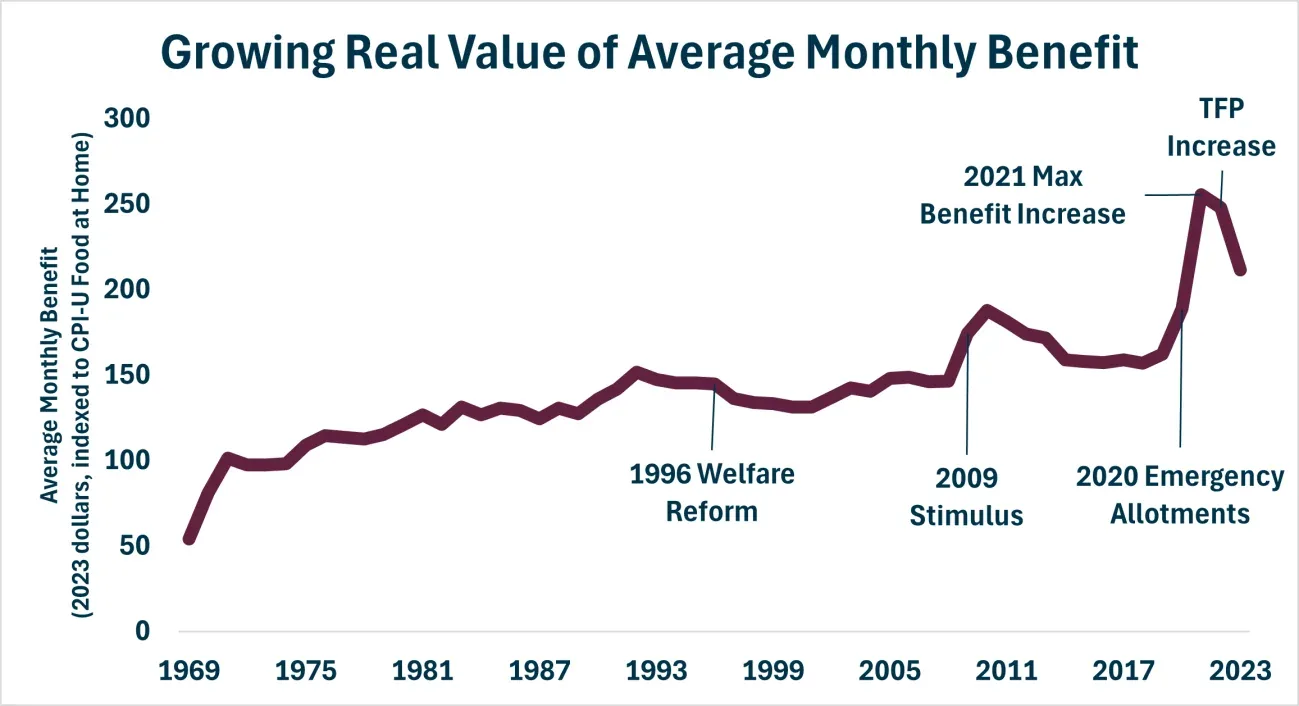
The maximum allotment receives an annual cost-of-living adjustment (COLA) through a calculation of the Thrifty Food Plan each June to account for inflation. However, food stamp allotments have grown significantly faster than inflation in recent years.
Chart 8
Source: USDA
The maximum food stamp allotment for a household of four people is equal to the “Thrifty Food Plan” for a “reference family” of an adult man, an adult woman, and two children. The Thrifty Food Plan is meant to represent the cost of “a nutritious, practical, cost-effective diet prepared at home.”[29] Maximum allotments are higher in Alaska, Hawaii, Guam, and the U.S. Virgin Islands.
In FY 2024, a household of four people could receive a maximum monthly food stamp allotment of $973, equating to an annual benefit of $11,676.[30]
The maximum allotment receives an annual cost-of-living adjustment (COLA) through a calculation of the Thrifty Food Plan each June to account for inflation. However, food stamp allotments have grown significantly faster than inflation in recent years.
Chart 8
 Sources: U.S. Department of Agriculture and U.S. Bureau of Labor Statistics.
Benefit levels have grown primarily due to policy changes meant to intentionally increase allotments faster than inflation.
Chart 9
Sources: U.S. Department of Agriculture and U.S. Bureau of Labor Statistics.
Benefit levels have grown primarily due to policy changes meant to intentionally increase allotments faster than inflation.
Chart 9
 Sources: U.S. Department of Agriculture and Bureau of Labor Statistics.
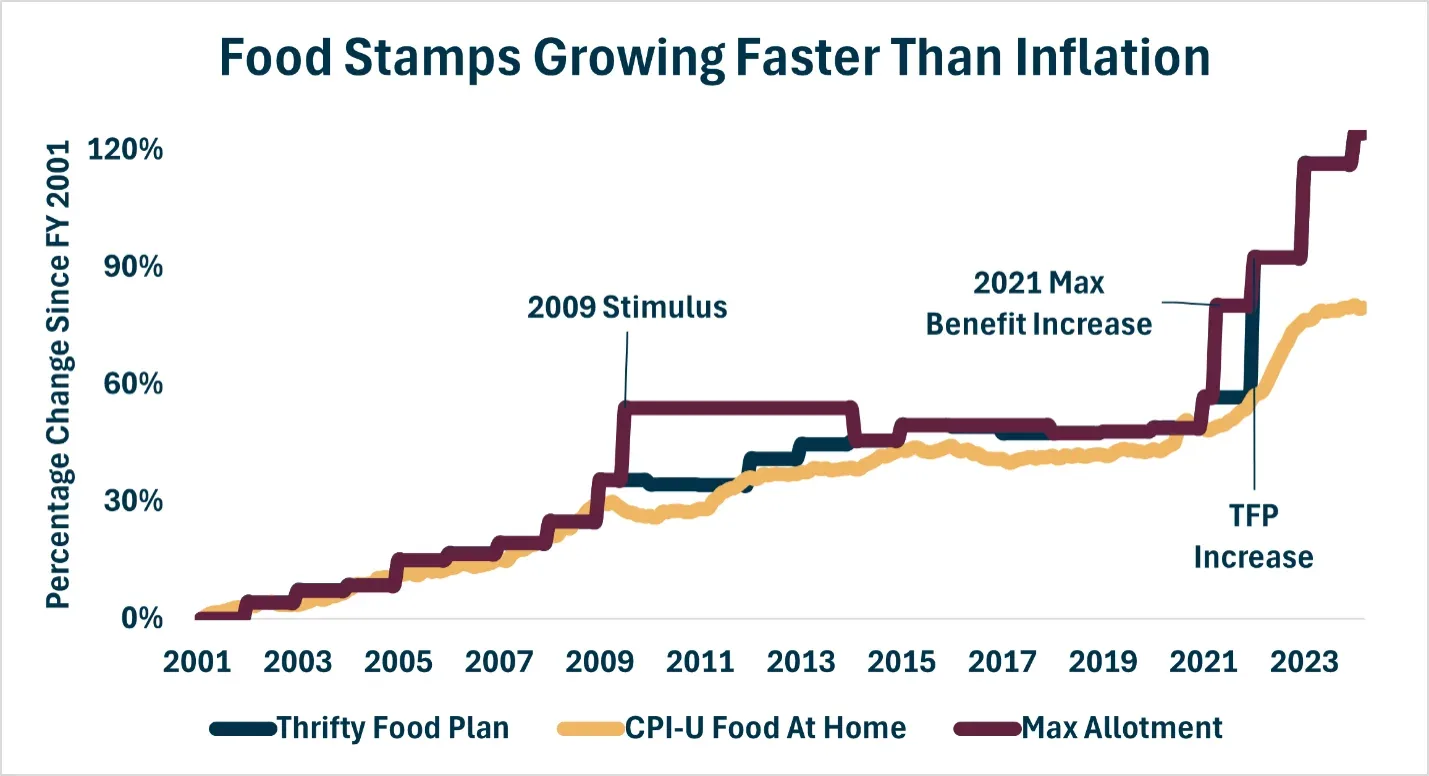
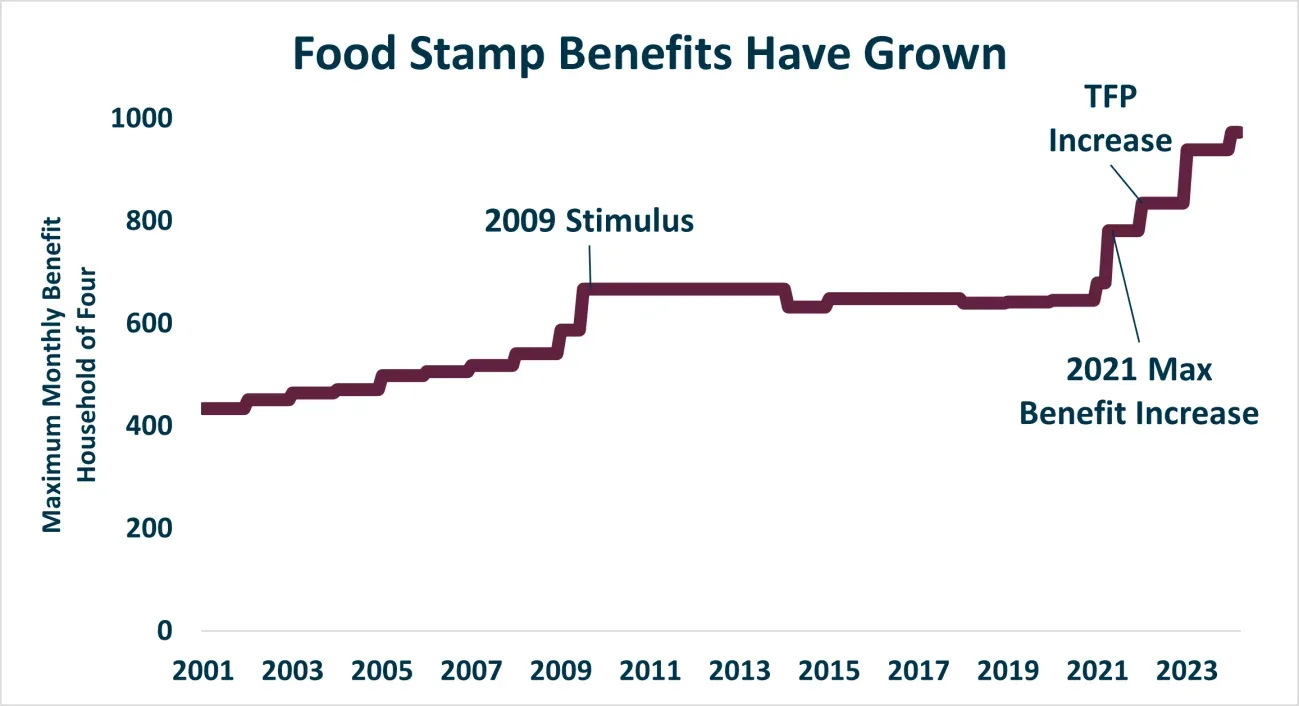
The maximum benefit increased significantly between FY 2008 and 2009 due to an 8.5 percent increase in the Thrifty Food Plan calculation[31] as well as a provision in Obama’s 2009 stimulus law that raised the maximum allotment by an additional 13.6 percent.[32] The stimulus law set the artificially increased benefit as a new floor, keeping the 2009 maximum benefit in place even when the normal formula indicated it should be lower. However, Congress later repealed the floor effective October 31, 2013. This allowed the normal Thrifty Food Plan calculation to set the maximum benefit for FY 2014.[33]
In March 2020, the Families First Coronavirus Response Act provided “emergency allotments” to all food stamp recipients, overriding the normal 30 percent contribution calculation to provide allotments equal to the maximum benefit for the household size.[34] In April 2021, the Biden Administration issued guidance allowing emergency allotments to even exceed the maximum statutory benefit.[35] Emergency allotments were available at the request of a state agency through the duration of the COVID-19 public health emergency declaration. Emergency allotments finally ended in February 2023, well after President Biden declared “the pandemic is over,” pursuant to a provision in the FY 2023 Consolidated Appropriations Act.[36]
The FY 2021 Omnibus signed into law in December 2020 included a provision increasing the maximum benefit by 15 percent through June 30, 2021.[37] President Biden’s American Rescue Plan Act extended the increased maximum benefit through September 30, 2021.[38]
The Biden Administration then unilaterally increased food stamp benefits by 21.03 percent through a “reevaluation” of the Thrifty Food Plan in 2021.[39] As mentioned previously, the Thrifty Food Plan calculation is normally updated each year for inflation to provide a cost-of-living-adjustment for food stamp benefits.
The Thrifty Food Plan also underwent three prior reevaluations in 1983, 1999, and 2006 to update changes in dietary guidelines and consumption patterns, but importantly, these reevaluations remained cost neutral with only adjustments for inflation.
The Biden Administration broke precedent and violated Congress’s budget neutrality intent for the purposes of keeping food stamp benefits elevated after the expiration of the emergency allotments and 15 percent maximum benefit increase. The Congressional Budget Office estimated that the TFP reevaluation will result in $250 to $300 billion in higher spending over the fiscal year 2022-2031 period.[40] The USDA’s process in reevaluating the TFP was severely criticized by the U.S. Government Accountability Office (GAO).[41]
Chart 10
Sources: U.S. Department of Agriculture and Bureau of Labor Statistics.
The maximum benefit increased significantly between FY 2008 and 2009 due to an 8.5 percent increase in the Thrifty Food Plan calculation[31] as well as a provision in Obama’s 2009 stimulus law that raised the maximum allotment by an additional 13.6 percent.[32] The stimulus law set the artificially increased benefit as a new floor, keeping the 2009 maximum benefit in place even when the normal formula indicated it should be lower. However, Congress later repealed the floor effective October 31, 2013. This allowed the normal Thrifty Food Plan calculation to set the maximum benefit for FY 2014.[33]
In March 2020, the Families First Coronavirus Response Act provided “emergency allotments” to all food stamp recipients, overriding the normal 30 percent contribution calculation to provide allotments equal to the maximum benefit for the household size.[34] In April 2021, the Biden Administration issued guidance allowing emergency allotments to even exceed the maximum statutory benefit.[35] Emergency allotments were available at the request of a state agency through the duration of the COVID-19 public health emergency declaration. Emergency allotments finally ended in February 2023, well after President Biden declared “the pandemic is over,” pursuant to a provision in the FY 2023 Consolidated Appropriations Act.[36]
The FY 2021 Omnibus signed into law in December 2020 included a provision increasing the maximum benefit by 15 percent through June 30, 2021.[37] President Biden’s American Rescue Plan Act extended the increased maximum benefit through September 30, 2021.[38]
The Biden Administration then unilaterally increased food stamp benefits by 21.03 percent through a “reevaluation” of the Thrifty Food Plan in 2021.[39] As mentioned previously, the Thrifty Food Plan calculation is normally updated each year for inflation to provide a cost-of-living-adjustment for food stamp benefits.
The Thrifty Food Plan also underwent three prior reevaluations in 1983, 1999, and 2006 to update changes in dietary guidelines and consumption patterns, but importantly, these reevaluations remained cost neutral with only adjustments for inflation.
The Biden Administration broke precedent and violated Congress’s budget neutrality intent for the purposes of keeping food stamp benefits elevated after the expiration of the emergency allotments and 15 percent maximum benefit increase. The Congressional Budget Office estimated that the TFP reevaluation will result in $250 to $300 billion in higher spending over the fiscal year 2022-2031 period.[40] The USDA’s process in reevaluating the TFP was severely criticized by the U.S. Government Accountability Office (GAO).[41]
Chart 10
 Sources: U.S. Department of Agriculture, Congressional Budget Office, and Bureau of Labor Statistics.
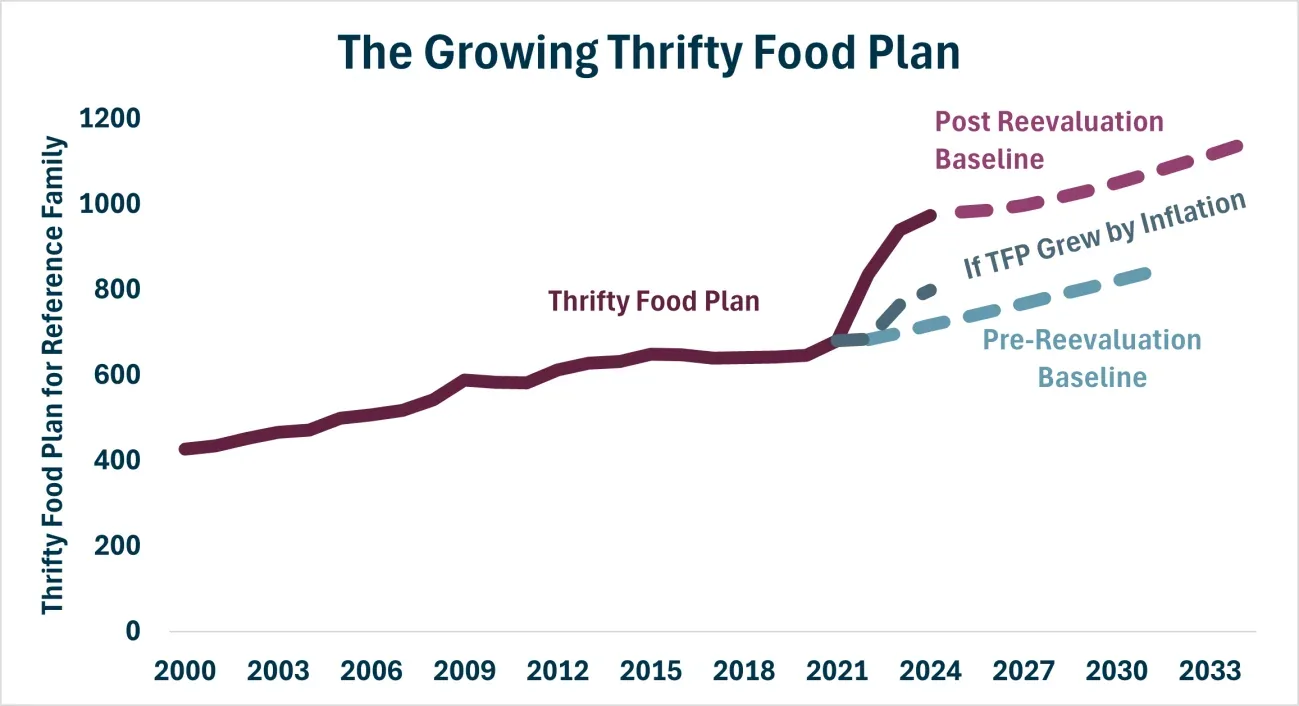
As a result of these multiple changes, the maximum allotment for a family of four has more than doubled since 2001, growing from $434 per month ($5,208 per year) to $973 per month ($11,676 per year) in FY 2024. Actual food stamp benefit levels are about 21 percent higher than they would have been if they had grown with inflation. If benefits had grown with the chained consumer price index for food at home since 2021, the maximum allotment for a family of four in FY 2024 would have been $798 per month ($9,576 per year).
Chart 11
Sources: U.S. Department of Agriculture, Congressional Budget Office, and Bureau of Labor Statistics.
As a result of these multiple changes, the maximum allotment for a family of four has more than doubled since 2001, growing from $434 per month ($5,208 per year) to $973 per month ($11,676 per year) in FY 2024. Actual food stamp benefit levels are about 21 percent higher than they would have been if they had grown with inflation. If benefits had grown with the chained consumer price index for food at home since 2021, the maximum allotment for a family of four in FY 2024 would have been $798 per month ($9,576 per year).
Chart 11
 Source: U.S. Department of Agriculture.
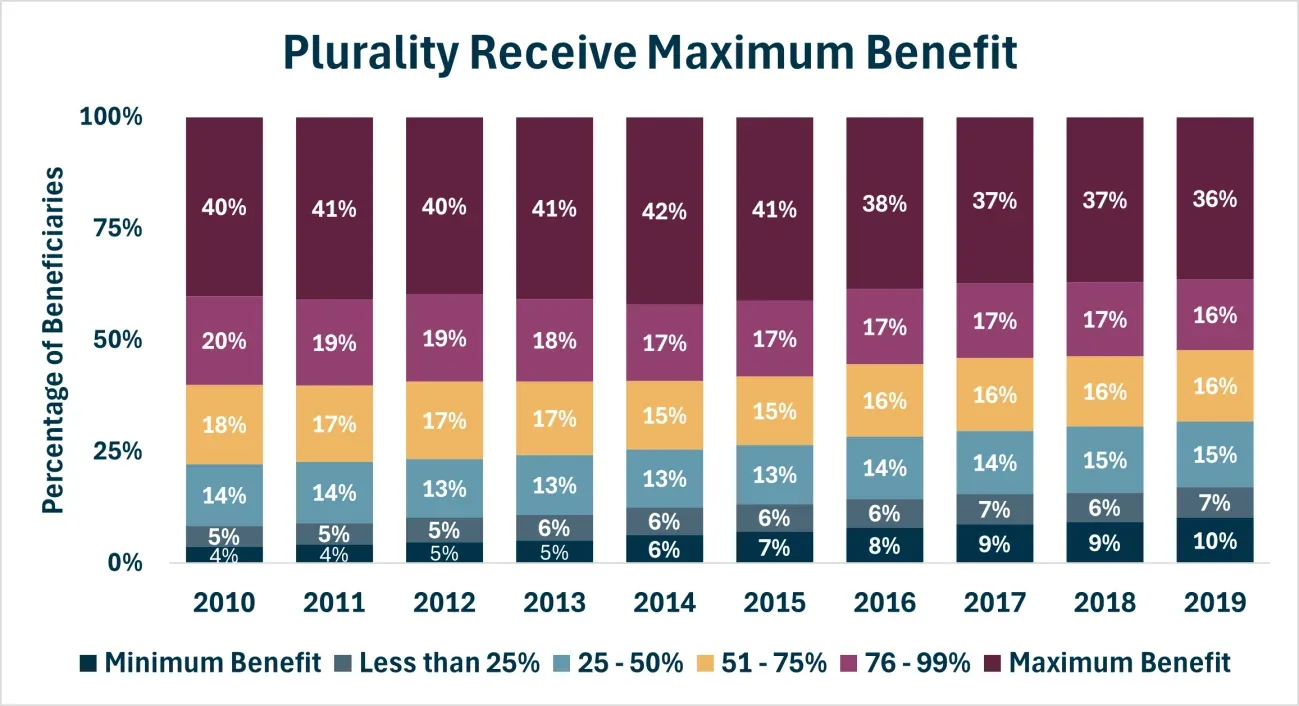
Most food stamp recipients qualify for the maximum benefit or close to the maximum benefit.[42] Over the FY 2010-2019 period, an average of 39 percent of food stamp beneficiaries received the maximum benefit level and another 17.7 percent received between 75 and 99 percent of the maximum benefit. Over that time period, an average of 73.5 percent of recipients collected more than 50 percent of the maximum benefit level. Only 26.5 percent received an allotment of 50 percent or less of the maximum benefit.
The proportion of people receiving the minimum monthly benefit has also increased in recent years. This is due to the increase in one- and two- person households enrolled in the food stamp program (the minimum benefit is only provided to single and two-person households).
Chart 12
Source: U.S. Department of Agriculture.
Most food stamp recipients qualify for the maximum benefit or close to the maximum benefit.[42] Over the FY 2010-2019 period, an average of 39 percent of food stamp beneficiaries received the maximum benefit level and another 17.7 percent received between 75 and 99 percent of the maximum benefit. Over that time period, an average of 73.5 percent of recipients collected more than 50 percent of the maximum benefit level. Only 26.5 percent received an allotment of 50 percent or less of the maximum benefit.
The proportion of people receiving the minimum monthly benefit has also increased in recent years. This is due to the increase in one- and two- person households enrolled in the food stamp program (the minimum benefit is only provided to single and two-person households).
Chart 12
 Source: U.S. Department of Agriculture.
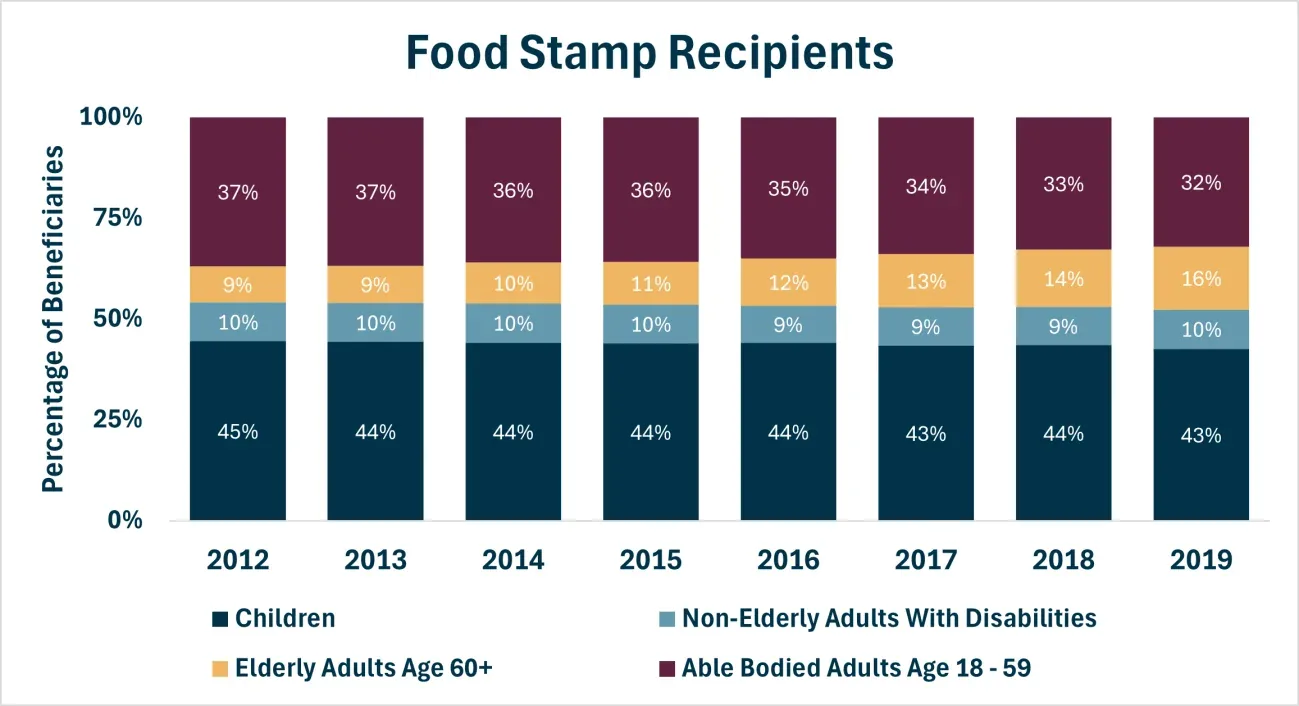 Just as the overall U.S. population is getting older, so too is the proportion of food stamp recipients that are elderly. Between 2012 to 2019, the percentage of recipients who were age 60 or older rose from 9 percent to 16 percent.
Since the 1990s, there has been a noticeable uptick in the percentage of food stamp households with a disabled individual.[47] In 1990, 8.9 percent of food stamp households included a non-elderly individual with a disability. By 2019, the percentage had increased to 21.1 percent of food stamp households.
Just as the overall U.S. population is getting older, so too is the proportion of food stamp recipients that are elderly. Between 2012 to 2019, the percentage of recipients who were age 60 or older rose from 9 percent to 16 percent.
Since the 1990s, there has been a noticeable uptick in the percentage of food stamp households with a disabled individual.[47] In 1990, 8.9 percent of food stamp households included a non-elderly individual with a disability. By 2019, the percentage had increased to 21.1 percent of food stamp households.
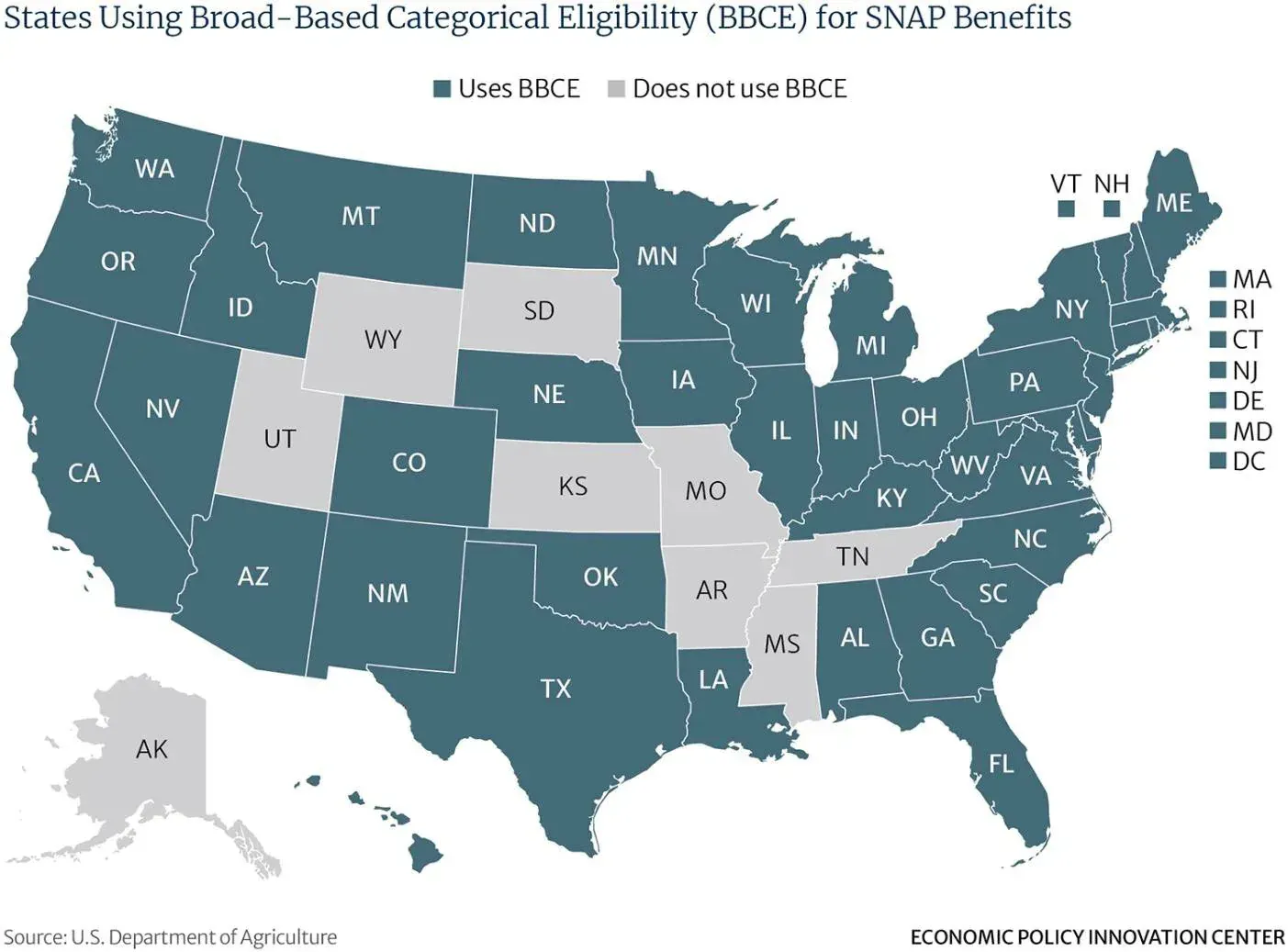 BBCE allows millionaires[50] and thousands of lottery winners[51] to receive food stamp benefits.
Categorical eligibility has expanded over time, both in terms of the programs that can qualify for food stamp categorical eligibility and the use of categorical eligibility by states. In 2007, 29 states used BBCE. The number grew to 36 in 2010.
The Food Security Act of 1985 provided categorical eligibility for food stamps for households receiving cash welfare benefits. The eligibility rules, including the asset test, for the Aid to Families with Dependent Children (AFDC) program were more restrictive than for food stamps. TANF, which replaced AFDC in the 1996 welfare reform law, proved states with broad flexibility for eligibility criteria as well as the types of benefits that could be provided beyond cash welfare. Most TANF spending is now for non-cash benefits. The Clinton Administration issued regulations allowing states to make a household eligible for the food stamp program if it receives or is authorized to receive non-cash TANF benefits.[52] Guidance from the Obama Administration further encouraged states to utilize BBCE.[53]
The USDA does not explicitly report the number of food stamp recipients who receive benefits via categorical eligibility. States are not even required to record the asset levels of recipients who are conferred benefits under BBCE. In FY 2019, 6.6 percent of households receiving food stamps had gross incomes above the statutory limit. These households included 2.1 million food stamp recipients.[54]
The Foundation for Government Accountability estimates that about 5.4 million food stamp recipients are made eligible through BBCE, with 4 million having assets above the program’s own statutory limits and 1.4 million with incomes above the limits. Ending BBCE could save taxpayers billions, and reserve program funding for the truly needy, the population it was intended to serve.[55]
BBCE allows millionaires[50] and thousands of lottery winners[51] to receive food stamp benefits.
Categorical eligibility has expanded over time, both in terms of the programs that can qualify for food stamp categorical eligibility and the use of categorical eligibility by states. In 2007, 29 states used BBCE. The number grew to 36 in 2010.
The Food Security Act of 1985 provided categorical eligibility for food stamps for households receiving cash welfare benefits. The eligibility rules, including the asset test, for the Aid to Families with Dependent Children (AFDC) program were more restrictive than for food stamps. TANF, which replaced AFDC in the 1996 welfare reform law, proved states with broad flexibility for eligibility criteria as well as the types of benefits that could be provided beyond cash welfare. Most TANF spending is now for non-cash benefits. The Clinton Administration issued regulations allowing states to make a household eligible for the food stamp program if it receives or is authorized to receive non-cash TANF benefits.[52] Guidance from the Obama Administration further encouraged states to utilize BBCE.[53]
The USDA does not explicitly report the number of food stamp recipients who receive benefits via categorical eligibility. States are not even required to record the asset levels of recipients who are conferred benefits under BBCE. In FY 2019, 6.6 percent of households receiving food stamps had gross incomes above the statutory limit. These households included 2.1 million food stamp recipients.[54]
The Foundation for Government Accountability estimates that about 5.4 million food stamp recipients are made eligible through BBCE, with 4 million having assets above the program’s own statutory limits and 1.4 million with incomes above the limits. Ending BBCE could save taxpayers billions, and reserve program funding for the truly needy, the population it was intended to serve.[55]
 Source: U.S. Department of Health and Human Services.
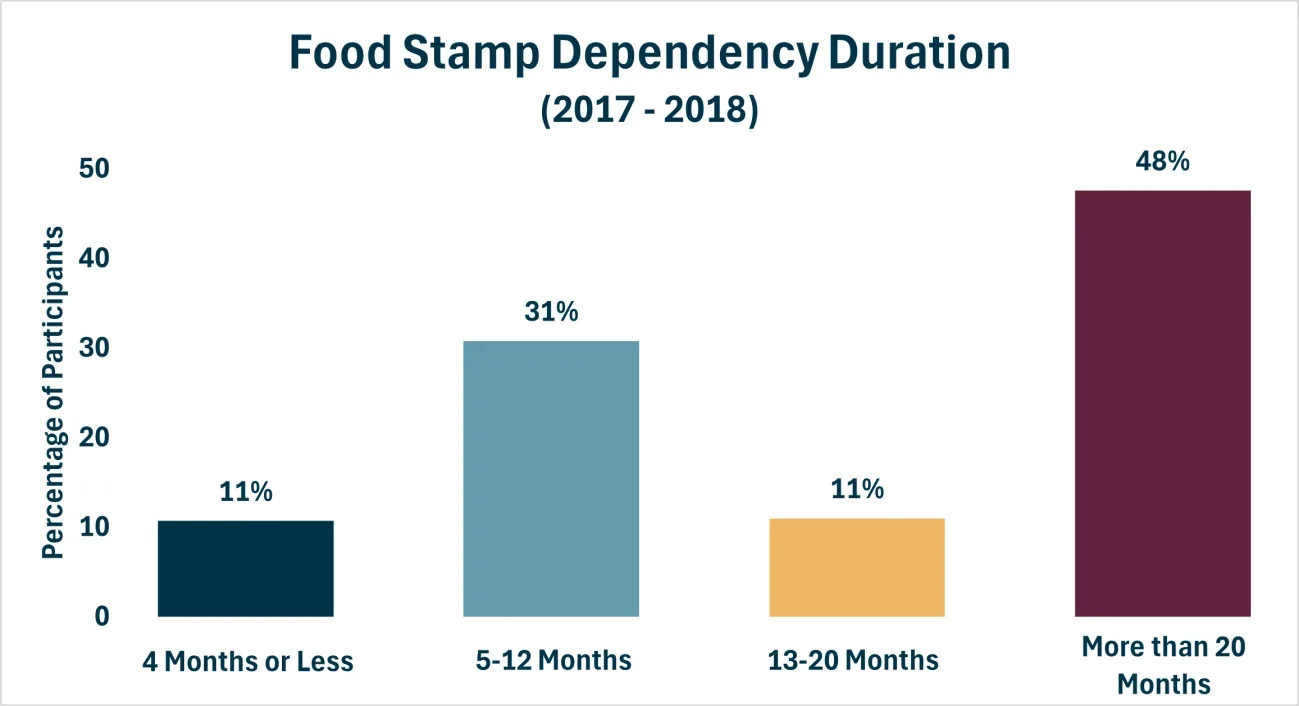
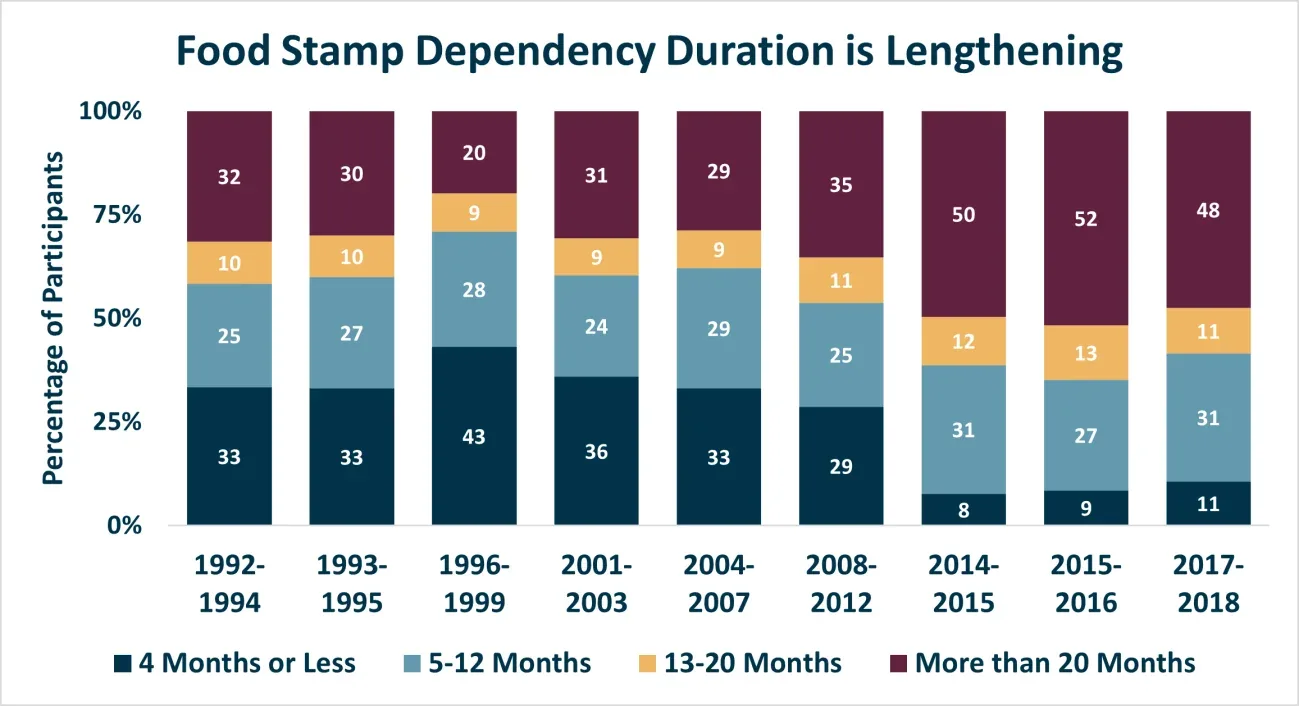
The reported duration of dependency on food stamp benefits has lengthened over time. After welfare reform, 71 percent of recipients had periods of receipt of a year or less, while 21 percent were on food stamps for longer than a year. [57]
Chart 15
Source: U.S. Department of Health and Human Services.
The reported duration of dependency on food stamp benefits has lengthened over time. After welfare reform, 71 percent of recipients had periods of receipt of a year or less, while 21 percent were on food stamps for longer than a year. [57]
Chart 15
 Source: U.S. Department of Health and Human Services.
The noticeable increase in reported benefit receipt duration from the 2008-2012 data to data reported after 2014 may be due, in part, to a redesign of the Census survey implemented in 2014 that was meant to improve data collection over longer periods.[58]
This transition to longer reported periods of benefit receipt also coincides with an increase in the participation rate of food stamp eligible households. Over the 2008-2012 period, an average of 76.8 percent of eligible households received food stamp benefits, while the participation rate averaged 85.7 percent over the 2014-2019 period.[59]
Other than the often-waived work requirement for ABAWDs, the food stamp program has no time limits for how long a person can receive benefits.
Source: U.S. Department of Health and Human Services.
The noticeable increase in reported benefit receipt duration from the 2008-2012 data to data reported after 2014 may be due, in part, to a redesign of the Census survey implemented in 2014 that was meant to improve data collection over longer periods.[58]
This transition to longer reported periods of benefit receipt also coincides with an increase in the participation rate of food stamp eligible households. Over the 2008-2012 period, an average of 76.8 percent of eligible households received food stamp benefits, while the participation rate averaged 85.7 percent over the 2014-2019 period.[59]
Other than the often-waived work requirement for ABAWDs, the food stamp program has no time limits for how long a person can receive benefits.
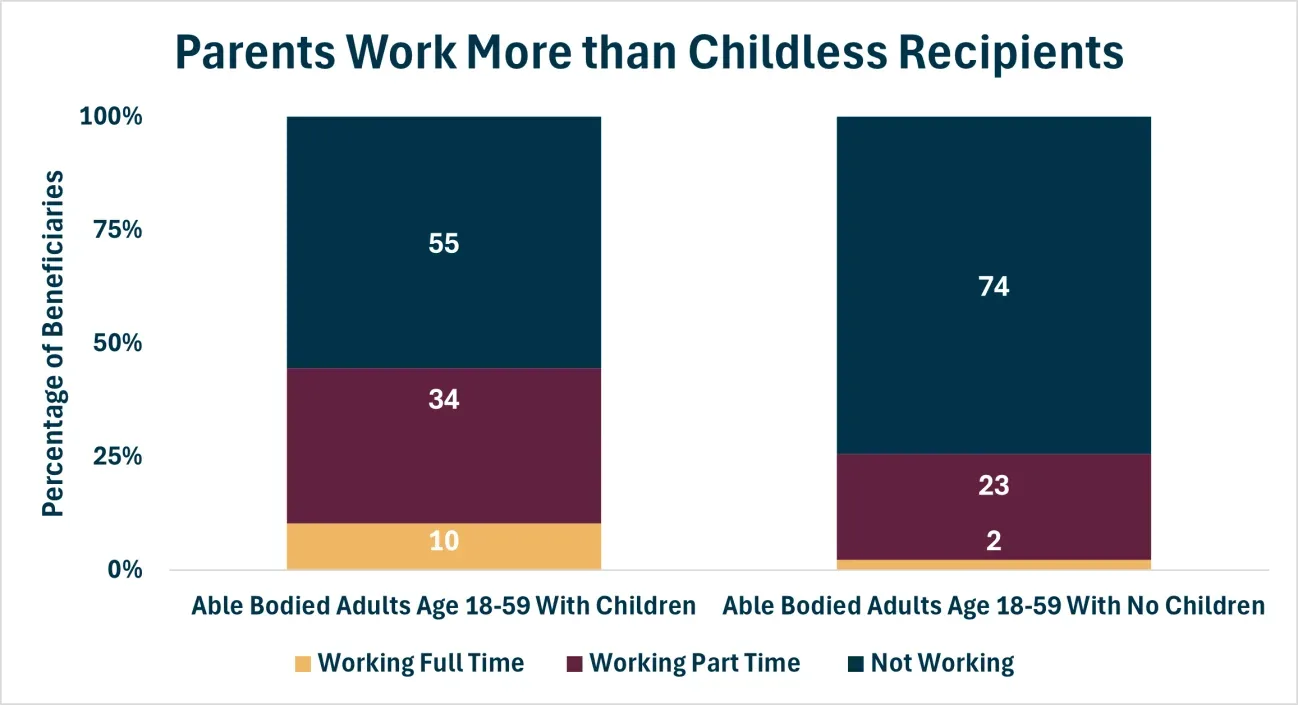
 Source: U.S. Department of Agriculture.
Of the population of able-bodied adults who receive food stamps, parents work more than childless adults. This is notable because only adults without dependents are subject to work requirements, while parents are excluded from work requirements.
Over the FY 2017-2019 period, an average of 45 percent of able-bodied adults on food stamps with children worked, compared to just 26 percent of childless able-bodied adults. The difference in full-time employment is particularly stark, with five times the percentage of parents working full-time compared to non-parents.[62]
At first, this result might seem counterintuitive, under the assumption that having young children is too time-consuming or demanding to allow parents to work.
However, parents have more reasons to work. Parents obviously have a strong incentive to provide for their families. EPIC Senior Fellow Rachel Greszler has found that the decline in the employment-to-population ratio after the COVID-19 pandemic has been driven by the decline in work by those without children, while employment by men and women with children has increased.[63]
Chart 18
Source: U.S. Department of Agriculture.
Of the population of able-bodied adults who receive food stamps, parents work more than childless adults. This is notable because only adults without dependents are subject to work requirements, while parents are excluded from work requirements.
Over the FY 2017-2019 period, an average of 45 percent of able-bodied adults on food stamps with children worked, compared to just 26 percent of childless able-bodied adults. The difference in full-time employment is particularly stark, with five times the percentage of parents working full-time compared to non-parents.[62]
At first, this result might seem counterintuitive, under the assumption that having young children is too time-consuming or demanding to allow parents to work.
However, parents have more reasons to work. Parents obviously have a strong incentive to provide for their families. EPIC Senior Fellow Rachel Greszler has found that the decline in the employment-to-population ratio after the COVID-19 pandemic has been driven by the decline in work by those without children, while employment by men and women with children has increased.[63]
Chart 18
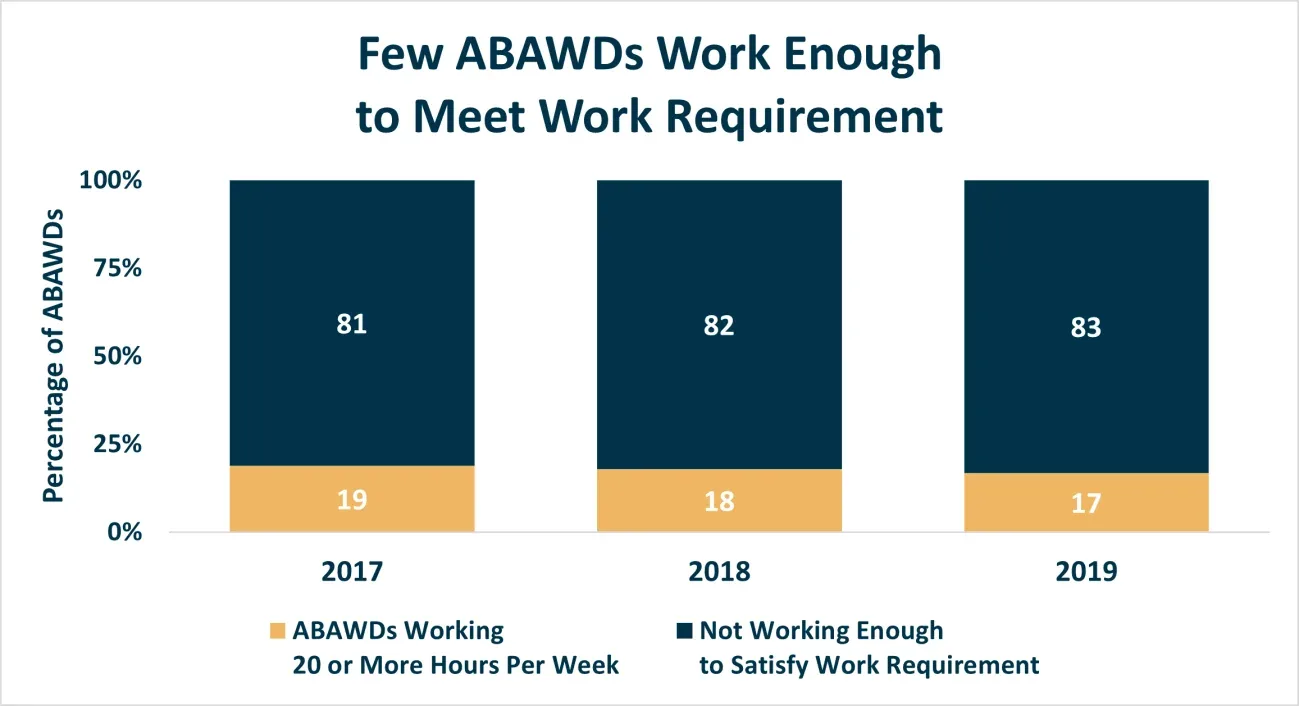
 Source: U.S. Department of Agriculture.
Only 18 percent of ABAWDs age 18-49 worked the 20 or more hours per week needed to satisfy the work requirement through employment between FY 2017 and 2019. This means that 82 percent of those subject to the work requirement did not work enough hours.[64]
These ABAWDs potentially could have satisfied the work requirement through job training or volunteering. However, it is most likely that these work-capable adults were waived or exempted from the work requirements altogether. Analysis from the Foundation for Government Accountability shows that at least 70 percent of ABAWDs were expected to be in areas covered by geographic waivers or provided discretionary exemptions when the work requirement moratorium was lifted in July 2023.[65]
Chart 19
Source: U.S. Department of Agriculture.
Only 18 percent of ABAWDs age 18-49 worked the 20 or more hours per week needed to satisfy the work requirement through employment between FY 2017 and 2019. This means that 82 percent of those subject to the work requirement did not work enough hours.[64]
These ABAWDs potentially could have satisfied the work requirement through job training or volunteering. However, it is most likely that these work-capable adults were waived or exempted from the work requirements altogether. Analysis from the Foundation for Government Accountability shows that at least 70 percent of ABAWDs were expected to be in areas covered by geographic waivers or provided discretionary exemptions when the work requirement moratorium was lifted in July 2023.[65]
Chart 19
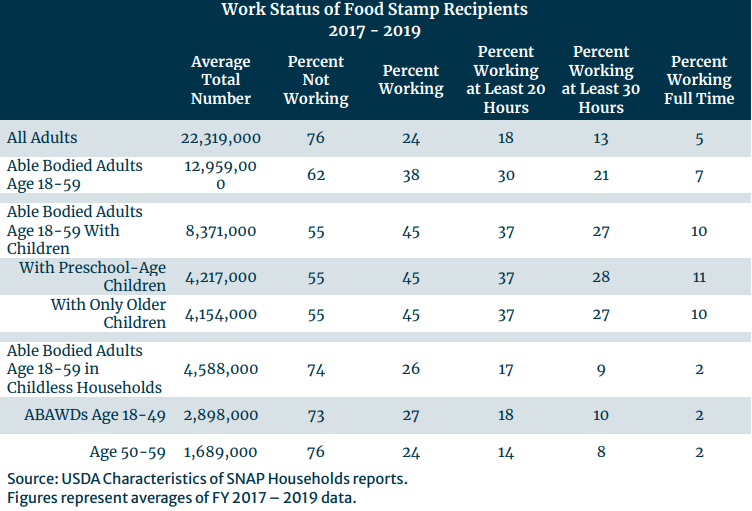
 Source: U.S. Department of Agriculture.
The table below summarizes data from the USDA on the work efforts of able-bodied food stamp recipients between FY 2017 to 2019, which is the period where complete data is available.
Table 3
Source: U.S. Department of Agriculture.
The table below summarizes data from the USDA on the work efforts of able-bodied food stamp recipients between FY 2017 to 2019, which is the period where complete data is available.
Table 3
 Source: U.S. Department of Agriculture.
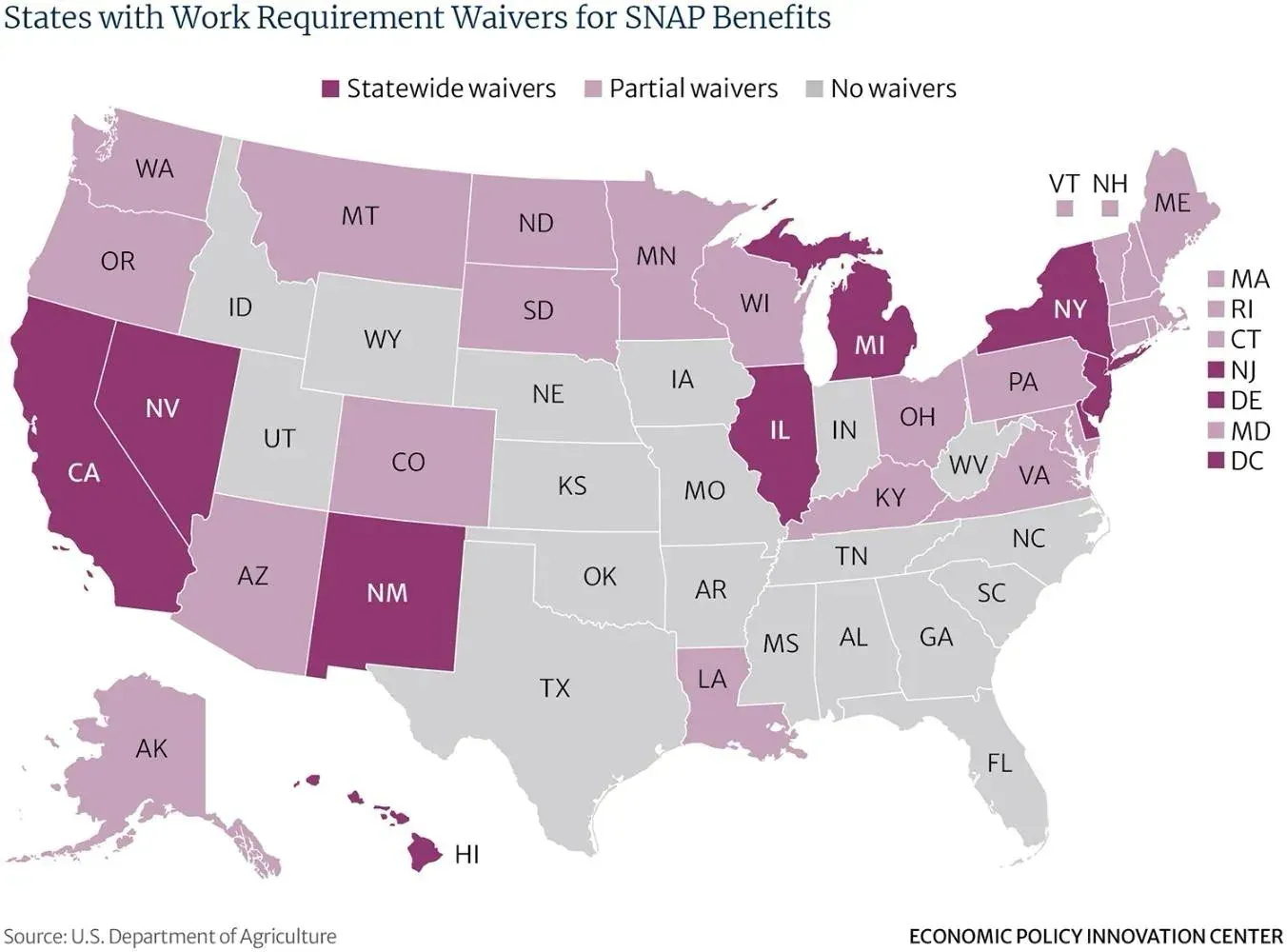
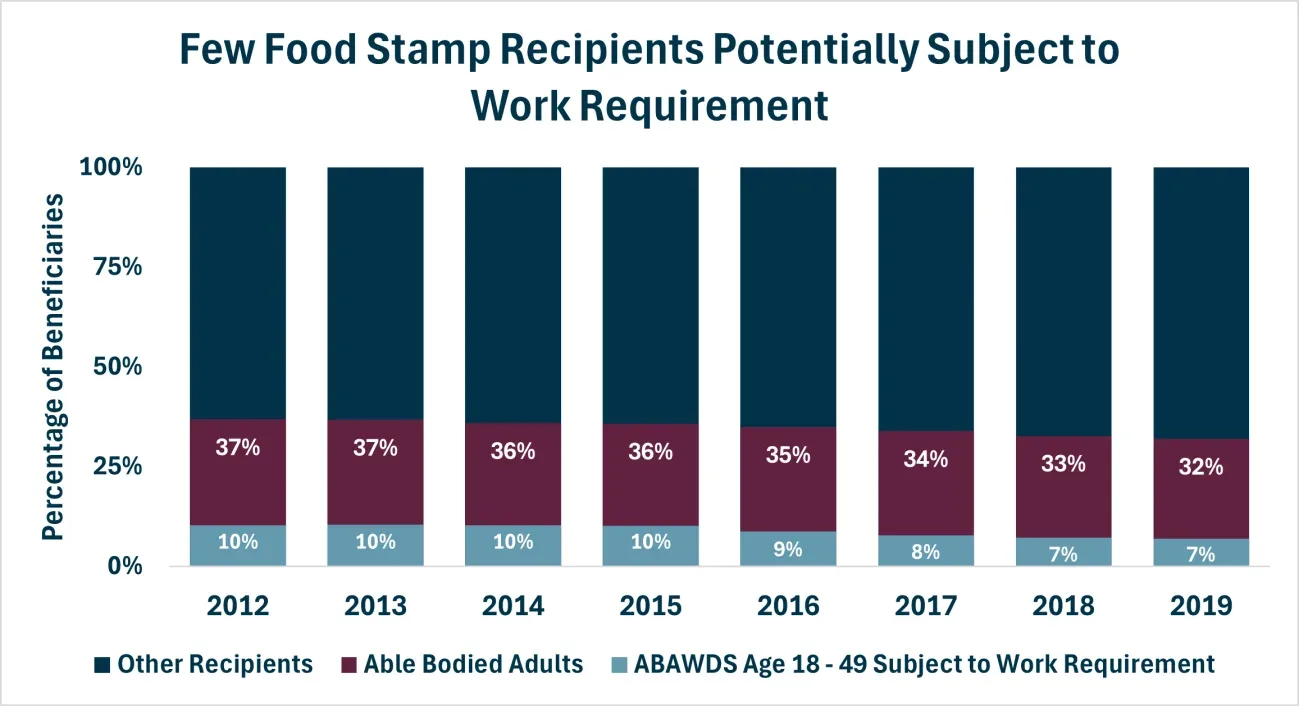
We describe the population of ABAWDs aged 18-49 as those who could potentially be subject to work requirements. The law states that this population is supposed to work, prepare for work through job training or education, or volunteer as a condition of receiving welfare benefits. As shown above, fewer than 20 percent of these ABAWDs actually work the 20-or-more hours per week required to satisfy the work requirement. This is allowed because the food stamp law is riddled with loopholes that significantly weaken the work requirement.
Analysis from the Foundation for Government Accountability showed that at least 70 percent of ABAWDs aged 18-49 were expected to be in areas covered by geographic waivers or provided discretionary exemptions when the work requirement moratorium was lifted in July 2023.[68]
In the second quarter of FY 2024, 12 states and territories have waived work requirements statewide and 22 states had implemented geographic waivers that covered parts of the state.[69] The states covered by these statewide and partial waivers had 26.5 million food stamp recipients in FY 2023, comprising 63 percent of all food stamp recipients nationwide.[70]
When these waivers took effect in January 2024, the U.S. unemployment rate was just 3.7 percent. In the states with a statewide or geographic waiver, the weighted average unemployment rate was 4.1 percent.[71] This is less than the than the average U.S. unemployment rate since 2001 of 5.8[72] percent and is less than the CBO’s projected Noncyclical Rate of Unemployment of 4.4 percent, considered the “natural unemployment” or “full employment” rate.[73],” February 8, 2024, retrieved from FRED, Federal Reserve Bank of St. Louis; https://fred.stlouisfed.org/series/NROU (accessed March 12, 2024).]
Figure 2
Source: U.S. Department of Agriculture.
We describe the population of ABAWDs aged 18-49 as those who could potentially be subject to work requirements. The law states that this population is supposed to work, prepare for work through job training or education, or volunteer as a condition of receiving welfare benefits. As shown above, fewer than 20 percent of these ABAWDs actually work the 20-or-more hours per week required to satisfy the work requirement. This is allowed because the food stamp law is riddled with loopholes that significantly weaken the work requirement.
Analysis from the Foundation for Government Accountability showed that at least 70 percent of ABAWDs aged 18-49 were expected to be in areas covered by geographic waivers or provided discretionary exemptions when the work requirement moratorium was lifted in July 2023.[68]
In the second quarter of FY 2024, 12 states and territories have waived work requirements statewide and 22 states had implemented geographic waivers that covered parts of the state.[69] The states covered by these statewide and partial waivers had 26.5 million food stamp recipients in FY 2023, comprising 63 percent of all food stamp recipients nationwide.[70]
When these waivers took effect in January 2024, the U.S. unemployment rate was just 3.7 percent. In the states with a statewide or geographic waiver, the weighted average unemployment rate was 4.1 percent.[71] This is less than the than the average U.S. unemployment rate since 2001 of 5.8[72] percent and is less than the CBO’s projected Noncyclical Rate of Unemployment of 4.4 percent, considered the “natural unemployment” or “full employment” rate.[73],” February 8, 2024, retrieved from FRED, Federal Reserve Bank of St. Louis; https://fred.stlouisfed.org/series/NROU (accessed March 12, 2024).]
Figure 2
 Sources: U.S. Department of Agriculture and PaymentAccuracy.gov.
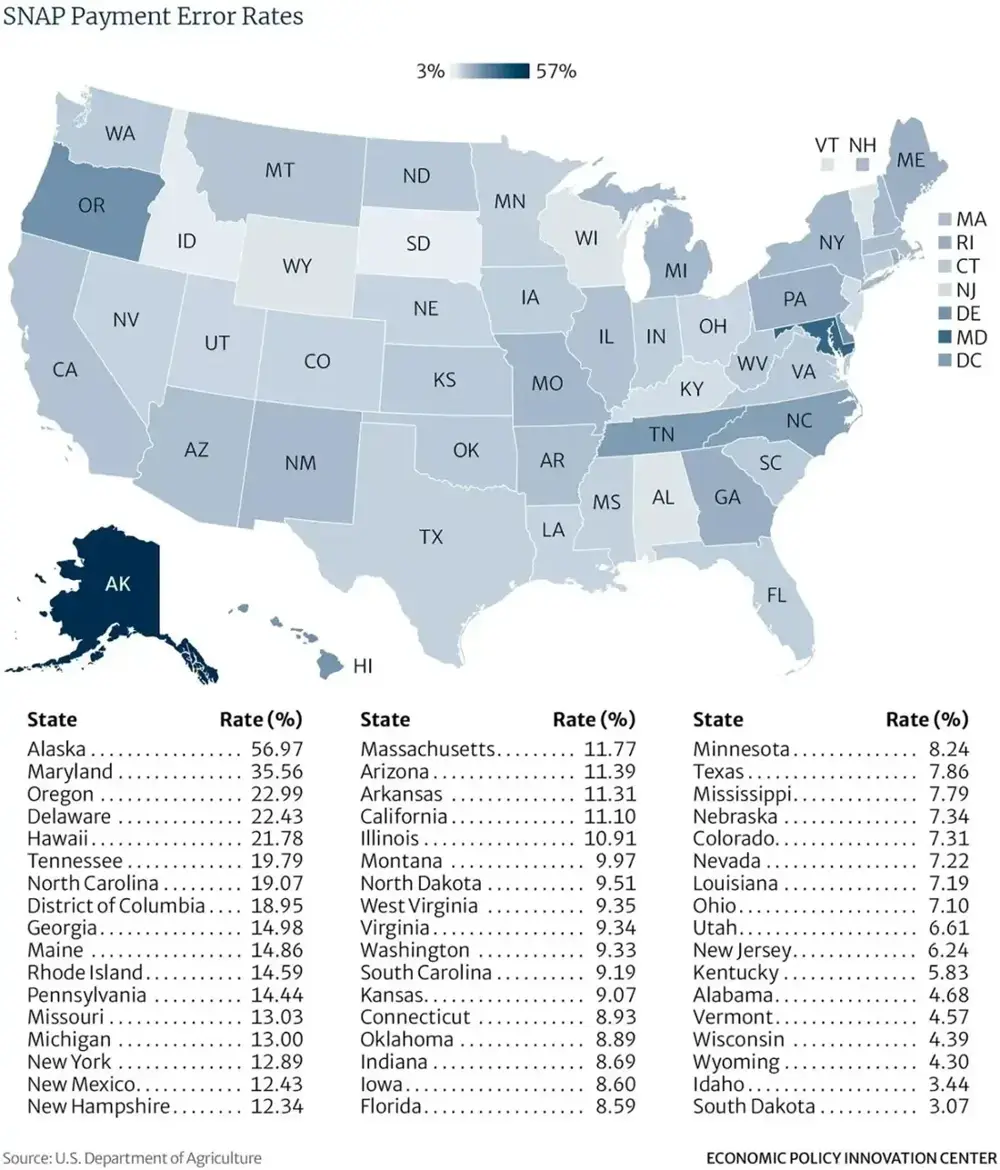
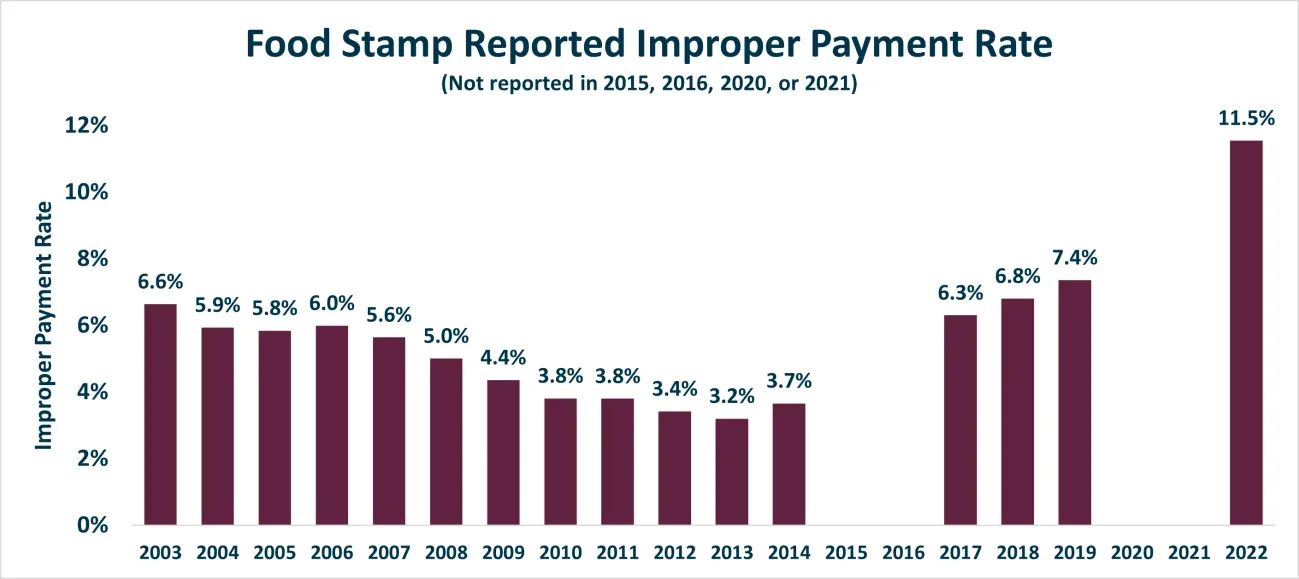
USDA reported data quality issues in FY 2015 and 2016 that prevented it from providing improper payment rates. In FY 2020 and 2021, USDA suspended state error data reporting requirements during the COVID-19 pandemic.
Improper payments are likely significantly higher than the reported amounts. In fact, the 2014 Farm Bill instructs USDA to ignore improper payments up to a “quality control tolerance threshold.”[75] This threshold was set at $37 in 2014 and increases with inflation each year. In 2022, the “tolerance threshold” was $48. Thus, any improper payment up to $48 in 2022 was not reported. The tolerance threshold increases to $56 for FY 2024.[76] The Snap Back Inaccurate SNAP Payments Act, introduced by Rep. Randy Feenstra (R- IA) and Sen. Joni Ernst (R-IA) would clarify that all improper payments must be counted as errors.[77]
The reported improper payment rates for the food stamp program vary alarmingly across states, indicating stark disparities in program administration. In FY 2022, an astonishing 57 percent of food stamp payments in Alaska were reported as improper, along with 35.6 percent in Maryland, 23 percent in Oregon, 21.8 percent in Hawaii, and 19.8 percent in Tennessee. Meanwhile, the reported improper payment rate in South Dakota was 3.1 percent, 4.3 percent in Wyoming, and 4.4 percent in Wisconsin.[78]
Figure 3
Sources: U.S. Department of Agriculture and PaymentAccuracy.gov.
USDA reported data quality issues in FY 2015 and 2016 that prevented it from providing improper payment rates. In FY 2020 and 2021, USDA suspended state error data reporting requirements during the COVID-19 pandemic.
Improper payments are likely significantly higher than the reported amounts. In fact, the 2014 Farm Bill instructs USDA to ignore improper payments up to a “quality control tolerance threshold.”[75] This threshold was set at $37 in 2014 and increases with inflation each year. In 2022, the “tolerance threshold” was $48. Thus, any improper payment up to $48 in 2022 was not reported. The tolerance threshold increases to $56 for FY 2024.[76] The Snap Back Inaccurate SNAP Payments Act, introduced by Rep. Randy Feenstra (R- IA) and Sen. Joni Ernst (R-IA) would clarify that all improper payments must be counted as errors.[77]
The reported improper payment rates for the food stamp program vary alarmingly across states, indicating stark disparities in program administration. In FY 2022, an astonishing 57 percent of food stamp payments in Alaska were reported as improper, along with 35.6 percent in Maryland, 23 percent in Oregon, 21.8 percent in Hawaii, and 19.8 percent in Tennessee. Meanwhile, the reported improper payment rate in South Dakota was 3.1 percent, 4.3 percent in Wyoming, and 4.4 percent in Wisconsin.[78]
Figure 3