



Data from the Bureau of Labor Statistics reveals 2.6 million missing workers. That is, if the employment-to-population ratio were the same today as it was before the COVID-19 pandemic in February 2020, 2.6 million more people would be employed today.
This gap in employment is not because there are not available jobs. There are 1.8 million more job openings in the U.S. today than just before the pandemic. Ample job openings and the current 3.7 percent unemployment rate (on par with the 3.5 percent rate just prior to the pandemic) suggest that the drop in employment primarily represents a decline in the desire and willingness to work among certain Americans.
Who are these missing workers? In short, they are potential workers without children.
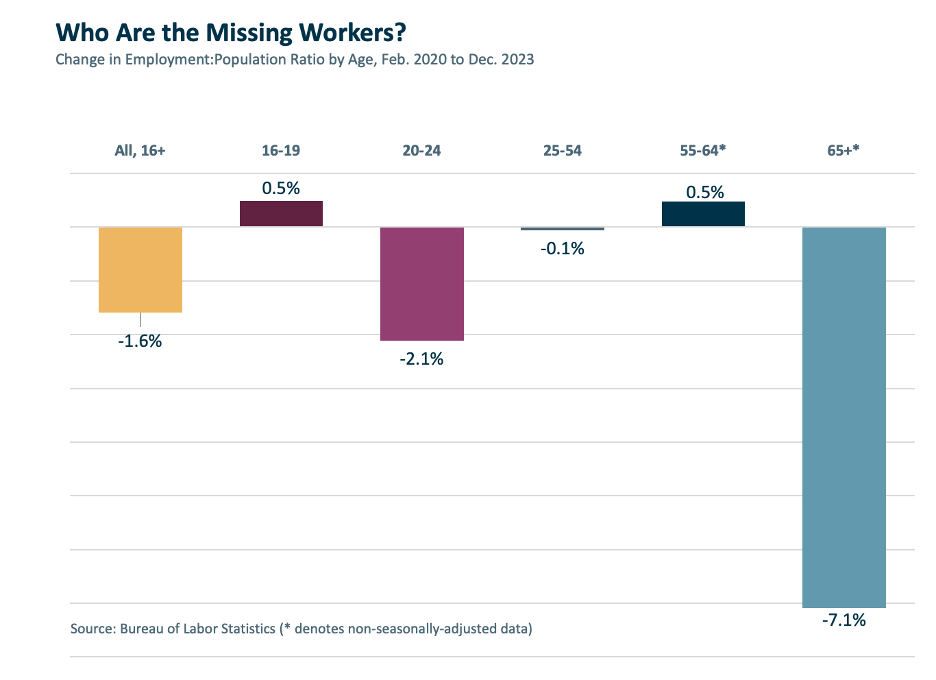
The biggest age-based decline in employment of 7.1 percent is among individuals ages 65 and older. Much of this decline is the result of individuals deciding to retire earlier than planned during the pandemic. This is related, in part, to the windfall in financial benefits that this population was able to benefit from. A study that examined home prices and labor force participation concluded that “the Great Resignation among older workers can be fully explained by increases in housing wealth.”
The next-biggest decline in employment is at the opposite end of the age spectrum.
Employment among workers ages 20-24 is down 2.1 percent since the start of the pandemic. This decline among workers who have their entire careers in front of them is particularly troubling. It wouldn’t be so concerning if more young people were pursuing education that would advance their future careers. However, enrollment in post-secondary education declined by 7 percent from 2019 to 2022. While apprenticeships have ticked up, they still represent only 0.4 percent of the workforce and account for only a small fraction of the gap in young Americans' employment and education.
Employment among prime-age workers (ages 25 to 54) is on par with its pre-pandemic level, and individuals ages 55-64 have experienced a small, 0.5 percent boost in employment.
The presence of children at home is another key distinguishing factor in recent employment trends. Contrary to conventional logic and widespread media reports that parents’—and particularly mothers’—employment has suffered because of childcare struggles, the opposite appears to be true.
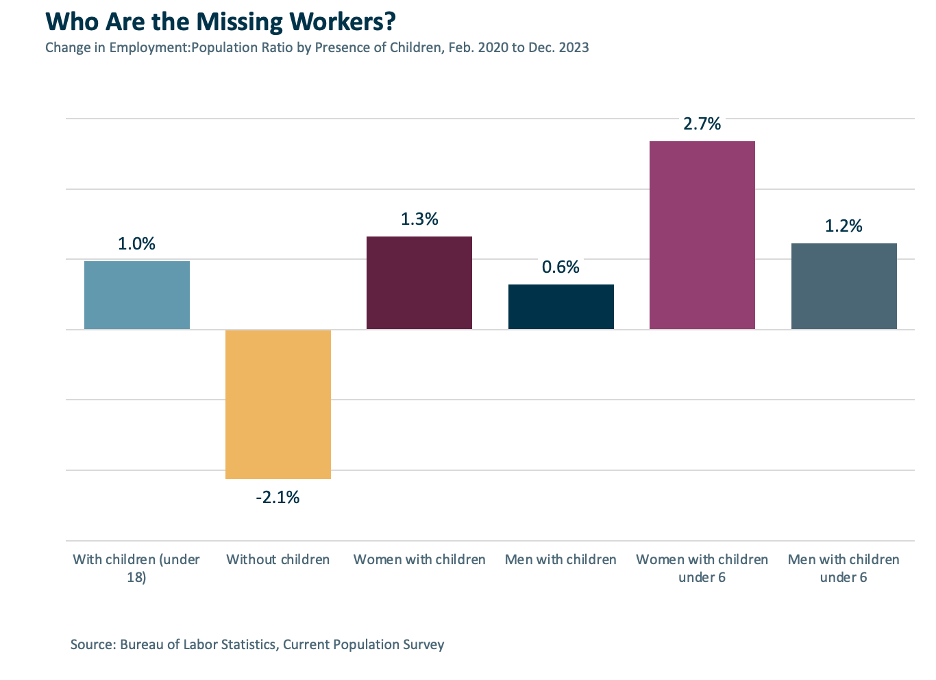
According to data from the Bureau of Labor Statistics Current Population Survey, employment among workers with children under age 18 at home is up 1.0 percent since the start of the pandemic while employment among workers without children at home is down 2.1 percent.
Drilling deeper into the data defies the narrative even further. Employment among women with children (+1.3 percent) has increased more than employment among men with children (+0.6 percent), and the biggest gain—a 2.7 percent increase—has occurred among women with children under age six.
This likely has to do with a silver lining of the COVID-19 pandemic, which is more flexible and remote work opportunities that have allowed many parents to do away with formal childcare. At the same time, job and location changes have allowed more families to make flexible and family-based childcare arrangements. In fact, an August 2021 survey of parents found that the greatest preference for childcare—the top choice of 31 percent of parents—was to have both parents work flexible hours and share childcare duties. Full-time, center-based care was parents' fifth preference, representing the top choice of just 11 percent of parents.
Considering the demographics of missing workers, policymakers should focus on expanding alternative education opportunities, like apprenticeships, and allowing flexible work opportunities to grow and flourish.