Introduction
As the United States confronts demographic struggles and a potential fiscal crisis, policymakers face the challenge of supporting an aging population while sustaining economic growth and preventing fiscal collapse.
A simple and initial step Congress can take is to eliminate Social Security’s retirement earnings test, as proposed in the Senior Citizens’ Freedom to Work Act of 2026.
[1] This outdated and counterproductive policy penalizes work, reduces economic output and government revenues, and undermines the well-being of older Americans. History suggests bipartisan support for ending the retirement earnings test once and for all.
What Is the Retirement Earnings Test?
The retirement earnings test (RET) is a relic of the Great Depression when policymakers wanted to push older Americans out of the labor force. This was part of a misguided effort to “free up” jobs for younger workers. Consequently, the earliest version of the RET was an outright prohibition on the receipt of Social Security benefits for anyone who performed any work. While the RET has evolved over time, it still functions as a significant penalty on work that directly reduces older Americans’ labor force participation.
Today, the RET applies to anyone who receives Social Security benefits before reaching their full retirement age (currently 66 years and 10 months in 2026 and rising to 67 years in 2027) and who continues working and earns more than $24,480 per year. Since the majority of people choose to claim Social Security benefits before reaching their full retirement age, the test can affect millions of seniors.
Individuals impacted by the earnings test lose $1 in Social Security benefits for every $2 they earn above $24,480. While those lost benefits are gradually added back in after the individual reaches full retirement age, most people do not realize this and therefore perceive the test as a pure tax. Moreover, individuals with lower life expectancies will not get back all—or sometimes even any—of the benefits they lose to the retirement earnings test. This can disproportionately hurt certain demographic groups. For example, while nearly nine out of every 10 Asian women live to age 70, just under half of Black men reach age 70.
[2]
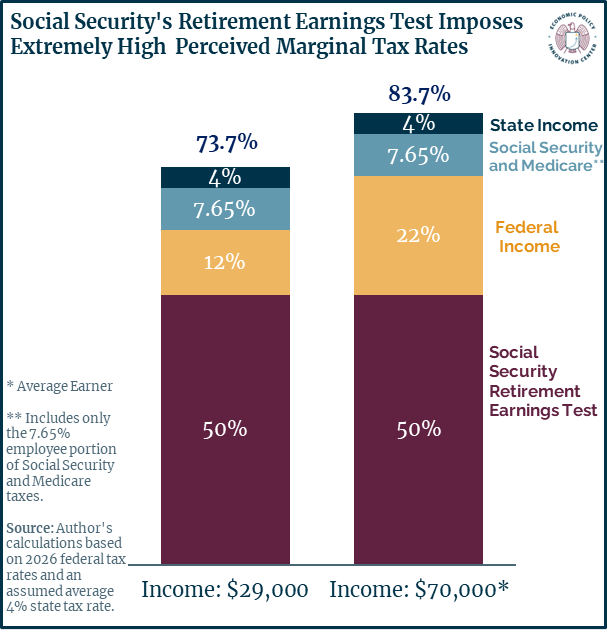
By adding what initially functions like an extra 50 percent tax on top of other federal, state, and payroll taxes, Social Security’s retirement earnings test results in marginal tax rates between 74 percent and 84 percent. Not surprisingly, multiple studies—including from the Social Security Administration—find that the test causes many older Americans who are subject to it to stop working, or to work significantly less than they would otherwise choose.
[3]
Older Americans Are the Fastest Growing Segment of the Workforce
Older Americans account for three-quarters of total employment gains since the turn of the 21
st Century.
[4] While part of these outsized gains are a result of the aging of the baby boomer generation (baby boomers are currently between ages 62 and 80), even a population-neutral metric like the employment-to-population ratio shows a 4.6 percentage point increase since 2000 among individuals ages 55 and older. In part, these gains come from more non-traditional retirement pathways. Whereas retirement was historically a one-time event, about half of Americans today are following non-traditional retirement paths by “unretiring” (returning to the workforce after an initial exit) or by transitioning from formal employment into more flexible self-employment.
[5]
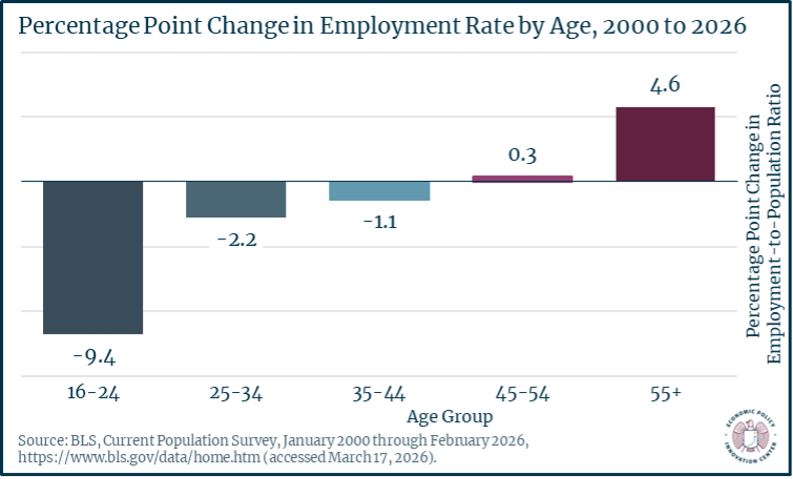
Meanwhile, younger Americans have experienced a significant decline in early employment, which is especially troubling considering that early employment imparts skills, experience, and habits that are foundational to future success. The increasingly screen-infused world in which today’s young people have grown up is proving particularly harmful to children and young adults, leading to a decline in personal characteristics that contribute to success in school, work, relationships, and overall well-being. Now, perhaps more than ever, younger Americans would benefit from spending more time interacting with and learning from older Americans who can share decades’ worth of wisdom and experience, impart a strong work ethic, set examples of working amicably with others, and demonstrate soft skills like punctuality, clear communication, and respect.
A Win-Win Policy: Eliminate Social Security’s Retirement Earnings Test
Senator Rick Scott (R-FL) and Congressman Greg Murphy, M.D. (R-NC-03) recently introduced companion bills—the Senior Citizens’ Freedom to Work Act of 2026—which would eliminate Social Security’s retirement earnings test once and for all.
[6] After roughly a dozen changes attempting to minimize the unintended costs of the earnings test over the past century, policymakers have the opportunity to support seniors, grow the economy, and improve the Social Security Administration’s operations by ending the earnings test entirely.
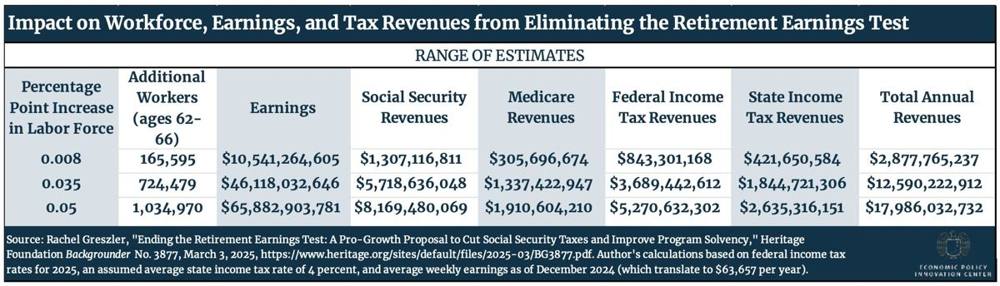
Pro Worker and Pro Growth. By penalizing work among Social Security recipients, the retirement earnings test reduces employment, incomes, economic output, and multiple sources of government revenues. Using evidence of labor supply effects from past studies, I estimate that removing Social Security’s retirement earnings test could increase the U.S. labor force by up to 1 million older workers.
[7] That additional work would increase older Americans’ incomes, modestly reduce poverty among seniors, potentially improve physical and mental health, and help to fill labor shortages. It would also increase economic output, boost government revenues by up to $18 billion per year, and modestly improve the solvency of the Social Security and Medicare programs.
 Simplicity and Accuracy for Seniors and the Social Security Administration
. Ending the retirement earnings test would eliminate millions of seniors’ confusion over the test, free the Social Security Administration from the burden of administering the test, and result in more accurate and consistent Social Security payments. According to a February 2024 letter from the SSA’s Office of the Inspector General (OIG), “[i]n FY 2021, SSA spent approximately $70 million in administrative costs to enforce the earnings test,”
[8] which includes monitoring the earnings of over 5 million beneficiaries and reducing the benefits of about 520,000 Social Security recipients.
[9] According to the 2024 OIG letter, the SSA issued 294,000 earnings test overpayments in FY 2021 and failed to provide timely earnings-test increases to 176,000 beneficiaries.
[10]
Historically Bipartisan. The last time that Congress made changes to Social Security’s retirement earnings test in 2000 (by eliminating it for beneficiaries at or above Social Security’s normal retirement age), the change was fully bipartisan. The Senior Citizens Freedom to Work Act of 2000 passed the House with a vote of 422 to 0, passed the Senate by unanimous consent, and was signed into law by President Bill Clinton. Since then, Social Security’s full retirement age has risen from 65 to almost 67. Consequently, the retirement earnings test now applies to millions more seniors, which furthers the case for ending the test outright.
Conclusion
As the fastest-growing segment of the workforce, older Americans are vital contributors to the economy. The expansion of transitional retirement and “unretirement” have contributed to millions more older Americans working today. These older workers bring wisdom, experience, and mentorship to the workplace at a time when younger generations need it most.
While it should always be the choice of individuals how they spend their time and resources, particularly in older age and after decades of work, the federal government should not penalize older Americans or make it harder for them to remain in the workforce. Social Security’s outdated retirement earnings test penalizes certain older workers by imposing marginal tax rates as high as 84 percent, including sometimes eliminating their entire Social Security benefits.
Eliminating Social Security’s retirement earnings test—as the Senior Citizens’ Freedom to Work Act of 2026 would do—would be a win-win: expanding employment, incomes, economic output, and positive contributions from seniors; increasing federal, state, and Social Security and Medicare tax revenues; and improving simplicity and accuracy for the Social Security Administration.
[1] Senior Citizens’ Freedom to Work Act of 2026, S. 4184 and H.R .8344, 119
th Congress, 2
nd Session.
[2] CDC, “United States Life Tables, 2023,” National Vital Statistics Report, Vol. 74, No. 6, July 15, 2025,
https://www.cdc.gov/nchs/data/nvsr/nvsr74/nvsr74-06.pdf (accessed March 18, 2026).
[3] Anya Olsen and Kathleen Romig, “Modeling Behavioral Responses to Eliminating the Retirement Earnings Test,”
Social Security Bulletin, Vol. 73, No. 1 (2013),
https://www.ssa.gov/policy/docs/ssb/v73n1/v73n1p39.pdf (accessed March 18, 2026); Steven J. Haider and David S. Loughran, “The Effect of the Social Security Earnings Test on Male Labor Supply: New Evidence from Survey and Administrative Data,”
Journal of Human Resources, Vol. 43, No. 1 (February 2008), pp. 57–87,
https://www.researchgate.net/publication/24142180_The_Effect_of_the_Social_Security_Earnings_Test_on_Male_Labor_Supply_New_Evidence_from_Survey_and_Administrative_Data (accessed March 18, 2026).
[4] Individuals ages 55 and older accounted for 19.84 million out of a total employment gain of 26.30 million between January 2000 and March 2026. BLS, Current Population Survey, January 2000 through March 2026,
https://www.bls.gov/data/home.htm (accessed April 21, 2026).
[5] Nicole Maestas, “Back to Work: Expectations and Realizations of Work after Retirement,” Journal of Human Resources, 2010 Summer; 45(3):718–74. Available for download at:
https://pmc.ncbi.nlm.nih.gov/articles/PMC4004604/ (accessed March 17, 2026).
[6] S.4184, Senior Citizens’ Freedom to Work Act of 2026, 119
th Congress, introduced March 24, 2026,
https://www.congress.gov/bill/119th-congress/senate-bill/4184 (accessed April 22, 2026); H.R. 8344, Senior Citizens’ Freedom to Work Act of 2026, 119
th Congress, introduced April 16, 2026,
https://www.congress.gov/bill/119th-congress/house-bill/8344 (accessed April 22, 2026) .
[7] Rachel Greszler, “Ending the Retirement Earnings Test: A Pro-Growth Proposal to Cut Social Security Taxes and Improve Program Solvency,” Heritage Foundation
Backgrounder No. 3877, March 3, 2025,
https://www.heritage.org/budget-and-spending/report/ending-the-retirement-earnings-test-pro-growth-proposal-cut-social (accessed April 23, 2026).
[8] Office of the Inspector General, “The Social Security Administration’s Enforcement of the Retirement Earnings Test,” Social Security Administration, February 2, 2024,
https://oig.ssa.gov/assets/uploads/a-08-21-51049.pdf (accessed March 18, 2026).
[9] Congressional Research Service, “Social Security Retirement Earnings Test Overview,” updated March 2, 2026,
https://www.congress.gov/crs-product/IF12014 (accessed March 19, 2026).
[10] Office of the Inspector General, “The Social Security Administration’s Enforcement of the Retirement Earnings Test.”