Overview: Another Complex Labor Report
Given the surprising complexity of recent jobs reports, it is time to start focusing on some of the drivers of employment change in the 21
st Century’s second decade. This month’s EPIC Jobs Report will look at what we know about AI and how that particularly fruitful technology may be reshaping work and employment growth.
Let us first start with a summary of the employment situation report for March. The
Bureau of Labor Statistics (BLS) reported a surprisingly strong jobs number on Friday, April 3, 2026. BLS estimated that the US economy produced a net increase of 178,000 jobs in March. The total would have been even higher had the government sector not lost 8,000 jobs: the private sector generated 186,000 new positions. This good news was coupled with a small but directionally important change in the unemployment rate from 4.4 to 4.3 percent over February.
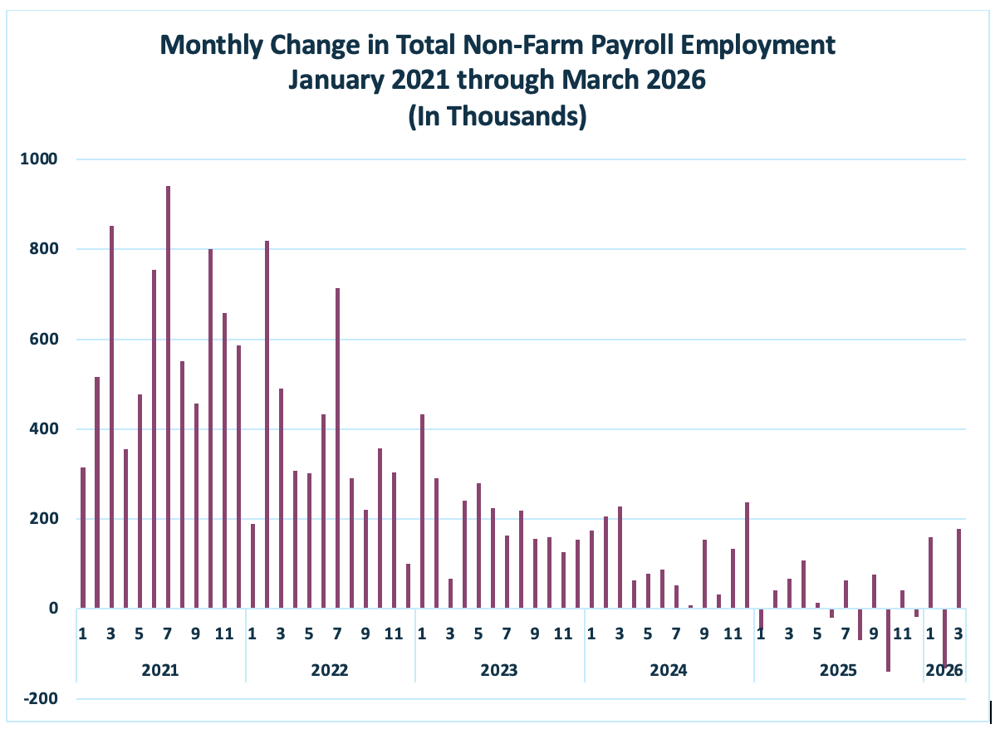
That said, labor markets remain highly complex once analysts peak below the headline numbers. BLS revised the January number up by 34,000 from 126,000 to 160,000 and February down by 41,000 from -92,000 to -133,000. Thus, the two-month cumulative movement is now a -7,000. Thus, is the labor scene improving or not?
The sources of the March job gains only adds to the questions that labor data are now producing. On the one hand, the goods producing sectors finally showed a solid gain. Overall, the sector saw an increase of 43,000 jobs, with construction contributing a healthy 26,000 and manufacturing weighing in with 15,000 new positions. On the other hand, the big gains in the service producing side of the economy (143,000 jobs) were largely centered in low productivity sectors like healthcare (89,900) and leisure and hospitality (44,000). Some of the service sectors that are crucial to productivity gains lost jobs in March or barely grew: information (-3,000), financial services (-15,000) and professional and business services (+2,000). We will have more to say about this sector later in the report.
As mentioned, the official unemployment rate dropped by 0.1 of a percent from 4.4 to 4.3.
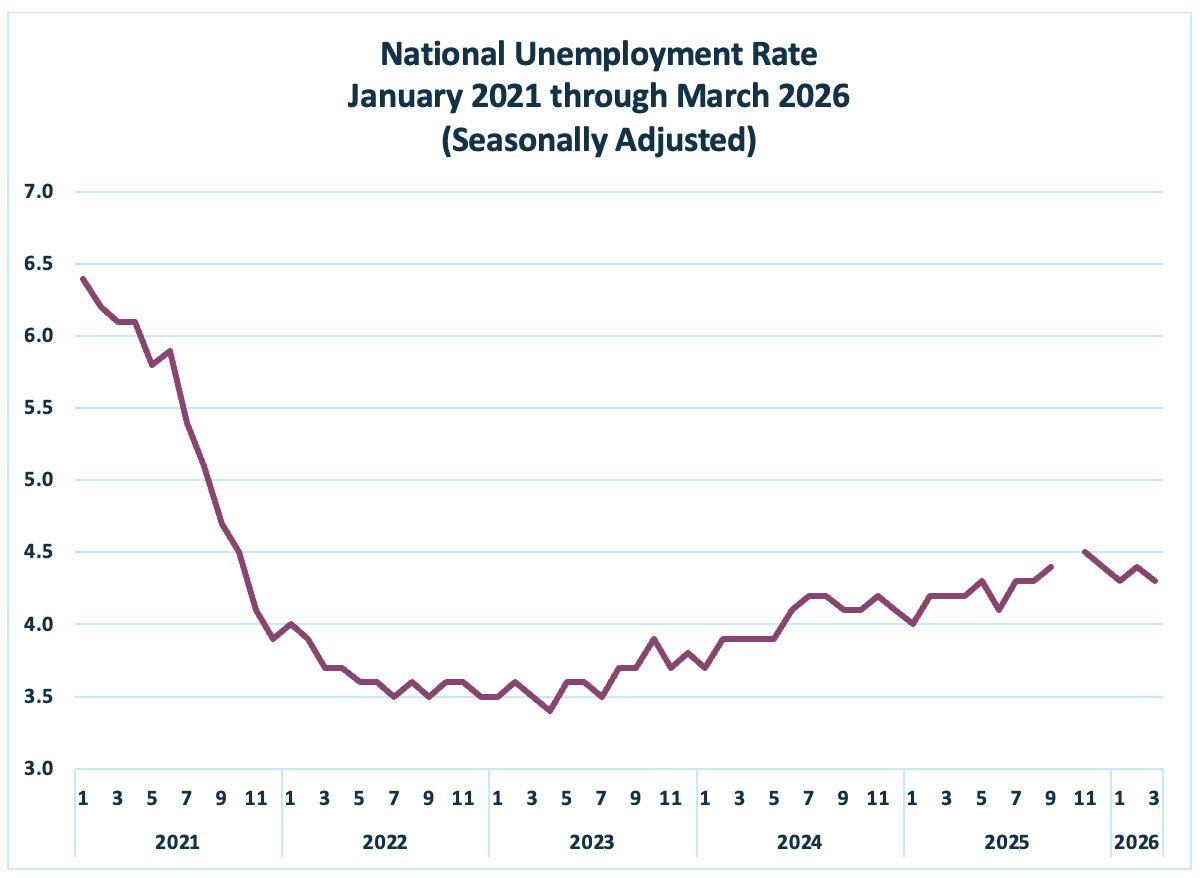
The population of unemployed people dropped by 332,000 from 7,571,000 to 7,239,000, which nearly reached the level of change to qualify as statistically significant. Most of the age, sex, and race/ethnicity unemployment rates remained nearly unchanged from last month, except for Asian unemployment which dropped by a statistically significant 1.1 percentage points.
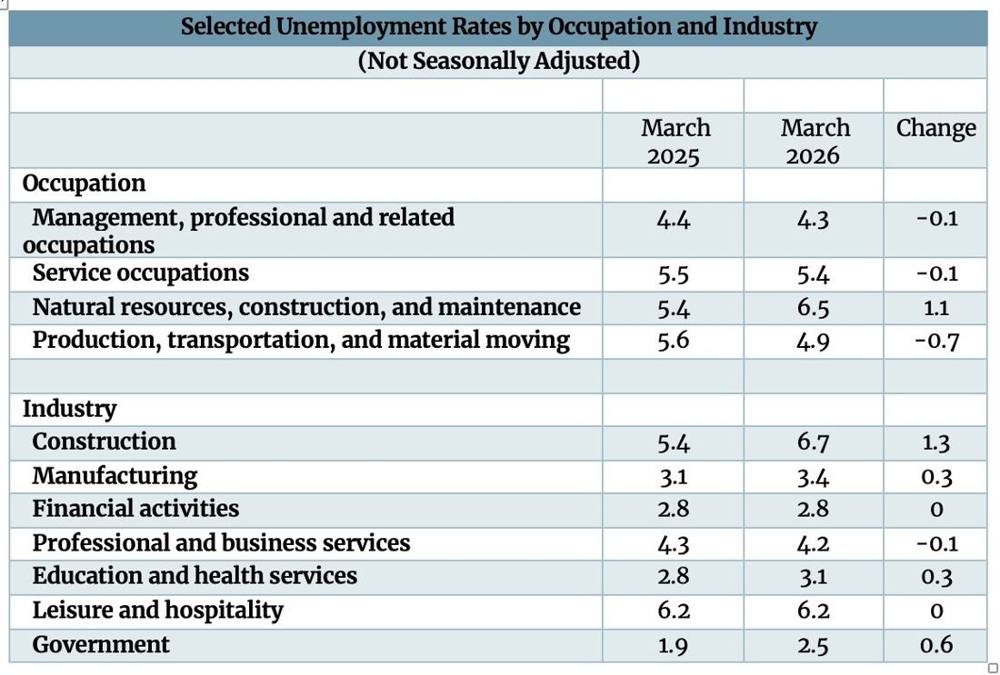
The impression given by month-after-month of steady unemployment rates is that something like a 4 percent rate prevails in every occupation and industry. However, this emphatically is not what
the data show.
Focus: Is Artificial Intelligence Wiping Out Jobs in the Tech Sector or Transforming It?
Careful observers of labor market trends have noticed areas of employment declines since 2022, often in high tech sectors, and have frequently tied these decreases to the effects of generative artificial intelligence (AI). Others frequently not so careful have taken these job losses as early indications of what could happen to the entire job market: AI evolves to a point that human jobs disappear as intelligent robots take over.
Not only does this scenario mistake the likely capabilities of future AI-driven robots (or AI agents) and what we know about near term AI trends, but it misreads what is happening in high tech and their adoption of AI in management and production. This Focus section aims to clarify what we know now about AI, what it is doing to tech jobs, and why governments need to be cautious in regulating this new technology.
In May of 2025, Dario Amodei, co-founder of Anthropic, predicted that AI would wipe out 50 percent of white-collar jobs within 5 years.
[1] This stunning prediction stemmed from the equally stunning progress made by generative AI in the last few years.
[2] For example, solutions to complex coding problems jumped from 4.4 percent to 71.7 percent in just one year, 2023-24. AI has made amazing progress over this same time span (but especially since then) in understanding languages, human knowledge, and reasoning.
Amodei’s jobs crisis prediction and the re-enforcement it received from the stunning progress of AI software and data infrastructure seemed to gain further concrete evidence from employment trends in the very industry that is developing and marketing AI applications. The chart below shows dramatic month-over-month changes in employment in computer services broadly defined, computer programming, and computer design.
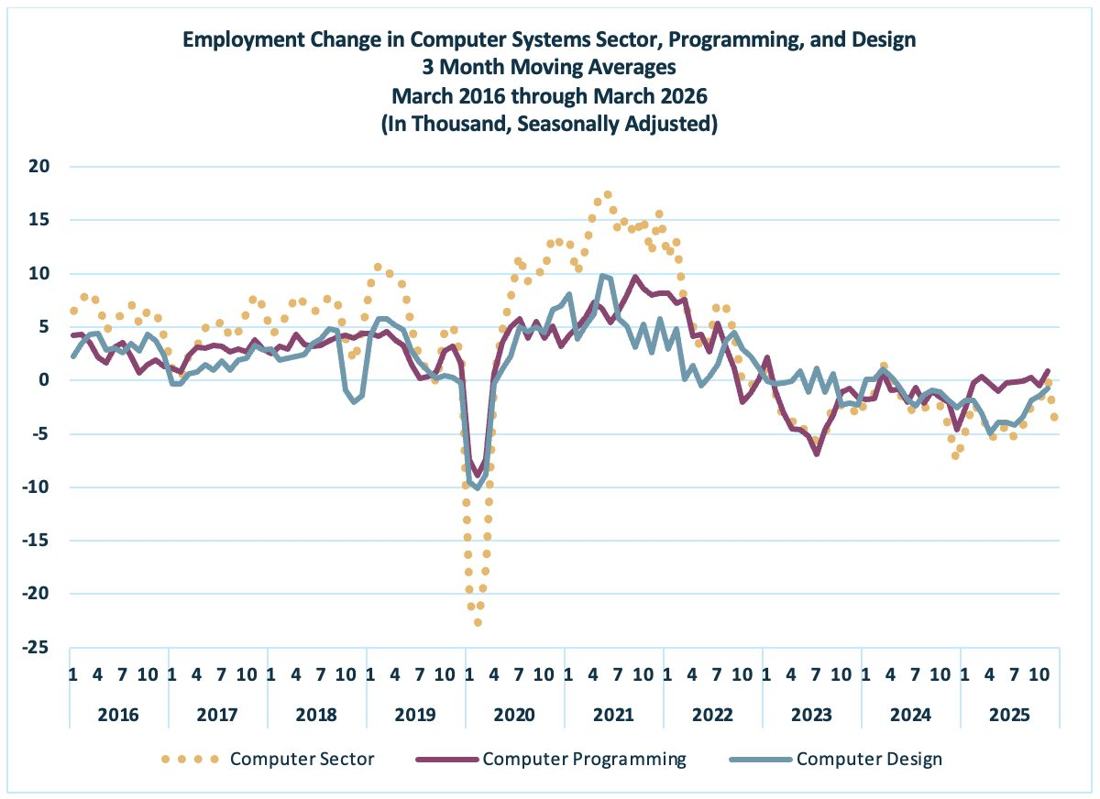
After collapsing during the pandemic, the sector and the two sector subcomponents shown here appear to have recovered their broad pre-pandemic trend in late 2020 and 2021. Then, roughly with the widespread introduction of AI software, particularly those AI products that were focused on coding, job gains slowed and ultimately went negative.
Many blamed AI, and their case was strengthened by job news from other fronts.
- According to the research firm, Challenger, Gray, & Christmas, AI was blamed for 50,000 layoffs in 2025.
- In mid-January of this year, Amazon announced a 16,000-job layoff on top of the 14,000 from the fall of 2025. Andrew Jassy, Amazon’s CEO, argued “As we roll out more generative AI and agents, it should change the way our work is done” and “…in the next few years, we expect that this will reduce our total corporate workforce.”
- Block, which owns Square, Cash App, and Tidal, announced in late February that it would cut 40 percent of its work force as it embraced AI tools. CEO Jack Dorsey said, “Intelligence tools have changed what it means to build and run a company. We’re already seeing it internally. A significantly small team, using the tools we’re building, can do more and do it better. And intelligence tool capabilities are compounding faster every week.”
However, economists and industry experts who study AI and its effects on productivity and the pace of economic activity have yet to see substantial economic gains from AI. A recent survey of economists, industry and financial experts, and informed public indicates a majority view that expects only moderate economic effects over the next three years. These experts point to likely barriers to rapid growth (regulation, implementation costs, international dislocations, etc.) that will dampen the effects of AI on principal economic indicators. Thus, Gross Domestic Product, Labor Force Participation Rates, productivity and so forth will certainly be more elevated in the next three years than without AI, but they will still be following their long-term trends and not some abrupt new path of higher output.
So, what is going on? On the one hand, experts and economists are hard pressed to find clear productivity gains in any but narrow portions of the economy. Perhaps this is a measurement problem like what economists faced when trying to find productivity gains from desktop computing, which they ultimately did find. On the other hand, we have highly successful companies and CEOs confidently announcing staff cuts because they have realized significant productivity gains from AI.
A possible answer to this conundrum lies in the confluence of two forces currently affecting the high tech sector and likely to affect other sectors in the future: staff reductions during transition and staff strengthening once AI has been integrated into production processes.
On the staff reduction side, tech firms over hired during the pandemic, and staffing levels in the United States and around the world rose higher than pre-pandemic levels. Corrections have been underway since 2022, and most have not been associated with AI adoption, which really began to affect coding in 2023 and 2024. In other words, the layoffs began for financial reasons. That said, generative AI is replacing coding personnel now, and we are seeing in the tech industry what we likely will observe in other sectors between now and 2030. How extensive will the AI transformation be? Forrester, a major management consulting company,
expects modest impacts on jobs by 2030: about 6 percent of jobs or about 10.4 million roles (tasks).
Most of the effect of AI will be to supplement and augment existing and new jobs over this period. A possible beginning of this strengthening of staffing through AI can be seen in the right-most portions of the graphic on the computer sector. The losses are slowing and turning to small gains.
AI’s likely path through the economy will be in producing additional value to existing labor. Some workers will adapt easily to the AI transformation, but others will face significant difficulties. The
Brookings Institution published a fascinating study in January of this year that estimated the adaptive capacity of various occupations to AI. They found that the top adaptive occupations (those workers who have the highest capacity to weather job transitions caused by AI) were those about which many analysts are most worried: web designers, marketing managers financial analysts, computer network architects, and so forth. They also found occupations about which we should be concerned: court and municipal clerks, secretaries and admin assistants, HR clerks, medical secretaries and assistants, tax preparers, and other narrowly focused occupations.
The introduction of AI into jobs that used to be guaranteed entry-level posts for recent high school and college graduates does raise real and actionable concerns. A 2026 study by the
Federal Reserve Bank of New York of employment experiences by recent college graduates clearly points to their worsening prospects. Those recent graduates aged 22 to 27 saw an unemployment rate of 5.6 percent at the end of last year, compared to the overall rate of 4.2 percent. Many of these graduates would have been taking employment in law firms, research organizations, tech companies, and public service agencies. However, these are the same types of organizations that are adopting AI to do the cognitive tasks that basic training in college prepares young people to take.
The point of this research is to warn us against overreacting to the job challenges faced by those most capable of adapting to change. Moreover, policymakers should be very careful to distinguish between financially driven layoffs and those stemming from AI.
AI is moving through parts of the economy more slowly than the tech sector’s marketing would have us believe, but it is nevertheless at work changing tasks and jobs. Policymakers need to be alert to these changes, watch them develop, but exercise caution in trying to tame a force that has yet to define itself.
[1] Erick Brynjolfsson, Bharat Chandar, and Ruyu Chen, “Canaries in the Coal Mine: Six Facts About the Recent Employment Effects of Artificial Intelligence,” p. 2 at https://digitaleconomy.stanford.edu/app/uploads/2025/11/CanariesintheCoalMine_Nov25.pdf.
[2] Ibid.