Introduction
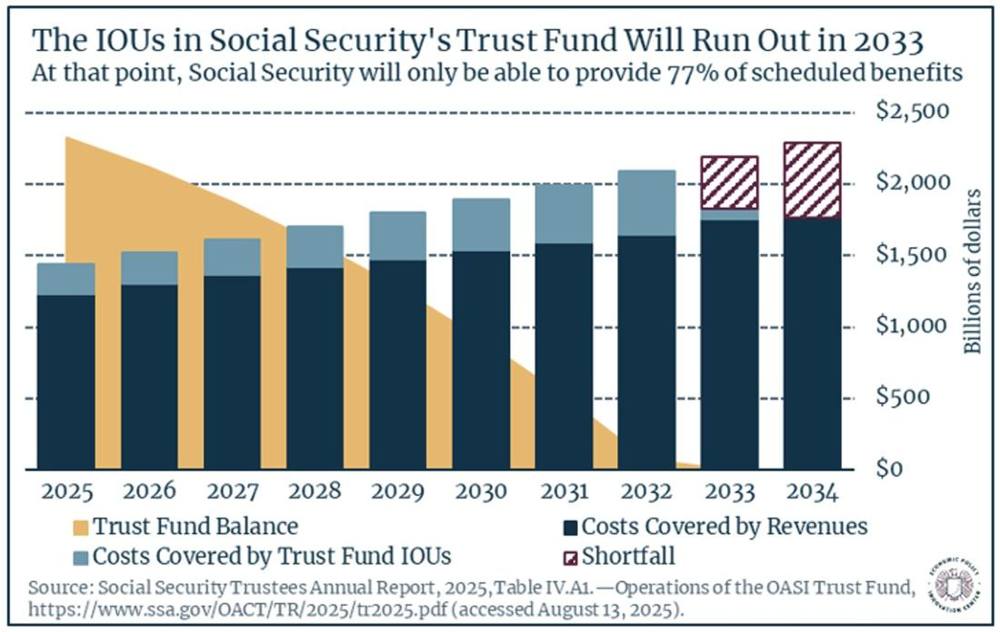
Under current law, Social Security cannot pay more in benefits than it has in revenues. Once the Old Age and Survivors Insurance Trust Fund (OASI) reserves are exhausted in 2032 or 2033, benefits will automatically be limited to incoming revenue, which will equal between 72 percent and 77 percent of scheduled benefits.
[1]
Comprehensive reform will be necessary to protect and improve the program, and any reforms should focus on protecting lower-income retirees, reducing Social Security’s long term tax burden on all Americans, and introducing a personal wealth building option to strengthen retirement security without expanding government dependency.
[2]
Since Social Security’s shortfalls are growing by trillions per year, policymakers should immediately take steps that would extend Social Security’s solvency and move toward long-term solutions.
Deteriorating Fiscal Space Limits Social Security Options
Without reform, Social Security’s OASI program, which provides retirement and survivors benefits, will run out of funds to pay full benefits beginning in 2032 according to the Congressional Budget Office (CBO) or 2033 according to the Social Security Trustees.
[3] Because Social Security’s finances are separate from other government spending and it does not have the authority to borrow, benefits will have to be reduced by 28 percent (according to the CBO) or by 23 percent (according to the Social Security Trustees) when Social Security’s trust fund runs dry.
[4]
The deteriorating fiscal outlook for the U.S. budget increases the urgency of taking immediate steps to shore up Social Security’s solvency. The U.S. is running out of fiscal space—the amount of additional borrowing the U.S. can take on before risking macroeconomic insecurity. Using the CBO’s most recent baseline, EPIC estimates that fiscal space will begin permanently eroding by 2029, making it very difficult for the federal government to confront crises such as war, recessions, and natural disasters.
[5] Attempting to pay for Social Security’s $25.4 trillion shortfalls through additional borrowing would be even more difficult and could trigger a fiscal crisis.
Comprehensive Social Security reform is necessary to improve and protect the program for current and future generations. Until that reform happens, policymakers should take meaningful steps to prolong Social Security’s solvency and reduce its unfunded obligations.
Immediate Actions Can Prolong Solvency, Strengthen Program
Absent congressional action, roughly 72 million Social Security recipients will have their benefits cut by 23 percent to 28 percent beginning in 2032 or 2033. Some common sense and relatively small changes—all of which bring Social Security closer to its original intent—could push back the date of Social Security’s insolvency and reduce its subsequent shortfalls.
Cap Benefit Increases for High-Income Recipients
Social Security’s benefit structure is both progressive and contributory, meaning lower income individuals receive proportionally higher benefits relative to their lifetime earnings, and higher income individuals proportionally lower but higher-dollar benefits based on their higher payroll taxes. The current maximum benefit for someone who had average lifetime earnings of $184,500 or more is about $4,370 per month, or $52,450 per year in 2026. The maximum benefit for new Social Security recipients rises each year based on earnings growth, and the maximum benefit for current recipients is increased by Social Security’s cost-of-living-adjustment (COLA).
Placing a cap on Social Security benefits beginning in 2027 and equal to the 2026 maximum levels would modestly reduce future Social Security benefits for the highest income earners.
[6] Initially, this proposal would affect only the top 2.5 percent of Social Security recipients, with that figure rising to close to 9.0 percent by 2036 as more people would hit the cap.
[7] A cap makes sense within the context of Social Security’s goal to reduce poverty in old age because only people who had very high average lifetime earnings would initially hit the cap, and they would still receive a benefit equal to about three times the poverty level for a single person.
[8]
A cap on Social Security benefits set at the 2026 maximum would save roughly $150-$220 billion over 10 years and push Social Security’s insolvency date back by one to 1.5 months.
[9]
Apply a Progressive Cost of Living Adjustment
Currently, all Social Security recipients receive an annual COLA, which has averaged 2.6 percent over the past 20 years. Limiting COLA increases for middle- and upper-income earners is a targeted way to prioritize benefit increases for those most in need. One way to do this would be to: apply a full COLA to the lower-income portion of workers’ earnings—that which falls in the 90 percent replacement rate under Social Security’s benefit formula; apply a half-COLA to the portion of retirees’ benefits that are in the middle 32 percent replacement rate of the benefit formula; and apply no COLA to the high-income portion of retirees’ benefits that are in the 15 percent replacement rate.
[10]
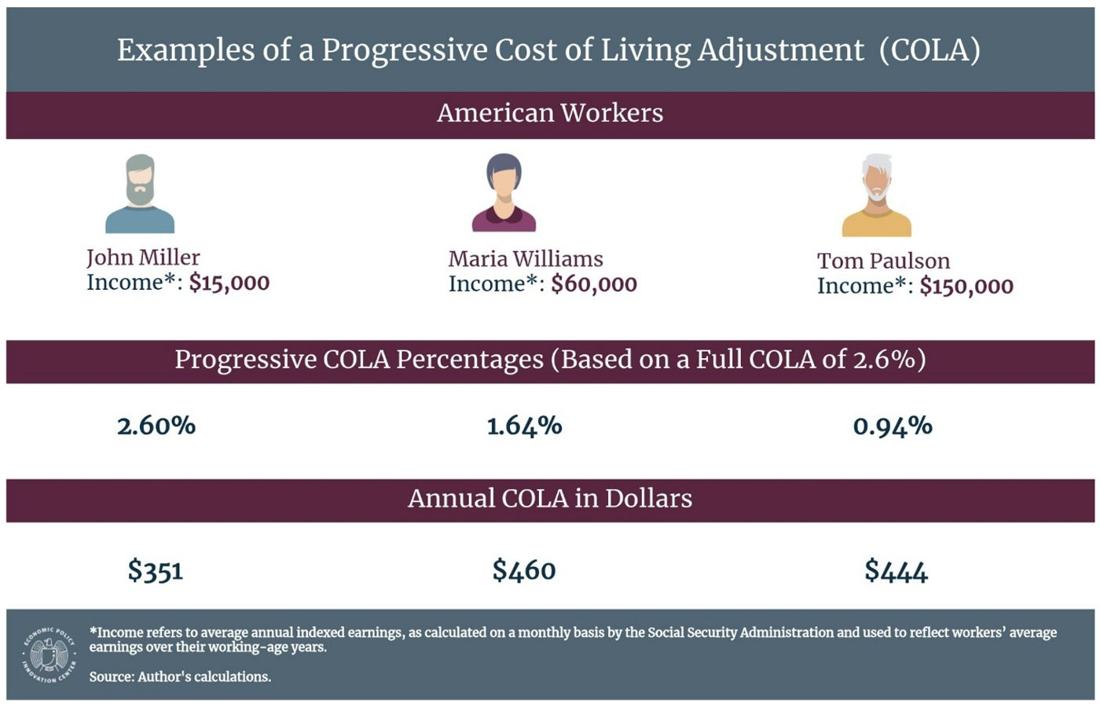
A progressive COLA adjustment would save about $200 billion over 10 years and push Social Security’s insolvency date back by about 1.5 months.
[11]
Use a More Accurate Inflation Index
Each year, Social Security benefits are adjusted upwards to help maintain beneficiaries’ purchasing power over time. Social Security uses an outdated and inaccurate inflation metric—the consumer price index for wage and clerical workers, or CPI-W, that is based on the prices paid by less than one-third of the population, and which tends to overstate actual inflation.
[12] When Social Security first began adjusting benefits, the inflation measure that economists and the nonpartisan Congressional Budget Office consider “a more accurate estimate of changes in the cost of living from one month to the next” was not available.
[13] The chained CPI is based on the Consumer Price Index for All Urban Consumers (CPI-U), which covers 93 percent of the population, and it accounts for how people change their purchases in response to changes in prices. Using the chained CPI for Social Security is something that both Democrat and Republican presidents have included in their budget requests. This would have only slightly changed the rate of growth of benefits and is consistent with Social Security’s goal of maintaining the purchasing power of benefits over time.
The CBO estimates that adopting the chained CPI would save Social Security $204 billion over 10 years and would cover about 12 percent of the program’s long run shortfalls.
[14] This would delay Social Security’s insolvency by about two months.
Begin Progressive Price Indexing for Newly Eligible Retirees
Social Security’s benefit formula is based on individuals’ average indexed earnings over their lifetimes, with a goal of replacing a higher percentage of lower-earners’ incomes, and a lower percentage of higher-earners’ incomes. The automatic wage indexing that Congress enacted in 1977 results in significantly overstated earnings because, unlike a price index that would account for inflation over time, Social Security’s wage index credits individuals with higher earnings—in real, inflation-adjusted terms—than they actually received. If Congress had instead implemented a price index into the benefit formula 1977, Social Security would be solvent today.
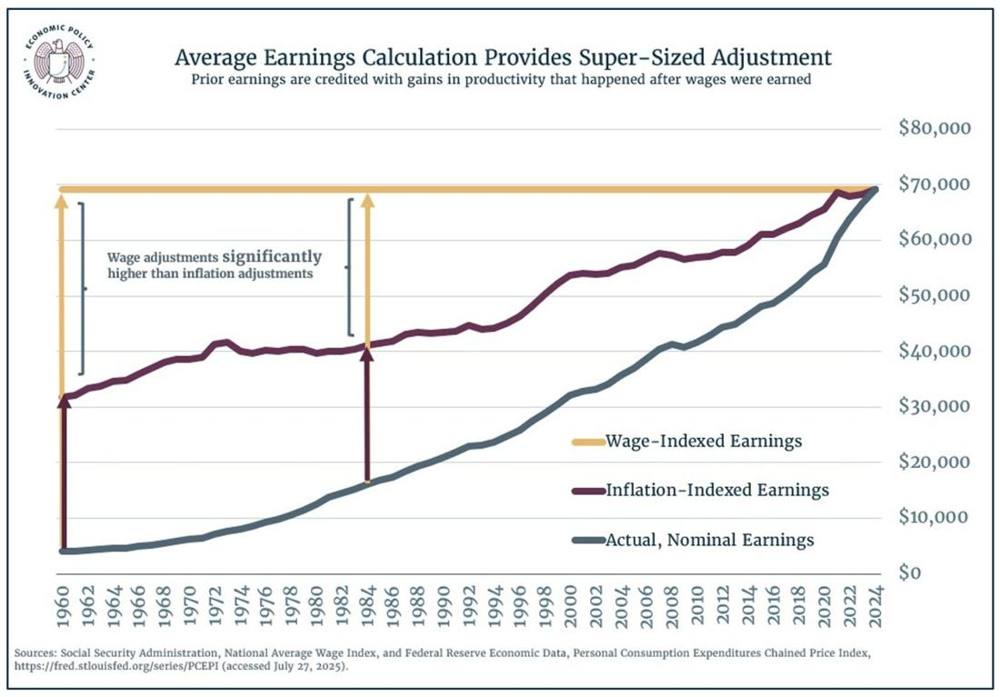
It would be difficult to retroactively apply a price index to current beneficiaries because doing so would result in large benefit reductions. Policymakers could, however, apply a progressive price index—maintaining wage indexing for lower income earners, and using a mix of wage and price indexing for middle and upper-income earners—as a targeted way to prolong Social Security’s solvency while protecting benefits for current recipients and lower-income earners.
One way to go about a progressive price index would be to use a wage index for earnings up to two times the poverty level, and a price index for earnings above that. While this would reduce benefits for newly retired middle- and upper-income earners, it would do so by shifting towards a more accurate inflation index and would still provide above-inflation earnings adjustments for a significant portion of the affected workers’ earnings.
This change would save about $200 to $220 billion over 10 years and push Social Security’s insolvency date back by a little more than one month.
[15] Over the long-term, this change would solve about 45 percent to 50 percent of Social Security’s current shortfalls.
[16]
Extend the Current Increase in Social Security’s Retirement Age
When Social Security first began in 1935, life expectancy at birth was about 62 years and Social Security’s earliest retirement age was 65 years.
[17] In other words, the average person was not expected to live long enough to receive Social Security benefits. Today, life expectancy at birth is 79, and life expectancy at age 65 is almost 20 years.
[18] Moreover, Social Security benefits are available as early as age 62. This means that a significantly larger share of the population lives long enough to collect Social Security benefits, and they collect the benefits for significantly more monthly checks.
In 1983, Congress enacted changes to increase Social Security’s normal retirement age gradually from 65 to 67. Since 2000, the age has been increasing by two months for each year of birth until it reaches 67 for individuals born in 1960 and later. Extending the current increase by adding two months per year to Social Security’s normal retirement age—bringing it to 67 years and 2 months for individuals born in 1961 and up to 70 for individuals born in 1981 and beyond—would align with Social Security’s intent to protect against individuals outliving their savings and would provide adequate time for current workers to prepare to either work slightly longer or to save slightly more for their retirement.
Expanding the current scheduled increases in Social Security’s normal retirement age by two months per year until reaching age 70 would save about $100 billion over 10 years and push Social Security’s insolvency date back by less than one month.
[19] The savings from this proposal would grow significantly over time and cover about one-third of Social Security’s long-run shortfalls.
[20]
Note on interaction of proposals: The rough estimates for savings provided in this report are discrete in nature and do not take into account interaction between the proposals. If multiple proposed actions were enacted simultaneously, the resulting savings would be larger than any of the singular proposals, but smaller than the sum of the proposals due to interactions between proposals. For example, applying progressive price indexing after capping higher-income earners’ benefits would mean that while progressive price indexing would still generate savings for individuals below the benefit cap, the portion of savings that would have accrued above the benefit cap have already been accounted for by the cap itself. Thus, while combining proposed reforms could reduce the savings attributed to each particular proposal, the addition of any one of the proposed reforms would always result in a larger positive impact on Social Security’s solvency.
Conclusion
Under current law, Social Security cannot pay benefits it does not have the revenue to support, and once the Old Age and Survivors Insurance Trust Fund reserves are exhausted in 2032 or 2033, benefits will automatically be reduced by 23 percent to 28 percent. Comprehensive reform will ultimately be necessary to improve and protect the program for current and future generations, particularly as the nation’s deteriorating fiscal outlook limits the government’s ability to rely on additional borrowing.
In the meantime, policymakers should take meaningful steps that prolong Social Security’s solvency and reduce its unfunded obligations while prioritizing protections for lower-income retirees. Taking common sense reforms now would move the program closer to its original intent and help lay the foundation for long-term solutions to extend Social Security’s solvency.
[1] Rachel Greszler, “CBO Baseline Says Social Security Insolvent One Year Earlier, in 2032, Followed by 28% Benefit Cuts,”
EPIC for America, February 23, 2026,
../../education-workforce-retirement/cbo-baseline-says-social-security-insolvent-one-year-earlier-in-2032-followed-by-28-benefit-cuts/ (accessed March 12, 2026); Rachel Greszler, “Social Security Trustees 2025 Report Shows Further Deterioration, Looming Benefit Cuts,”
EPIC for America, June 24, 2025, The
../../social-programs/social-security-trustees-2025-report-shows-further-deterioration-looming-benefit-cuts/ (accessed March 12, 2026).
[2] Rachel Greszler, “Social Security Is Running Out of Time and Money,”
EPIC for America, May 23, 2024,
../../social-programs/social-security-is-running-out-of-time-and-money/ (accessed March 12, 2026).
[3] Rachel Greszler, “EPIC Explainer: Social Security’s Trust Fund,”
EPIC for America, September 2, 2025,
../../education-workforce-retirement/epic-explainer-social-securitys-trust-fund/ (accessed March 12, 2026); The Congressional Budget Office, “The Budget and Economic Outlook: 2026 to 2036,” (February 2026),
https://www.cbo.gov/publication/62105 (accessed March 12, 2026); Board of Trustees, Federal Old-Age and Survivors Insurance and Federal Disability Insurance Trust Funds, “The 2025 Annual Report of the Board of Trustees of the Federal Old-Age and Survivors Insurance and Federal Disability Insurance Trust Funds,” (June 2025),
https://www.ssa.gov/oact/TR/2025/trTOC.html (accessed March 12, 2026).
[4] Rachel Greszler, “EPIC Explainer: What Will Happen When Social Security’s Trust Fund Runs Dry?,”
EPIC for America, February 9, 2026,
../../education-workforce-retirement/epic-explainer-what-will-happen-when-social-securitys-trust-fund-runs-dry/ (accessed March 12, 2026).
[5] Matthew Dickerson, “The Fiscal State of the Nation Demands Attention,”
EPIC for America, February 24, 2026,
../../federal-budget/the-fiscal-state-of-the-nation-demands-attention/ (accessed March 12, 2026).
[6] The cap would vary by age at first claiming to prevent incentivizing changes in claiming age. For those claiming at the earliest age of 62, the cap would equal about $3,060; at normal retirement age (67 beginning in 2027), the cap would equal about $4,370, and for individuals who wait until age 70 or later to first claim benefits, the cap would equal about $5,420.
[7] Estimates are very rough, based on the use of AI modeling incorporating data from the Social Security Administration’s monthly statistical snapshots, the Social Security Trustees’ 2025 annual report, and the Congressional Budget Office’s February 2026 baseline budget projections.
[8] Over the very long run, a cap on benefits is a way to achieve a flat benefit. A flat, or universal benefit based on years of work instead of earnings levels, could restore Social Security solvency while better preventing poverty in old age. Eventually, a cap on benefits would need to be adjusted for inflation and should be done at or before the flat benefit reaches the poverty level. A universal benefit based on years of work would increase benefits for millions of recipients, reducing poverty among the elderly.
[9] Estimates are very rough. See footnote 7.
[10] The 90 percent replacement rate corresponds to average annual earnings up to about $15,500; the 32 percent replacement rate corresponds to average annual earnings between about $15,500 and $93,000, and the 15 percent replacement rate corresponds to earnings above $93,000. Middle- and high-income earners would receive a mixed COLA, including a full COLA on the lower part of their earnings, a half COLA on middle-earnings, and no COLA on high earnings.
[11] Estimates are very rough. See footnote 7.
[12] Romina Boccia and Rachel Greszler, “Social Security Benefits and the Impact of the Chained CPI,”
The Heritage Foundation, May 21, 2013,
https://www.heritage.org/social-security/report/social-security-benefits-and-the-impact-the-chained-cpi#_ftn9 (accessed March 9, 2026).
[13]Rob McClelland, “Differences Between the Traditional CPI and the Chained CPI,”
Congressional Budget Office, April 19, 2013,
http://www.cbo.gov/publication/44088 (accessed March 10, 2026).
[14] Congressional Budget Office, “Preliminary Estimate of the Budgetary Effects of Using the Chained CPI for Mandatory Programs and the Tax Code Starting in 2014,”
Congressional Budget Office, March 1, 2013,
http://www.cbo.gov/sites/default/files/cbofiles/attachments/Government-wide_chained_CPI_estimate-2014_effective.pdf (accessed March 10, 2026).
[15] Estimates are very rough. See footnote 7.
[16] Ibid.
[17] Congressional Research Service, “Life Expectancy in the United States,” Congressional Research Service Report for Congress, August 16, 2026,
https://www.congress.gov/crs_external_products/RL/PDF/RL32792/RL32792.4.pdf (accessed March 12, 2026).
[18] U.S. Centers for Disease Control and Prevention, National Center for Health Statistics
, Mortality in the United States, 2024, January 2026, no. 548, https://www.cdc.gov/nchs/data/databriefs/db548.pdf (accessed March 10, 2026).
[19] Congressional Budget Office, “Raise the Full Retirement Age for Social Security,”
Congressional Budget Office (December 2024), https://www.cbo.gov/budget-options/60913 (accessed March 10, 2026).
[20] Ibid.