Social Security’s Trust Fund Is Not a Savings Account
When Social Security was first established, Congress created a special fund—the Old-Age and Survivor’s Insurance Trust Fund,
[1] or OASI—as a means of keeping Social Security’s finances separate from other government taxes and spending. Since the program’s inception, all
Social Security taxes have been credited to Social Security’s trust fund, and all benefits and administrative expenses have been debited from it.
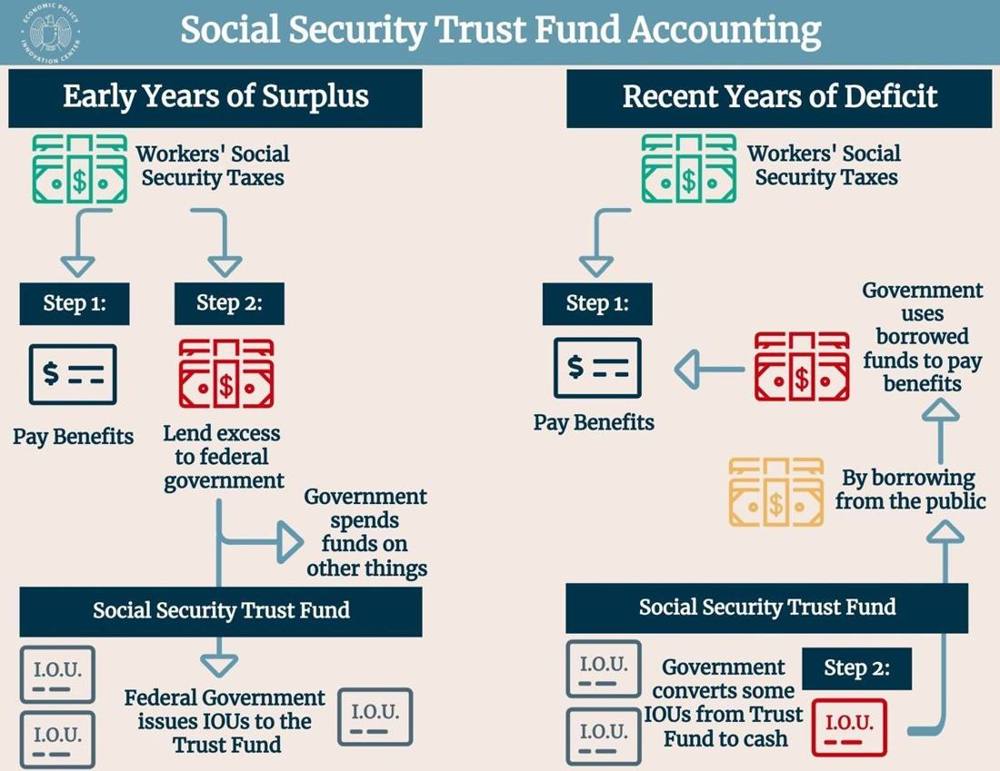
Social Security’s Trust Fund Is an Accounting Metric with No Real Money. Although Social Security’s OASI trust fund has held a positive balance throughout history—maxing out at $2.8 trillion in 2017—there has never been a single actual dollar in the trust fund. Instead, the trust fund is an accounting mechanism to keep track of otherwise comingled government taxes, spending, and debt.
Throughout history, every dollar that Social Security has collected in any given year has been first used to pay
Social Security benefits due that year plus other program costs. Any remainder has been lent to the federal government—in the form of special issue U.S. Treasuries that avoid having to issue new publicly held debt—to pay for other, non-Social Security government spending. The balances of the OASI trust fund are classified as "intragovernmental debt" and count towards the debt limit.
[2] These special issue Treasuries are essentially IOUs.
For example, in 1950, Social Security collected $2.928 billion in revenues (mostly taxes and interest paid to the fund) and spent $1.022 billion on benefits and administrative costs. The remaining $1.905 billion was lent to the general fund of the federal government in exchange for $1.905 billion of IOUs credited to Social Security’s trust fund.
In addition to any annual surpluses credited to the trust fund, the federal government also issues and credits additional IOUs into the trust fund each year to cover the annual interest due on the trust fund’s balance. The trust fund balance equals the net total of all past borrowing from the trust fund.
 Social Security’s Trust Fund Is Running Consistent Deficits
. While Social Security has run annual surpluses more times than not throughout history, it has run consistent deficits in recent years. When Social Security collects less in taxes than it is scheduled to pay in benefits and expenses, which has happened in each of the past 15 years, the program cashes in on some of its IOUs.
For example, in 2024, Social Security collected $1.224 trillion in taxes and interest IOUs. To pay $1.327 billion in benefits and administrative expenses, the program had to cash in on $103 billion in IOUs. This caused the OASI trust fund balance to fall from $2.641 trillion to $2.538 trillion.
[3]
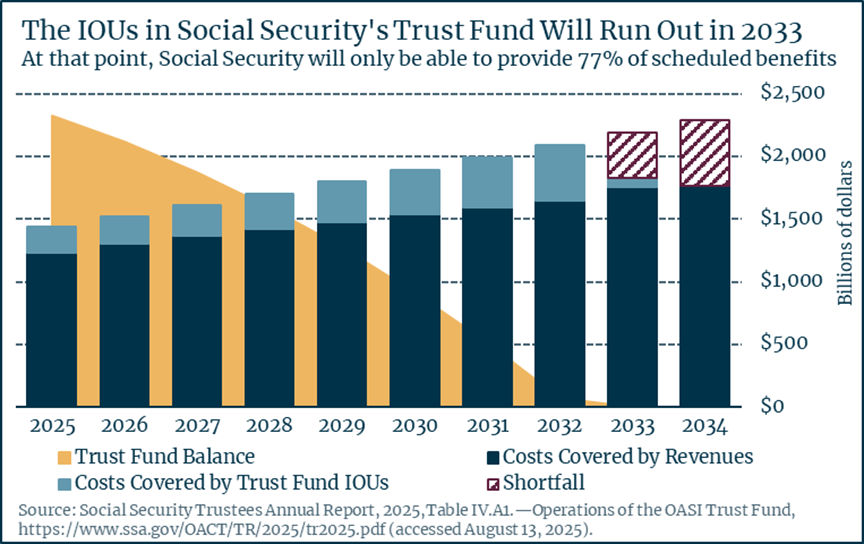
Social Security’s Trust Fund Is Rapidly Depleting. Over the next eight years, Social Security’s annual shortfalls will cause the program to cash in on all of its remaining IOUs and the OASI trust fund is expected to become depleted in 2033.
At that time, Social Security can legally pay only as much in benefits as it collects in taxes, which will equal an
estimated 77 percent of currently scheduled benefits.
Summary
When Congress established Social Security in 1935, it created a trust fund to keep Social Security’s finances separate from other federal government taxes and spending. While it is true that the Social Security taxes workers pay are credited to Social Security’s trust fund, the trust fund itself is a mere accounting mechanism. There have never been any actual dollars in the trust fund.
Instead, Social Security taxes have been immediately spent to pay Social Security benefits with any remainder lent to the federal government to spend on other programs. Social Security’s trust fund consists entirely of special-issue Treasuries, or IOUs, that the federal government has issued to the fund. Because Social Security has been paying more in benefits than it collects in taxes in recent years, it has been cashing in on those IOUs.
The IOUs available to backfill the cost of currently scheduled benefits will be depleted in 2033. At that point, Social Security can only pay as much in benefits as it collects in revenues, which will equal about 77 percent of currently scheduled benefits.
[1] The original Social Security legislation established an Old-Age Reserve Account. Amendments passed in 1939 changed this to the Old-Age and Survivor’s Insurance Trust Fund. A disability insurance program was added to Social Security in 1956, along with the creation of a separate Disability Insurance (DI) trust fund. Although Social Security’s OASI and DI trust funds are often refereed to as the combined OASDI trust fund, no such fund actually exists as they are two legally separate trust funds each serving legally separate programs.
[2] Congressional Budget Office, “Answers to Questions for the Record Following a Hearing on Social Security’s Finances,” September 26, 2024,
https://www.cbo.gov/publication/60733.
[3] Social Security Administration, “The 2025 Annual Report of the Board of Trustees of the Federal Old-Age and Survivors Insurance and Disability Trust Funds,” Table IV.A1.—Operations of the OASI Trust Fund, Calendar Years 2020-2034.