Social Security Taxes Over Time
Social Security Taxes Were Initially Low and Supposed to Max Out at Less Than Half Their Current Level. When Social Security first began collecting taxes in 1937, it started out as a two percent tax on workers’ earnings, with both workers and employers paying one percent each. The Social Security Act included a gradual increase in the tax rate to a maximum of six percent. As explained in “The 1936 Pamphlet on Social Security” that was sent to all American adults:

[B]eginning in 1949, twelve years from now, you and your employer will each pay 3 cents on each dollar you earn, up to $3,000 a year. That is the most you will ever pay. [emphasis added] [1]
Despite that promise, Social Security’s current 12.4 percent tax is more than twice what the original law stipulated, and maintaining current benefits would require Social Security’s tax to reach nearly three times its intended level.
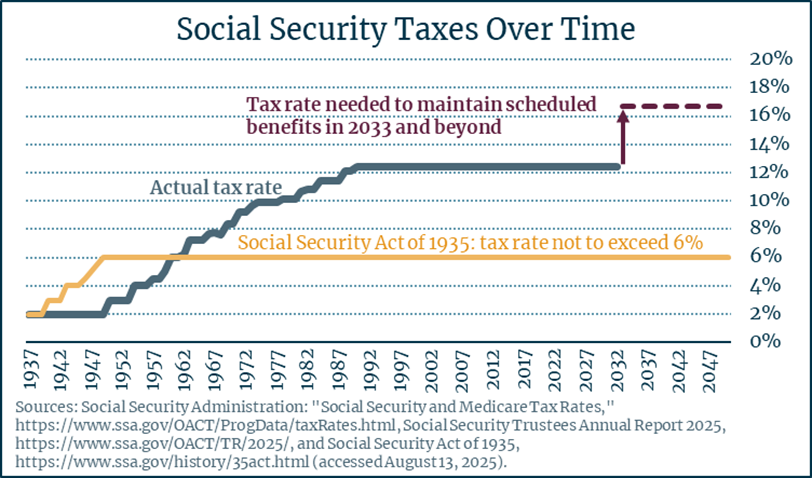
According to the Social Security Trustees, maintaining currently scheduled benefits would require the tax rate to rise to 16.05 percent immediately (in 2025), or to 16.7 percent if policymakers wait until 2033 when the trust fund runs dry.
[2]
Workers Only See Half of the Social Security Taxes They Pay. With workers increasingly using direct deposit to receive their paychecks, fewer Americans actually see their paystubs. But those who do, or who look at their end-of-year W-2 tax records, will see a breakdown of the Social Security (and Medicare) taxes that have been withheld from their paychecks.
The actual amount that was paid on their behalf, however, is twice what they see, as employers have to pay half of the tax (this does not typically appear on the paystub). Since employers take into account the total cost of employing someone when setting their wages, economists agree that workers bear the burden of employer-paid taxes in the form of lower wages.
[3]
Social Security’s Tax Base Has Increased. As noted in the 1936 Social Security pamphlet quoted above, workers only paid taxes on the first $3,000 of their earnings, which is equivalent to about $66,000 in 2025 dollars. This limit is referred to as Social Security’s taxable maximum (or tax cap). The amount of income below the cap equals Social Security’s tax base.
The purpose of a tax cap—which automatically translates into a benefit cap—was to provide a basic level of retirement income without providing excessive benefits to high-income earners who were the least in need. While the original $3,000 tax cap was not even indexed for inflation, subsequent legislative changes to the program have resulted in a tax cap—currently $176,100 in 2025—that is more than 2.5 times its original level, even after adjusting for inflation.
[4]
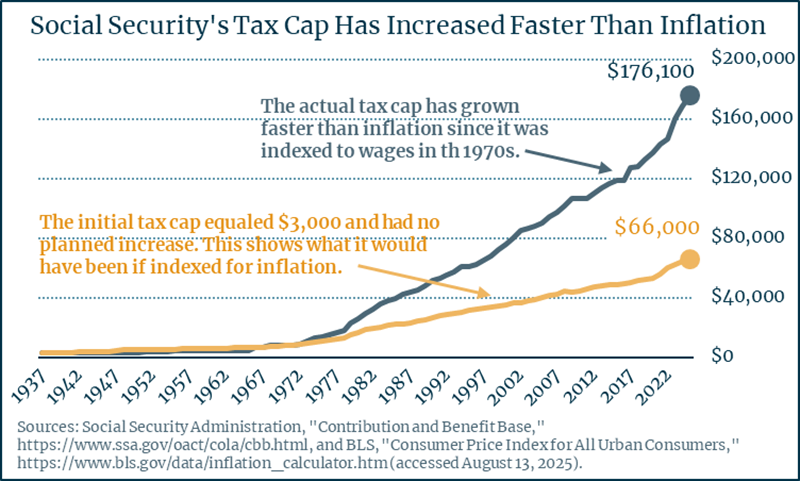
The establishment of and growth in Social Security’s taxable maximum have transformed the program from a relatively small, anti-poverty program into an enormous and nearly universal benefit program that looks vastly different than Social Security’s founders envisioned. Social Security’s draft plan submitted to Congress by President Franklin Delano Roosevelt’s Committee on Economic Security did not include a tax cap, but instead completely excluded individuals who made over $250 per month ($3,000 per year) from the program. Had the House Committee on Ways and Means not replaced the $250/month exclusion from the program with a $3,000 annual tax cap, Social Security would have been a true anti-poverty program, available only to low- and middle-income earners.
Causes of Rising Taxes. Social Security’s rising taxes are primarily the result of a series of large benefit increases, which go far beyond what the program’s founders intended for the anti-poverty, social insurance program they designed. In 1950, Social Security’s
maximum annual benefit was equivalent to $7,332 in 2025 dollars; today, it is $48,216. Social Security’s
average annual benefit has roughly tripled from an inflation-adjusted $9,976 in 1960 to $29,905 in 2025.
[5]
In addition to higher benefit levels, increased life expectancy means that a higher percentage of the population lives long enough to collect Social Security benefits, and they collect them for a longer period of time. In 1940, only 57 percent of people who survived to age 21 lived to at least age 65 (Social Security’s original retirement age).
[6] Today, 80 percent of people who survive to age 21 are expected to reach age 67 (the normal retirement age for anyone born in 1960 or later).
Moreover, whereas the average Social Security recipient who retired in 1940 collected benefits for 13.7 years, the average recipient who retires today at age 67 will collect benefits for 17.3 years. In other words, there has been at least a 40 percent increase in the percentage of adults that lives long enough to collect Social Security benefits, and a 27 percent increase in the amount of time over which they collect those benefits.
[7] In short, Social Security has expanded far beyond its original size because more people receive significantly larger benefits over much longer time periods.
[8]
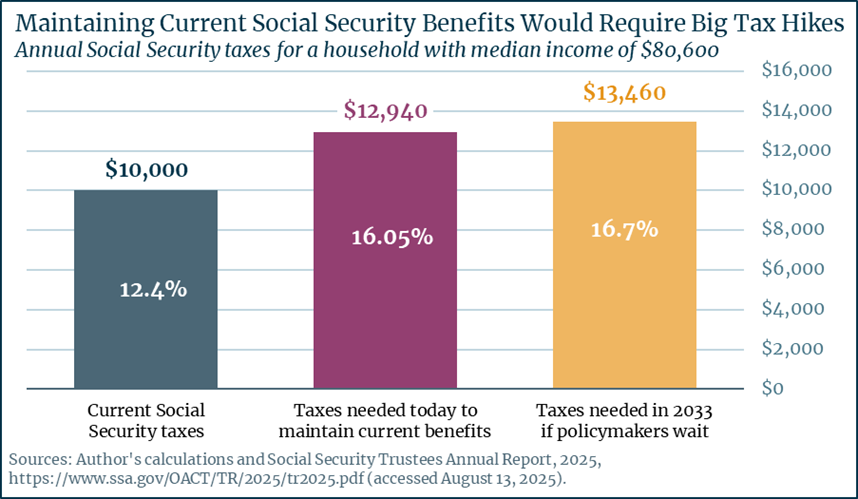
Maintaining Current Benefit Levels Would Require Large Tax Hikes. As explained below, Social Security’s trust fund is running out of money because the program has been paying out more in benefits than it collects in tax revenues for the past 15 years. According to the Social Security Trustees, maintaining current benefits exclusively through tax hikes would require Social Security’s current 12.4 percent tax to rise immediately to 16.05 percent. For a median household with $80,600 in income, that would mean a $2,900 tax hike and a total of $12,900 per year in Social Security taxes. If policymakers wait until 2033, Social Security’s tax would have to rise to 16.7 percent, which would equal $13,500 per year in Social Security taxes.
Summary
Social Security started out as a two percent tax and the program was never supposed to take more than six percent of workers paychecks. Yet today, Social Security’s tax is 12.4 percent. Workers only see half of this tax come out of their paychecks as their employers pay the other half and reduce workers’ wages accordingly.
Social Security has a taxable cap, which, by limiting the amount of earnings subject to Social Security taxes, also limits the maximum benefit that can be received. The purpose of the cap is to focus the program on its social insurance goals of targeting benefits to lower- and middle-income earners. The current tax cap of $176,100 in 2025 is roughly three times its original level, after adjusting for inflation.
Social Security has expanded far beyond its intended size because a larger percentage of the population receives increasingly bigger benefits over a longer period of time. Maintaining current benefit levels for everyone when the trust fund runs out of money in 2033 would require Social Security’s tax rate to rise to 16.7 percent or higher.
[1] Social Security Administration, “The 1936 Government Pamphlet on Social Security,”
https://www.ssa.gov/history/ssn/ssb36.html (accessed August 10, 2025).
[2] Social Security Administration, “The 2025 Annual Report of the Board of Trustees of the Federal Old-Age and Survivors Insurance and Disability Trust Funds,” June 18, 2025,
https://www.ssa.gov/OACT/TR/2025/tr2025.pdf (accessed August 12, 2025).
[3] Jonathan Gruber, “The Incidence of Payroll Taxation: Evidence from Chile,” National Bureau of Economic Research Working Paper 5053, March 1995,
https://www.nber.org/papers/w5053 (accessed August 12, 2025).
[4] Social Security’s taxable maximum is indexed to growth in the national average wage index.
[5] Author’s calculations based on: Social Security Administration, “Annual Statistical Supplement, 2025,” Table 5B8—Number and Average Monthly Benefit of Retired-Worker Beneficiaries With and Without Reduction for Early Retirement, by Sex, December 1956–2024, Selected Years,
https://www.ssa.gov/policy/docs/statcomps/supplement/2025/5b.pdf (accessed August 10, 2025); and Federal Reserve Economic Data, “Consumer Price Index for All Urban Consumers,” Federal Reserve Bank of St. Louis,
https://fred.stlouisfed.org (accessed August 10, 2025). Note that the average 2025 benefit assumes a 3.9 percent increase from 2024 to 2025 in the average retired worker benefit.
[6] Social Security Administration, “Life Expectancy for Social Security,” Social Security History,
https://www.ssa.gov/history/lifeexpect.html (accessed August 12, 2025).
[7] These estimates assume individuals begin collecting benefits at the normal retirement age of 67. In reality, most people begin collecting benefits between ages 62 and 66. If considering Social Security’s earliest eligibility age of 62, then 86 percent of people who survive to age 21 reach Social Security eligibility age, and those who first claim benefits at age 62 will receive benefits for an average of 21.1 years.
[8] Another factor not discussed in this explainer is that Social Security originally excluded about half of all workers from the system. Most of those workers have been brought into Social Security since then. If the program had been fully pre-funded—with benefits received by one generation equal to what they paid into the system plus interest—then the addition of more workers would have been neutral on the program’s costs. But because Social Security has consistently paid out more in benefits than it collected in taxes from generation to generation, Social Security’s inclusion of additional workers exacerbated the total size of the program’s shortfalls.