Overview: Signs of Economic Vitality in the April Report
Today’s
report from the Bureau of Labor Statistics (BLS) provides more evidence that the economy generally and labor markets in particular may be weathering the headwinds of war, price increases, and immigration changes.
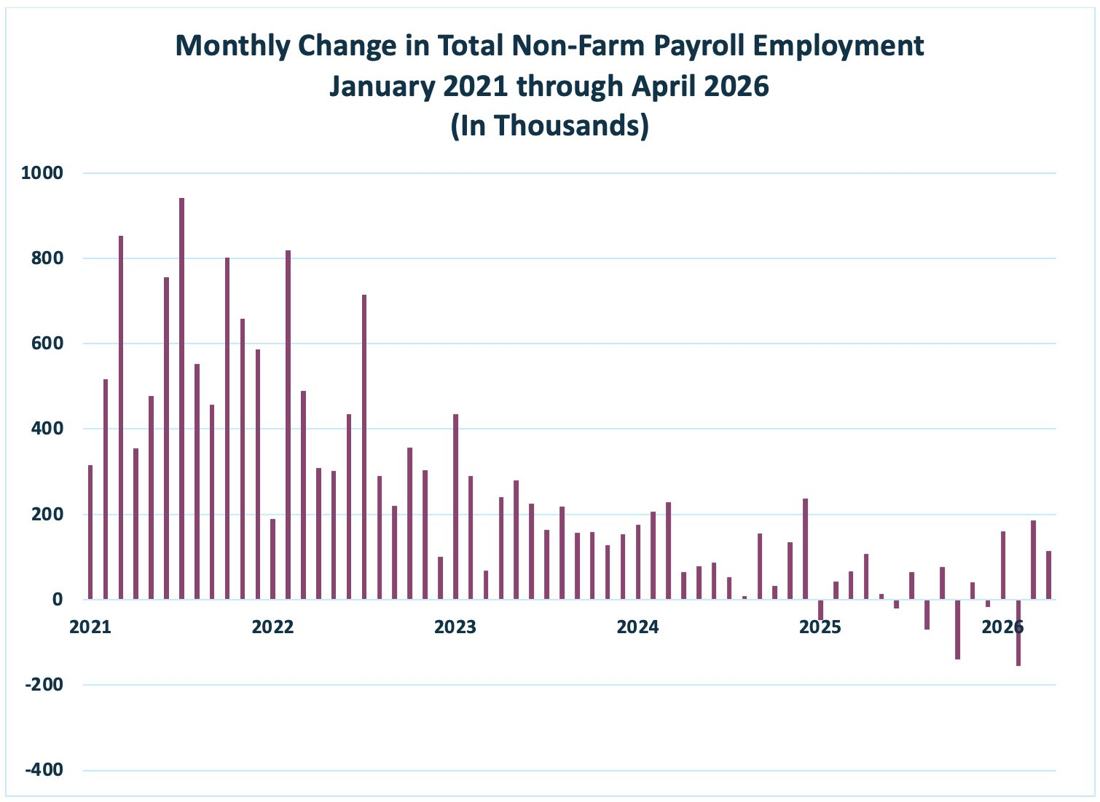
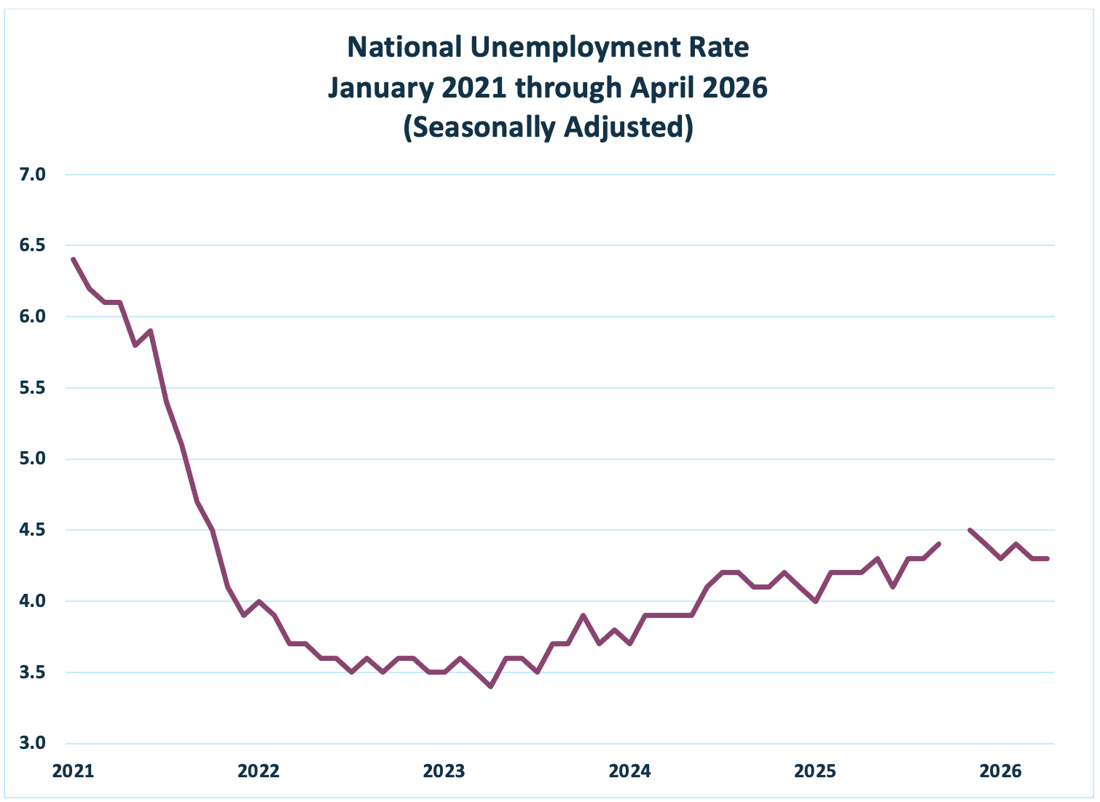
BLS reported job gains in April of 115,000. This estimate stands well above the consensus forecast of 55,000 for April. The Bureau also reported that the unemployment rate was unchanged from its March reading of 4.3 percent. The total number of people who looked for work in April grew by a small 134,000 out of the 7,373,000 estimated unemployed, which likely reflects discouraged workers who started searching for jobs now that hiring appears more robust.
[1]
Other reports signaled strength, as well. BLS’s closely watched
Job Openings and Labor Turnover, a monthly readout on hires and fires, estimated that the active inventory of March jobs stood at 6.9 million and that hiring had increased over the month, from 4.9 million in February to 5.6 million in March.
[2] Hiring expanded in nearly every component of the private sector, with especially large gains in Transportation, Warehousing, and Utilities; Leisure and Hospitality; and Professional Business Services.
BLS and the Bureau of Economic Analysis (BEA) in the Commerce Department added still more evidence that the economy may be stronger than expected.
BLS reported a decent growth in labor productivity for the first quarter of 2026 compared to the first quarter of 2025: labor productivity grew by 2.9 percent.
[3] This annual rate bodes well for both profits and wages going forward. On April 30,
BEA announced that final sales to private domestic purchasers (which excludes government consumption and inventories) grew at an annualized rate of 2.5 percent in the first quarter. This reading on private sector economic activity provides another reason to believe that the recent gains in non-farm employment are signaling labor market strength.
Non-Farm Employment
The private sector grew by 123,000 jobs in April, while government declined by 8,000. Private sector employers increased payrolls in many sectors. Transportation and warehousing expanded by 30,300; retail trade grew by 21,800; and health care and social assistance by 53,900. The goods sector grew by 10,000, but declines occurred in motor vehicles and parts (3,000) and non-durables (4,000).
One of the big variables in the jobs picture is AI. Last month’s
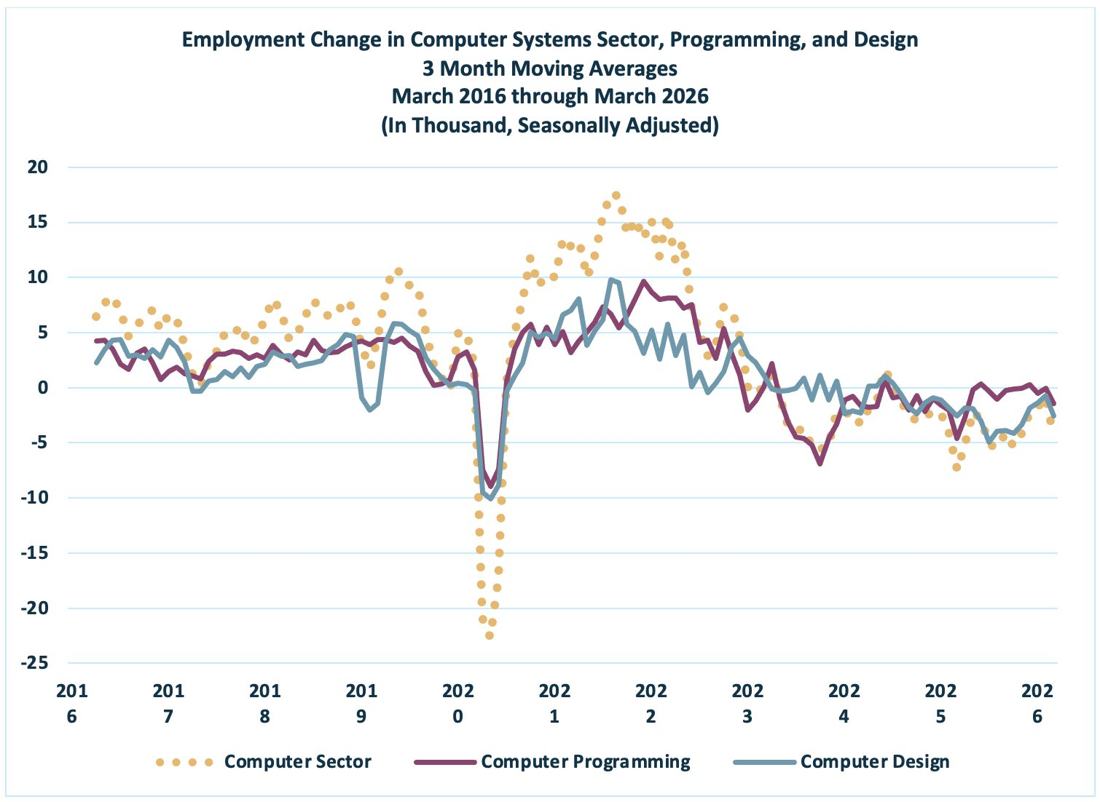
EPIC Jobs Report argued that it was too early to discern AI’s path through most of the economy. However, we do have increasingly good labor data from the sector where we know for sure that AI is at work: the computer systems, programming and design sector. This sector grew substantially during the pandemic, and some payroll adjustments were inevitable. That said, entry-level programming and design jobs have been particularly affected by AI agents that can quickly and adequately preform this work. Since January of 2021, this sector has lost 115,000 jobs. These declines continued in April with a decline of 11,200.
It is especially important now to watch changes in this sector, especially is we want to answer the question: will AI replace workers or, after transforming a part of the job market, begin to support job growth? So far in the computing sector, the answer is job replacement.
Labor Demographics
The demographic side of today’s jobs report will likely get little attention, given that the unemployment rate remained unchanged at 4.3 percent. Indeed, BLS reported no statistically significant changes in the male, female, age, race, and ethnicity unemployment rates. However, the Household Survey continues to provide some of the most interesting labor market data in any BLS report.
For example, the labor force is growing more slowly this year than in any of the past 15 years, including the pandemic year of 2020. April’s labor force declined by 92,000 when compared to March; and March declined from February by 396,000. In part this labor force shrinkage is due to workers retiring out of the labor force. At the same time, new workers are not replacing them. The civilian non-institutionalized population aged 16 and above grew by only 229,000 over these same three months. The labor force in April of this year is 1,059,000 smaller than a year ago; and the civilian population is 1,758,000 larger. Given that not everyone who turns 16 immediately looks for work, this ratio of people leaving the labor force and those entering does not bode well for future labor force growth.
The factor most likely causing this slowdown in labor force growth other than retirement is the substantial decrease in immigration. A recent
report from the Brookings Institution estimates that net migration in 2025 likely ranged from 295,000 to -10,000 and that 2026 would likely settle between -925,000 and 185,000. These ranges capture legal migrants as well as an estimate of undocumented border crossings. In either case, many of these migrants will enter the labor force. Clearly, these are exceptionally low migration estimates when compared to the estimated annual net migrant flows of 1.5 and 2.5 million in the three years prior to 2025.
This sharp slowdown in immigrant contributions to the labor force is hardly offset by increases in the native-born population. The
U.S. Census Bureau reports that the population grew by 10,268,744 from 2020 through the end of 2025. Of that total, 81 percent, or 8,328,837, was from international migration, mostly non-US born immigrants. That means the contribution to population change from native-born births was 1,939,907 or 387,981 on average per year.
The message is clear: our labor force will continue to shrink on average under current law. That may be fine if technological changes continue to boost labor productivity in those sectors where high-tech is appropriate. However, wages are likely to rise as the labor supply shrinks in those sectors less subject to technological change, like leisure and hospitality.
So, where does the BLS report on April employment activity leave us? It would be fair to say that we can more confidently see economic vitality, after months of truly unclear labor market signals. It is not just today’s jobs report that justifies that confidence, but a small constellation of recent economic reports that look at economic activity from varying angles.
Will this apparent strength continue to hold under the pressures of rising energy costs, war expenses that divert funds from private use, and the sharp decline of the labor force? The next few months are particularly important to that question, as the effects of each of these factors comes more clearly in focus.
[1] This increase in the number of unemployed was not enough to raise the rate nor was it a statistically significant increase.
[2] The JOLTS report is one month behind the monthly jobs report. Also note that the Employment Situation Report contains estimates in net job changes while the Job Openings and Labor Turnover report contains total job hirings and separations.
[3] More on this later but note that some of this gain may have been due to the slowdown in hours stemming from demographic changes.