What Is Required to Receive a Benefit?
Retirement Benefits. Individuals become eligible for Social Security’s retirement benefits by earning at least 40 Social Security credits and reaching Social Security eligibility age.
[i] Workers earn one credit for each $1,810 of covered earnings in a year, up to a maximum for four credits per year. Thus, someone who earns at least $7,240 per year for 10 years, is eligible for Social Security benefits upon reaching Social Security’s retirement age.
Disability Benefits. Individuals can be eligible for disability insurance benefits before they reach Social Security retirement age and even if they have not worked long enough to earn 40 Social Security credits.
[ii] Disability insurance eligibility is based on recent work history. For example, individuals who are between ages 24 and 31 need to have earned at least six Social Security credits over the prior three years, and individuals who are over 31 years of age need to have at least 20 credits over the prior 10-year period.
Auxiliary Benefits. Social Security also provides auxiliary benefits, such as to survivors and children based on the work history of a deceased spouse or parent. This explainer does not cover eligibility and benefit calculations for auxiliary benefits, but they are typically a specified percentage of a deceased worker’s benefits.
Calculating Average Indexed Monthly Earnings
Once an individual reaches retirement eligibility age and applies for benefits, the Social Security Administration calculates their benefit. The first step in that process is to calculate the worker’s Average Indexed Monthly Earnings, or AIME. To do that, the Social Security Administration takes the worker’s entire history of earnings records and applies a wage adjustment to their past earnings. Unlike an inflation adjustment that would place the value of their past earnings into today’s dollars, a wage adjustment is a super-sized increase that effectively credits workers’ past earnings with gains in productivity that happened after they earned those wages.
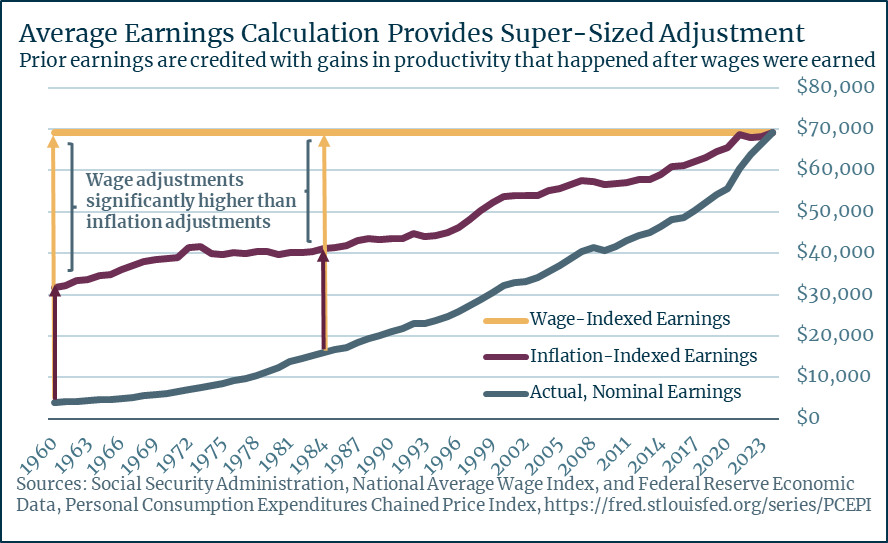
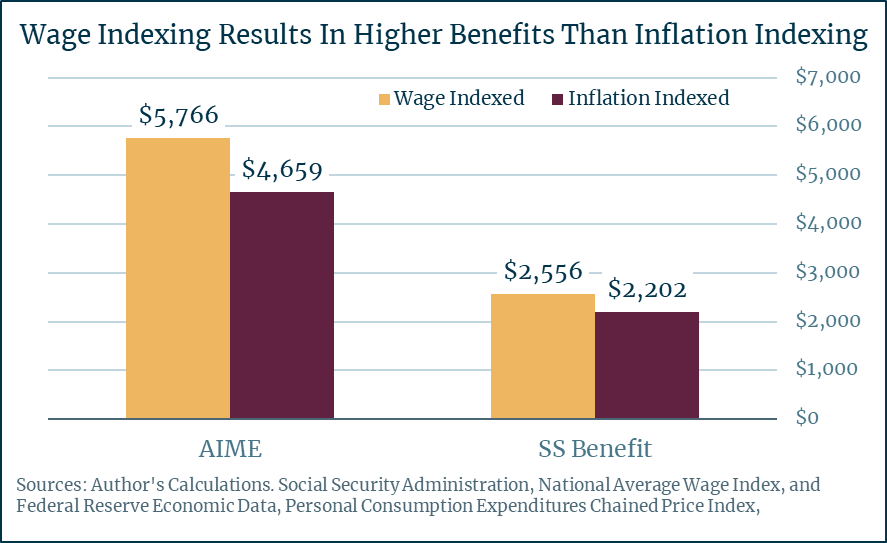
This results in significantly higher benefits. For example, if someone earned the national average wage for 35 years and retired in 2024, their inflation-adjusted AIME would be $4,659 ($55,904/yr), but their wage-adjusted AIME is $5,766 ($69,189). This means that the individual gets credited with about 24 percent higher wages than they actually earned. Consequently, workers’ AIMEs and Social Security benefits are higher than they would be if simply adjusted for inflation.
 Without the 1977 Congressional action that built automatic wage indexing into the benefit formula, Social Security would likely be solvent today.
Calculating Primary Insurance Amount, or Monthly Benefit
The second step the Social Security Administration takes is to use a worker’s AIME to calculate their monthly benefit, which is called a Primary Insurance Amount, or PIA. To do this, the Social Security Administration applies a progressive “bend point” formula that results in workers with lower earnings receiving benefits that replace a higher percentage of their past earnings, or a so-called “replacement rate.” Conversely, individuals with higher earnings receive lower replacement rates.
In 2025, AIME amounts up to $1,226 are multiplied by 90 percent, amounts between $1,226 and $7,391 are multiplied by 32 percent, and amounts between $7,391 and $14,675 get multiplied by 15 percent.
[iii] Amounts above $14,675 (which corresponds to Social Security’s taxable maximum of $176,100 per year) are neither subject to Social Security taxes nor credited towards benefits.
[iv]
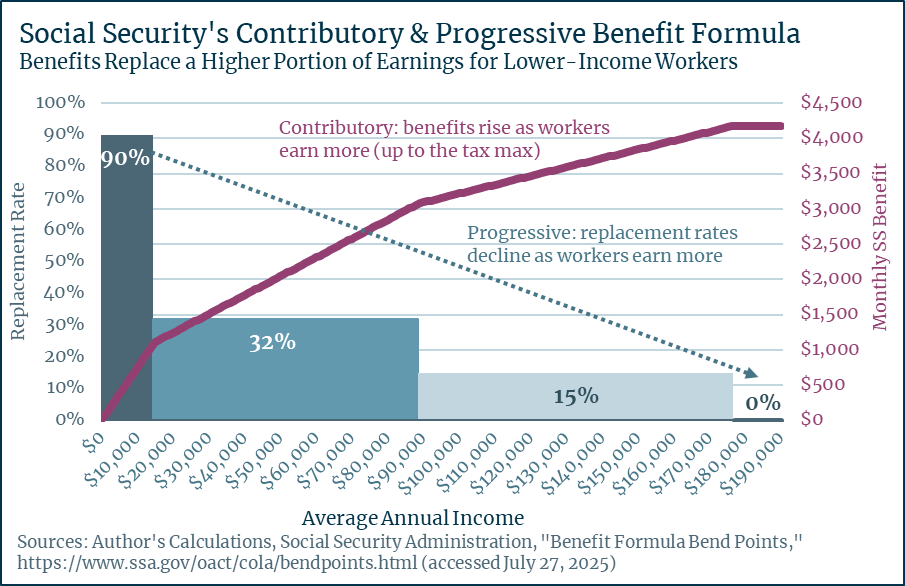
The sum of the three earnings portions multiplied by the corresponding percentages equals the worker’s PIA, which is their monthly Social Security benefit. For example, someone with average annual earnings of $60,000, and an AIME of $5,000 would have the following benefit calculation:
- Bend Point 1: AIME up to $1,226 get multiplied by 90 percent. Since $5,000 is above $1,226, the full $1,226 gets multiplied by 90 percent.
- Bend Point 2: AIME between $1,226 and $7,391 get multiplied by 32 percent. Since $5,000 is between $1,226 and $7,391, the amount above $1,226 and below $5,000 gets multiplied by 32 percent ($5,000- $1,226 = $3,774).
- Above Bent Point 2: AIME above $7,391 and below the taxable max of $14,675 get multiplied by 15 percent. Since $5,000 is below $7,391, no portion of this $5,000 AIME is multiplied by 15 percent.
- Monthly Social Security Benefit, or PIA = $1,103 + $1,208 = $2,311
If a worker has more than 35 years of earnings, only their highest 35 years are included in the average. If a worker has fewer than 35 years of earnings, any years without earnings equal zeros.
Thus, someone who earned $80,000 per year, but who worked for only 17.5 years would have the same AIME, and therefore receive the same benefit, as someone who earned $40,000 per year and who worked for 35 years or more.
Adjustments for Age
Third, the SSA may make an adjustment to a worker’s benefits based on the age at which they choose to first begin claiming benefits, which is generally between 62 and 70 years old.
[v] There are no adjustments for workers who first claim benefits at their normal retirement age, which is 67 years old for anyone born in 1960 and later.
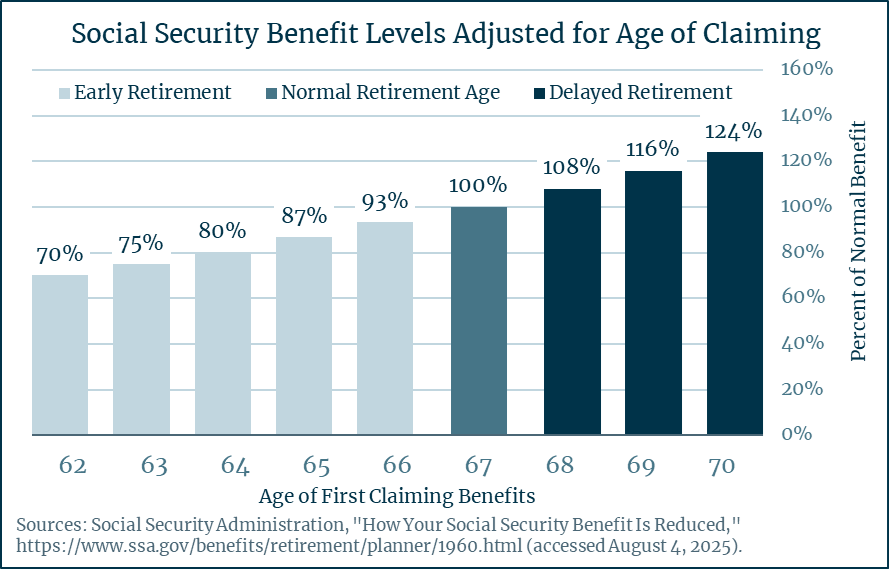
Workers who begin claiming as early as age 62 and prior to age 67 will receive an actuarially-fair benefit reduction such that their total amount of lifetime benefits will be the same as if they had waited until their normal retirement age to begin claiming benefits. For anyone born in 1960 or later, their benefit would be reduced by 30% if they began claiming at age 62, by 25% at age 63, by 20% at age 64, by 13.3% at age 65, and by 6.7% at age 66.
Workers who wait until after age 67 to begin claiming benefits receive an actuarially-fair benefit increase. For anyone born in 1960 or later, their benefit would be 8% higher if they wait until age 68, 16% higher at age 69, and 24% at age 70. Age 70 is the maximum age to which benefit increases apply, so anyone who does not begin claiming by age 70 will not receive any further benefit adjustments.
Adjustments for Annual Inflation
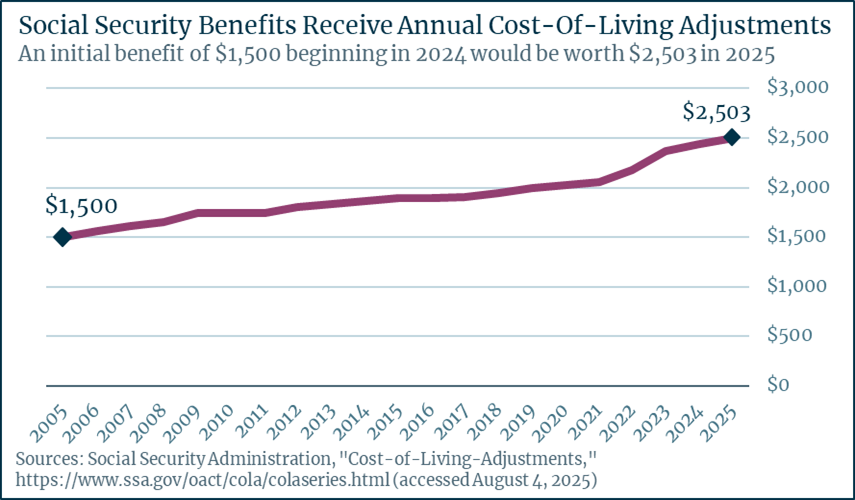
Lastly, all Social Security beneficiaries receive a cost-of-living adjustment (COLA) each year. The COLA equals the change in the Consumer Price Index for Wage and Clerical Workers (CPI-W) over the prior year. If the CPI-W showed 2.5 percent growth, for example, all Social Security benefits would be increased by 2.5 percent for the following year. If the index is zero or negative, there is no COLA. Over the past two decades, the COLA has been as low as 0.0 percent and as high as 8.7 percent.
[vi] This means that someone who retired in 2005 with a monthly benefit of $1,500 would receive $2,503 per month in 2025.
While these adjustments intend to provide an inflation-adjusted benefit level, the metric the SSA uses—the CPI-W—is outdated and inaccurate; it reflects prices paid by less than one-third of the population and it fails to take into account changes in what people purchase over time. If the SSA applied a comprehensive and up-to-date inflation adjustment, annual COLAs would be slightly lower in most years.
[vii]
Summary
To qualify for Social Security retirement benefits, individuals must work and pay Social Security taxes for at least 10 years (40 quarters). The Social Security Administration uses workers’ earnings records to calculate their benefits upon retirement. Social Security benefits are both contributory (higher payroll tax contributions result in larger benefits) and progressive (lower-income earners receive proportionally larger benefits, as a percentage of their earnings, than higher-income earners). Since 1977, wage-indexing has resulted in significant benefit growth far beyond inflation.
If workers claim benefits early (generally between ages 62 and 66), their benefits will be reduced to reflect their longer claiming period. If they wait until after their normal retirement age (generally after age 67), their benefits will be increased to reflect their shorter claiming period. Once someone is a Social Security recipient, they will receive an annual cost-of-living adjustment.
[i] Social Security’s normal retirement age is 67 for anyone born in 1960 and later. Individuals can choose to begin collecting Social Security benefits as early as age 62, with a reduction in their benefit amount.
[ii]Disability Insurances provides Social Security-level benefits before individuals are eligible for retirement benefits if they are determined to have a qualifying disability.
[iii] Social Security has a taxable maximum amount, beyond which earnings are neither subject to Social Security taxes nor do they count towards future benefit calculations. The taxable maximum equals $176,100 in 2025, which means that the maximum AIME is $14,675 in 2025.
[iv] Bend point amounts and Social Security’s taxable maximum are adjusted annually based on growth in the national average wage index.
[v] When Social Security was first enacted in 1935, there was a single retirement eligibility age of 65. In 1956, Congress enabled women to begin claiming reduced Social Security benefits as early as age 62. In 1961, Congress extended early benefits to men. In 1983, Congress passed a law gradually raising Social Security’s normal retirement age from 65 (for workers born before 1938) to 67 (for workers born in 1960 or later).
[vi] Social Security Administration, “Cost-of-Living Adjustments,” https://www.ssa.gov/oact/cola/colaseries.html (accessed August 4, 2025).
[vii] Romina Boccia and Rachel Greszler, “Social Security Benefits and the Impact of the Chained CPI,” Heritage Foundation
Backgrounder No. 2799, May 21, 2013,
https://static.heritage.org/2013/pdf/bg2799.pdf.