Current Law Requires Benefit Cuts Beginning in 2033
Social Security’s finances are separate from other government spending.
[1] Unlike other programs,
Social Security does not have the authority to borrow money and the
Antideficiency Act prevents government spending in excess of available funds.
Historically, Social Security held a positive balance as it collected more in
Social Security taxes than it paid out in
benefits. Since 2010, however, the program has paid out more in benefits each year than it has received in tax revenues, drawing down on accumulated trust fund reserves to cover the difference.
[2] According to the most recent projections,
Social Security’s OASI Trust Fund will run out of reserves in 2033. At that time, Social Security can only pay as much in benefits as it collects in taxes, which will equal an
estimated 77 percent of currently scheduled benefits.
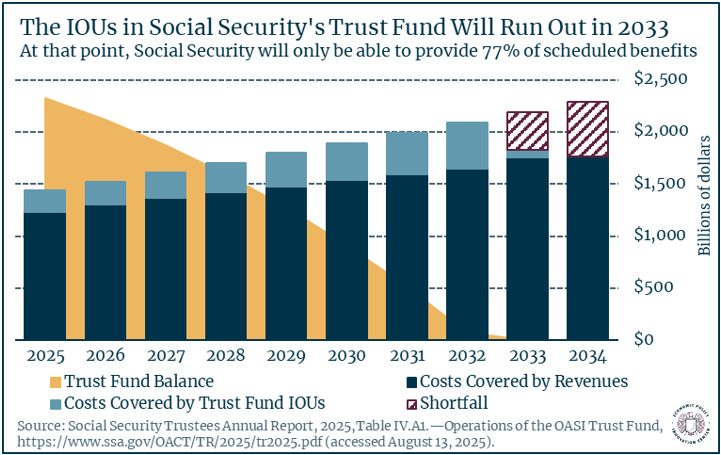
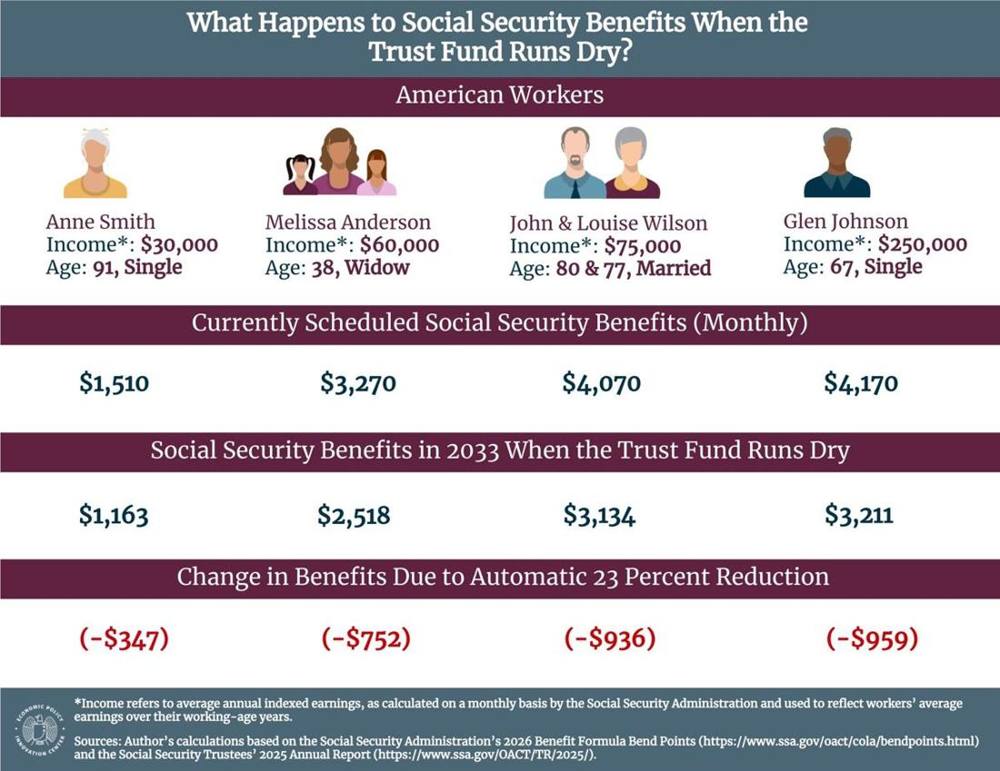
Absent any congressional action to reform Social Security, roughly 72 million recipients of Social Security’s old age and survivors benefits will be subject to 23 percent benefit cuts beginning in 2033. Those cuts will apply to all recipients, regardless of whether they are 65 or 95 years old, or whether they have $20,000 or $200,000 in annual income.
Policymakers who fail to consider reforms to Social Security are accepting 23 percent benefit cuts. The following examples demonstrate the automatic benefits cuts that the law will require beginning in 2033 if Congress does not take action to prevent the trust fund from running dry before then.
Summary
Under current law, Social Security cannot pay benefits it does not have the revenue to support. Once the Old Age and Survivors Insurance Trust Fund reserves are exhausted in 2033, benefits will automatically be limited to incoming revenue, resulting in a roughly 23 percent benefit cut for all retirement and survivor benefits.
As such, refusal to work towards Social Security reform is effectively endorsing across-the-board benefit cuts. Policymakers who want to avoid that outcome should focus reforms on protecting lower-income retirees, reducing Social Security’s long-term tax burden on all Americans, and introducing personal ownership options that strengthen retirement security without expanding government dependency.
[1] While the federal government has borrowed from Social Security’s trust fund, it maintains separate accounting including crediting the Social Security trust fund with interest on borrowed funds.
[2] For example, in 2024, Social Security collected $1.224 trillion in taxes and interest IOUs. To pay $1.327 billion in benefits and administrative expenses, the program had to cash in on $103 billion in IOUs. This caused the OASI trust fund balance to fall from $2.641 trillion to $2.538 trillion.