Reports suggest that President Trump will use the State of the Union tonight to highlight the economy and ways that the administration plans to increase affordability in areas like health care. That is the right focus and there are many areas where the American economy shows great progress, such as stronger than anticipated job gains and economic growth.
However, federal spending remains above pre-pandemic levels, debt is reaching new peaks, and long-term interest rates are elevated, all of which weaken the economic gains accomplished by the administration by adding risk to the macroeconomic outlook.
Despite progress from the administration on reducing spending, the Fiscal State of the Nation is
headed in the wrong direction. The budget is on an unsustainable trajectory. High spending, taxes, and deficits are harmful to families across America. They add to inflationary pressures, push interest rates higher, reduce investment, and raise the cost of living on essentials like housing while also increasing the cost of credit available to small businesses and families.
Congress and the President made substantial progress last year on reducing long-term spending in the One Big Beautiful Bill (OBBB). However, the OBBB was only a start in correcting the fiscal imbalance that drives the debt. They must continue that work by reducing the growth in spending. They must also continue to root out waste, fraud, and abuse and focus on the underlying problems in the budget to protect the American dream for current and future generations.
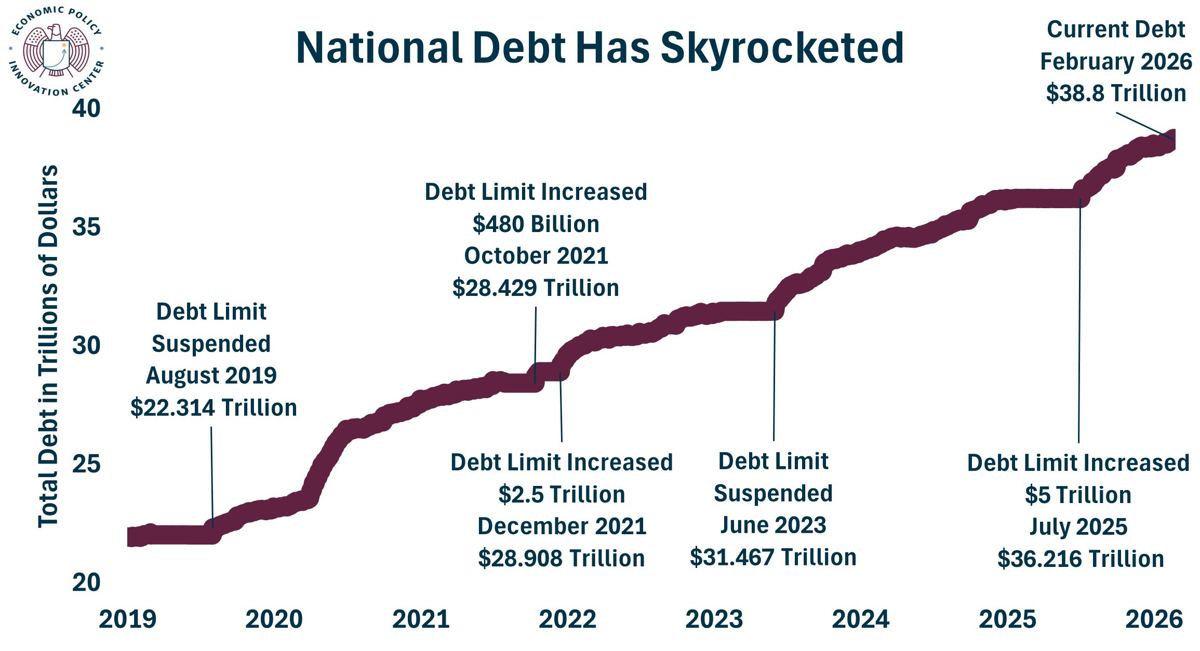
More than Half of the $5 Trillion Debt Limit Increase Has Already Been Used
The national debt sits at $38.8 trillion. The federal government is rapidly burning through the $5 trillion debt limit increase provided by the OBBB. Meanwhile, $9.97 trillion in Treasury securities will mature in 2026. With a primary deficit of 2.6% of GDP, all new spending will only add to the debt.
The national debt has
increased more than $2.5 trillion in the just seven-and-a-half months since the limit was increased on July 4, 2025. In the
last month, more than $250 billion was added to the national debt.
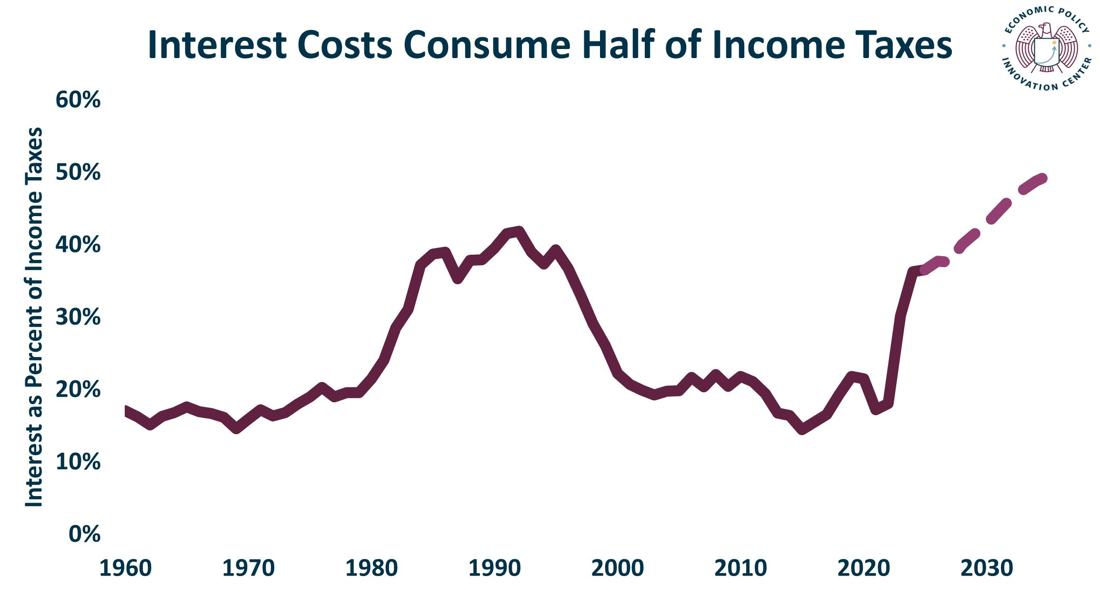
Interest Costs Will Consume Half of Income Taxes
Spending on interest to finance the $38.8 trillion national debt is now the second largest line item in the budget, exceeding national security and Medicare.
The rising interest costs are consuming a larger share of tax revenues. The Congressional Budget Office (CBO) projects that interest outlays will be equivalent to more than 50% of income taxes by fiscal year 2036.
Because the debt is so large, these debt service costs can add a substantial amount to inflation which is compounded when interest rates are high. This is likely a significant reason for why the Federal Reserve has found it difficult to use conventional monetary policy to reduce the pandemic-era inflation back down to its 2% target.
In an environment where the debt is substantial and interest rates are high, the federal government ends up absorbing a large portion of investment from the private sector simply to pay for past spending. This has the effect of crowding out other investment thereby making it more difficult for the private sector to access capital needed for economic growth.
Entitlement Trust Funds Going Broke
The trust funds that finance the two largest entitlement programs will be depleted in the coming years.
The CBO now projects that
Social Security’s trust fund will be insolvent in 2032. This is a full year sooner than previously predicted. When the trust fund is depleted, payable benefits will be reduced 28% from the promised payments.
The CBO projects the Medicare Hospital Insurance (HI) to be
exhausted in 2040. Once the HI trust fund is depleted, benefits would need to be reduced by 8%.
The projected depletion of the HI trust fund is 12 years earlier than the estimate provided by the CBO a year ago. However, the
Medicare Trustees project that the HI trust fund will be insolvent by 2033, seven years earlier than the CBO’s estimate.
| Projected Trust Fund Depletion |
|
Trustees |
CBO |
| Social Security (OASI Trust Fund) |
2033 |
2032 |
| Medicare (HI Trust Fund) |
2033 |
2040 |
The looming insolvency of the trust funds means that lawmakers will be voting on entitlement reform in the near future.
The Fiscal State of the Nation Demands Attention
Excessive spending is the driver of the unsustainability of the federal budget. Federal spending is projected to be $3 trillion (68% higher) in 2026 than in 2019, before the pandemic.
This excessive spending has
contributed to the erosion of fiscal space, or the nation’s borrowing capacity, over time. Using data from the most recent CBO baseline,
EPIC estimates that remaining fiscal space is between $14.1 and $17.9 trillion before additional borrowing would increase the risk of macroeconomic instability. Furthermore, this fiscal space will begin permanently eroding by 2029. When this happens, it will substantially limit the nation’s ability to confront crises such as war, natural disasters, and recessions.
This is also the root of American’s affordability concerns today. High deficits and the growing national debt increase interest rates and can contribute to higher prices across the economy. The most effective way for lawmakers to improve affordability is to slow the growth of government spending.