The Congressional Budget Office (CBO) released its
latest budget baseline (officially titled “The Budget and Economic Outlook” report), covering projections for fiscal and economic policy for fiscal years (FY) 2026 through 2036.
The new projections show that the budget is on an unsustainable trajectory. Over the next decade, spending would total $94.6 trillion and revenues would total $70.2 trillion, while $24.4 trillion would be added to the deficit.
The rising spending and high deficits crowd out economic growth, drive up interest rates, increase the cost of living, and erode the government’s fiscal space to respond to emergencies.

What is the CBO Baseline?
The baseline is the official benchmark against which legislative proposals are scored to produce cost estimates.
The baseline is sometimes misunderstood as being a forecast of what budgetary outcomes
will be in the future. But we know that laws, policies, and economic conditions will ultimately be different than the assumptions that the baseline is built upon — in fact, most politicians run for office because they
want different outcomes than the status quo. Rather, the baseline shows what the outcome
would likely be unless the fiscal and economic trajectory is changed.
The CBO baseline is often described as reflecting current law, but
this is a myth. In reality, tax and spending programs are treated differently. Reflecting the
rules imposed by law, the official CBO baseline follows strict current law for most tax policies, but uses a mix of current policy and current law for spending programs. This means that the budget baseline is biased in favor of bigger government.
Growth in Spending and Revenues Since 2019
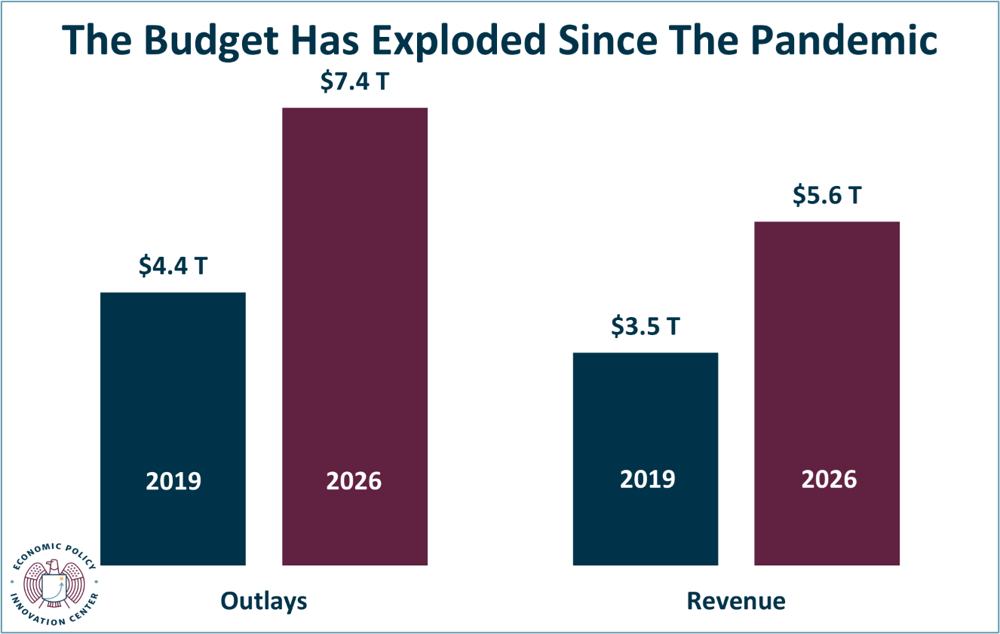
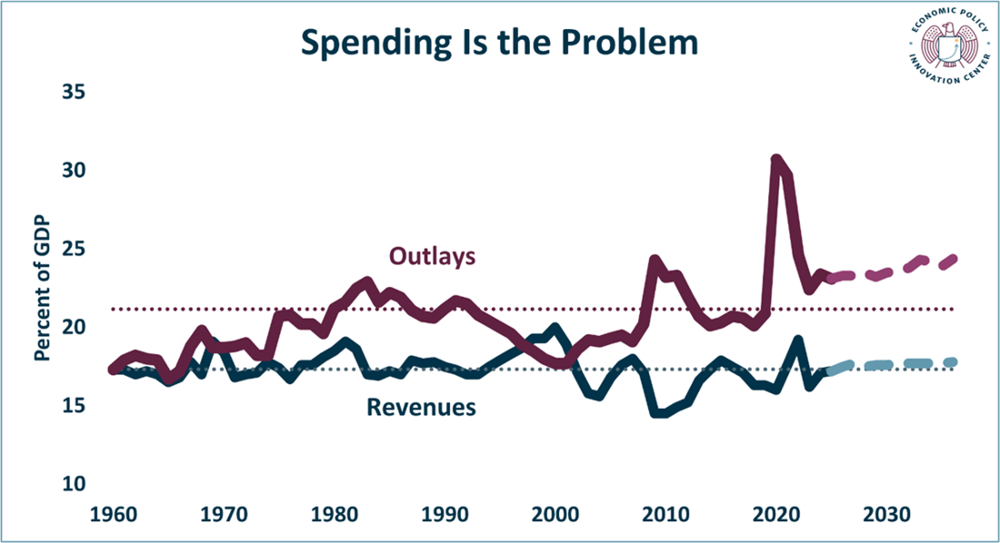
The federal budget has exploded since the COVID-19 pandemic. Federal spending is projected to be $3 trillion (68%) higher in FY 2026 compared to FY 2019. Tax revenues are projected to be $2.1 trillion higher (62%) than prior to the pandemic.
Spending Is the Problem
Excessive spending is the driver of the unsustainability of the federal budget.
Spending that grows faster than the economy is inherently unsustainable over the long term. This is measured in the report as a percentage of gross domestic product (GDP).
The CBO baseline projects that outlays will remain significantly above the historical average as a percentage of the GDP. At the same time, tax revenues are projected to remain above the historical average, even taking into consideration the tax cuts included in the One Big Beautiful Bill Act. The elevated revenues are due in part to higher tariffs.
Autopilot Spending Drives Spending Growth
The growth of spending is driven by programs on legislative
autopilot (these programs are sometimes misleadingly called “mandatory” spending, although there is nothing required of Congress to continue on an unsustainable course).
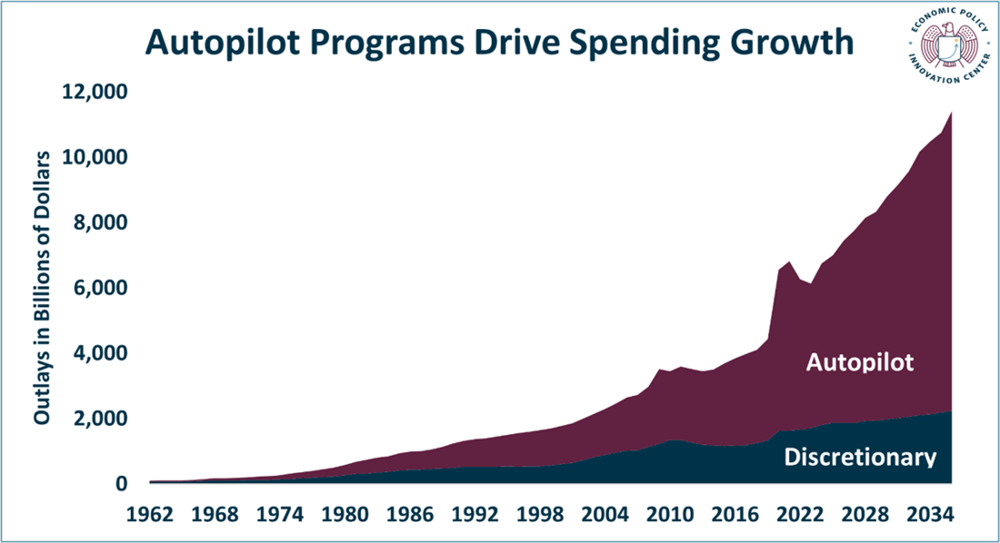
FY 1974, the year the
modern budget process was established, was the last time that annual discretionary spending made up the majority of outlays. In FY 2026, the CBO projects that 75% of spending will be on autopilot, while only 25% will be discretionary.
By FY 2036, only 20% of annual spending is projected to be discretionary while 80% will be on autopilot.
Interest Costs Grow
Spending on interest to finance the national debt is now the second largest line item in the budget, exceeding national security and Medicare. Interest costs are also one of the fastest growing categories of the budget.
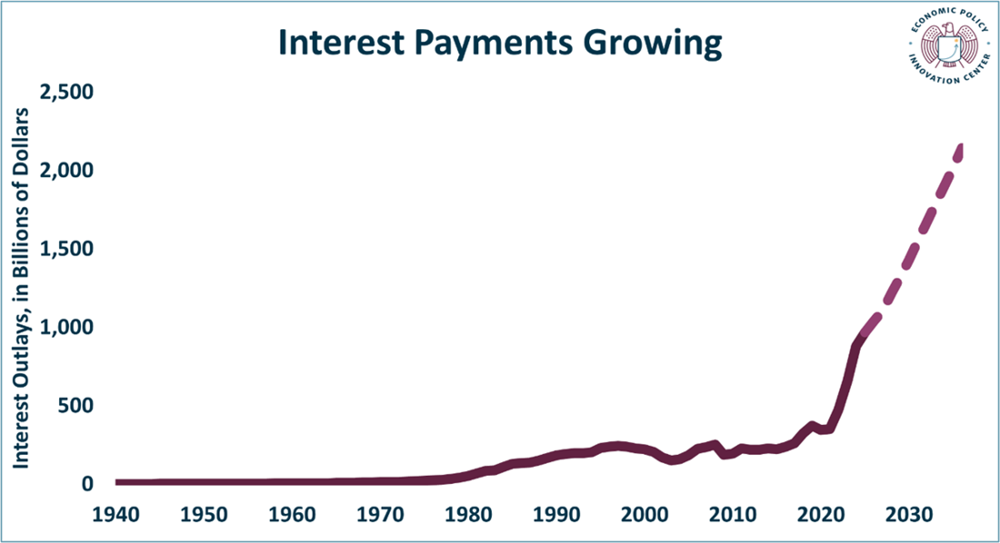
Net interest outlays are projected to total $1.039 trillion in FY 2026, rising to $2.144 trillion in FY 2036. By the end of the next decade, interest costs will consume more than 25% of total tax revenues and about half of individual income taxes. Interest costs will consume larger and larger shares of the overall budget, growing from 13.8% of total outlays in FY 2026 to 18.8% by FY 2036.
Debt Skyrockets
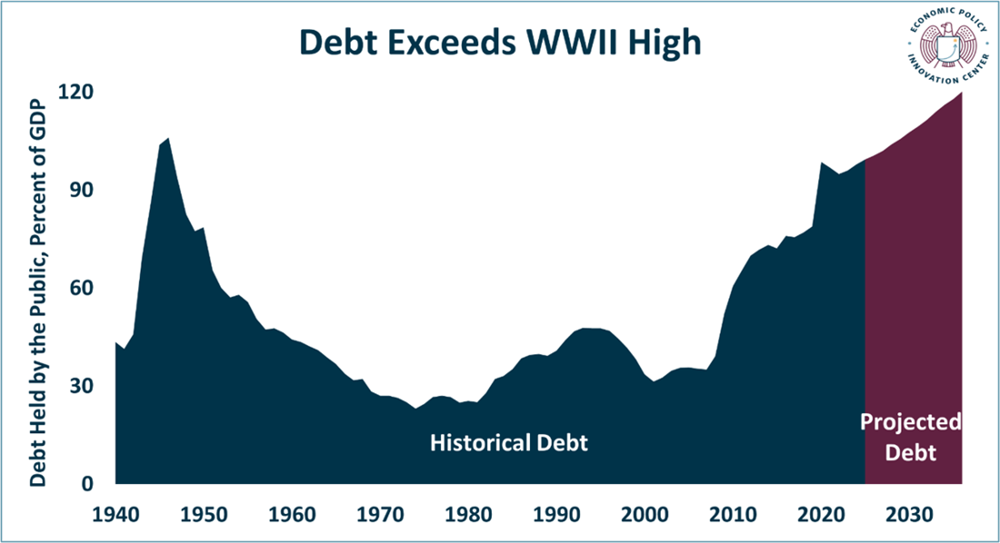
The growing spending and deficits will drive the national debt to record levels.
The total national debt is projected to grow from $38.5 trillion today to $63.7 trillion at the end of FY 2036.
Federal debt held by the public reached a record high in 1946 at 106% of GDP, in the immediate aftermath of World War II. The CBO projects that record will be broken in 2030, with debt levels continuing to grow thereafter.
Social Security Trust Fund Projected to Be Exhausted in 2032
In an important warning sign, the CBO now projects the Social Security OASI Trust Fund to be depleted in FY 2032. This is one year earlier than was previously projected.
Once
the Social Security Trust Fund is exhausted, the CBO estimates that benefits would be reduced automatically by 28% for all beneficiaries.
Sounding the Alarm
The new CBO baseline should sound the alarm to the harms of the current fiscal trajectory.
High spending, taxes, and deficits are harmful to families across America. They add to inflationary pressures, push interest rates higher, reduce investment, and reduce the affordability of essentials like gas and groceries.
The budget is on an unsustainable path, reducing the government’s fiscal capacity and risking a crisis. Congress must continue to root out waste, fraud, and abuse and focus on the underlying problems in the budget to protect the American dream for current and future generations.