
First Principles of Budgeting
Budgeting should first and foremost be considered a moral issue.[1] The federal budget has a direct impact on the prosperity and well-being of all Americans. When the government is too big, too burdensome, and extends beyond its proper constitutional bounds, that causes negative consequences for individuals, families, communities, and the American people. When our hard-earned money is taken by the government — allegedly to provide for our common defense and general welfare — and used to fund divisive, disgraceful, and damaging activities, it reduces trust in our government and rightly angers us. The growing government allows politicians and bureaucrats to exert more control over the most personal aspects of our lives. Excessive spending is a tax on all Americans, squeezing out the productive sector of the economy, stifling innovation, and lowering the quality of life for current and future generations. The factors that matter most for evaluating the federal budget are how much money is spent out of the Treasury, what that spending is for, the Constitutional authority for the activity being funded, and what effects those programs have on American families, communities, society, and the economy. Policymakers should recognize that the budget process is about making tradeoffs—deciding how best to allocate limited taxpayer resources among competing interests.The Power of the Purse
As described by EPIC’s President and CEO Paul Winfree, “The language, policy, and power of government is money.”[2] Practically every question about policy boils down to: “What is government spending money on?” The power to tax and spend is the mechanism that allows government to exercise all its other powers. Providing for the common defense would not be possible without funds to compensate personnel and to procure materiel. Regulatory powers could not be exercised without funding for administrators to engage in rulemaking and for enforcement. Government may have power to regulate, but those regulations are toothless if there are no funds to enforce them. Therefore, controlling the federal budget means controlling federal policy. As Madison famously explained this power in Federalist 58:“The House of Representatives cannot only refuse, but they alone can propose, the supplies requisite for the support of government... This power over the purse may, in fact, be regarded as the most complete and effectual weapon with which any constitution can arm the immediate representatives of the people, for obtaining a redress of every grievance, and for carrying into effect every just and salutary measure.”[3]In other words, the power to levy taxes and provide spending authority — and the power to withhold funds from the Executive — is the most effective way for the elected representatives of the American people to provide for the vital and appropriate services of the federal government, as well as to prevent abuses by the government.
The General Welfare
The power of the federal government to tax and spend is not unlimited. In fact, it is quite intentionally and explicitly constrained by the Founders. Article 1, Section 8, Clause 1, of the Constitution provides that “The Congress shall have Power To lay and collect Taxes, Duties, Imposts and Excises, to pay the Debts and provide for the common Defence and general Welfare of the United States.” The power to tax is granted only for the purposes of paying debt and funding the common defense and general welfare. Properly understanding the general welfare clause is vital. It was not intended for spending that would be simply limited, local, particular, parochial, narrow, or a regional benefit, but rather only for the national welfare. Even Hamilton, often regarded as a proponent of an expansive national government, conceded in his Report on Manufactures that “the object, to which an appropriation of money is to be made, be general, and not local; its operation extending, in fact, or by possibility, throughout the Union, and not being confined to a particular spot.”[4] The spending and general welfare clauses are followed by an enumeration of specific powers that would be considered in the general welfare of the nation. The federal government has no legitimate power to spend for purposes beyond what the enumerated powers specify. As Madison described in Federalist 45, “The powers delegated by the proposed Constitution to the federal government are few and defined.”[5] The Tenth Amendment further makes the point even clearer that the powers of the federal government provided by the Constitution are limited and reinforces the principle of federalism.[6] Article 1, Section 9, Clause 7 of the Constitution prohibits expenditures unless Congress appropriates such funds by law. This is an important restriction on the ability of the President and Executive Branch to spend without Congressional approval and harkens back to English reforms from prior centuries.The Congressional Budget Act Was a Product of Its Time and Creators
Since the Founding, the federal government’s budget process has gradually evolved in response to contemporaneous events and challenges. Today, the basic structure of the budget process is governed by the Congressional Budget Act of 1974 (CBA), which is now 50 years old. The Budget Act was designed by and for those who drafted the law. It was meant to address the problems and situation of its time, as understood by the Members of Congress who crafted the legislation. Writing for the Congressional Research Service, Allen Schick said of the Budget Act, “Virtually every component of the 1974 Act is traceable to a perceived shortcoming in the existing process.”[7]One-Party Control of Congress
The Congressional Budget Act was created in an era characterized by one-party control of Congress. Democrats controlled both the House and Senate for the 19 years prior to enactment of the CBA. Democrats maintained large majorities in the House of Representatives for another 22 years after 1974, while also controlling the Senate for most of the next two decades. After 40 years, one-party dominance in Congress came to an end. In the three decades since the 1994 Republican Revolution, control of the House has flipped four times, with majorities lasting no more than 12 years. It could be said that the budget process was written by Democrats in Congress, for Democrats in Congress, to be used in response to then-incumbent Republican President Richard Nixon.The Changing Congressional Executive Relationship
One of the driving factors of the Budget Act was the growing use of impoundment, or the unilateral cancelation of budget authority by the President. This authority had been used by presidents throughout American history. However, President Nixon’s aggressive use of impoundment angered Congress and contributed to the deterioration of relations between the Legislative and Executive Branches. Although sometimes overlooked today, Title X of the Congressional Budget Act of 1974 included the Impoundment Control Act. The Impoundment Control Act prohibited the executive impoundment power and instead created a process that allows the President to propose rescissions of budget authority for Congress to consider.Congress’s Need for Independent Information and Analysis
The Executive Branch had long dominated the budget process. A key source of this advantage was access to information and the professional staff to utilize it. The President’s Budget Bureau (since renamed the Office of Management and Budget, “OMB”) was created in 1921, more than 50 years before the establishment of the Congressional Budget Office (CBO). Before the CBO existed, Congress was forced to rely on the Executive Branch for fiscal information and analysis of legislative proposals. This inherently disadvantaged Congress. As the Legislative Branch sought to assert itself into the budget process, it knew that it needed additional resources and its own sources of data. The creation of the CBO has largely been a success. As explained by Phillip Joyce, “CBO has replaced the Office of Management and Budget (OMB, the President’s budget office) as the authoritative source of information on the economy and the budget in the eyes of Congress, the press, and the public.”[8]The Budget Situation
Notably, fiscal year 1974 was the last year discretionary outlays comprised a majority of the annual budget. In the context of the experience of those who created the Budget Act, it was logical that the new process they were establishing would be centered around completion of the regular discretionary appropriations bills. Since 1974, autopilot spending has exploded and is projected to continue growing under current law. Today, discretionary outlays make up less than a third of total spending. The significant change in the composition of the budget has made the specific process laid out in the Budget Act less effective five decades later.Chart 1: Autopilot Spending Devours Discretionary Spending
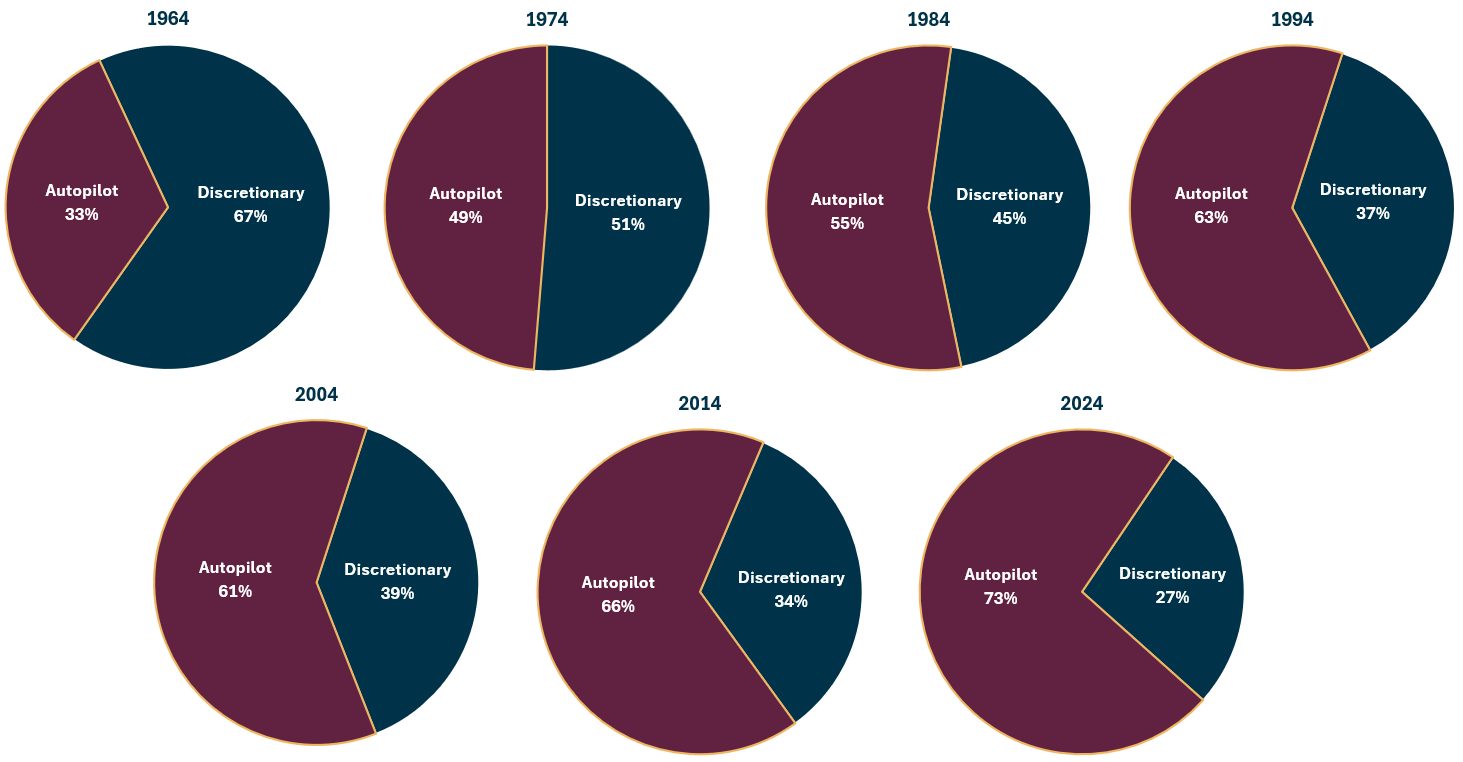 Source: OMB
The Economic Situation
Despite the one-party control of Congress in 1974, there was basic agreement on some of the fundamental questions of fiscal and economic policy. There was a common belief that deficits should be generally controlled. The overarching aims of economic policy were to promote stable prices and full employment, which can be observed in the Federal Reserve’s dual mandate that was codified in 1977. These beliefs were undoubtedly shaped by the significant economic challenges of the time. This was the beginning of the stagflation era. In the month the Budget Act was enacted, inflation reached 11.5 percent while the unemployment rate was concerningly on the rise towards a peak of 9 percent just a few months later.How Congress Has Responded to a Changing Environment
“Policymakers, it seems, are always unsatisfied with the existing budget process.”[9] Over the last 50 years, Congress and the Executive Branch have shed, either formally or informally, many aspects of the 1974 Congressional Budget Act. This even includes some of the process reforms that lawmakers thought would be most impactful at the time the law was crafted. Many aspects of the budget process have devolved into opportunities for symbolic showmanship rather than a process by which policy decisions are made and carried out.The Budget Resolution
The Congressional Budget Act of 1974 originally required Congress to adopt two budget resolutions each fiscal year. This second budget resolution requirement was scrapped by legislation in the 1980s. The remaining annual concurrent resolution on the budget has become superfluous. Rather than a governing plan to be followed and enforced, budget proposals have come to be viewed as “aspirational” documents that few Congressional leaders or committee chairmen even attempt to follow. Today, the budget resolution is seen as a “priority setting” document that can be sidestepped if Congressional Leadership establishes or declares the session’s priorities through another vehicle. In the last 25 years, Congress has failed to adopt a budget resolution 12 times. In the last 15 years, the only six budget resolutions that were adopted were solely for the purpose of unlocking the budget reconciliation process.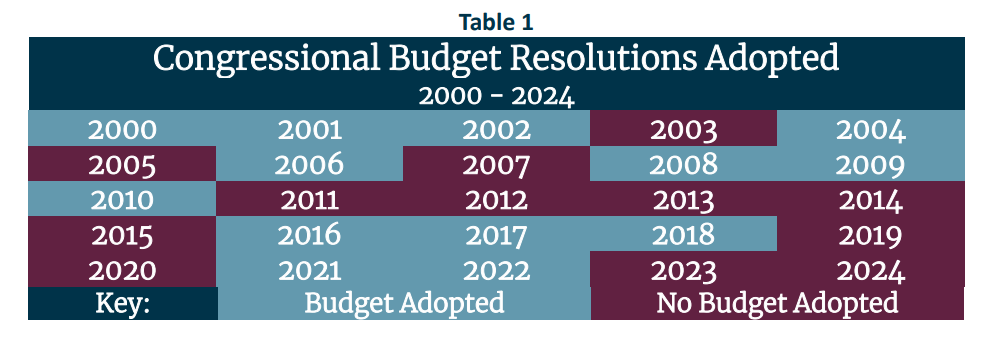 The structure of the Congressional Budget Act calls for the House and Senate to negotiate a concurrent resolution on the budget each year. However, in recent years, budgetary conflict has centered on disagreements between Congress and the President rather than between the two chambers of Congress. The result has been a series of budget deals cut by the White House and Congress, while the Congressional budget resolution has largely been abandoned.
The President’s Budget Request
Many aspects of the President’s budget request are treated no more seriously than a press release. It is common for lawmakers and commentators to declare the budget request as “dead on arrival” in the Capitol. While the Congressional Appropriations Committees rely heavily on the agency Budget Justifications, the direct spending and revenue proposals that make up the majority of the budget request are rarely described in significant detail and are even more infrequently adopted by Congress.The Regular Appropriations Process
Despite the Budget Act’s driving focus on completing the annual appropriations process, Congress did not follow through. There was never some mythical time where the appropriations bills were enacted on time. According to data compiled by the Pew Research Center, all of the regular appropriations bills have been enacted on time only four times since 1977: 1977, 1989, 1995, and 1997. More than half of the appropriations bills passed on time only one additional time.[10]Other Process Reforms Disregarded
Other budget process reforms enacted since 1974 have also been disregarded. For instance, the Statutory Pay-As-You-Go (PAYGO) Act of 2010 was enacted by President Barack Obama and a unified Democrat-controlled Congress with much fanfare. However, as soon as Statutory PAYGO was enacted, Congressional Democrats set out to undercut it, beginning to exempt legislation from counting just 18 days later.[11]A Wide Gulf Between the De Jure and De Facto Budget Process
The substantial differences between what the law dictates is the budget process and what lawmakers actually do is a source of significant discontent. The policy process often fails to live up to the lofty rhetoric repeated every year about following “regular order.” However, observing what occurs in practice can be useful for shaping budget process reforms. The revealed preferences of actual participants within the budget process can show which aspects of the process prescribed by the statutory budget process are not useful or inconvenient to policymakers. The breakdown of the budget process is not a recent development. The Congressional Budget Act has been diagnosed as inherently flawed. As the House Rules Committee stated in 1999:“After 25 years of experience with the Budget Act, and despite several major modifications to the process, Members and the public still conclude that the process does not work. Layer upon layer of procedures have combined to make the process confusing, lacking in accountability, inefficient and vulnerable to break downs. The result has been a pervasive lack of public trust.”[12]After 50 years since the enactment of the Congressional Budget Act, the same holds true.
An Important Lesson
A lesson to be learned by budget process reformers is that overly prescriptive procedures, such as those in the 1974 Budget Act, are unlikely to be sustainable. Rather than focusing on the exact steps that future Congresses would be expected to follow, today’s policymakers should be incentivized to address the unsustainability of federal spending.The Challenges of Today and Tomorrow
Any proposal to reform the budget process must first begin with a frank assessment of the challenges that policymakers face today. Given that the major budget process reform laws have been enacted decades apart, lawmakers must also anticipate upcoming and potential challenges.Unsustainable Spending
The primary problem with fiscal policy is that government spending is on an unsustainable trajectory. Over the long run, government spending cannot continue to grow faster than the economy.[13] This can be considered the Golden Rule of fiscal policy. It is a question of basic economics: if spending grows faster than the economy, then revenues from taxation of the private sector will be unable to keep up consistently. The rule has held true throughout history. In the entire history of the nation, revenues have never reached the current level of spending as a percentage of the economy, or anywhere close to the levels that spending is projected to grow under current law. Since 1930, the level of federal revenues as a percentage of GDP has never grown year-over-year for more than six consecutive years, much less indefinitely. As reviews of deficit reduction efforts around the world have shown, controlling spending is more successful and sustainable than fiscal consolidation efforts that primarily increase tax revenues, which can cause economic harm.[14]Erosion of Fiscal Space
A related problem to unsustainable spending is the erosion of the government’s capacity to borrow without compromising economic stability, known as fiscal space. As described by Paul Winfree, this fiscal space is “crucial for the government’s ability to respond to crises such as war, pandemics, and recessions. However, persistent structural deficits, rising interest costs, and slower economic growth erode fiscal capacity and threaten the nation’s ability to manage future challenges without causing additional harm.”[15] Winfree recently projected that under the current fiscal trajectory and CBO's economic assumptions, the federal government’s fiscal space would be completely depleted within three decades, with the debt spiral beginning within the next 10 years.[16] This scenario presents a serious challenge for policymakers.Exposure to the Direct Loan and Loan Guarantee Portfolio
The federal government has dramatically expanded its portfolio of direct loan and loan guarantee programs in recent years. The total face value of outstanding loans in these programs exceeded $5 trillion at the end of fiscal year 2023. Recent legislation, such as the American Rescue Plan Act (ARPA), the Infrastructure Investment and Jobs Act (IIJA), and the Inflation Reduction Act (IRA), increased the lending portfolios. These programs expose the government to systemic risks, which could escalate during a macroeconomic shock. Additionally, these loan portfolios increase the potential risk to taxpayers, particularly from political manipulation, such as ongoing efforts to shift the burden of student loan costs from borrowers to taxpayers.Need for Sustainable Economic Growth and Opportunity for All
Economic growth is essential for the prosperity of individuals, families, local communities, and the whole nation, as well as for the sustainability of the federal budget. As Rachel Greszler found, when workers leave the labor force, that subtracts from economic output and can “cause a double whammy to the federal budget,” as people who do not work fail to contribute tax revenues and then receive generous government transfer payments.[17] Too often debates about fiscal policy devolve into simple questions about changes in outlays and revenues, without a further examination of the macroeconomic impacts of those proposed changes in policy. The growing budget is harmful to economic growth, as excessive government debt crowds out private investment. Increased spending puts politicians and bureaucrats in charge of redistributing and allocating the nation’s economic resources. High taxes discourage work, investment, and innovation. When the Congressional Budget Act of 1974 was enacted, there was a general consensus that economic policy should produce stable prices and support full employment. Unfortunately, there has been a total collapse of consensus on economic policy. In recent years, legislation has been passed with economic goals as varied as:- Keynesian stimulus to increase aggregate demand;
- Combatting climate change;
- Subsidizing politically favored industries, such as manufacturing and the defense industrial base;
- Promoting race-based diversity and equity outcomes;
- Reducing tax penalties to private sector investment;
- Bailing out financial institutions; and
- Regulating and restricting activities of financial institutions.
The Rise of the Administrative State
Although a key goal of the Congressional Budget Act was to “assure effective congressional control over the budgetary process,” the administrative state has only grown in size and power. The Executive Branch has begun taking legislative actions when Congress frustrates or thwarts its priorities. The House Budget Committee reports that President Biden has proposed and implemented executive actions with fiscal costs exceeding $2 trillion.[19] There remains a major discrepancy in the resources available to the administrative state compared to Congress. While there are about 1.5 million employees at civilian Executive Branch agencies, the Legislative Branch employs fewer than 20,000 people. This puts lawmakers at a significant disadvantage in developing and providing oversight of the budget.Reestablishing Constitutionalism and Federalism
The national government has unquestionably grown beyond its proper Constitutional bounds. In addition to harmful economic consequences, this has eroded other important values, such as the rule of law. In many cases, the national government has intruded into policy issues that are most appropriately the domain of the state and local governments or civil society. Federal grants to state and local governments now exceed $1 trillion annually, nearly one-fifth of total federal spending. Federal funds make up more than one-third of state budgets, exceeding general fund revenues in many states. Restoring the principle of federalism would have a dramatic effect in deescalating the tensions present in policymaking, as well as putting the federal budget on a more sustainable path.Questions of Governance and Policymaking Inflection Points
Despite the Congressional Budget Act’s precise plan for regular and consistent budgeting, the last several decades have shown that fiscal reforms have generally required action-forcing events. Brian Reidl of the Manhattan Institute reviewed decades of budgetary negotiations to understand why some succeed and some fail. Reidl found that “nearly all successful deficit-reduction deals have included at least two of the following three primary ingredients: 1) a penalty default that lawmakers sought to avoid; 2) public support for the broad elements of a deal; and 3) lawmakers who trust one another and take a good-faith, integrative approach to negotiating.”[20] While unforced policymaking can occur, it often requires a point of conflict to prompt serious negotiations. Going back four decades, all of the most notable deficit reduction deals have been tied to debt limit increases, including:[21]- Balanced Budget and Emergency Deficit Control Act of 1985
- Budget Enforcement Act of 1990
- Deficit Reduction Act of 1993
- Budget Enforcement Act of 1997
- Budget Control Act of 2011
- Fiscal Responsibility Act of 2023
“The historical record has demonstrated that innovation within the budget process has often come from necessity, outside pressure, divided government, and too much power swinging to one branch or the other. Innovation from these last three causes is based on the inherent conflict associated with the period. In other words, any cooperation that seemingly leads to reform is often born from conflict.”[22]As the erosion of fiscal space continues, we may be on the doorstep of just such a reform catalyst.
Ad Hoc Policymaking
This political conflict has led to ad-hoc policymaking. Over the last decade-and-a-half, there have been a series of two-year spending agreements on appropriations, several of which overrode the prior ten-year spending agreement. At times, lawmakers even create deadlines to force budget negotiations, such as potential debt limits, government shutdowns, tax increases, or sequestration cuts. While it can appear messy and disorganized (because it is), ad hoc policy making is not necessarily a bad thing, if the outcomes are acceptable and sustainable. Of course, when the federal budget is so large and so integrated into the world’s economy, predictability would be desirable. Credit rating agencies such as Moody’s have expressed concerns about political brinksmanship.[23]But Policymaking Is Necessary
However, consistency on and attachment to the wrong fiscal track would be even worse than ad hoc budgetary changes. Indeed, the same credit rating agencies who have expressed concerns about governance and political risk have stated even stronger concerns about the fiscal state of the nation. In Moody’s 2023 negative outlook change to the U.S. credit rating, it stated:“The key driver of the outlook change to negative is Moody’s assessment that the downside risks to the US’ fiscal strength have increased and may no longer be fully offset by the sovereign’s unique credit strengths. In the context of higher interest rates, without effective fiscal policy measures to reduce government spending or increase revenues, Moody’s expects that the US’ fiscal deficits will remain very large, significantly weakening debt affordability.”[24]
The Hamiltonian Norm
These considerations date back to the very founding of the country and the American financial system. In his seminal Report on the Public Credit, Hamilton (writing in the third person) reported to Congress his belief that “the proper funding of the present debt, will render it a national blessing … he ardently wishes to see it incorporated, as a fundamental maxim, in the system of public credit of the United States, that the creation of debt should always be accompanied with the means of extinguishment. This he regards as the true secret for rendering public credit immortal.”[25] The Hamiltonian Norm of ensuring America’s good credit as a national asset has persisted for generations. However, these fiscal foundations are eroding due to irresponsible government spending, threatening a financial crisis and the American dollar’s status as the world’s reserve currency.[26] The real question of “governance” is the ability of policymakers to get the budget on a sustainable path. To ensure this is possible, budget process reformers will need to balance the need for predictability with the need for inflection points that result in actual policy changes to the current fiscal trajectory.Budget Process Reforms to Reflect the Challenges of Today and Tomorrow
Given the significant challenges facing the nation, what should budget process reformers prioritize today? As Winfree has described the limits of budget process reform:“When the budget process has been successful, the structure does not have material effects on the actual outcomes. As many budget analysts have said over a long time, process does not guarantee outcomes. The structure itself is endogenous to the institutions, personalities involved, the time period, the various economic theories, and exogenous factors. “Historically, the budget process has evolved quickly to deal with challenges of the day, whether war or economic crises, but it is not very effective in helping to resolve fundamental disagreements whether they are political or economic.”[27]However, a useful budget process would help facilitate negotiations to resolve those political disputes about the future. As explained by Yuval Levin in his recent book, American Covenant:
“The purpose of our national government and the purposes of the institutions that compose it is not to put into effect a single, unified policy vision but to enable our society to take on common challenges through common action, despite the fact that Americans sometimes do not all share one such vision. This is why the central institution of our national government is not the executive (which puts an agenda into action but the legislature (which negotiates through durable differences).”[28]This depiction of the national government’s institutional design can help inform how we think about the design of the government’s budgetary process. Just as the Constitution sets out a statement of purpose in the preamble and then defines the guardrails within which the federal government may operate in the enumerated powers, so too can the budget process guide lawmakers. The budget process may not be able to dictate detailed policy outcomes, or even predict all the steps necessary to arrive at the end goal. But a successful budget process should help point lawmakers towards a shared understanding of the north star that policymaking should strive towards. The budget process should establish guardrails around the debate to help establish what is in and out of bounds and light waypoints to help guide the way towards fiscal sustainability.
Set and Achieve Fiscal Goals
Set Responsible Budget Targets
Congress and the President should set and achieve responsible budgetary targets. Policymakers should then have flexibility on how to use their time and resources for how to meet those overall targets. However, there needs to be sufficient enforcement and incentives as a backstop to keep the budget on a sustainable path. A fiscal rule is a structural framework that can result in better outcomes by forcing Congress to prioritize limited taxpayer resources for the most important and effective programs in the federal budget. Fiscal rules can take many forms. A successful and effective fiscal rule would:- Ensure the budget is sustainable by limiting the growth of spending.
- Be comprehensive and limit overall spending, not simply a small slice of the budget.
- Include enforcement mechanisms that would incentivize following the rule and would actually be carried out if required. Lawmakers could consider incremental adjustments to programs, spreading out enforcement over time.
Improve Budget Dealmaking
In recent years, the appropriations 302(a) topline allocation has not been determined through the concurrent budget resolution, as the Budget Act dictates. Instead, the annual discretionary spending levels have been decided through a series of short-term deals made between the President and Congress. These deals have generally paired an agreement on discretionary spending caps to facilitate further negotiations on the regular appropriations bills with some reforms to autopilot spending programs. Deals centered around getting the appropriation bills enacted may be the natural inclination of policymakers operating in a budget process that is built around passing the appropriations bills. Unfortunately, in today’s fiscal environment, where discretionary spending constitutes only about a quarter of total outlays and autopilot spending is the remaining three-fourths of the budget, dealmaking focused on appropriations is deficient. Instead of narrow, appropriations-focused deals, future budget deals should include all government spending. The budget deal should include agreements on the appropriate level of budget authority and outlays for:- National Defense
- Social Security
- Medicare
- Medicaid and other health programs
- Net interest
- All other spending
Eliminate the Prescriptive Timetable
In general, the process by which budgeting occurs should be less prescriptive about the individual steps that must be followed. The modern legislative process is not a boardgame that will be orderly followed from square to square. Any budget process that relies on a complicated calendar or numerous sequential steps that are required is a process set up to fail. Perhaps it would be better if Congress did follow all the steps and check all the boxes on time every year. But for the last half-century, lawmakers have failed to do so. That is simply the reality we are dealing with, and budget process reformers should do their best to work with the hand they have been delt. Budget reformers who care about addressing the sustainability of the federal government should welcome the chance to move away from the current prescriptive timetable. The Congressional calendar set up by the Congressional Budget Act of 1974 is overly focused on completion of the annual appropriations bills, which now comprise only a fraction of annual spending (1974 was the last year where discretionary outlays were the majority of spending). Efforts to replicate the current appropriations-based budget process schedule for the rest of the budget seem more likely to replicate the recurring failures of the appropriations process, but on a grander scale. Instead, Congress should have the flexibility in its schedule to focus on making the legislative changes necessary to satisfy the terms of the most recent budget deal and stay within the confines of the fiscal rule.Transition PAYGO to CUTGO to Restrict Harm of Further Spending Increases
While perhaps well-intentioned, “pay-as-you-go” (PAYGO) rules are too limited in their scope and are focused on controlling deficits rather than stopping the growth of spending, which is the underlying cause of deficits. PAYGO is flawed because it allows bigger government and higher spending — and even encourages damaging tax increases. These PAYGO rules should be replaced with cut-as-you-go (CUTGO) rules. CUTGO rules would require that all new spending (not just certain categories of spending) be offset with reductions to other outlays.Use CUTGO for Authorizations
The CUTGO principle should also apply to authorizations of appropriations. Legislation that proposes to authorize appropriations should be required to include offsetting reductions of other authorized appropriations. Furthermore, authorizations that propose unlimited amounts, such as “such sums as necessary,” should be prohibited.Strengthen the Full Faith and Credit of the United States
Reaching the debt limit has traditionally served as an important opportunity to address the problem of growing debt caused by unsustainable rates of spending. Going back four decades, successful bipartisan budget deals have been tied to debt limit increases. The debt limit is an indispensable tool to protect taxpayers. Repealing the debt limit, as proposed by the End the Threat of Default Act, would increase the likelihood of a fiscal crisis because of unsustainable government spending. The Treasury has the authority and ability to prioritize debt payments in the event that the debt limit is reached, and it plans to do exactly that. Section 2 of the 1789 law establishing the Department of the Treasury provided that “it shall be the duty of the Secretary of the Treasury to digest and prepare plans for the improvement and management of the revenue, and for the support of public credit.”[30] Federal law further provides that “the faith of the United States Government is pledged to pay, in legal tender, principal and interest on the obligations of the Government.”[31] An extensive investigation by the House Financial Services Committee found that the Obama Administration misled Congress and the public with its claims that prioritization was not possible in an effort to “maximize pressure on Congress” for political purposes, despite implementing prioritization plans and running exercises.[32] The Government Accountability Office confirmed in 1985 that in the event the debt limit is not increased, “Treasury is free to liquidate obligations in any order it finds will best serve the interests of the United States.”[33] Congress can strengthen the ability of the Treasury to ensure that payment of principal and interest on the debt held by the public are prioritized if the debt limit is reached by making this authority explicit. The Default Prevention Act would require such prioritization by the Treasury Secretary. This would ensure that negotiations over the debt limit are centered on the sustainability of non-interest spending. Congress could also ensure payment of principal and interest on the debt by ensuring that certain revenues are appropriated to the Treasury Secretary for this purpose. Sinking funds have been utilized throughout American history to manage and reduce the national debt, particularly in the wake of large increases in debt levels.[34]Emergency Spending Reforms
Congress has added trillions of dollars in “emergency” spending in recent decades that gets exempted from budget enforcement rules. The emergency designation can often be abused, with significant funds being provided for events that are not unanticipated, sudden, urgent, unforeseen, or temporary (the statutory definition of an emergency that requires supplemental appropriations). These emergency designations that circumvent budget accountability measures should be used rarely and only for true emergencies. To restrict such abuse, lawmakers should:- Ensure all spending, including emergency spending, is covered by fiscal rules so that limited taxpayer resources are indeed prioritized.
- Offset emergency spending by reducing future spending over time.
- Require proponents of emergency spending to justify the reasons why the proposed spending meets the definition of an emergency.
- Time-limit the availability of emergency budget authority, to ensure such funds go to the highest priority response in a prompt manner.
- Do not distort the baseline to incorporate one-time emergency spending indefinitely into the future.
Make It More Difficult to Waive the Budget Rules
Congress often waives its own rules and even the laws that are meant to control budgetary enforcement. In the 117th Congress, special rules from the House Rules Committee for considering legislation waived budget enforcement laws at least 57 times. The House PAYGO rule prohibiting deficit increases was waived 24 times. They even waived the House rule that requires a cost estimate in the committee report 19 times.[35] These waivers in special rules come in addition to the times when the House considered legislation under a suspension of the rules. It should be more difficult to waive these budget rules. The vote threshold for waiving budget points of order should be increased. Under current practice, the number of votes required to waive budget points of order is generally the same as it is to advance legislation (a simple majority in the House and 60 in the Senate). This means the points of order provide little impediment along the way to passage of legislation. The thresholds for waiving the budget points of order could be scaled based upon the scope of the budget violation, so that larger supermajority votes are needed for larger violations. In the House, it should be easier for a rank-and-file Member to force a vote specifically on any budget enforcement waiver proposed by a rule for considering legislation or to raise such a point of order against a bill considered under a suspension of the rules.No Reconciliation that Increases Spending
Reconciliation is a powerful fast-track process because it can bypass the Senate’s filibuster. This process should not be used to worsen the underlying driver of the unsustainability of the budget. No reconciliation bill that proposes to increase net outlays should be permitted.Make it Easier to Consider a Budget in the House
If the Congress has not agreed to a budget resolution by the statutory deadline, any Senator can introduce and force a vote on a budget. This process encourages individual initiative if the Budget Committees have been unable to complete their work. The ability to force a vote on a complete budget resolution should also be available in the House.Increase Transparency
Transparency is essential for the policymaking process to function well. The need for transparency in the budgetary process is reflected in the Constitution. Article 1, Section 9, Clause 7 requires that “a regular Statement and Account of the Receipts and Expenditures of all public Money shall be published from time to time.”Expand Availability of Data and Modeling from the CBO and JCT
The Congressional Budget Office (CBO) and the Joint Committee on Taxation (JCT) serve Congress by providing analysis independent from the Executive Branch. To accomplish this mission, it is essential that Congress and the public have faith in the methodology by which the CBO and the JCT produce their estimates and reports. An important way to improve trust in the Congressional scorekeepers is by increasing transparency. In response to mounting criticism by Members of Congress and the public, the CBO has made progress increasing transparency in recent years. The CBO has disclosed additional data, published working papers explaining methodology and assumptions, and conducted selected analyses of previous cost estimates. Despite this progress, more can be done. By contrast, the JCT has not undertaken similar efforts to promote transparency. Concerns from Members of Congress about the lack of transparency from the tax estimators have been present for some time. Legislation mandating more disclosure from the JCT was first introduced more than three decades ago.[36] Part of the difference between the JCT and the CBO may be traced to the organic statutes that established and govern the two scorekeeping agencies. While the Budget Act does generally promote disclosure and public access to the CBO’s work,[37] such requirements do not exist in law to the same extent for the JCT. Because of the lack of disclosure, it has been said that tax policy is developed in a “secret chamber” rather than the public square.[38] Yet, the JCT is responsible for all estimates relating to revenues – a critical component of any budget plan. The Budget Committees should require the CBO and the JCT to publish detailed descriptions of how they produce cost estimates, including assumptions, behavioral modeling reasoning, data inputs, and methodologies. A reasonable goal should be to provide sufficient transparency so independent sources could replicate CBO’s estimates. H.R. 1492, the CBO Show Your Work Act, introduced by Rep. Warren Davidson (R-OH-08) would require the CBO to publish models used for cost estimates.Modernize the Public Access to CBO Budget Data Requirements
The CBO has been a leader in providing information online, including using different accessible file formats. Unfortunately, the laws governing the public’s access to budget data are stuck in the 1970s. Sec. 203 of the Budget Act provides for “Public Access to Budget Data.” However, the specific requirements placed on the CBO reflect a time when individuals had to go to an office in person to create a copy of a physical document. The law does not consider the opportunities and challenges of our modern information age. As a part of the Budget Committee’s review of the CBO, Sec. 203 should be modernized and future proofed.Require Transparency from the OMB on Unobligated Balances, Reprogramming, and Transfers
The Office of Management and Budget (OMB) currently provides SF133 Reports of unobligated balances by budgetary account. Other budget information is available on USASpending.gov. However, this data can be out of date, disjointed, and lacks crucial details for policymakers. The OMB should provide detailed real-time reports of the balances of budgetary accounts, including the amount of original budget authority provided, the amount obligated, the amount unobligated, and the amount expended, including details about the year and laws which provided the budget authority and when such budget authority expires. Similar reporting should be made available about budget authority that is reprogrammed or transferred.Require OMB Apportionment Data Transparency
A recent appropriations bill required the OMB to make apportionment data available publicly. As a next step, the OMB should be required to make the data user friendly and easy to navigate.End the Baseline Bias
Use a Current Law Baseline
The CBO baseline is often described as reflecting current law, but this is a myth.[39] There are four deviations from current law in the baseline that the CBO is required by statute to incorporate: three that make spending look much higher and one that makes revenues look slightly higher than they would actually be if Congress made no further changes in law:- Discretionary appropriations are assumed to be continued and grow with inflation each year.
- Direct spending programs larger than $50 million are assumed to be extended beyond their statutory expiration.
- Entitlement programs are assumed to make all scheduled benefit payments, even if a program’s trust fund and financing is inadequate to do so.
- Excise taxes dedicated to a trust fund are assumed to be continued beyond their statutory expiration.
Provide Supplementary Forecasts
While proposed legislation should be measured against a current law baseline, the CBO should also produce a variety of informational alternative fiscal scenarios to show what the fiscal outlook could be under different fiscal and economic paths.[42]Fix the Measure of Tax Expenditures
Tax expenditures are special tax deductions, credits, and exemptions. The U.S. Treasury Department, the JCT, and the CBO are required to report on tax expenditures, measured against a “normal law” tax baseline. However, the definition of tax expenditures that is codified in the Congressional Budget Act as deviations from “gross income” is flawed and highly misleading.[43] The baseline way that tax policies are described is biased in a direction that favors higher taxes and economically harmful outcomes. The “gross income” baseline definition assumes that double taxation of savings and investment is normal. This means that the “reduced” rates on capital gains and dividends, the exclusion of capital gains taxation of principal residences, and individual retirement accounts are all considered tax expenditures. Expensing of business investments, which simply removes the tax bias against investments, is also listed as a tax expenditure. Taken to the extreme, this concept is used to claim that taxing unrealized capital gains would be closing a loophole, as argued by the Biden-Harris Administration.[44] Policymakers should end special carveouts in the tax code and adopt fair, pro-growth policies. However, the baseline for how tax policies are reported must be fixed so that actual loopholes are ended. The definition of the baseline from which tax expenditures is measured should instead be “consumed income.”[45]Improve Scorekeeping
Improve Macroeconomic Estimates
Understanding the economic effects of legislation is now more important than ever. Congress must ensure that scorekeeping agencies use best practices when conducting so-called dynamic scoring that provides analysis of the macroeconomic changes prompted by changes in fiscal policy. The CBO has used outdated models assuming simplistic Keynesian “multipliers” to government spending, which attempt to quantify the change in the gross domestic product (GDP) associated with an increase in government spending. A complete dynamic score should include “the other side of the equation” reflecting the diversion of resources from the private sector by taxes or deficit (future taxation) financing for the government spending, as those private resources could have otherwise been put to uses with a higher productivity than the government spending. A CBO working paper has shown there are significantly different effects on the economy depending on the sources of financing government spending.[46] The Budget Committees should require the CBO update its macroeconomic scoring methodology for all dynamic estimates to incorporate the budgetary effects of changes in economic output, employment, capital stock, tax revenues, sources of financing new outlays, total debt of the federal government, international trade, and international capital flows resulting from the legislation. The Pro-Growth Budgeting Act, introduced by Representative Kevin Hern (R-OK-01) in the 117th Congress, would implement these requirements. The CBO and the JCT should also be as transparent as possible regarding their dynamic scoring models. For example, the CBO and the JCT should discuss their assumptions regarding the long-run equilibrium and the speed of convergence for when the debt-to-GDP ratio stabilizes.[47]Incorporate Debt Servicing Costs for Legislative Proposals
Net interest costs are one of the largest and fastest growing components of the federal budget. Congress should understand how proposed legislation would add to or decrease interest costs. The Budget Committees should require cost estimates to include the projected debt servicing costs that would be attributable to the legislation. H.R. 311, the Cost Estimates Improvement Act, introduced by Rep. Michael Cloud (R-TX-27) would implement this reform. CBO Director Phillip Swagel has previously testified that “In most cases, inclusion [of debt service costs] would be feasible and require few additional resources.”[48]Use Fair Value Methodology for Credit Programs
The Federal Credit Reform Act of 1990 (FCRA) controls how credit assistance programs are counted for purposes of budget scorekeeping. The FCRA method discounts the cost of loans using the interest rates of Treasury securities. However, this understates the actual costs to taxpayers because it fails to account for market risks. In contrast, fair-value accounting would take into account the market risk of the cost of credit assistance. A CBO working paper states, “Fair-value budgeting represents a more comprehensive measure of cost for government activities than the measure required under current law.”[49] H.R. 5571, the Fair-Value Accounting and Budget Act, was introduced by Rep. Ralph Norman (R-SC-05) to implement this reform.Long-Term Scoring
Congress should require the CBO to provide information about the long-term impacts of all legislation being considered. Such cost estimates should assess whether the legislation would increase outlays or deficits in any fiscal year or 10-year period following the normal budget window. Congress should be prohibited by House and Senate rules from considering any legislation that increases outlays in any 10-year period beyond the original 10-year budget window. A similar point of order was established by the fiscal year 2016 budget resolution.Account for the Costs of Transfers from the General Fund to Trust Funds
For purposes of scoring and budget enforcement, transfers from the General Fund to any trust fund should be counted as new budget authority and outlays. A similar rule related to transfers to the Highway Trust Fund was included in the fiscal year 2016 budget resolution.Understand How Government Spending and Taxes Fit into the Economy
The terms by which components of the federal budget are generally described can be confusing and often fail to convey information about how government spending and taxes will fit into the national economy. For example, spending is described as either mandatory or discretionary based on the process by which it was approved by Congress, but these terms do not describe how the money is ultimately used in the economy. The Bureau of Economic Analysis at the Department of Commerce describes economic activity using national income and product accounts (NIPAs), which make up the gross domestic product (GDP). This data provides a useful framework for understanding how the government sector affects production and consumption, and how much is transferred by the government from individuals to other individuals, state and local governments, or the rest of the world. The CBO provides a reoccurring report that translates the projections of the budget baseline projections into NIPAs.[50] Additional information about how policy changes would fit into the economy would help policymakers make better decisions. In the cost estimates for legislation, the CBO should describe how the legislation would affect NIPAs. Specifically, the cost estimate should include supplementary estimates of the increases or decreases to consumption expenditures, current transfer payments, subsidies, and interest payments resulting from the legislation. This information should not replace the normal cost estimate, but it would help lawmakers better understand the impact of bills under consideration.Provide Cost Estimates for Appropriations Bills
Appropriations bills are the most important federal spending legislation considered by Congress on a regular basis. Despite this, the CBO does not provide formal cost estimates on the regular appropriations bills. This is because a loophole in Section 402 of the Budget Act carves out bills reported by the House or Senate Appropriations Committees from the requirement that the CBO prepare cost estimates for legislation reported by other committees.[51] However, the appropriations loophole does not prohibit the CBO from conducting analyses of appropriations bills. In fact, the CBO has disclosed that it “provides detailed reports showing estimates of the discretionary budget authority provided and the outlays that would occur in that year, including the estimated budgetary effects of provisions that make changes in mandatory programs,” including “account-level details.” These analyses are provided to the Appropriations Committee and other “interested parties in the Congress.”[52] However, the data is not widely distributed to all Members of Congress, their staff, or the public. In response to questioning from Representative Tom McClintock (R-CA-05) on the House Budget Committee, former CBO Director Keith Hall testified in 2017 that “CBO is developing a plan to make that information available to the public in an accessible format.”[53] While the CBO has since then publicly provided additional information about appropriations bills, it has yet to make all relevant analysis available. Requiring cost estimates on appropriations bills from Congress’s non-partisan official scorekeeper would be an important step towards transparency and uniformity in understanding the fiscal implications of spending legislation. To fix this problem, Representative Glenn Grothman (R-WI-06) has introduced H.R. 7584, the Appropriations Transparency Act, to close the loophole and finally require CBO to provide cost estimates for appropriations bills.[54] The Appropriations Transparency Act would require the CBO’s cost estimates for appropriations bills to include:- Total discretionary budget authority and outlays
- Rescissions of budget authority and the resulting changes in outlays
- Changes in Mandatory Programs (CHIMPs)
- Offsetting receipts and collections
- Direct spending and any authorizing provisions
- A comparison of the net total discretionary budget authority and the 302 allocations
End Gimmicks in Appropriations Bills
Under the current scorekeeping guidelines, certain provisions that make changes in mandatory programs (CHIMPs) included in appropriations bills can be used to increase discretionary spending. These CHIMPS are often just gimmicks that shift the timing of mandatory spending or otherwise fail to reduce mandatory outlays and allow increases in discretionary spending year after year using the same “offset” repeatedly. The use of these CHIMP gimmicks has increased in recent years. The fiscal year 2024 appropriations bills included $43.5 billion of gimmicks under the side deal cut between Speaker Mike Johnson and Senate Majority Leader Chuck Schumer. President Biden’s fiscal year 2025 budget request would double down on these irresponsible gimmicks, proposing $41.5 billion in CHIMPs.[55] These gimmicks should be eliminated.Provide Preliminary Cost Estimates Prior to Committee Markups
Under current law, the CBO is only required to provide a cost estimate for legislation after it is reported out of a committee. In order to provide transparency, the CBO should publicly provide a preliminary cost estimate prior to a committee’s consideration of fiscally significant legislation. This would enable Members sitting on the committee to make more informed decisions during a legislative markup.Provide Regular Updates on Congressional Legislative Action
Section 308(b) of the Congressional Budget Act requires the CBO to issue monthly reports on the progress of Congressional action on legislation and their fiscal impacts, including a comparison to the levels set forth in the budget resolution. The House and Senate Budget Committees are also required to make this information available to Members of their respective chambers. However, in recent years, scorekeeping reports are infrequently (or rarely) made widely available. This reporting should be modernized and updated. The CBO should make its monthly reports available publicly, including on its website. To help Members of Congress and the public better track each committee’s efforts to meet its obligations, the website of every committee should be required to prominently display an updated tracker showing the total fiscal effects of legislation from the committee and disclose the gap between what the committee has accomplished to date and the fiscal results the committee is required to achieve under the budget. The websites of the Budget Committees should display a scoreboard for all of the committees as well as an aggregate tabulation. This overview table should be duplicated on the Congress.gov website for public consumption.Provide Updated Assumptions Regarding Major Enacted Legislation
Understanding the past is essential for preparing for the future. When the CBO’s understanding of the costs of previously enacted legislation are updated based on new information, it should alert Congress to these facts. For example, the CBO and the JCT originally estimated that green energy tax subsidies in the so-called Inflation Reduction Act would cost less than $300 billion over ten years. But now, the estimated costs exceed $650 billion, more than double the original projection.[56] Similarly, the Inflation Reduction Act’s $80 billion slush fund for the Internal Revenue Service has only brought in a fraction of the new revenue originally projected by the CBO.[57] Another instance that should trigger disclosure is if a provision in a previously enacted law that was meant to offset the costs of other spending is later repealed or proves to save less than originally estimated. An example of this is the CLASS Act budget gimmick included in Obamacare that was scrapped before ever being implemented.[58]Create an Offset Accountability Tracker
Using the updated data about enacted legislation, the CBO should establish an “offset accountability tracker” cataloguing if Congress is keeping its promises to pay for various legislative proposals.Reauthorize and Provide Oversight of the CBO and JCT
The CBO has functioned under the same authorization since its creation in 1974. The JCT’s “prescribed responsibilities under the Internal Revenue Code have remained essentially unchanged since 1928.”[59] Reauthorizations serve an important role. They ensure that agencies continue to serve an appropriate mission, continue to be relevant, and continue to be a necessary expenditure of taxpayer funds. Critically, reauthorizations are when Congress has the opportunity to reexamine and make changes to an agency’s mission, structure, and operations on a regularized basis. Congress should regularly review and reauthorize the CBO and the JCT.Integrate the CBO and JCT
The CBO and the JCT each provide similar, vital expertise to Congress. Despite the similarities and overlapping missions, the two scorekeeping agencies are fragmented in their operations and services. To better serve Congress, the CBO and the JCT should be integrated. This would provide a more consistent level of work product and transparency for lawmakers and the public. Recognizing the unique work of the tax scorekeepers, the revenue estimating division of the integrated agency could still be primarily responsive to the House Ways and Means Committee and Senate Finance Committee. Furthermore, access to confidential taxpayer information should be restricted and secured to only authorized and cleared staff members in the revenue estimating division.Provide a Common Language of Budget Concepts and Terminology
One of the most important aspects of an effective budget process is to ensure that all parties are able to speak the same “language.” Providing a common language of concepts and terminology is one area where the current budget process is generally effective. Many of the most important terms are agreed upon and codified in law. However, lawmakers should take the opportunity to clarify misleading or confusing concepts, particularly for instances where usage differs between the branches of government.Misleading “Mandatory” Spending
The term “mandatory” spending is completely misleading and should be retired. There is nothing compulsory about such programs from the perspective of a lawmaker, or anything that prevents necessary adjustments to the program. Already the terms “mandatory” and “direct” spending are used interchangeably in the budget laws. Using both of these terms is duplicative and confusing. The concepts of “mandatory” and “discretionary” spending only describe the process by which Congress debated the budget authority for a program. Once Congress provides the budget authority to the Executive Branch, it generally does not matter how those funds moved through the legislative process. For the purposes of budgeting, the distinction between “mandatory” and “discretionary” spending is artificial. A dollar of either type of spending equally adds a dollar to the deficit. What really matters is how much money is spent out of the Treasury and for what that spending goes to. The treatment of spending out of the Highway Trust Fund is even more confusing and problematic. Under current practice, budget authority for highway programs are considered “mandatory” while outlays are “discretionary.” This makes the reporting of such funds inconsistent. Furthermore, this treatment has the effect of exempting highway spending from all of the current budget enforcement mechanisms.The Budget Functions in the Budget Resolution
The Congressional budget resolution is required to display the totals of proposed budget authority and outlays by functional category. These budget functions do not align with the concepts used by the Legislative Branch, including committee jurisdictions. They do not even align with Executive Branch agencies. As a result, the functional totals in the budget resolution fail to convey useful information to lawmakers and generally cause confusion. However, the OMB uses the functional categories to classify and organize budgetary data. If Congress continues to consider budget resolutions, the budget resolution should use broader categories of spending rather than the functional categories. The CBO’s Budget Analysis Division units should also be updated to match these new categories.“On” and “Off” Budget
Certain programs, including Social Security and the Postal Service, have been designated to be “off budget.” As a practical matter, this designation is meaningless, other than to make the Congressional budget resolutions and the President’s budget request even less useful or accurate. These programs still add to the budget deficit. The “off budget” and “on budget” concepts should be eliminated. All programs should be treated as the current “on budget” programs.Promote Constitutionalism and Support Federalism
Reinstate the Earmark Ban
Earmarks are special interest giveaways of taxpayer funds included in spending bills. The practice of earmarking took off in the 1990s and accelerated in the early 2000s. Between 1994 and 2011, the number of earmarks each year increased by 282 percent to nearly 16,000 earmarks in a single year. Earmarks are a form of public corruption. The prospect of directing millions of taxpayer dollars toward special interests creates an incentive for lawmakers, lobbyists, and potential recipients of earmarked funds to behave in unscrupulous ways. Several former members of Congress and DC lobbyists have been convicted of crimes related to earmarking, and many more have been implicated in unsavory schemes.[60] In response to the public outcry against the corruption and controversy, earmarks were banned beginning in fiscal year 2011. Unfortunately, earmarks returned in 2022. Earmark proponents have attempted to refer to them euphemistically as “Community Project Funding” in the House or “Congressionally Directed Spending” in the Senate. No matter what they are called, the wasteful earmark spending has continued. Earmark requests are provided little oversight. Shockingly, the Ranking Member of the House Appropriations Committee even said that reviewing spending projects would leading to “chaos.” Rep. Rosa DeLauro (D-CT-03), told Politico, “If we start to review everybody’s project, can you imagine what kind of chaos? If we go down that slippery slope, I would be the first one to say: End it.”[61] Earmark proponents argue that the practice allows Congress to exercise its Article I “power of the purse.” They say that since Members of Congress have specialized knowledge of their district and state, “Community Project Funding” is important to provide for their particular local needs. The very point of earmarks is contrary to the limited Article I powers of the Constitution. Few earmarks could seriously be described as carrying out a specific enumerated power and rarely (if ever) has a sponsor described his earmark as such. Providing funds from the federal Treasury for the particular benefit of an entity, state or local government, or other organization at the request of a Member of Congress is decidedly opposed to the furtherance of the “general welfare.” The argument that the specialized knowledge of a Member of Congress is required in order to narrowly tailor federal funding to fit the particular needs of a local community is itself a denial that the proposed funding even pretends to be for the general, national welfare. It is also a rejection of federalism. The notion that earmarks could be a tool for Congress to exercise its legitimate Article I powers is a complete myth.[62] Earmarks should be banned.[63]Invest in Congress
One of the most impactful things Congress could do would be to invest in its own capacity. The number of staff and total resources available to the Legislative Branch pales in comparison to those of the Executive Branch. This lack of capacity stretches the limited staff and funds that Congress has too thinly. The portfolio of policy issues that a typical legislative assistant in the House must cover would be comically vast, if the stakes were not so important. Members of Congress often lack advisors with substantial experience. In the House, 56.6 percent of staff are under 30 years old, along with 49.9 percent of the Senate’s staff.[64] This is not meant in any way to criticize Congressional staff, who come to the nation’s capital to serve their country and work long hours for relatively low pay compared to their peers. But rather, it is a call to increase staff allocations and provide greater pay, which would be a worthwhile investment. The House and Senate should encourage and make it easier for Members of Congress to pool their funds to invest in shared staffers, projects, and other resources. An example of the benefits of pooling resources is the Republican Study Committee’s Budget and Spending Task Force, which produces a comprehensive budget proposal each year, even when the House and Senate budget committees fail to complete their task. Congress should think creatively about how to take advantage of this ability. While it would be great to have a serious economist on every Member’s office staff, you could easily imagine a scenario where small groups of like-minded Members jointly hire a high-level policy expert to provide them with specialized advice. This model could be replicated across issue sets to provide better expertise to a larger number of Members.Encourage Fiscal Responsibility by the Executive Branch
The Executive Branch has an important role in a responsible budget process. Reform proposals often focus exclusively on Congress. This is mistaken, because both Congress and the Executive Branch play distinct roles in budgeting. “Congress does not control spending because it does not execute federal programs. It controls the authorization associated with an agency’s ability to spend money.”[65] As the President, OMB, and the federal agencies take care that the laws are faithfully executed, they should ensure it is done in a fiscally responsible way.Administrative PAYGO
Congress should also pass legislation imposing a fiscal rule on the Executive Branch that limits the President’s ability to increase budgetary costs via regulation or other administrative actions. The George W. Bush Administration first put in place an administrative Pay-As-You-Go (PAYGO) rule in 2005, which required agencies that proposed increased spending to also propose policies that would comparably reduce spending. President Donald Trump issued an executive order to strengthen administrative PAYGO in 2019.[66] However, this executive order was repealed on President Biden’s first day in office.[67] The need for an administrative PAYGO rule has become more urgent, as President Biden has proposed and implemented executive actions with fiscal costs totaling more than $2 trillion.[68]The Limits of Budget Process Reform
Budget rules and processes are needed tools for policymakers. But the budget process is no substitute for the political process. For a century, Congress has attempted various budget reforms. Nevertheless, during that same time period, the size and scope of the federal government has grown at an unsustainable rate with the national debt reaching the highest level seen during peacetime. Improving the budget process is only a small first step toward achieving the goal of reversing the growth of government spending. But it is no substitute for political will. Only a steadfast recommitment and fidelity to the Constitution by our elected representatives will refocus government back to its proper roles and produce a sustainable federal budget.Appendix of Budget Process Reforms to Reflect the Challenges of Today and Tomorrow
Set and Achieve Fiscal Goals
- Set Responsible Budget Targets
- Improve Budget Dealmaking
- Eliminate the Prescriptive Timetable
- Transition PAYGO to CUTGO to Restrict Further Harm
- Use CUTGO for Authorizations
- Strengthen the Full Faith and Credit of the United States
- Emergency Spending Reforms
- Make it More Difficult to Waive the Budget Rules
- No Reconciliation that Increases Spending
- Make it Easier to Consider a Budget in the House
Increase Transparency
- Expand Availability of Data and Modeling from the CBO and JCT
- Modernize the Public Access to CBO Budget Data Requirements
- Require Transparency from the OMB on Unobligated Balances, Reprogramming, and Transfers
- Require OMB Apportionment Data Transparency
End the Baseline Bias
- Use a Current Law Baseline
- Provide Supplementary Forecasts
- Fix the Measure of Tax Expenditures
Improve Scorekeeping
- Improve Macroeconomic Estimates
- Incorporate Debt Servicing Costs for Legislative Proposals
- Use Fair Value Methodology for Credit Programs
- Long-Term Scoring
- Account for the Costs of Transfers from the General Fund to Trust Funds
- Understand How Government Spending and Taxes Fit into the Economy
- Provide Cost Estimates for Appropriations Bills
- End Gimmicks in Appropriations Bills
- Provide Preliminary Cost Estimates Prior to Committee Markups
- Provide Regular Updates on Congressional Legislative Action
- Provide Updated Assumptions Regarding Major Enacted Legislation
- Create an Offset Accountability Tracker
Reauthorize and Provide Oversight of the CBO and JCT
- Regularly Review and Reauthorize the CBO and the JCT
- Integrate the CBO and JCT
Provide a Common Language of Budget Concepts and Terminology
- Misleading “Mandatory” Spending
- The Budget Functions in the Budget Resolution
- “On” and “Off” Budget
Promote Constitutionalism and Support Federalism
- Reinstate the Earmark Ban
Invest in Congress
- Expand Resources and Expertise
Encourage Fiscal Responsibility by the Executive Branch
- Administrative PAYGO