Introduction
Today, 2.3 million fewer people are employed than if the employment-to-population ratio were the same as it was exactly four years ago, just before the COVID-19 pandemic.
[1] This lack of workers is hurting economic growth and exacerbating the federal government’s unsustainable budget.
Fewer Workers Equal a Smaller Economy
Since the gross domestic product (GDP) of a country equals the value of all the goods and services that workers and the capital they use (like technology and machines) produce, missing workers—all else being equal—lead to a smaller economy.
[2]
This was evident when the COVID-19 lockdowns prevented many people from working. The resulting decline in products, from cars and household staples to medical care, subtracted from economic output, and GDP fell by more than 9 percent in the first two quarters of 2020. That sharp decline in output also reduced personal wellbeing, as many people either went without products and services or had to wait longer to obtain them. Moreover, the basic economic law of supply and demand demonstrated how a reduction in supply contributed to an increase in prices as people had to pay more for everything from groceries to home repairs.
While economic output has effectively recovered to pre-pandemic trends, it could be significantly higher—all else being equal—if millions more workers were to fill some of the 8.8 million current job openings in the U.S.
[3]
Fewer Workers Exacerbate Federal Budget Deficits
While missing workers equal a direct reduction in economic output, they can cause a double whammy to the federal budget.
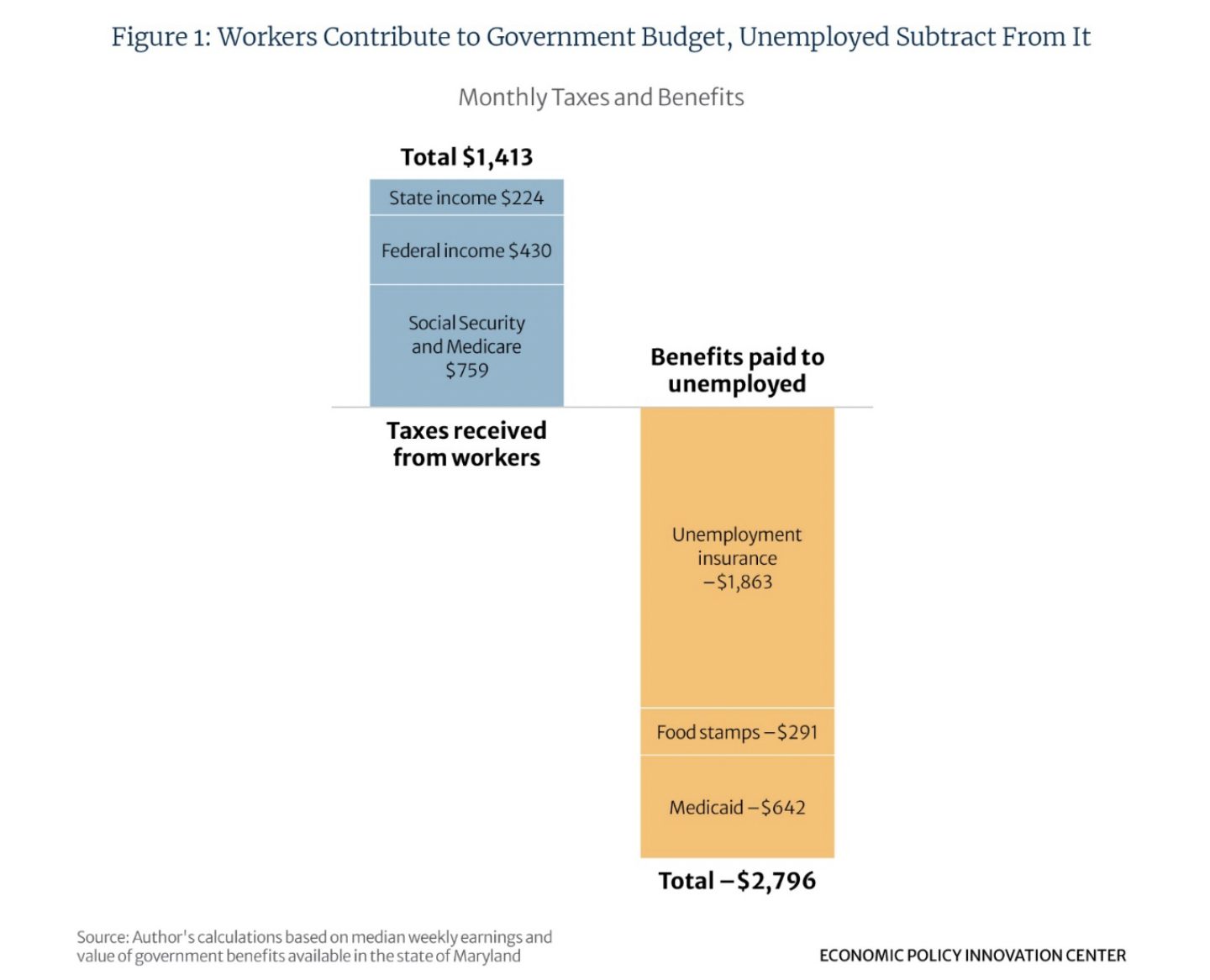
First, people who are not working do not pay employment taxes and they typically pay less toward other government revenues, such as sales taxes because they have less income to spend. For example, an individual who makes a median wage of about $60,000 per year pays about $9,100 in Social Security and Medicare taxes, $5,200 in federal income taxes, and $2,700 in state income taxes. This totals about $17,00 per year, or $1,400 per month, in employment-based taxes alone.
[4]
Second, individuals who are not working often receive government transfers, meaning welfare payments. A single, unemployed worker can receive roughly $2,800 per month in unemployment insurance, food stamps (SNAP), and Medicaid benefits alone. Combined, the loss of work-related tax revenues plus the cost of welfare benefits equals just over $4,200 per month.
Welfare benefits for people who are not working—particularly for able-bodied individuals without children—have not always been so generous. Federal transfers consume an enormous and growing share of federal spending. Even after subtracting spending on Social Security, Medicare, and pensions, the federal government spent nearly $2.2 trillion on transfer payments in fiscal year 2023—the equivalent of $16,500 per American household.
The shortfall in workers is already weighing on the economy and the federal budget, and these consequences could grow over time due to the makeup of the missing workers.
Younger Americans
As shown in a prior report on “Who Are the 2.6 Million Missing Workers?” some of the biggest declines in employment have been among young workers, including a 1.8 percent decline in employment among 20-to-24-year-olds since the start of the pandemic.
[5] (Note that the 2.6 million missing workers figure was from December 2023.) If more individuals were gaining education to improve their future productivity, the decline in employment could be a good thing, but post-secondary educational enrollment is down by 1.3 million, or 7 percent, since 2019.
[6]
This decline in productive activity among 20-to-24-year-olds is particularly troubling because the members of this group have their entire career ahead of them, and periods of unemployment—particularly longer periods—have lasting negative impacts on workers’ opportunities and earnings,
[7] their physical work capabilities and stress levels,
[8] and even their fertility.
[9]
Moreover, long periods of unemployment increase the likelihood of people spending a lifetime on Disability Insurance instead of working.
[10]
Solutions to Improve Younger Americans’ Employment Opportunities
While policies that expand educational and employment opportunities and lead to rising wages help all workers, the following policies would particularly benefit younger Americans:
- Expanded apprenticeships. Apprenticeships are a proven alternative to degree programs, but a government monopoly on Registered Apprenticeship Programs prevents apprenticeships from expanding outside a small number of trades. A proposed, 180,000-word regulation would end many existing apprenticeship programs and make it harder to start new ones.[11] The Apprenticeship Freedom Act[12] and the Training America’s Workforce Act[13] would allow apprenticeships to expand across more industries, resulting in more young people receiving on-the-job, paid education on the path to a successful career.
- Replacement of failed federal job training programs with more effective private, or state and local, programs. Federal workforce programs have an unfailing record of failure.[14] In large part, that is because funding is not tied to outcomes and workforce training is scattered across 47 different programs and multiple agencies. Meanwhile, many employers are eagerly providing education and training—often with no experience or degree—to meet their own workforce needs.[15] Policymakers should streamline existing programs and condition funding on successful outcomes.
- Federal accreditation reform. Current accreditation requirements for federal student loans and grants crowd out alternative, and often more effective, education options. The Higher Education Reform and Opportunity (HERO) Act would expand the use of federal aid to include state-credentialed institutions and individual courses, allowing students to have a more customized higher education experience, and to enter the labor market sooner and with less debt.
- Phased-down federal subsidies for higher education. Federal subsidies for higher education inflate total costs, reduce the returns to higher education, and enable higher education institutions to fail at providing relevant education.[16] Lack of preparedness for the workforce is an increasingly common complaint among employers of new graduates. Policymakers should phase down federal subsidies for higher education to shift financing to more effective private financial institutions and schools that will only finance effective education programs.
- Reform and repeal of licensure laws. While supposedly meant to safeguard the public from unqualified practitioners, most state licensure schemes function as cartels to restrict new entrants.[17] Licensure laws are especially harmful to younger and lower-income individuals, and to the more than one in four American adults who have a criminal record. Requiring hefty fees and hundreds of hours of training just to braid hair or arrange flowers limits work and income opportunities and drives up costs for consumers. State policymakers should eliminate licensure laws that are not truly necessary to protect consumers.
- Increased wages through reduced taxes and elimination of double taxes. Workers’ wages are based on the value of what they produce, after subtracting businesses’ taxes and costs. Lower taxes on businesses translate into higher wages for workers.[18] Since investments in equipment and technology make workers more productive, lower taxes on investments lead to higher productivity and wages. Policymakers should minimize corporate taxes and eliminate double taxes on investments that boost workers’ productivity and wages.
- Work-oriented welfare. Welfare for work-capable adults should be temporary and empower people, through work, to earn a living and pursue their goals. Utah’s “One Door” system provides an effective model for integrating work-oriented welfare and workforce support, but federal rules currently prohibit other states from enacting similar models.[19]
Congress currently has the opportunity to improve the bipartisan A Stronger Workforce for America Act[20] by allowing all states to pursue Utah’s successful “One Door” welfare and workforce model.[21]
Utah’s employment-to-population ratio is 7.3 percentage points higher than the U.S. average (67.4 percent vs. 60.1 percent) and if the entire U.S. had followed Utah’s employment path over the past four years, 5 million more Americans would be working today.
Older Americans
The other large decline is among Americans ages 65 and over. That decline is understandable, and also less troubling. Older Americans faced greater health risks from the coronavirus, and a worker retiring a year or two earlier than planned is far less damaging— both to that individual and to the economy—than a worker losing foundational years of employment that can have lifelong consequences.
The decline in older workers’ employment is also unlikely to increase government spending because it appears to be driven by increased wealth among older Americans. An economic analysis of home prices and labor-force participation by age across metropolitan areas concluded that “the Great Resignation among older workers can be fully explained by increases in housing wealth.”
[22] Nevertheless, policymakers should break down barriers that are needlessly holding older Americans back from working.
Solutions to Improve Older Americans’ Employment Opportunities
To improve employment opportunities for older Americans who either want to stay engaged in the workforce or who need the income that work provides, policymakers should:
- Protect flexible, independent work opportunities. After retiring from 9-to-5 jobs, many older Americans want to keep working—if they can control how much work they do, and when they do it. And, staying engaged can lead to better physical and mental health. A new U.S. Department of Labor rule (effective March 11, 2024) will restrict independent work opportunities for tens of millions of Americans. thereby taking away the only type of work that many older Americans want to, or are able to, perform.[23] Congress should protect independent work by passing the 21st Century Worker Act, which establishes a bright-line test, consistent across all federal laws, to determine who is an “employee” and who is an “independent contractor.”[24]
- Eliminate the retirement earnings test. Social Security’s earnings test acts like a 50 percent tax on earnings above a certain level, which causes some older Americans to work less and earn less than they otherwise would. (The fact that those taxes are re- incorporated into workers’ benefits years later is not well-known.) Policymakers should eliminate the earnings test so that older Americans are not discouraged from working and earning more. This would have a neutral or positive effect on Social Security’s long-run finances.
- Reduce or eliminate Social Security taxes on older workers. Social Security benefits are based on workers’ highest 35 years of earnings. Most people who work beyond Social Security’s standard, or normal retirement age of 67 receive no additional benefits despite still having to pay Social Security’s 12.4 percent tax. Policymakers should consider reducing or eliminating Social Security taxes beginning at age 67 or 70. This change could be pro-growth and reduce Social Security’s shortfalls if combined with a modernization of Social Security’s normal retirement age (gradually increasing and indexing it to life expectancy).
Conclusion
Work is essential to a well-functioning society, and it is fundamental to human wellbeing. Work produces the goods and services that people need to survive and thrive, and work creates a growing economy and rising standards of living.
Work is also fundamental to personal human flourishing. Beyond the income it provides to survive, work—both paid and unpaid—provides dignity and purpose. It can evoke joy and accomplishment, enable creative expression, develop character and perseverance, and help to build community. In contrast, the absence of work among capable individuals is a drain on the economy, a burden on the federal budget and other Americans’ incomes, and a squandering of human potential.
Policymakers can relieve economic and fiscal constraints by creating an environment in which more Americans want to work and are able to find fulfilling work. The good news for policymakers is that the most helpful actions they can take do not require new programs or more spending—policymakers can simply remove the barriers to work that the federal government has created.