
Discretionary spending is dictated by Congress each year and enacted through appropriation bills. Autopilot spending is not reviewed regularly by Congress and is provided by existing law.
Discretionary Spending:
- Provided through the annual appropriations process.
- The House and Senate Appropriations Committees, through their 12 subcommittees (i.e., Homeland Security, Energy and Water, Financial Services and General Government), address funding each year.
- Total discretionary spending for the year is split between national defense and non-defense agencies.
Autopilot Spending:
- Often referred to as “mandatory” or “direct” spending.
- Does not require the approval of Congress each year; automatic until prior law changes or expires.
- Authorizing committees (i.e., House Ways and Means, Senate Finance) have jurisdiction.
- Majority is spent on entitlement programs like Medicare and Social Security.
- Includes net interest on the debt.
Spending Trends:
Since 1974, autopilot (non-discretionary) spending has increasingly dominated federal expenditures; this trend is anticipated to persist under current law. The explosion of autopilot spending has coincided with the rise in federal debt.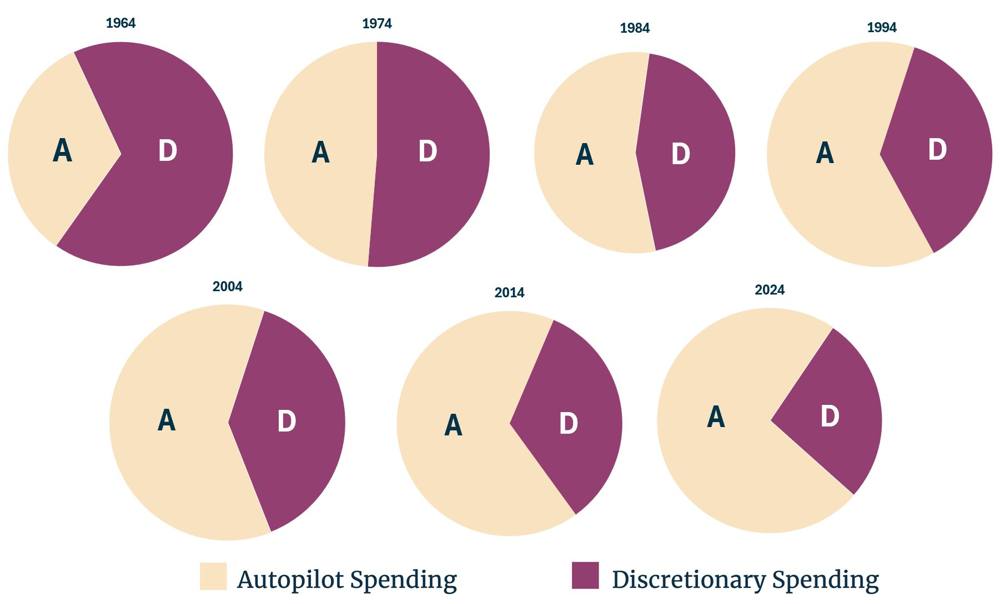
Nearly three-quarters of annual federal spending is now on autopilot, which means that most federal expenditures occur without government oversight.