President Joe Biden unilaterally increased welfare benefit spending in 2021, costing taxpayers hundreds of billions of dollars without Congress’s explicit approval. By modifying the food stamp benefit calculation, allotments increased by 21 percent above inflation.
The government’s official watchdog, the Government Accountability Office (GAO), found that the U.S. Department of Agriculture’s (USDA’s) actions violated administrative guidelines and failed to sufficiently manage risk. Congress should reverse the benefit increase as quickly as possible and prevent future abuses.
The Thrifty Food Plan Is Used to Calculate Food Stamp Benefits
The Thrifty Food Plan (TFP) is used to calculate food stamp benefit levels, which are called allotments. The TFP is meant to represent the cost of “a nutritious, practical, cost-effective diet prepared at home,” for households.
[1]
The maximum allotment for a household of four people is equal to the TFP for a “reference family” of an adult man, an adult woman, and two children. Maximum allotments for different recipients are adjusted for factors such as household size and income. Recipients are assumed to spend 30 percent of their monthly net income on food, so the actual monthly allotment provided is equal to the maximum allotment for the household size minus 30 percent of the household’s net income. Thus, a household with no income would receive the maximum allotment.
Maximum Monthly Benefit for Household Size - 30% of Net Monthly Income = Monthly Allotment
Allotments receive an annual cost-of-living adjustment (COLA) to account for inflation. The USDA updates the TFP data for inflation each month in a Cost of Food report based on the change in the Consumer Price Index (CPI) for specific food items.
[2] The June Cost of Food report is used to set the maximum Supplemental Nutrition Assistance Program (SNAP) allotment for each upcoming fiscal year, which begins in September.
Every Prior Re-Evaluation Was Cost Neutral
The TFP was created in 1975. It was equal to an inflation-based adjustment of the 1962 “Economy Food Plan” that was used when the food stamp program was established.
The TFP was re-evaluated and updated in 1983, 1999, and 2006. Each of these updates integrated changes in dietary guidelines and consumptions patterns. Significantly, each of these re-evaluations remained cost neutral, with adjustments only for inflation.
2021 TFP Change
In 2021, the Biden Administration conducted another TFP re-evaluation. This time, however, the USDA was not cost neutral and instead increased the TFP well above inflation, costing taxpayers hundreds of billions in expanded welfare spending. This was the largest expansion in the history of the food stamp program, and it was implemented via executive action in violation of congressional intent to maintain cost neutrality.
2018 Farm Bill
The 2018 farm bill included a provision that required the USDA to “re-evaluate and publish the market baskets of the Thrifty Food Plan based on current food prices, food composition data, consumption patterns, and dietary guidance,” “by 2022 and at 5-year intervals thereafter.”
[3]
According to the GAO, “while past TFP updates also incorporated data on these four elements, the 2018 Farm Bill codified them in law and added the requirement for regular updates,” which had previously occurred, but at inconsistent intervals.
[4]
The Congressional Budget Office (CBO) cost estimate for the 2018 farm bill indicated that this provision would have no effect on spending.
[5] The TFP re-evaluation provision was originally proposed by the House Republican version of the farm bill, and no comparable version was included in the Senate bill. There is no evidence that Congress intended for this provision to allow the USDA to break precedent and increase food stamp benefits above inflation. In fact, it is inconceivable that Congress intended to grant the executive branch broad power to unilaterally increase welfare spending by hundreds of billions of dollars.
2021 Re-Evaluation
Breaking precedent is exactly what the Biden Administration did with its re-evaluation of the TFP in 2021. The USDA acknowledged that “The Thrifty Food Plan, 2021 marks a significant first…. [F]or the first time in more than 45 years, maintaining cost neutrality did not drive the process.”
[6]
The USDA released a TFP re-evaluation report on August 16, 2021, in which the June 2021 TFP was set at $835.57 per month. That level was 21.03 percent higher than it would have been had the TFP been increased in line with inflation from the prior year, as had always been the process.
Chart 1
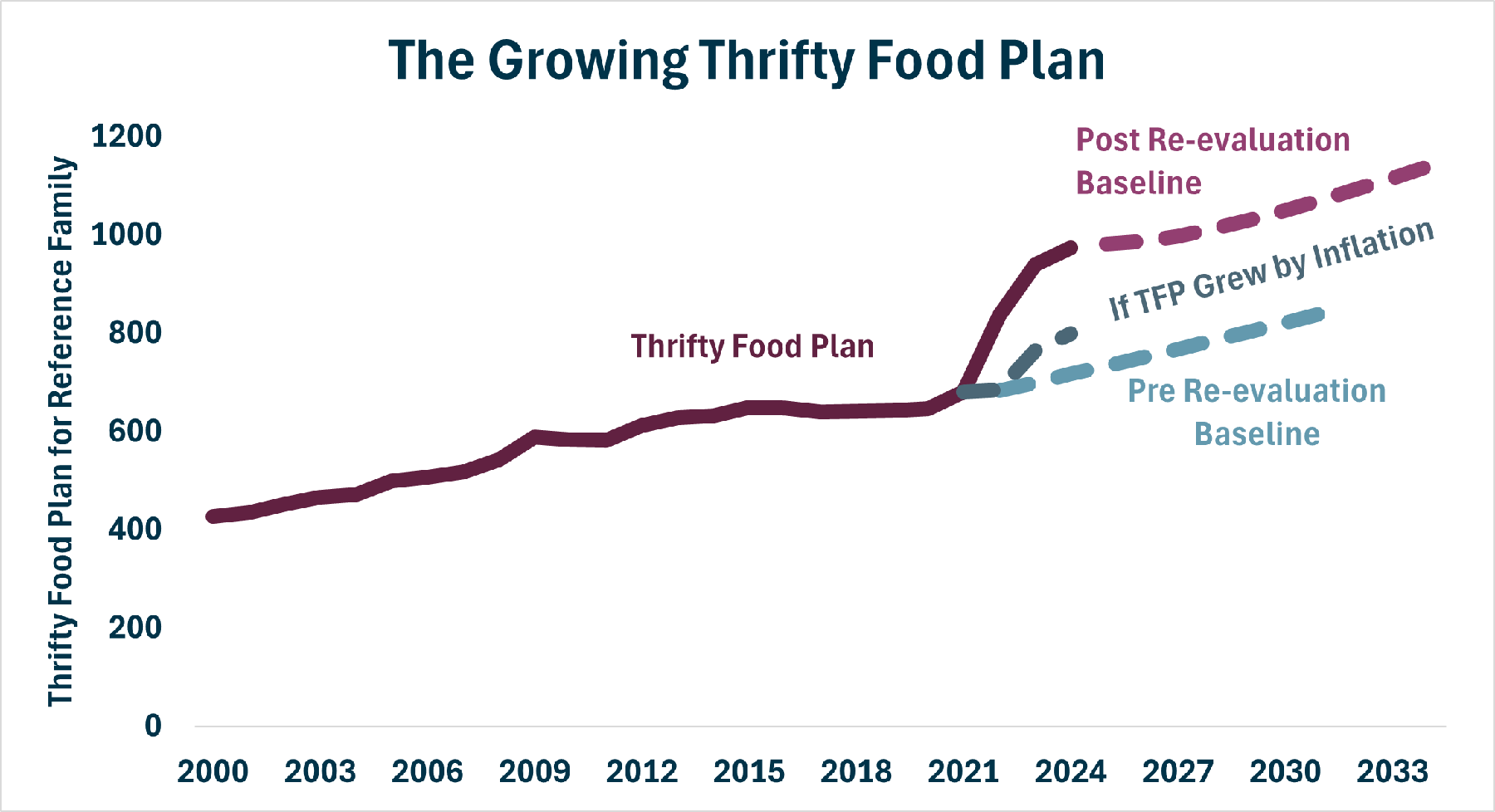 Sources: U.S. Department of Agriculture, Congressional Budget Office, and Bureau of Labor Statistics.
As a result of the TFP re-evaluation and soaring inflation, the maximum food stamp benefit in fiscal year (FY) 2024 is 50.6 percent higher than in FY 2020, providing up to $3,924 more in welfare benefits per year for a family of four.
GAO Reviews of the Re-Evaluation
The GAO severely criticized the USDA’s process in re-evaluating the TFP in two reports.
In December 2022, the GAO released a 79-page report identifying several issues with management, quality assurance, and other procedural problems with the TFP re-evaluation.
[7] The GAO found that the USDA:
- Decided early in the process to increase the TFP above and beyond inflation;
- Accelerated the timeline for publishing the results by six months “so that FNS [Food and Nutrition Service] could apply any resulting SNAP benefit increases on October 1, 2021, according to internal documents we reviewed. This deadline coincided with the expiration of a temporary COVID-19 pandemic-related increase to SNAP benefits”;
- Failed to meet GAO standards for economic analysis in making 11 key decisions about the TFP re-evaluation model, including the decision to remove cost constraints;
- “Officials did not document or conduct a risk assessment”;
- “Did not meet relevant Office of Management and Budget (OMB) and USDA guidelines”; and
- “Began the reevaluation without three key project management elements in place.”
The GAO concluded that the
USDA’s decision in 2021 to allow the cost of the TFP to increase for the first time was a substantial and novel shift that raised the stakes for the reevaluation. Despite the greater importance of the 2021 TFP reevaluation, USDA did not take sufficient action to manage risk in planning and executing the reevaluation, particularly in light of accelerated timeframes.[8]
The GAO made eight recommendations to the USDA. As of April 2024, the USDA had not
implemented half of these recommendations.
[9]
Furthermore, the GAO found that the USDA violated the congressionally mandated rulemaking process. The Congressional Review Act (CRA) requires that agencies submit new rules to Congress before the rule can take effect. The CRA requires agencies to delay the effective date of major rules (those with $100 million or more of annualized economic effects) such as this one for 60 days from the date of finalization to allow Congress time to review and respond accordingly. The USDA failed to meet this obligation and asserted that it was exempt from the requirement. In a July 2022 decision, the GAO found that the USDA erred and must submit the rule to Congress.
[10]
Cost of 2021 TFP Change
In a June 2022 letter to the House Budget Committee, the CBO estimated that the TFP re-evaluation will result in $250 billion to $300 billion in higher food stamp spending between FY 2022 and FY 2031.
[11]
CBO Baseline Increases, Anticipating Future Re-Evaluations
The CBO also projects that the USDA will abuse the TFP re-evaluation process again in the future. Specifically, the CBO projects that the TFP will be increased above inflation in the re-evaluations that will take effect in 2027 and 2032, which could cost taxpayers an additional $25 billion to $30 billion. However, because these re-evaluations have no statutory guardrails, the costs could be much higher or lower, depending on the USDA’s actions. The USDA has released an initial study plan for the next TFP re-evaluation, which is expected to be completed in 2026; it makes no mention of taxpayer costs.
[12]
Requested Additional Appropriations to Support TFP Increases
The Biden Administration has also requested millions in additional appropriations to justify its 2021 benefit increase and support future TFP re-evaluations.
President Biden’s FY 2023 budget requested:
- $18 million for evaluation and analysis support for the impact of the TFP increase, including the “circumstances, shopping patterns and dietary choices of low-income households affected by this update with a focus on SNAP
participants and eligible nonparticipants”; and
- $2.5 million in FY 2023 and a total of $27.4 million over the FY 2023–FY2032 period to support updating the TFP. This additional funding would be used by the bureaucrats at the USDA’s Food and Nutrition Service for administrative purposes.[13]
The FY 2024 budget requested a total of $44.5 million over the FY 2024–FY2033 period for “ensuring scientific integrity of dietary guidelines and food plans” which would be used to support TFP re-evaluations.
[14]
The FY 2025 budget further requested $5 million for the “scientific integrity of dietary guidelines and food plans” activity at the USDA’s Center for Nutrition Policy and Promotion.
[15]
The Context Surrounding the Re-Evaluation
It is useful to understand the context in which the TFP re-evaluation occurred. President Biden and congressional Democrats had been able to temporarily increase food stamp benefit levels under the guise of COVID-19 pandemic relief for those affected by government shutdowns of the economy. These temporary increases were expiring, and the Biden Administration wanted to lock in benefit increases permanently.
The FY 2021 omnibus appropriations bill signed into law in December 2020 included a provision increasing the maximum benefit by 15 percent through June 30, 2021.
[16] President Biden’s American Rescue Plan Act extended the increased maximum benefit through September 30, 2021.
[17]
In March 2020, the Families First Coronavirus Response Act provided “emergency allotments” to all food stamp recipients, overriding the normal 30 percent contribution calculation to provide allotments equal to the maximum benefit for the household size.
[18] In April 2021, the Biden Administration issued guidance allowing emergency allotments to even exceed the maximum statutory benefit for households.
[19] Emergency allotments were available at the request of a state agency through the duration of the COVID-19 public health emergency declaration. Emergency allotments finally ended in February 2023, well after President Biden declared that “the pandemic is over,” pursuant to a provision in the FY 2023 Consolidated Appropriations Act.
[20]
These policy changes allowed food stamp benefits and overall program spending to increase significantly in a short period of time.
Chart 2
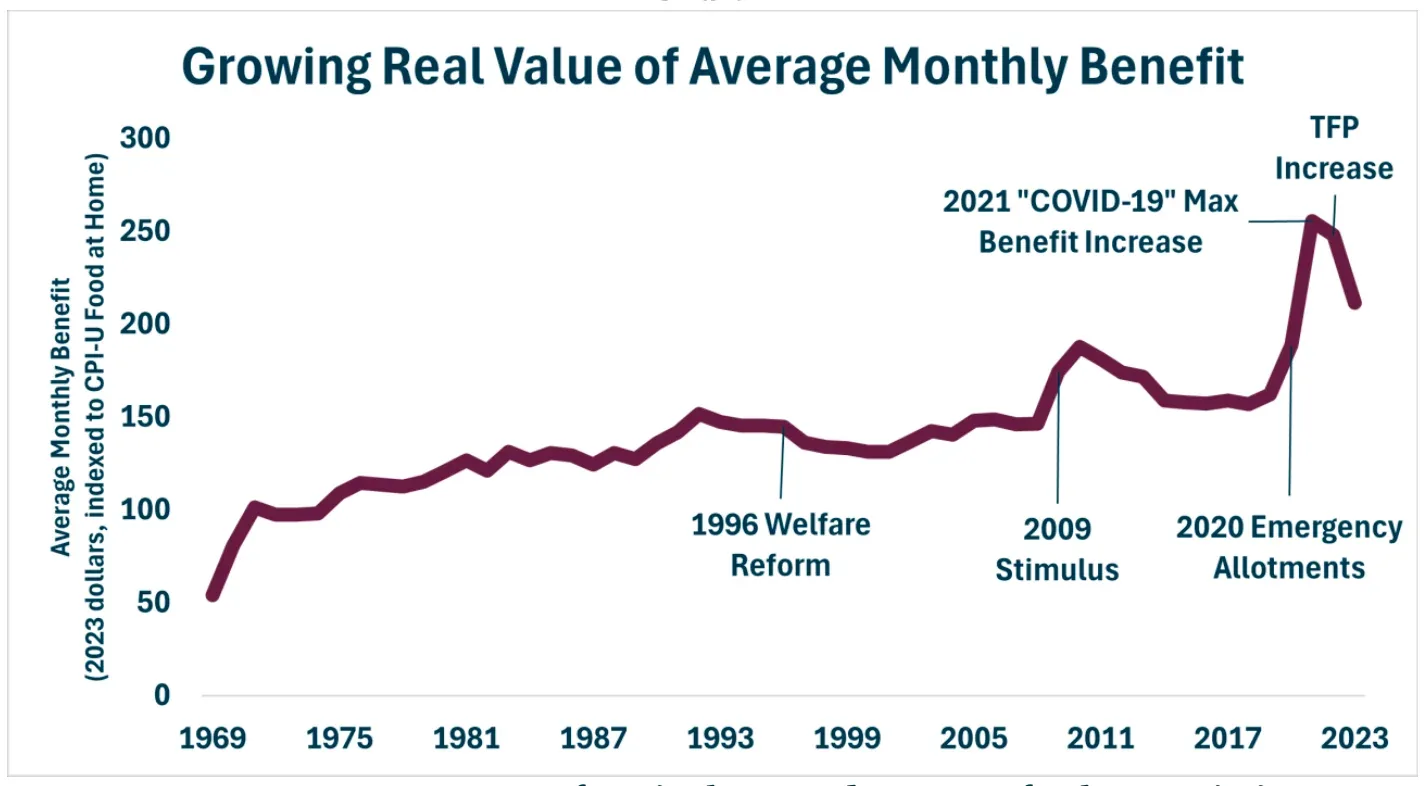 Sources: U.S. Department of Agriculture and Bureau of Labor Statistics.
However, President Biden and congressional Democrats did not have the votes in Congress to permanently expand welfare benefits after the pandemic with such a large price tag. The Biden Administration was under heavy pressure from welfare advocates to spend more, and their only route was by thwarting congressional intent and taking unprecedented executive action.
What Should Congress Do?
The Biden Administration’s unilateral welfare benefit increase has been costly and harmful. To prevent further damage, Congress should:
- Rescind the 2021 TFP re-evaluation;
- Reset the TFP to what it would currently be, had it grown only with inflation (as measured by the chained Consumer Price Index for Food at Home since 2021;
- Implement guardrails around future TFP re-evaluations to be cost-constrained at no greater than the chained Consumer Price Index for Food at Home;
- Prohibit USDA appropriations from being used to support future re-evaluations that are not cost-constrained or that attempt to justify its 2021 re-evaluation;
- Assert Article I power to review TFP re-evaluations under the Congressional Review Act;
- Ensure that TFP re-evaluations follow all regulatory review processes, including the Administrative Procedure Act[21] that requires publication in the Federal Register and providing a notice and comment period, review by the Office of Information and Regulatory Affairs, and a review pursuant to Executive Order 12866 including a full economic analysis of the regulatory costs, benefits, and transfer effects.
The next Administration could also implement most of these reforms via executive action, the same way that the Biden Administration did. This would carry out Congress’s actual intent from the 2018 farm bill, in contrast with the Biden Administration’s arbitrary and capricious actions.
The established regulatory processes, including the Administrative Procedure Act, the Congressional Review Act, and Executive Order 12866, exist for good reasons. They promote transparency, fair notice, due process, and reasoned decision-making grounded in rigorous economic analysis. The USDA must respect and follow these good
government practices.
If benefits had grown with the chained Consumer Price Index for Food at Home since 2021, a family of four would have been eligible for up to $9,576 in food stamp benefits in 2024. Under this policy, food stamp recipients would still be protected from price increases by providing a COLA with inflation for food costs each year. This measure would also protect taxpayers, saving about $300 billion in excessive spending. Furthermore, it would reclaim and protect Congress’s vital Article I authorities. H.R. 4964, the Thrifty Food Plan Accountability Act of 2023, introduced by Representative Josh Brecheen (R–OK), incorporates some of these proposals, by requiring future re-evaluations of the TFP to be budget-neutral.
[22]
Read More: