Taxpayer spending on the food stamp program has surged in recent decades as the rolls expanded significantly and benefit levels increased. Between 2017 and 2019, an average of 13 million able-bodied adults received food stamps. Just 38 percent of these capable welfare recipients worked at all, with only 7 percent working full time.
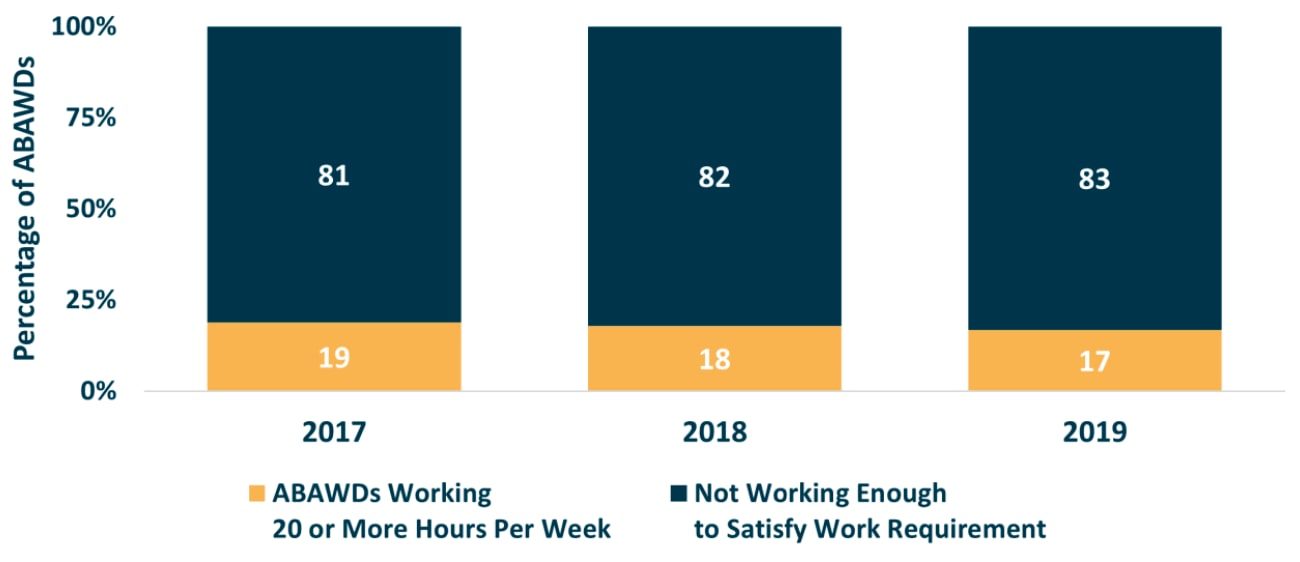
The current food stamp work requirements apply to fewer than 4 million able-bodied adults without dependents (ABAWDs). Just 18 percent of ABAWDs age 18-49 worked the minimum 20 hours per week needed to meet the work requirement through employment.
[1] These work requirements are currently waived in all or parts of 34 states.
Work requirements as a condition of welfare benefits for able-bodied adults help move people off welfare and into the workforce. However, the current food stamp work requirements are limited, weak, and often rendered ineffective by loopholes. Consequently, the food stamp program has fostered a culture of dependency.
Congress should continue the important work of welfare reform to strengthen work requirements and promote opportunity.
Work Is an Important Value for Individuals, Families, and Communities
Work is an essential American value. It is a positive good for individuals, families, communities, and our nation.
Employment is a mutually beneficial arrangement between a worker and an employer. It provides necessary income for employees and a return on investment for employers. This income allows those who work to purchase the essentials of life, such as food and shelter. Participating in the workforce promotes upward mobility and economic opportunity, allowing people to achieve the quintessential American dream. Those who work full time are virtually guaranteed not to be in poverty.
[2]
But work is much more than just a beneficial economic force. Pope John Paul II taught that:
The Church is convinced that work is a fundamental dimension of man’s existence on earth… Work is a good thing for man – a good thing for his humanity – because through work man not only transforms nature, adapting it to his own needs, but he also achieves fulfilment as a human being and indeed, in a sense, becomes ‘more a human being’.[3]
Work requires effort that is essential to earned success. This effort inculcates values that are essential for a flourishing and thriving society. Work requires cooperation and collaboration; it can therefore instill an ethics of integrity, honesty, respect, empathy, and accountability. It increases and amplifies peoples’ engagement with their communities, strengthening local bonds and trust. Collaborative work provides an avenue for innovation to solve problems, encouraging growth and development to improve quality of life for all. As it benefits the larger society, work gives individuals a sense of purpose, allowing them to utilize their unique gifts and talents and achieve their full potential.
The United States was founded on a strong work ethic. Captain John Smith, president of the council of Jamestown in Virginia proclaimed that, “He that will not work shall not eat,” quoting 2 Thessalonians 3:10 and requiring each of the colonists to contribute to the success of the first permanent English settlement in America.
[4] There is an inherent dignity in honest work. Work is not a punishment. Rather, work provides an important source of meaning for people. As Arthur Brooks, a Harvard professor focusing on happiness and former President of the American Enterprise Institute, has written, “Work gives people something welfare never can. It’s a sense of self-worth and mastery, the feeling that we are in control of our lives. This is a sense of abiding joy.”
[5] Author David Bahnsen writes in Full-Time: Work and the Meaning of Life that, “We know that what people do matters, but we often choose to pretend it is just an abstraction. It is not. Activity and achievement are very much a part of our identity… But how one works, whatever the outcome, is an important part of one’s identity—one’s passion, discipline, service, and purpose.”
[6]
Work is associated with positive mental and physical health outcomes. A study for the United Kingdom’s Department for Work and Pensions found:
There is a strong evidence base showing that work is generally good for physical and mental health and well-being. Worklessness is associated with poorer physical and mental health and well-being. Work can be therapeutic and can reverse the adverse health effects of unemployment.[7]
A recent American Enterprise Institute study found that food stamp recipients who worked were 14 percentage points less likely to report feelings of hopelessness or worthlessness than recipients who did not work.
[8]
It is only right that government policy helps people escape from poverty and reach their full potential.
Supporters of the status quo welfare bureaucracy point to the more than $1 trillion spent by the federal government each year and the millions of work capable Americans who stay on the welfare rolls year after year as a positive-yet-insufficient safety net that should even be expanded. It is demeaning to believe that many Americans are simply unable to be successful and should be relegated to a life of dependence on perpetual government subsidization of their basic needs. Trapping people in cycles of dependency is a symptom of a deficit mindset about low-income people.
President Bill Clinton, who signed the landmark 1996 welfare reform law, understood the problems with enduring dependency and championed an agenda that promoted opportunity. As Congress was finalizing the bill, Clinton stated that, “I made my principles for real welfare reform very clear from the beginning. First and foremost, it should be about moving people from welfare to work. It should impose time limits on welfare.”
[9] Clinton further stated his goal was to “transform a broken system that traps too many people in a cycle of dependence to one that emphasizes work and independence, to give people on welfare a chance to draw a paycheck, not a welfare check.”
[10]
Even Joe Biden as a Senator said when voting for welfare reform: “The culture of welfare must be replaced with the culture of work. The culture of dependence must be replaced with the culture of self-sufficiency and personal responsibility.”
[11]
Clinton and then-Senator Biden were correct. We should not define success for government anti-poverty programs by inputs like how much they spend, how many people are enrolled, or by allowing people to stay on the rolls forever. Instead, we should insist on sustainable positive outcomes by ensuring policies empower people to earn success and that poverty and dependency are temporary conditions. The best welfare benefit is one that gets a person off of welfare and into a job.
Work Requirements for Welfare Work
Policies that expect work or work preparation activities as a condition of receipt of welfare benefits for able-bodied adults have a positive impact. Those who move from welfare to work are able to move from dependence to self-sufficiency and often see their take-home pay exceed what they previously received in welfare benefits. When the work requirement is enforced, work-capable adults who refuse to take advantage of resources provided to them by taxpayers are removed from the dole. This ensures that precious taxpayer funds that support true safety net programs are preserved for the genuinely needy.
Requiring work as a condition of welfare benefits is a way of enforcing the principle that “no able adult should be allowed to voluntarily take from the common good without also contributing to it” described by the Working Seminar on Family and American Welfare Policy.
[12] Offering a hand up and not just a handout would ensure better results for everyone: recipients who are put on a path towards self-sufficiency, the truly needy for whom a safety net is safeguarded, and the taxpayers whose funds are used more efficiently and effectively.
In contrast, welfare programs without work requirements for able-bodied adults encourage dependence and reduce employment. In 2018, the White House Council of Economic Advisors (CEA) found that, “a significant body of evidence generally suggests that welfare programs which do not require work reduce employment among adults, with estimates varying widely across programs and specific studies." The CEA further reported that:
non-disabled working-age adults have become increasingly reliant on welfare and experienced stalled employment growth, in part because of the disincentives welfare programs impose on increasing one’s own income. Program work requirements, which require recipients to work or engage in work-related activities in order to maintain benefits, can help overcome this problem.[13]
The food stamp program was described as having “negative effects on labor supply (in line with prior literature)” in a study by researchers at the U.S. Treasury and University of Connecticut.
[14] Another study showed that the introduction and expansion of the food stamp program in the 1960s and 1970s led to lower rates of employment and hours worked, particularly for female-headed households.
[15]
In today’s economy, improving labor force participation is a major challenge.
[16] While the headline unemployment rate is low relative to historical norms, too many people remain out of the labor force entirely. At the same time, many jobs have been left unfilled, resulting in about 2.3 million more job openings than unemployed individuals throughout the country.
[17] Policies that encourage work and rejoining the labor force can only help address these problems. As the CEA found, “expanded work requirements would increase the incentive for individuals to work without exacerbating the high marginal tax rates faced by some current low-wage, part-time workers.”
[18]
Welfare reforms to promote work have achieved encouraging results. The 1996 welfare reform law (the Personal Responsibility and Work Opportunity Reconciliation Act, or PRWORA) transformed the old Aid to Families with Dependent Children (AFDC) program to the Temporary Assistance for Needy Families (TANF) block grant. A major policy change was the imposition of work activation requirements for recipients. Welfare researcher Robert A. Moffitt concluded that “The welfare rolls indeed plummeted under the influence of welfare reform… In the initial years after reform, many more women joined the labor force than even the reform’s most ardent supporters had hoped. ”
[19] The Urban Institute documented that TANF caseloads were cut in half between 1996 and 2000, while work and incomes increased substantially.
[20]
Efforts at the state level to promote work have continued to pay dividends. When Kansas strengthened TANF work requirement enforcement in 2011, those who left the welfare rolls saw incomes rise by an average of 247 percent within four years after finding employment in more than 600 different industries.
[21] A recent study by the Congressional Budget Office on an expansion of the TANF work requirement in Alabama found an 11 percentage point increase in employment among affected recipients.
[22] It is worth noting that the TANF reforms that achieved these overwhelmingly positive results were focused on a population that many believed it would be difficult to engage in work - single mothers with children.
Work requirements for the food stamp program have also encouraged able-bodied adults to leave the welfare rolls and join the workforce. A nationwide study by the Upjohn Institute found that work requirements did increase employment levels for able-bodied enrollees while also reducing participation.
[23] Another nationwide study found that work requirement waivers between 2004 to 2018 decreased hours worked.
[24] A National Bureau of Economic Research working paper using administrative data of recipients in Virginia showed that enforcement of work requirements led to substantial exits from the program by able-bodied adults, although little effect on earnings for recipients who remain.
[25] A study of nine states by the Urban Institute for the U.S. Department of Agriculture found similar results.
[26] Angela Rachidi of the American Enterprise Institute summed up her evaluation of work requirements, concluding that, “policymakers should consider [work requirements] an effective anti-poverty tool, especially in light of the evidence that they actually increase employment and raise incomes for families.”
[27]
Studies by the Foundation for Government Accountability that tracked individuals in Arkansas, Maine, Mississippi, and Missouri showed that when food stamp work requirements are enforced, the number of able-bodied adults on the welfare rolls fall, time on welfare is reduced, people reenter the workforce, and incomes increase. Most importantly, people have greater opportunity to realize success and dependency decreases:
- Arkansas: After Arkansas reinstated food stamp work requirements in 2016, those who left the welfare rolls saw their incomes increase an average of 204 percent, earning $1.18 for every dollar of food stamp benefit forgone.[28]
- Maine: When Maine enforced the food stamp work requirements for 16,000 able-bodied adults without children in 2014, incomes rose an average of 114 percent within one year, more than offsetting the lost benefits.[29]
- Mississippi: When Mississippi reinstated food stamp work requirements in 2016, those who left welfare saw incomes rise 121 percent within 18 months as they gained employment in 716 different industries.[30]
- Missouri: When Missouri enforced food stamp work requirements for 53,000 childless able-bodied adults on food stamps in 2015, those who left the welfare rolls saw their incomes increase by 70 percent within just three months and eventually doubled, more than offsetting the foregone food stamp benefits.[31]
Work requirements are overwhelmingly popular with the public. Some recent surveys of the issue showed that:
- 79.5 percent of voters on a 2023 ballot referendum in Wisconsin voted yes on the question “shall able-bodied, childless adults be required to look for work in order to receive taxpayer-funded welfare benefits?”[32]
- 72 percent of voters, including 67 percent of Democrats and 70 percent of Independents supported work requirements for food stamps in a poll from the Center for Excellence in Polling.[33]
- 68 percent of Americans said that “people who receive assistance from welfare programs in the U.S. should be required to work or participate in job training programs” in a 2023 YouGov poll.[34]
The Food Stamp Program’s Work Policies
The food stamp program includes two different policies meant to promote work:
- The work registration requirement, also called the general work requirement.
- The work requirement, also called the ABAWD work requirement or the ABAWD time limit.
The work registration requirement has a broader applicability than the ABAWD work requirement, but weak work promotion standards.
The ABAWD work requirement has a narrower applicability, but stronger work promotion requirements, although it is riddled with loopholes.
As a consequence, most policy reform efforts in recent decades have been focused on ending the loopholes, strengthening the requirements, and broadening the applicability of the ABAWD work requirement.
The Work Registration Requirement
The Food Stamp Act Amendment of 1970 originally established work registration requirements for able-bodied adults aged 18 to 65, other than those already working 30 hours per week or caring for a dependent, enrolled in school, or participating in a job training program.
[35] The work registration requirements have been modified several times since then.
Those subject to the work registration requirement are referred to as “work registrants.” The work registration requirement currently applies to able-bodied individuals aged 16 to 59 who are not already working at least 30 hours per week, earning the equivalent of the federal minimum wage multiplied by 30 hours ($217.50), or attending school or job training half time. Parents of children aged 6 and under are exempt, as are those caring for an incapacitated person, or participating in alcohol or drug treatment programs.
[36]
The exemption tied to earning the equivalent of the federal minimum wage for 30 hours per week means that a person earning minimum wage in a state with a higher minimum wage could be exempt from the work registration requirements by working only a few hours a week. For example, an individual in Washington, DC, earning the $17 per hour minimum wage would be exempt by working just 12.8 hours per week.
This work registration requirement does not require a person to work as a condition of receiving food stamp benefits. Work registrants must “register for work” by filing a job search with a state employment agency, accept any offer of suitable employment (generally offering at least minimum wage), not voluntarily quit or reduce employment below 30 hours per week without good cause, and participate in an employment and training (E&T) program if required by the state.
Work registrants who fail to comply with the general work requirements listed above are disqualified from benefits for a certain period of time, unless the state agency determines there was “good cause” for noncompliance. On the third strike for noncompliance without good cause, the state may permanently disqualify the individual from food stamp benefits.
The meaning of “good cause” is not defined in law, which delegates that authority to the U.S. Secretary of Agriculture. The USDA broadly defines good cause to encompass “circumstances beyond the member’s control, such as, but not limited to, illness, illness of another household member requiring the presence of the member, a household emergency, the unavailability of transportation, or the lack of adequate child care, ” and other situations.
[37]
Few states mandate E&T participation. Only nine states required mandatory E&T participation for any work registrants in 2021, which prompted the Foundation for Government Accountability to describe the so-called general work requirement as “more of a work suggestion,” and “voluntary.”
[38]
In 2019, there were 4.484 million food stamp recipients subject to the work registration requirement. Of those, 70percent did not participate at all in an E&T program. While States assigned 1.1 million to mandatory E&T participation, only 223,000 took advantage of voluntary government-funded E&T programs. Additionally, the USDA found 109,000 individuals who should have registered for work, but failed to do so.
[39]
The ABAWD Work Requirement
The work requirement for able-bodied adults without dependents (ABAWDs) in food stamps was added by the 1996 welfare reform law.
[40]
The work requirement is enforced by limiting benefits to no more than three months out of a 36-month period for individuals who are subject to but fail to satisfy the requirement. Because of this enforcement mechanism, the ABAWD work requirement is sometimes called a “time limit requirement.”
Who Does the Work Requirement Apply To?
The work requirement applies to able-bodied adults without dependents older than age 18. The maximum age individual subject to the work requirement in FY 2024 is 52.
The Fiscal Responsibility Act (FRA) of 2023increases the maximum age for applicability of the ABAWD work requirement gradually in the coming years. The new maximum age phases up from 49 before the FRA to 54 by FY 2025. Unless extended by future legislation, the maximum age will revert back to 49 in FY 2031 and later years.
Table 1
| Before FRA |
18 to 49 |
| FY 2023 |
18 to 50 |
| FY 2024 |
18 to 52 |
| FY 20-5 2030 |
18 to 54 |
| FY 2031 and After |
18 to 49 |
The Fiscal Responsibility Act, P.L 118-5, Sec. 311(a)
Other exceptions from the work requirement include any person who is:
- Medically certified as physically or mentally unfit for employment;
- Pregnant;
- Living with a child under 18;
- Responsible for caring for an incapacitated person;
- Going to school at least half time;
- Meeting the work engagement requirements for Temporary Assistance for Needy Family (TANF) benefits or the work search requirements for receiving unemployment insurance benefits;
- A regular participant in a drug addiction or alcoholic treatment and rehabilitation program; or
- Otherwise exempt from the work registration requirement.[41]
The Fiscal Responsibility Act temporarily added three new exceptions to the work
requirement, which are also applicable through fiscal year 2030:
- Able-bodied homeless individuals;
- Able-bodied veterans; or
- Able-bodied individuals aged 24 and younger who were formerly in foster care.
These new exceptions will trap more work-capable adults in dependance rather than helping them become self-sufficient members of society.
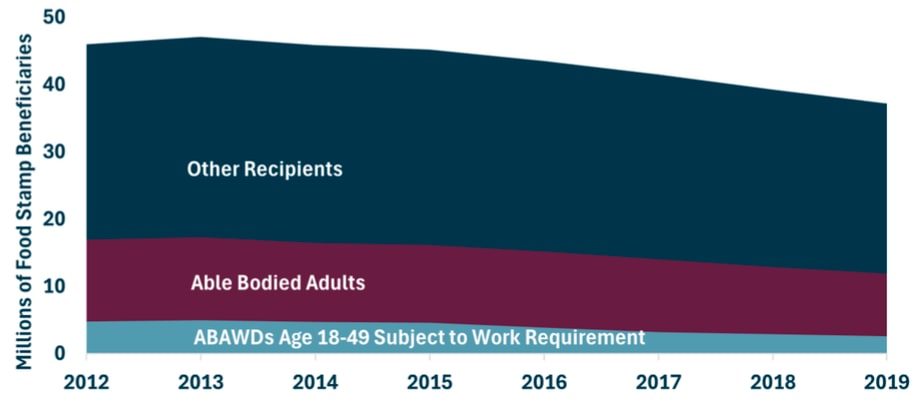
In 2019, 11.9 million non-elderly work capable adults received food stamp benefits. However, only 2.6 million of these were classified as able-bodied adults without dependents (ABAWDs) aged 18-49 who could potentially be subject to work requirements. Non-disabled work-capable adults made up 32 percent of total food stamp recipients; within this group, ABAWDs represented 7 percent of recipients.
[42]
While updated quality control data is not yet available, the USDA now estimates that 9 percent of food stamp recipients at the beginning of FY 2024 were ABAWDs.
[43] This equates to 3.7 million ABAWDs who could potentially be subject to the work requirement.
Chart 1: Few Food Stamp Recipients Potentially Subject to Work Requirement
 Source: U.S. Department of Agriculture
How Can the Work Requirement Be Met?
The ABAWD work requirement can be satisfied in several ways, by engaging in 80 hours per month (20 hours per week) of:
- Employment;
- Unpaid volunteering work; or
- A job training work program.
Only 18 percent of ABAWDs age 18-49 worked the 20 or more hours per week needed to satisfy the work requirement through employment on average between FY 2017 and 2019.
[44] This means that 82 percent of those subject to the work requirement did not work enough hours.
These ABAWDs potentially could have satisfied the work requirement through job training or volunteering. However, it is likely that most of these work-capable adults were waived or exempted from the work requirements altogether.
Chart 2: Few ABAWDs Work Enough to Meet Work Requirements
 Source: U.S. Department of Agriculture
The Geographic Waiver & Regulations to Waive the Work Requirement
States can apply geographic waivers of the ABAWD work requirement for food stamp recipients in any area that has an unemployment rate above 10 percent or “does not have a sufficient number of jobs.”
Waivers can cover all or parts of the state. The law does not specify how long a waiver should last, but the USDA typically approves waivers lasting 12 months and sometimes 24 months.
[45]
The geographic waivers are a massive loophole in the ABAWD work requirement. Analysis from the Foundation for Government Accountability showed that at least 70 percent of ABAWDs aged 18-49 were expected to be in areas covered by geographic waivers or provided discretionary exemptions in July 2023.
[46]
The Biden Administration has pushed states to seek waivers, with a USDA official writing that the agency “highly encourages states to consider requesting waivers of the ABAWD time limit and to use discretionary exemptions as appropriate.”
[47]
In the second quarter of FY 2024, 12 states and territories have waived work requirements statewide and 22 states had implemented geographic waivers that covered parts of the state.
[48] The states covered by these statewide and partial waivers had 26.5 million food stamp recipients in FY 2023, 63 percent of all food stamp recipients nationwide.
[49]
When these waivers took effect in January 2024, the U.S. unemployment rate was just 3.7 percent. In the states with a statewide or geographic waiver, the weighted average unemployment rate was 4.1 percent.
[50] This is less than the than the average U.S. unemployment rate since 2001 of 5.8
[51] percent and is less than the CBO's projected Noncyclical Rate of Unemployment of 4.4 percent, considered the “natural unemployment” or “full employment” rate.
[52],” February 8, 2024, retrieved from FRED, Federal Reserve Bank of St. Louis;
https://fred.stlouisfed.org/series/NROU (accessed March 12, 2024).]
Figure 1
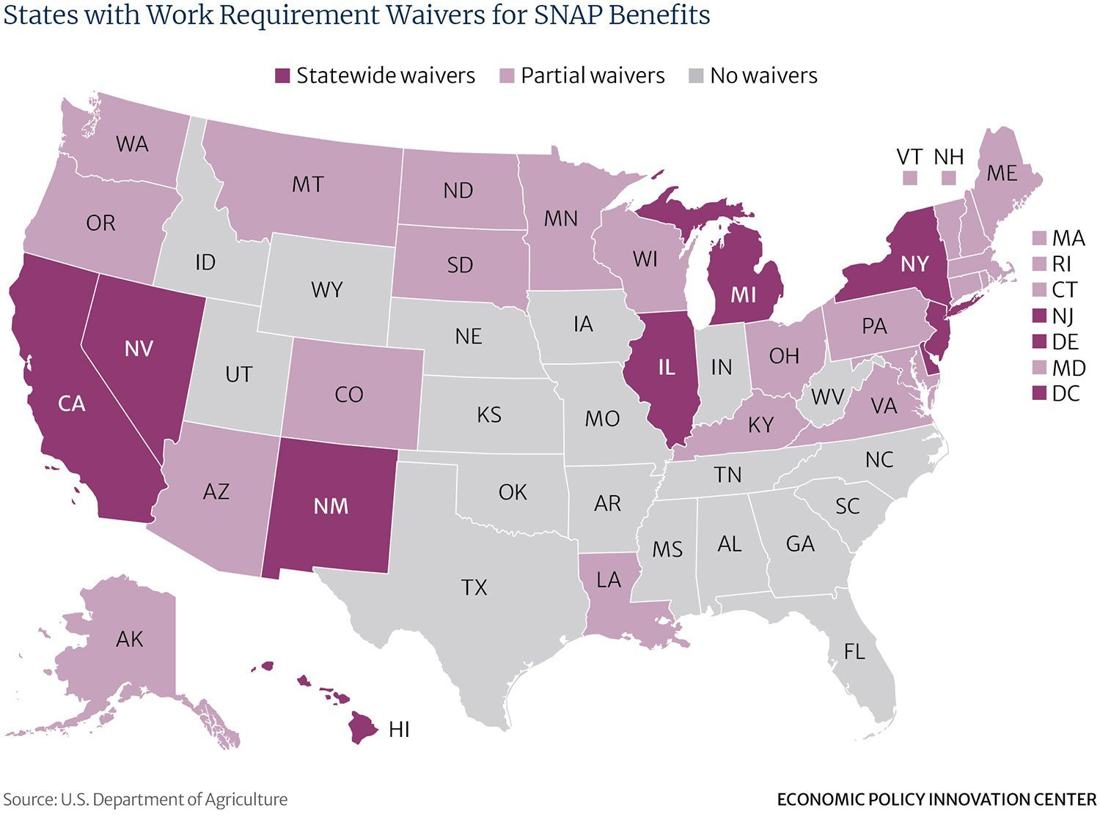
The work requirement was waived nationwide from March 2020 through July 2023 under the Families First Coronavirus Response Act and subsequent extensions of the COVID-19 public health emergency declaration.
USDA Regulations on the Geographic Waiver Weaken the Work Requirement
The terms “area” and “sufficient number of jobs” with respect to the geographic work requirement waiver are not defined in law, but are instead defined by executive regulations put in place by the Clinton Administration. These regulations allow states to gerrymander waivers to include areas with very low unemployment, completely gutting the work requirements in many states.
[53]
The regulations describe how an area can be deemed to “not have a sufficient number of jobs”:
To support a claim of lack of sufficient jobs, a State may submit evidence that an area:
- “Is designated as a Labor Surplus Area (LSA) by the Department of Labor's Employment and Training Administration (ETA);[54]
- “is determined by the Department of Labor's Unemployment Insurance Service as qualifying for extended unemployment benefits;
- “has a low and declining employment-to-population ratio;
- “has a lack of jobs in declining occupations or industries;
- “is described in an academic study or other publications as an area where there are lack of jobs;
- “has a 24-month average unemployment rate 20 percent above the national average for the same 24-month period. This 24-month period may not be any earlier than the same 24-month period the ETA uses to designate LSAs for the
current fiscal year.”[55]
To be clear, these criteria were created by the USDA, and are not reflected in the underlying law. The USDA allows states to rely on old, outdated, and cherry-picked data to justify waiving the food stamp work requirements in as many areas and for as many welfare recipients as possible.
The USDA allows states to gerrymander together different jurisdictions to meet its waiver criteria and exempt as many food stamp recipients as possible from work requirements.
[56] For example, Illinois grouped 101 of its 102 counties into one “area” for a waiver for 2018 using data from as old as 2015 – including many counties with low unemployment rates under 4 percent.
[57] Left-wing advocacy groups even provide mapping and consulting services for states, helping them implement waivers of work requirements that are as broad as possible.
[58]
A 2016 USDA Office of the Inspector General report found that states “specifically requested ABAWD time limit waivers in as many parts of the State as possible to minimize the areas where they needed to track the ABAWD time limits.”
[59] The USDA OIG report further reported that:
States are requesting, and FNS is approving, as allowed by law, ABAWD time limit waiver requests for parts of States where unemployment rates are as low as 0 percent but are averaged with areas with higher unemployment rates to demonstrate areas with insufficient jobs. The statute provides FNS with the authority to approve these waivers.[60]
In addition to gerrymandering, states are permitted to use data in their waiver proposals that may not reflect current economic conditions. This is despite the plain language of the underlying law indicating that a potential waiver should reflect the present situation experienced by affected individuals.
USDA guidance provides that a “State can qualify for a 12-month statewide waiver as long as the waiver is implemented within 12 months of the [Unemployment Insurance Extended Benefits] Trigger Notice effective date.”
[61] That means that a statewide waiver can remain in place up to two years after the conditions were met for extended unemployment benefits.
Even for calculating if an area has an unemployment rate above 10 percent, the USDA does not require the current unemployment rate to actually exceed 10 percent. The USDA will accept data stretching back 23 months prior to the implementation of a proposed waiver as a part of the calculation.
[62] That means at the end of a 12-month waiver, the data used to justify providing welfare without work could be nearly three years old.
Older and heavily cherry-picked data can be used to meet the thresholds for the “20-percent higher than the national average” criteria for justifying a geographic work requirement waiver. That means a 12-month long work requirement waiver beginning in FY 2024 (a waiver that could be in effect through September 30, 2025) could be based on data from as far back as January 1, 2021.
[63]
Jamie Hall of the Heritage Foundation has found that the regulations governing geographic waivers of the food stamp work requirements have “resulted in situations where many areas are usually or always eligible for waivers, and most waivers go to those areas that are usually waived. This situation creates a dynamic in which, in theory, some work-capable individuals may receive SNAP benefits for their entire lives without looking for work even once.”
[64]
Discretionary Exemptions
After all of the exceptions and waivers, states are also allowed to apply a limited number of monthly discretionary exemptions to individuals who are expected to, but nonetheless fail to satisfy the ABAWD work requirement. These can be referred to as a “no good cause exemption.” Certain states have even applied such exemptions retroactively to avoid sanctioning an ABAWD who did not meet the work requirement.
[65]
The FRA reduced the number of discretionary exemptions from the ABAWD work requirement that states can provide each year to 8 percent of the caseload subject to the work requirement from 12 percent under prior law. For FY 2024, states were allowed a total of 593,652 new participant-months’ worth of discretionary exemptions, enough to provide year-long exemptions for up to 49,471 ABAWDs.
[66] This is about 175,000 participant-months fewer new discretionary exemptions than were provided in FY 2023.
Discretionary exemptions that are unused by the state can be carried over from year to year. The FRA limited states’ ability to carry over unused exemptions to only those allotted in the year prior, rather than banking exemptions for several years. Data on the unused FY 2023 exemptions is not available at this time.
[67]
Reducing the available discretionary exemptions from work requirements was a good policy. However, the reform in the FRA was a modest change. According to the CBO cost estimate for the FRA, “the changes to discretionary exemptions would reduce spending for SNAP by a negligible amount.”
[68]
The geographic waivers of work requirements are a much larger loophole than the discretionary exemption. For context, the total number of new discretionary exemptions provided to all states in FY 2024 is about one-tenth of the number of ABAWDs exempted from the work requirement under just California’s statewide geographic waiver.
[69]
Reforms to Strengthen Food Stamp Work Requirements
Work and self-sufficiency are important values that government policies should promote and protect. Work requirements as a condition of welfare benefits for able-bodied adults help move people off welfare and into the workforce. However, the current food stamp work requirements are limited, weak, and often waived. Congress should continue the important work of welfare reform to strengthen work requirements and promote opportunity.
Below are descriptions of policy reforms that Congress should enact. The Appendix that follows describes specific proposals that have been introduced and are under consideration by policymakers.
Eliminate Geographic Waivers
Geographic waivers are a significant loophole in food stamp work requirements. Analysis from the Foundation for Government Accountability showed that at least 70 percent of ABAWDs aged 18-49 were expected to be in areas covered by geographic waivers or provided discretionary exemptions in July 2023.
[70]
Congress should eliminate the geographic waiver. Several proposals to end the loophole have been proposed in the 118th Congress, including H.R. 4969, the Ending the Cycle of Dependency Act of 2023,
[71] introduced by Rep. Eric Burlison (R-MO), and H.R. 1550/S. 1062, the Jobs and Opportunities for SNAP Act,
[72] introduced by Rep. Jake LaTurner (R- KS) and Sen. John Kennedy (R-LA).
Other proposals have been put forward to curtail the geographic waiver loophole. Both H.R. 1581, the America Works Act of 2023,
[73] introduced by Rep. Dusty Johnson (R-SD), and S. 1188, the SNAP Reform and Upward Mobility Act of 2023,
[74] introduced by Sen. Mike Lee (R-UT), would end the subjective “lack of sufficient jobs” criteria for geographic waivers.
In December 2019, the Trump Administration promulgated a final rule modifying some of the Clinton-era regulations governing geographic waivers.
[75] The rule would have tightened the definition of “area” and established an unemployment rate floor of 6 percent to qualify for a geographic waiver. However, the rule was quickly blocked by the courts.
Implement Work Requirements for Work-Capable Adults, Including Parents
Promoting work for parents would be an important pro-family reform.
Pope John Paul II taught that “Work constitutes a foundation for the formation of family life, which is a natural right and something that man is called to... In a way, work is a condition for making it possible to found a family, since the family requires the means of subsistence which man normally gains through work.”
[76]
Households with children should have at least one full-time worker to provide for the family and set a positive example for the next generation. The best way to reduce child poverty is not through government handouts, but by helping parents get on an upwardly mobile trajectory.
The CEA concluded that “the evidence on welfare programs suggests that work-conditioned programs are uniquely able to both increase adult employment and improve child outcomes.”
[77] These types of policies would help work-capable parents get back to receiving a paycheck to provide for themselves and more importantly, their children.
Work instead of welfare can lead to better mental and physical wellbeing for both children and parents.
[78] As the Foundation for Government Accountability summarized the issue:
Based on the experiences of other populations and other programs, expanding work requirements to able-bodied parents would lead to less dependency, more employment, higher incomes, and greater economic growth… Congress should help these families out of the welfare trap by expanding successful work requirements to all able-bodied adults on food stamps.[79]
In 2019, there were about 7.75 million able-bodied adults aged 18 to 59 living with children receiving food stamps. Within this total, about 3.9 million had pre-school aged children while 3.8 million had only older children.
[80] All of these work-capable adults are currently excluded from the work requirement.
Of the population of able-bodied adults who receive food stamps, parents already work more than childless adults. This is notable because only adults without dependents are subject to work requirements, while parents are excluded from work requirements. Of course, parents have more reason to work to provide a better future for their families rather than remain dependent solely on government welfare.
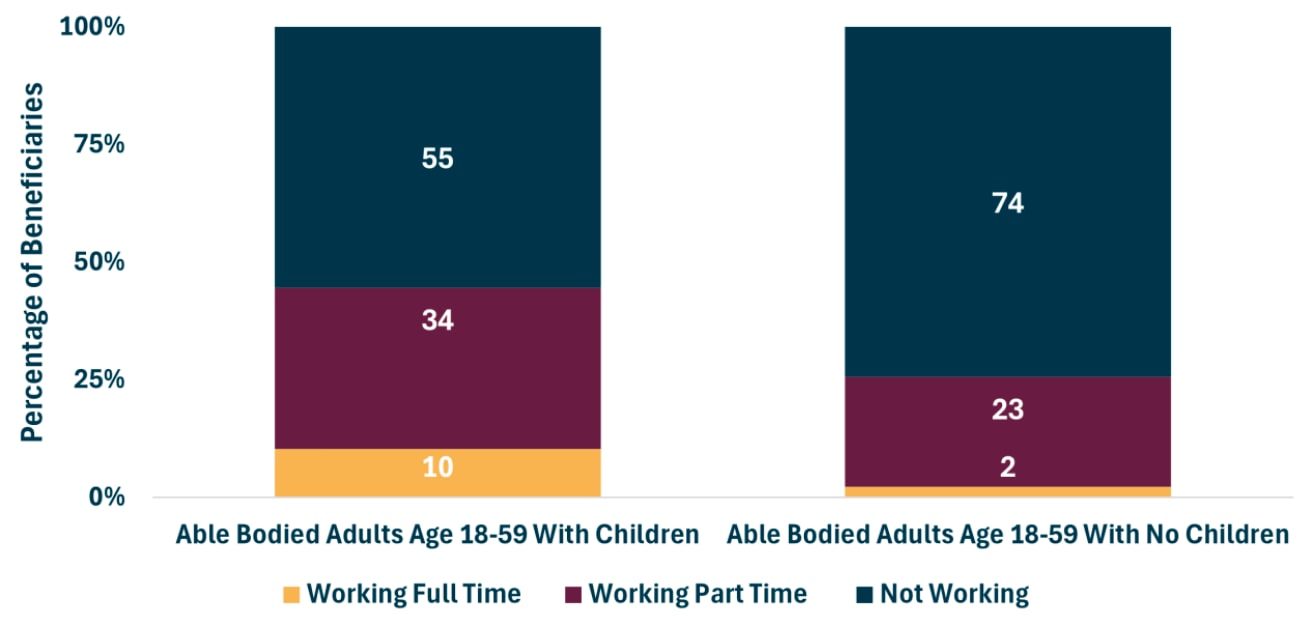
Over the FY 2017 – 2019 period, an average of 45 percent of able-bodied adults on food stamps with children worked, compared to just 26 percent of childless able-bodied adults. The difference in full-time employment is particularly stark, with five times the percentage of parents working full-time compared to non-parents.
[81]
Chart 3: Parents Work More than Childless Recipients
 Source: U.S. Department of Agriculture.
Several significant food stamp work requirement bills introduced in the 118th Congress would apply work requirements to able-bodied adults with children, including legislation sponsored by Sen. Mike Lee (R-UT), Rep. Eric Burlison (R-MO), Rep. Jake LaTurner (R-KS), Sen. John Kennedy (R-LA), and Rep. Dusty Johnson (R-SD).
[82]
Expand the Age Applicability of Work Requirements
The Fiscal Responsibility Act temporarily phases in an increase in the maximum age covered by work requirements to 54. In FY 2031, the maximum age subject to work requirements will revert back to 49.
Congress should expand the age applicability of work requirements for able-bodied adults under the normal retirement age. Earnings between ages 45 and 64 represent some of the most important over the course of a typical worker’s career.
[83] Today, a growing share of the workforce consists of older workers, who benefit in numerous ways from remaining engaged in work and bolstering their financial wellbeing headed into later retirement years. Food stamp policies should recognize these dynamics and help work-capable individuals remain in the workforce.
Between FY 2017 and 2019, an average of 1.7 million able-bodied adults aged 50 – 59 without children received food stamps. Unfortunately, 76 percent of them did not work at all, and only two percent worked full time.
[84]
Several significant food stamp work requirement bills introduced in the 118th Congress would expand work requirements for able-bodied adults older than 49, including legislation sponsored by Sen. Mike Lee (R-UT), Rep. Eric Burlison (R-MO), Rep. Jake LaTurner (R-KS), Sen. John Kennedy (R-LA), and Rep. Dusty Johnson (R-SD).
[85]
Expand the Hours of Effort Requirement
The best pathway out of poverty is a full-time job.
Unfortunately, the current work requirements only mandate 80 hours per month -equivalent to 20 hours per week – of work and work-preparation for ABAWDs. This is only half of the normal 40-hour workweek that is considered full-time employment.
The hours of work requirement is also undermined by the fact that an individual exempted from the work registration requirement is also excepted from the work requirement. The work registration exemption tied to earning the equivalent of the federal minimum wage for 30 hours per week ($217.50) means that a person earning minimum wage in a state with a higher minimum wage could be exempt from the work registration requirements by working only a few hours a week. For example, an individual in Washington, DC, earning the $17 per hour minimum wage would be exempt
by working just 12.8 hours per week. This exemption should be repealed.
[86]
The 20-hours of work per week expectation for able-bodied adults should be increased. During the debate over the Fiscal Responsibility Act, some members considered requiring 30 hours per week as a proposal, which would align with the 30 hours per week exemption from the work registration requirement.
One option is that the number of hours of work required to satisfy the ABAWD work requirement could be phased up depending on the length of time the able-bodied adult has been on the welfare rolls. For example, the current 20 hours per week level could remain in place for the first six months of food stamp benefits, increasing to 30 hours per week for the second six months of benefits, with an expectation of 40 hours per week of full-time effort for any period of welfare receipt lasting a year or more.
[87] This would put work-capable adults on a sustainable pathway of self-sufficiency.
Of course, any hours of effort requirement does not matter much if most able-bodied adults are waived from any work requirement through geographic waivers and discretionary exemptions, so reforms should be paired together.
Prevent a Lifetime of Dependency
The purpose of government welfare programs is to provide a temporary safety net for those in need and to promote a pathway towards self-sufficiency so families can enjoy better lives.
The 1996 welfare reform included a lifetime limit of 60 months of Temporary Assistance for Needy Families (TANF) benefits for adults. A similar policy should be applied to food stamps.
H.R. 4969, the Ending the Cycle of Dependency Act of 2023,
[88] introduced by Rep. Eric Burlison (R-MO), would implement a similar policy for the food stamp program. Under the bill, able-bodied adults aged 18 to 64 without children aged six or younger would be limited to no more than 60 months of food stamp benefits.
Work is Essential to Human Flourishing: The Food Stamp Program Should Promote Work.
Work is an important value that is vital to human flourishing for individuals, families, communities, and the United States. The food stamp program provides billions of dollars in benefits to millions of work-capable people each year. Unfortunately, the food stamp program undermines work and traps too many people in dependency, rather than promoting opportunity.
Congress should strengthen food stamp work requirements by including all work capable adults, eliminating geographic waivers, phasing up the hours of expected effort, and preventing a lifetime of dependency. These significant policy reforms will increase human flourishing and help our fellow Americans.
Appendix:
Comparing Proposals to Strengthen Food Stamp Work Requirements for Able-Bodied Adults
|
Ages Covered by Work Requirement |
Adults with Children Covered? |
Geographic Waivers |
Discretionary Exemptions |
Other Provisions |
| Current Law, as amended by Fiscal Responsibility Act |
"Before FRA: 18 to 49.
FY 2023: 18 to 50.
FY 2024: 18 to 52.
FY 2025 - 2030: 18 to 54.
FY 2031 and After: 18 to 49." |
No. All parents in household with children exempt. |
"10% or higher; or
“Area” that “does not have a sufficient
number of jobs to provide
employment for the individuals.”
Regulations define as: 20% above
national average for a recent 24-month
period or a Labor Surplus Area." |
"8%.
Limits rollover of exemptions." |
"Other exceptions from work
requirements through FY 2030:Homeless, Veterans, and Former foster children under age 24." |
| H.R. 1550/S. 1062 - Jobs and Opportunities for SNAP Act (Rep. Jake LaTurner / Sen. John Kennedy) |
18 - 64 |
Parent in a household of child under 7 exempt. |
Eliminated. |
"3%.
Limits rollover." |
Eliminates FRA exemptions for homelessness, veterans, and former foster care. |
| H.R. 1581 - America Works Act of 2023 (Rep. Dusty Johnson) |
18 - 64 |
Parent in a household of child under 7 exempt. |
Areas 10% or higher. |
"8% (unchanged).
Limits rollover." |
Eliminates FRA exemptions for homelessness, veterans, and former foster care. |
| "H.R. 4969 - Ending the Cycle of Dependency Act of 2023 (Rep. Eric Burlison)" |
18 - 64 |
Parent in a household of child under 6 exempt. |
Eliminated. |
Eliminated. |
"Enacts a lifetime benefit limit of no more than 60 months for able- bodied adults (other than those with children under 6).
Eliminates FRA exemptions for homelessness, veterans, and former foster care.
Modifications to work registration requirement: 1) expands applicability to age 64; and 2) clarifies that only a primary caretaker of a dependent child may qualify for exemption." |
| S. 1188 - SNAP Reform and Upward Mobility Act of 2023 (Sen. Mike Lee) |
18 - 63 |
"Parents subjected to work requirement (intends to exempt parents with child 6 and under)
Sets combined requirement for both spouses of a married couple with a child over age 6 at 20 hours per week." |
"10% or higher.
Redefines “area” as county or equivalent.
Requires county to be in a labor market area with unemployment rate above 10%." |
5% |
"Phases in 50% state matching requirement for benefits.
Ends broad-based categorical eligibility loophole.
Expands work registration requirement
applicability to age 64.
Requires food eligible for purchase be deemed "essential" by USDA.
Anti-fraud provisions.
Modifies poverty data reporting." |
| USDA Rule, finalized but vacated 2019 (Trump Administration) |
"No change.
18 - 49" |
"No change. All parents in
household with children exempt." |
"Adopts Labor Market Areas to restrict arbitrary combining of “areas.”
6% unemployment floor.
Limits duration of waiver to 1 year." |
Limits carryover to equal to one year’s worth. |
- |
| "Agriculture and Nutrition Act of 2018, as passed by the House, 115th Congress (Rep. Michael Conaway)" |
18 - 59 |
Parent in a household of child under six exempt. |
"10% or higher; or
In a state receiving extended,
temporary, or emergency unemployment; or
“Designated as a Labor Surplus Area;” or
Areas 20% higher than national average, with a 6% minimum.
No combining jurisdictions, except Labor Market Areas." |
"15%.
After 2026: 12% of covered individuals in 2019." |
Many other provisions. |
Sources:
Current Law: 7 USC 2015.
Jobs and Opportunities for SNAP Act: H.R. 1550 and S. 1062, 118th Congress, 1st Session,
https://laturner.house.gov/media/press-releases/rep-laturner-introduces-medicaid-snap-work-requirements-legislation (accessed February 3, 2024).
America Works Act of 2023: H.R. 1581, 118th Congress, 1st Session,
https://dustyjohnson.house.gov/media/press-releases/johnson-leads-work-requirements-fight-us-house (accessed February 3, 2024).
Ending the Cycle of Dependency Act of 2023: H.R. 4969 118
th Congress, 1
st Session,
https://burlison.house.gov/media/press-releases/burlison-and-brecheen-introduce-america-works-welfare-reform-package (accessed February 3, 2024).
SNAP Reform and Upward Mobility Act of 2023: S. 1188, 118th Congress, 1st Session,
https://www.lee.senate.gov/2023/4/lee-introduces-snap-reform-and-upward-mobility-act (accessed February 3, 2024).
Trump Administration Rule: U.S. Department of Agriculture Food and Nutrition Service, "Supplemental Nutrition Assistance Program Requirements for Able-Bodied Adults Without Dependents," Federal Register, 84 FR 66782, 66782-66812, December 5,
2019, https://www.federalregister.gov/documents/2019/12/05/2019-26044/supplemental-nutrition-assistance-program-requirements-for-able-bodied-adults-without-dependents (accessed January 25, 2024).
Agriculture and Nutrition Act of 2018: H.R. 2, 115th Congress, 2nd Session,
https://www.congress.gov/bill/115th-congress/house-bill/2/text/eh (accessed February 16, 2024).