The Welfare Bureaucracy Is Full of Bad Incentives
Senator Joe Biden said when voting for the 1996 welfare reform law that, “The culture of welfare must be replaced with the culture of work. The culture of dependence must be replaced with the culture of self-sufficiency and personal responsibility."
Welfare reform made many improvements, but the welfare bureaucracy is broken, making it more difficult for millions of people to achieve the American Dream.
Encourages Long-Term Dependency. It is demeaning to believe that many Americans are simply unable to be successful and should be relegated to a life of dependence on perpetual government subsidization of their basic needs. Welfare programs should serve as safety nets during genuine need while also fostering opportunity for sustainable success.
Discourages Work. Work is an essential American value that fosters personal dignity. Unfortunately, the welfare bureaucracy undermines and discourages employment. Only 18% of able-bodied adults receiving Food Stamps, who are expected to meet work requirements, actually work 20 hours or more per week. Offering a hand up and not just a handout would ensure better results for everyone: recipients who are put on a path towards self-sufficiency, the truly needy for whom a safety net is safeguarded, and the taxpayers whose funds are used more efficiently and effectively.
Penalizes Marriage. Many welfare programs undermine the institution of the family — and the benefits brought by stable two-parent households — by including marriage penalties.
Displaces Civil Society and Federalism. As the welfare bureaucracy has grown, it has displaced the institutions of society that are best able to understand and address the problems faced by the most vulnerable. The principle of subsidiarity dictates that the independent sector, communities, and local and state governments should be empowered rather than the distant and bureaucratic central government.
The Welfare Bureaucracy Is Duplicative and Confusing
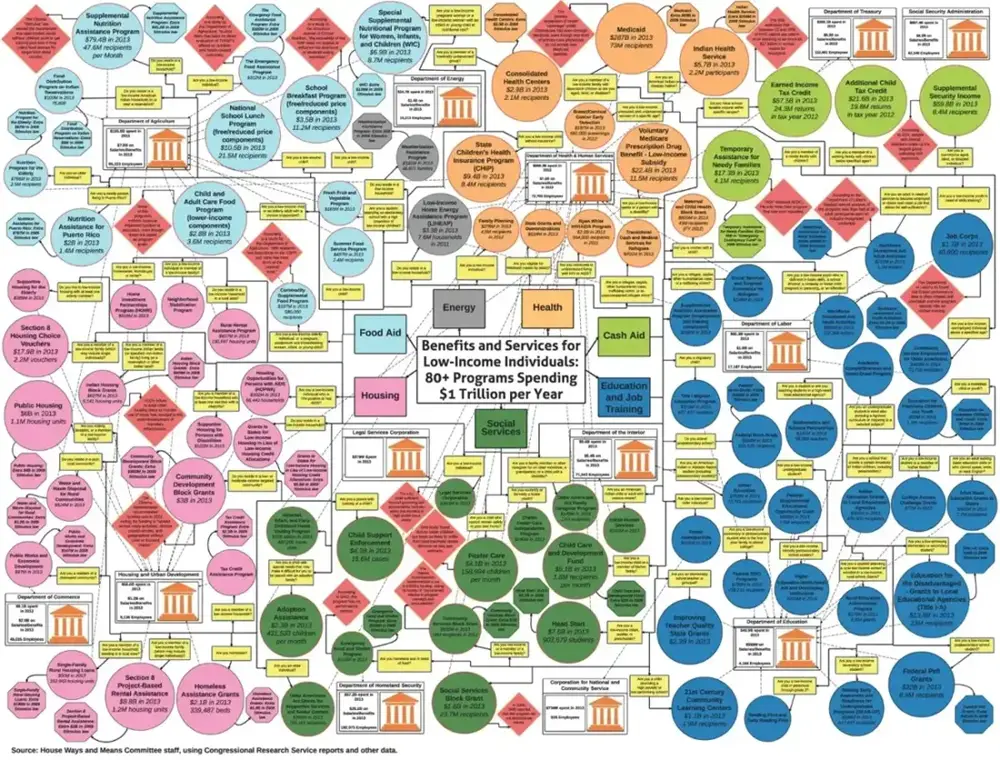
The federal government funds more than 80 different welfare programs.
As this flow chart of the benefits and services for low- income people from the
House Committee on Ways and Means shows, the welfare bureaucracy is a tangled web of bureaucracy. Those who need assistance have to deal with multiple federal and state agencies.
The welfare bureaucracy is also filled with duplication and overlapping programs. According to the
Congressional Research Service, there are 15 different food aid, 13 housing, 12 health care, and five cash aid programs.
The Welfare Bureaucracy Covers Millions of Americans
After the 1996 welfare reform, the Temporary Assistance for Needy Families (TANF) rolls fell significantly compared to the old Aid to Families with Dependent Children (AFDC) program. Fewer than 2 million individuals
received TANF in 2023.
However, overall welfare receipt has increased since welfare reform, as other programs have expanded and become more generous.
In FY 2022, 94 million Americans
received Medicaid coverage, more than double the number from just 20 years prior. More than 28% of the population was on Medicaid in 2022. In fiscal year 2023, 42.1 million Americans received
Food Stamps, 2.4 times the number who were enrolled in 2001. About 12.6% of Americans were on Food Stamps in 2023. In 2022, 22.6 million individuals received the Earned Income Tax Credit (EITC), about 6.8% of the population.
Statistics from the
U.S. Department of Health and Human Services and the
Census Bureau reveal that many recipients receive welfare for extended durations.
The Welfare Bureaucracy Is Costly
Welfare is one of the largest categories of the federal budget, comprising about 20% of annual spending.
The federal government spent $955 billion on 83 different programs for low-income individuals in 2019, according to the
Congressional Research Service. Since the COVID-19 pandemic and President Biden's spending spree, welfare spending has only grown.
The Welfare Bureaucracy Is Generous
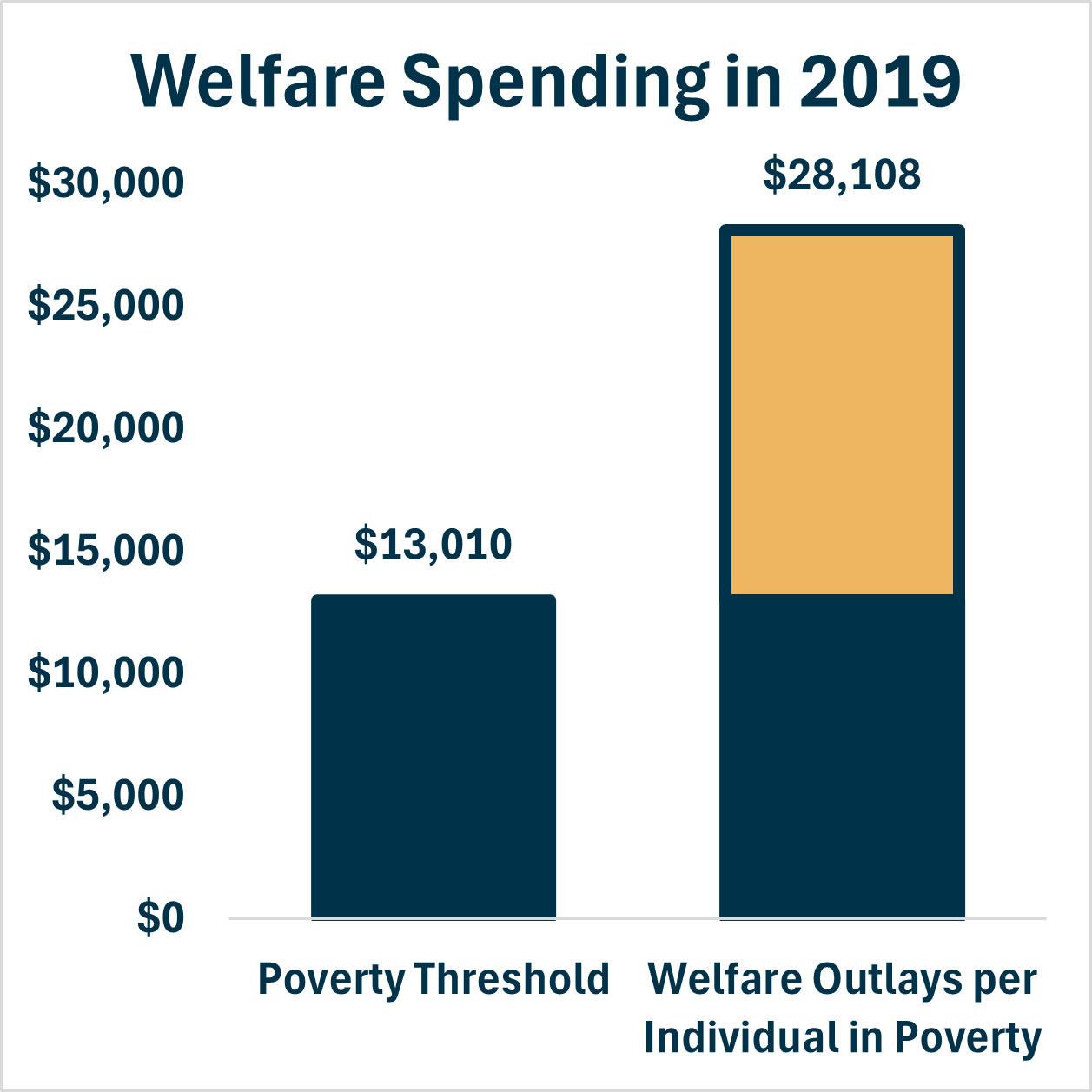
In 2019, the federal government spent more than $28,100 per person in poverty — providing benefits $15,000 above the poverty threshold for individuals.
According to the
Heritage Foundation, "The average poor family with children already receives $65,200 in cash, food, housing, medical care, and educational support from the taxpayer each year."
Data from the
Federal Reserve Bank of Atlanta shows that a single mother with two children at the poverty threshold is eligible for more than $42,000 in welfare benefits from Medicaid, Children's Health Insurance Program (CHIP), Food Stamps, TANF, the EITC, and Child Tax Credit payments. Housing, childcare subsidies, and other programs can add tens of thousands in additional benefit payments.