Key Changes to Food Stamps in the Fiscal Responsibility Act
The Fiscal Responsibility Act (FRA) of 2023 was enacted in June 2023 to suspend the debt limit and control federal spending.
[1] The FRA made changes to the work requirements for able-bodied adults without dependents (ABAWDs) in the food stamp program (officially called the Supplemental Nutrition Assistance Program, or SNAP).
Then-Speaker Kevin McCarthy (R-CA) touted these provisions:
“We also unleash policies to encourage economic growth. We add new work requirements for adults without dependents who receive money from SNAP and TANF welfare programs. That will help beneficiaries contribute to society, develop their talents, lift themselves out of poverty and achieve financial freedom and personal success.”[2]
Unfortunately, the former Speaker of the House was mistaken. On net, the FRA weakened work requirements in the food stamp program. This will trap more work- capable adults in dependance rather than helping them become the self-sufficient members of society they could be.
CBO estimates that an average of 78,000 people per month would be added to the welfare rolls during the 2025 to 2030 period as a result of the changes to food stamps.
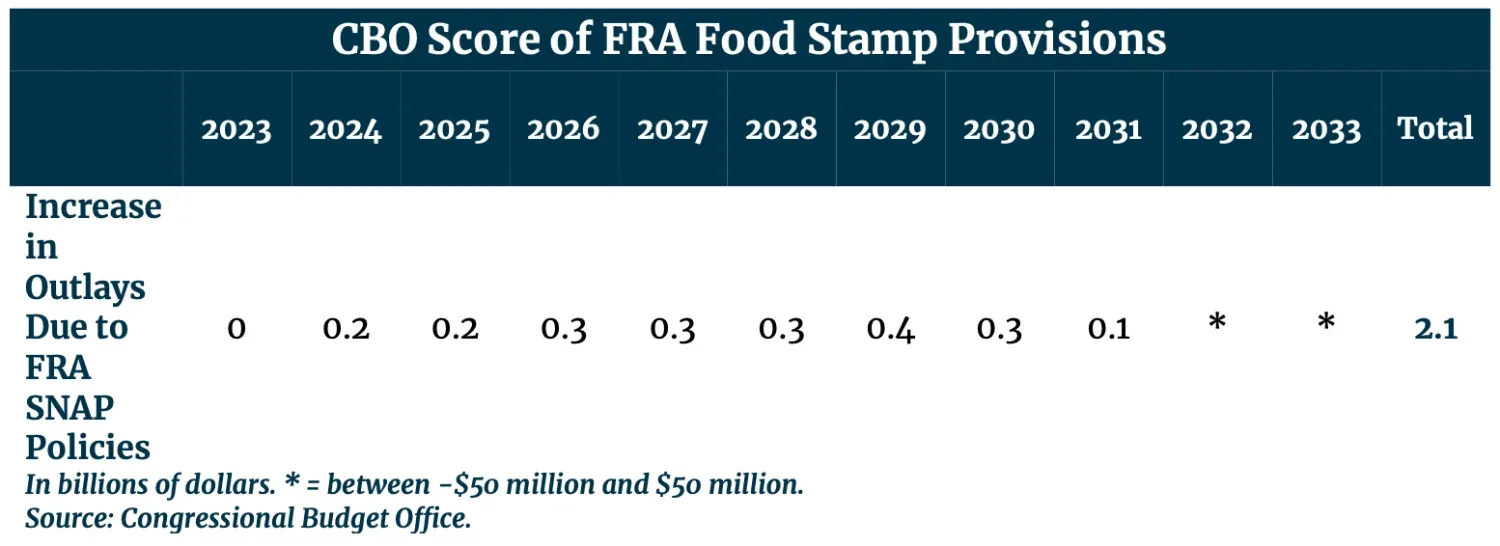
In total, the food stamp provisions in the FRA will increase federal spending on welfare benefits by $2.1 billion between fiscal years 2023 and 2033.
[3]
Table 1: CBO Score of FRA Food Stamp Provisions
Brief Overview of ABAWD Work Requirements and Exemptions
The food stamp program includes work requirements for able-bodied adults as a condition of receiving benefits. Generally, work requirements are a positive control on welfare programs that encourage recipients to become self-sufficient, ultimately moving off of government support.
Unfortunately, the work requirements for the food stamp program are weak and riddled with waivers, exceptions, and exemptions. These challenges lessen their effectiveness, trapping more beneficiaries in a cycle of poverty and dependence.
[4]
Work Requirements
The work requirement for able-bodied adults without dependents (ABAWDs) in food stamps was added by the 1996 welfare reform law.
[5]
The work requirement is enforced by limiting food stamp benefits to no more than three months for those expected to work, but who fail to satisfy the requirement. The ABAWD work requirement is sometimes called the “time limit requirement” because of this enforcement mechanism.
The ABAWD work requirement can be satisfied in several ways, by engaging in 80 hours per month (20 hours per week) of:
- Employment;
- Unpaid volunteering work; or
- A job training work program.
Exceptions to the ABAWD Work Requirements
Prior to the enactment of the FRA, food stamp recipients were excepted from the ABAWD work requirement if they meet any of these conditions:
[6]
- Under age 18;
- Age 50 or older;
- Medically certified as physically or mentally unfit for employment;
- Pregnant;
- Living with a child under 18;
- Responsible for caring for an incapacitated person;
- Going to school at least half time;
- Meeting the work engagement requirements for Temporary Assistance for Needy Family (TANF) benefits or the work search requirements for receiving unemployment insurance benefits; or
- A regular participant in a drug addiction or alcoholic treatment and rehabilitation program.
Geographic Waivers
States can apply geographic waivers of the ABAWD work requirement for food stamp recipients in any area that has an unemployment rate above 10 percent or “does not have a sufficient number of jobs.” The terms “area” and “sufficient number of jobs” are not defined in law, but instead by executive regulations. This allows states to gerrymander waivers to even include areas with very low unemployment, completely gutting the work requirements in many states.
[7]
In the second quarter of FY 2024, 12 states and territories have waived work requirements statewide and 22 states had implemented geographic waivers that covered parts of the state.
[8]
Discretionary Exemptions
After all of the exceptions and waivers, states are also allowed to apply a limited number of discretionary exemptions each year to individuals who have failed to satisfy the ABAWD work requirement. Discretionary exemptions that are unused by the state can be carried over from year to year.
Overview of FRA Changes to Food Stamps
The FRA made two changes that strengthen work requirements:
- Work requirements phase in to temporarily include those aged 50 to 54.
- The cap on discretionary exemptions from work requirements is reduced to 8
percent (from 12 percent) of those covered by work requirements and the
carryforward of unused waivers will be restricted.
The FRA made three changes that weaken work requirements:
- Able-bodied homeless individuals are excepted from work requirements.
- Able-bodied veterans are excepted from work requirements.
- Able-bodied people aged 24 and younger who were formerly in foster care are
excepted from work requirements.
The FRA made two other changes to modestly improve the food stamp law:
- Requires USDA to make state geographic waiver requests publicly available.[9]
- Adds to the non-binding statement of policy, stating that the food stamp program is meant to “assist low-income adults in obtaining employment and increasing their earnings, ” in addition to other purposes such as raising levels of nutrition.[10]
All of the policy changes to the work requirement exceptions made by the FRA will expire on October 1, 2030. The policies related to discretionary exemptions, transparency, and the statement of purpose are permanent law.
Homeless Exception
The FRA includes a new exception from work requirements for homeless individuals. The USDA estimates that 20.6 percent of ABWDs aged 18-54 are experiencing homelessness (about 766,000 in FY 2026), with 2.7 percent of these homeless individuals currently satisfying the work requirement.
[11.U.S. Department of Agriculture, “Supplemental Nutrition Assistance Program: Program Purpose and Work Requirement Provisions of the Fiscal Responsibility Act of 2023, ” Proposed Rule, Federal Register, Vol. 89, No. 84, (April 30, 2024), pp. 34340-34382,
https://www.govinfo.gov/content/pkg/FR-2024-04-30/pdf/2024-08338.pdf (accessed May 1, 2024).] The USDA’s estimate of the number of homeless individuals who would receive food stamp benefits in 2026 is 113,000 higher than the entire point-in-time count of the actual homeless population conducted by U.S. Department of Housing and Urban Development (HUD) in 2023, which was the largest national reporting ever recorded.
[12]
Advocates for the most vulnerable in our society should be concerned that this exception could boomerang and prove harmful for individuals experiencing homelessness.
As explained by the Substance Abuse and Mental Health Services Administration, “Many experiencing homelessness have high rates of chronic and co-occurring health conditions, mental and substance use disorders.”
[13] In the U.S. Department of Housing and Urban Development’s 2023 point in time count of the national population of people experiencing homelessness, 21 percent suffered from “severe mental illness” and 17 percent struggled with “chronic substance abuse.”
[14] The food stamp law already provided exceptions to the ABAWD work requirement for any person who is “medically certified as physically or mentally unfit for employment”
[15] or is “a regular participant in a drug addiction or alcoholic treatment and rehabilitation program.”
[16]
However, by encouraging states to use the “simpler box to check” work requirement exception for all people experiencing homelessness, this provision could discourage efforts to connect those suffering with much-needed targeted mental health services or substance abuse treatment.
Furthermore, it increases the risk that able-bodied individuals experiencing homelessness slip into substance abuse, mental health, or other problems because they have not been connected to beneficial work, job training, or volunteering activities. Instead of providing people experiencing homelessness with a pathway to better outcomes through work and social connectedness, the FRA promotes dependency.
The definition of “homeless individual” eligible for the exclusion used in the food stamp law extends beyond what many people would think of as the common understanding of an individual experiencing homelessness.
[17] The definition could even allow an able-bodied person living with relatives to qualify as “homeless.”
[18] The USDA's proposed regulations go even further, and attempts to classify people who have not yet lost housing as “homeless.”
[19]
This new exception expires in FY 2031.
Veterans Exception
The FRA includes a new exception from the ABAWD work requirements for all veterans. The USDA’s guidance and regulations regarding the exception even includes former servicemembers who were dishonorably discharged.
The USDA estimates that 0.22 percent of food stamp recipients are veteran ABAWDs aged 18 to 54 who would be subject to work requirements, about 92,000 individuals.
[20] An important selling point for military recruitment is the on-the-job training and technical skills that will translate to post-service career success. The U.S. Department of Veterans Affairs
[21] and the U.S. Department of Labor
[22] both offer career and employment services for veterans. The federal government provides hiring preferences for veterans.
[23]
The food stamp law already provides that participation in “a program of employment and training for veterans operated by the Department of Labor or the Department of Veterans Affairs” would satisfy the ABAWD work requirement.
[24]
If Congress feels these investments in veterans are ineffective, additional oversight and reform would be warranted. However, providing a blanket exemption of food stamp work requirements for able-bodied veterans sends the wrong message that those who have served their country have little left to offer.
This new exception expires in FY 2031.
Foster Care Exception
The FRA includes a new exception for individuals aged 24 and younger who were in foster care upon becoming an adult. The USDA estimates that about 35,000 food stamp recipients are former foster care youth aged 18 to 24 and subject to the work requirements.
[25]
The years between age 18 and 24 are formative, so policies should encourage activities that promote future success. The existing food stamp law already provides many ways to satisfy or be exempt from the ABAWD work requirement, including work, going to school, job training, or volunteering. These are precisely the types of activities that we want our young people to do to set themselves up for success throughout the rest of their life. The last thing we should want is to condemn these promising young people to dependency on government.
This new exception expires in FY 2031.
USDA Regulations Attempt to Expand Exceptions Beyond Congressional Intent
The USDA released a proposed rule in April 2024 to implement the FRA’s food stamp provisions. Unfortunately, the proposed rule includes problematic definitions regarding the definitions of “homeless individual” and “veteran” that seek to expand the definition beyond Congressional intent. The proposed rule also includes new restrictions on the ability of states to enforce the work requirement, which could increase improper payments.
Homeless Individual Exception
The USDA proposed definition of “homeless individual” in the regulation is arbitrarily different than the statutory definition for purposes of the food stamp law.
[26] The USDA even describes this statutory definition as “longstanding.”
[27]
The proposed regulation attempts to expand the definition of “homeless individual” to also include “an individual who will imminently lose their nighttime residence,” a condition which is not included in the statutory definition. This attempted expansion of the term beyond the statutory definition is a clear violation of Congressional intent.
Veterans Exception
The USDA proposed definition of “veteran” in the regulation is arbitrarily different than the standard statutory and regulatory definition used for purposes of veterans’ benefits. The USDA states that, “Given the persistent and rising concern over food insecurity for veterans, it is critical to ensure the exception covers a broad range of veterans, including individuals with former military service who may not identify with the term ‘veteran.’”
[28] It is difficult to believe that it was Congress's intent to include within the definition of “veteran” individuals “who may not identify with the term ‘veteran.’”
The regulation seeks to define a “veteran” as:
“an individual who, regardless of the conditions of their discharge or release from, served in the United States Armed Forces (such as Army, Marine Corps, Navy, Air Force, Space Force, Coast Guard, and National Guard), including an individual who served in a reserve component of the Armed Forces, or served as a commissioned officer of the Public Health Service, Environmental Scientific Services Administration, or the National Oceanic and Atmospheric Administration.”[29]
However, the statutory
[30] and regulatory
[31] definition pertaining to veterans’ benefits includes a statutory definition of veteran as meaning “a person who served in the active military, naval, air, or space service, and who was discharged or released therefrom under conditions other than dishonorable.”
The USDA's proposed definition would provide an exception for food stamp work requirements for dishonorably discharged former service members. Those dishonorably discharged are not considered to be “veterans” under the commonly accepted and generally used definition, and they are disqualified from veterans’ benefits. There is no reason for the USDA to create its own, unique definition of “veteran, ” and it is surely not what Congress intended.
Regulations Regarding Screening for Work Requirement Exceptions
The USDA is proposing new requirements for states to provide food stamp benefits to individuals who could potentially be ineligible.
The proposed regulation would prohibit states from counting months towards the three-month time limit for ABAWDs to receive food stamp benefits without satisfying the work requirement unless the state has fully screened and confirmed that the individual is not excepted or exempted from the work requirements.
Under the USDA proposal, even if the state knows that a food stamp recipient no longer qualifies for a certain exception from the work requirement, the state could not sanction the ABAWD for failure to work “until it screens the individual to determine whether any other exception applies.” And the USDA says that if the welfare recipient simply fails to respond, the state has to continue providing benefits: “In the case that a state agency attempts to screen during the certification period, but is unable to do so, the State agency must not penalize individuals for not responding, require the household to come into the office per program rules… or send a request for contact.”
[32]
The USDA’s proposed arrangement runs counter to the way the food stamp law is written and intended to operate. Under the law, ABAWDs are subject to the work requirements and are limited to no more than three months of benefits when the work requirement is not satisfied. Within that general rule, certain individuals may qualify for an exception to the work requirement.
The USDA further “encourages State agencies avoid setting guidelines for questionable information that would consider self-attestation questionable and require every individual who meets exception criteria to provide verification.”
[33]
The USDA’s proposal undermines the work requirement and increases the risk of improper payments.
New Exceptions and USDA Guidance Increase Risk of Improper Payments
The food stamp program makes billions in improper payments each year. Improper payments are government outlays that should not have been made or were made in the wrong amount. These improper payments often include fraud, abuse, and waste, but are not always indicative of illegal activity.
The USDA has reported more than $45.75 billion of improper payments between FY 2003 and FY 2022. The reported improper payment rate was 11.5 percent in 2022.
[34]
The new exceptions, and the USDA’s guidance to states for implementing them, increase the risk for improper payments.
Guidance from USDA directs states to use lax or even no verifications if food stamp recipients claim they meet one of the new exceptions:
“There are no new verification requirements for the modified exceptions from the ABAWD time limit. State agencies are expected to only require verification of information that they determine is questionable... State agencies must support households in obtaining verification, provided the
household is cooperating, and must accept any reasonable documentary evidence provided by the household.”[35]
The “reasonable documentary evidence” could even include a claim made by a member of the same household:
“State agencies may accept a statement from a household member that they or another household member meets one of the modified exceptions. There are no new verification requirements for the modified exceptions.”[36]
In response to questions from state agencies, the USDA provided guidance prohibiting states from requiring food stamp recipients to report changes in their exception status:
“Can State agencies require individuals to report information on the modified exception criteria?
Response: No. State agencies cannot require recipients to report changes in exception status outside of their reporting requirement system. Individuals are only required to report changes in circumstances outlined in 7 CFR 273.12(a)(1)(i) through (a)(1)(viii).”[37]
USDA even specifies that any screening questions that a state might add to the periodic report required by households about the new exceptions are voluntary for recipients:
“State agencies may add additional screening questions about the modified exceptions to the periodic report; however, the household’s response is voluntary. The State must not terminate a household for failure to respond to the additional screening questions.”[38]
In particular, the exception for people experiencing homelessness poses a risk for fraud and abuse. The USDA told states that “Homeless individuals and households are specifically exempted from the requirement to verify residency.”
[39] The USDA will allow states to effectively allow self-attestation for claiming the homeless exception.
[40]
Expansion of Age Applicability of Work Requirements
The FRA increases the maximum age for coverage by the ABAWD work requirement. The new maximum age phases up from 49 before the FRA to 54 by FY 2025.
The maximum age reverts back to 49 in FY 2031.
Table 2: Ages Covered by ABAWD Work Requirement
| Before FRA |
18 to 49 |
| FY 2023 |
18 to 50 |
| FY 2024 |
18 to 52 |
| FY 2025 - 2030 |
18 to 54 |
| FY 2031 and After |
18 to 49 |
The age-related changes made by the FRA are modest. The USDA projects that just 1.8 percent of food stamp recipients could be newly subject to work requirements once the maximum age applicability fully phased in, although 33 percent of these individuals are projected to be exempted from work requirements for a reason other than disability and another 30 percent are expected to live in an area covered by a geographic work requirement waiver.
[41] That means the FRA age-related expansion of work requirements will only cover about 350,000 work-capable individuals receiving food stamps per year when full phased in.
According to data from the USDA, able-bodied adults without dependents age 50 to 59 enrolled in food stamps have employment rates that are statistically similar to ABAWDS aged 18 to 49.
[42] The USDA estimates that only 10.6 percent of able-bodied adults aged 50 to 54 receiving food stamps currently meet the work requirement.
[43] Government policy should not discourage work by people who should be in their prime-earnings years prior to retirement.
Discretionary Exemptions
The FRA reduces the number of discretionary exemptions from the ABAWD work requirement that states can provide each year to 8 percent of the caseload subject to the work requirement from 12 percent.
The FRA also limits states’ ability to carry over unused exemptions from year to year. During the COVID-19 public health emergency declaration, work requirements were waived nationwide between April 2020 to July 2023, so states did not have to use discretionary exemptions and thus accumulated large surpluses that could have been carried forward until the state used them up. For FY 2023, states and territories had accumulated more than 11.5 million available months of discretionary exemptions, of which 10.7 million were carried over from prior years.
[44]
The FRA restricts exemption carry over for only one year. Guidance from USDA explains:
“In FY 2024 and FY 2025, State agencies may use the discretionary exemptions they earn during the fiscal year and unused exemptions accumulated in prior years. In FY 2026 and subsequent years, State agencies may only carryover unused exemptions allotted from the prior fiscal year.”[45]
The USDA has issued guidance to states, urging them to use the available discretionary exemptions to gut the expansion of the maximum age for work requirements implemented by the FRA. Guidance documents state that:
“FNS encourages State agencies to use discretionary exemptions to the maximum extent allowable to mitigate any implementation challenges and ensure access to vulnerable populations. For example, State agencies may choose to use discretionary exemptions for 50-year-olds in the month of September 2023.”[46]
A question-and-answer document providing guidance also says:
“Can State agencies use discretionary exemptions to exempt all ABAWDs subject to the new age provision (e.g., all 50–52-year-olds)?
Response: Yes. State agencies may use discretionary exemptions to ease the transition into the new age criteria without violating program rules at 7 CFR 273.24(g)(4). FNS encourages State agencies to consider using their available discretionary exemptions when transitioning between the different modified age-based criteria.”[47]
Reducing the available discretionary exemptions from work requirements is a good policy. However, it is a modest policy change. According to the CBO cost estimate for the FRA, “the changes to discretionary exemptions would reduce spending for SNAP by a negligible amount.”
[48] The USDA notes that “state agencies typically use less than an 8 percent allotment of discretionary exemptions,” identifying only five instances among all states between FY 2016 and 2019.
[49]
What Congress Should Do
Policies that expect work or work preparation activities as a condition of receipt of welfare benefits for able-bodied adults have been shown to have a positive impact. Congress should focus on promoting work for all able-bodied adult food stamp recipients to promote self-sufficiency and end dependency.
Eliminate the new exceptions.
Congress should repeal the new exceptions for homeless individuals, veterans, and former foster care children. An amendment proposed in the House to the FY 2024 Agriculture-FDA Appropriations bill to prohibit USDA from expending funds to carry out the new FRA exclusions would have saved taxpayers $8.6 billion over the FY 2024-2033 period.
[50]
Expand and strengthen work requirements.
Congress should further expand and strengthen work requirements for able-bodied adults.
[51] The age applicability should be permanently expanded to cover work capable adults through age 64. Work requirements should apply to all able-bodied adults. Most importantly, the geographic waivers should be eliminated.
Block USDA’s proposed regulations that do not align with Congressional intent.
Congress should block the USDA’s proposed rule that attempts to expand the new exceptions for homeless individuals and veterans, and which also increases the risks of improper payments. If the USDA finalizes the rule without fixing these problems, the rule could be disapproved via the Congressional Review Act.
[52]
Work is essential to human flourishing. While the FRA included some modestly positive policies, it unfortunately weakened the food stamp work requirements by adding new exceptions. The USDA’s implementation of the FRA attempts to further undermine work. Congress should use every opportunity to correct these problems, including the farm bill, agriculture appropriations bills, Congressional Review Act disapproval resolutions, and upcoming reconciliation legislation.