Background
Congress will vote on the Social Security Fairness Act (H.R. 82) during the lame duck session of the 118th Congress in late 2024. While this bill addresses a problem that needs to be fixed, it does so by reviving large windfall benefits to predominantly middle- and upper-income retirees instead of relying on now-available data to apply a fair and accurate fix.
Providing windfall benefits to individuals who worked in government jobs that were exempt from Social Security taxes would
cost $196 billion over 10 years and cause Social Security to become insolvent six months earlier than projected. This will directly result in an additional $2,500 in benefit cuts for a typical Social Security recipient in 2033.
An Unintended Flaw in Social Security’s Original Benefit Formula
Social Security was designed to provide progressive benefits, meaning that Social Security benefits replace a higher share of lower-income individuals’ prior earnings.
Social Security was also designed to support the family and workforce structure of the era: the 1930s. At the time, this meant providing a spousal benefit to individuals—almost always women—who did not work long enough to earn a benefit of their own.
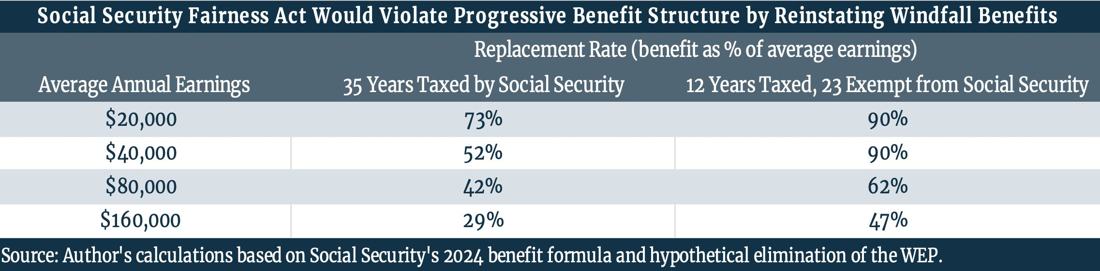
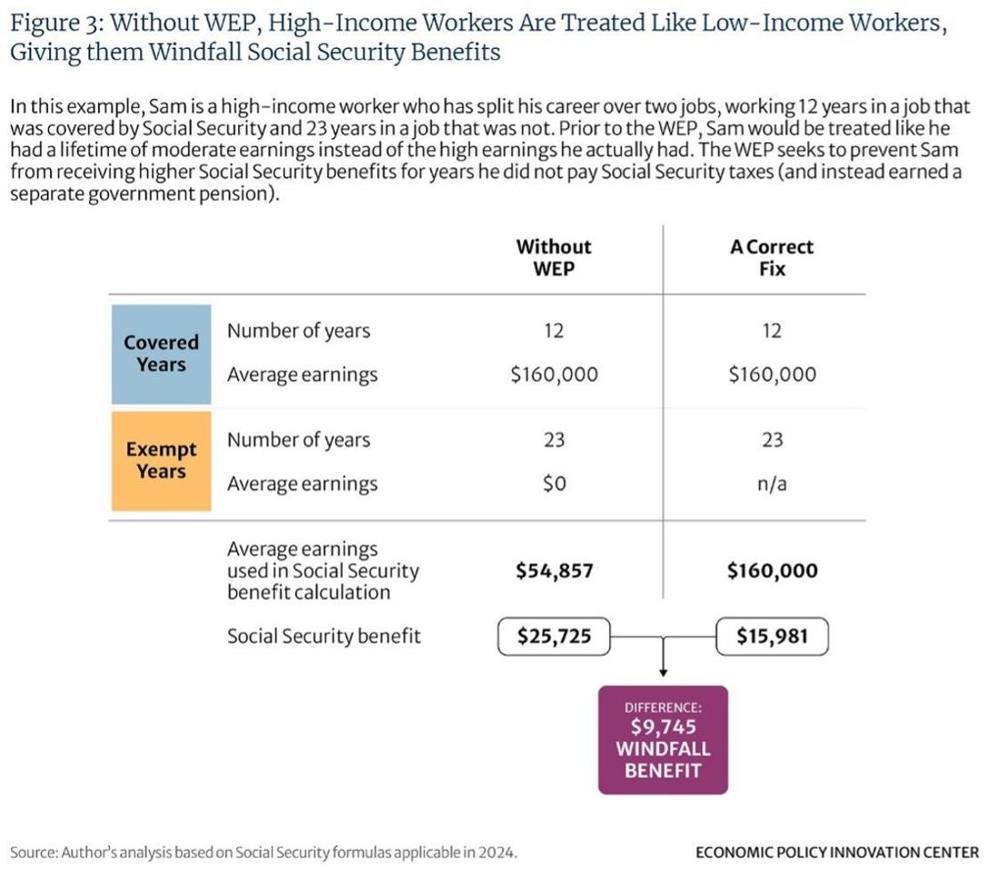
An unanticipated flaw in the benefit formula—which counted years spent in government jobs exempt from Social Security taxes as zeros—violated the program’s intents for progressive and spousal benefits. Consequently, workers who had jobs that were not subject to Social Security taxes and instead provided their own benefits ended up being treated like they had lower incomes than they actually earned, or like they were stay-at-home-spouses when they worked and earned their own pensions.
When Congress passed the legislation to eliminate these windfall benefits—
the Government Pension Offset (GPO) in 1977 and the Windfall Elimination Provision (WEP) in 1983—they lacked the data necessary to apply an accurate fix, so they implemented an imperfect one instead. This means that some people still receive windfall benefits (albeit much smaller than before), and others end up with lower Social Security benefits, or a penalty, compared to the program’s intended benefits.
Finding a Fair and Fiscally Responsible Fix
Reverting to the originally flawed formulas would neither be fair nor fiscally responsible. The Social Security Fairness Act would cause some individuals with identical incomes to be treated differently and some individuals with different lifetime incomes to be treated the same. It would also hasten Social Security’s insolvency and result in even larger benefit cuts.
Instead of reverting to a deeply flawed formula, policymakers should use the data that is now available to implement a fair and accurate fix, based on the income people actually earned and the Social Security taxes they actually paid.
The
Equal Treatment of Public Servants Act provides a fair long-term fix for the WEP (without reducing any benefits and providing lump sum payments to affected individuals) at a cost of $24 billion over 10-years and a
“negligible” long-term cost. A similar fix for the GPO could be incorporated into that Act or a separate bill.