Since President Donald J. Trump was first sworn into office in January 2017, the fiscal and economic state of the United States has undergone significant changes. In the intervening eight years, the federal debt has grown dramatically as government spending has outpaced escalating revenues. This growing debt has led to inflation and higher interest rates, and significantly eroded the nation’s debt capacity.
Any resilient nation with a strong foundation should be able to effectively respond to crises caused by war, recession, or natural disaster. However, the federal government’s fiscal policy was unsustainable even before the COVID-19 pandemic. This trend worsened under the Biden Administration, whose additional stimulus in 2021 and 2022 pushed the debt higher despite an ongoing economic recovery and caused the cost of living for Americans to rise by more than 20 percent.
Most notably, debt held by the public has soared as a share of the nation’s gross domestic product (GDP), federal revenues have increased beyond initial projections (despite the enactment of the Tax Cuts and Jobs Act of 2017), and government expenditures (both mandatory and discretionary) have seen significant growth. The cost of servicing the national debt (i.e., the interest the government pays) has risen dramatically and now overshadows the country’s total defense expenditures.
Examining these trends together provides a clearer understanding of how drastically America’s fiscal situation has changed since 2017 – and foreshadows the nation’s future. The growth in government spending, which drove the explosion of debt, was caused by two interrelated factors:
- Repeated, deliberate decisions to increase spending; and
- Autopilot increases to government spending in programs that are sensitive to inflation, which was caused by the irresponsible spending policies.[1]
It will be necessary for President Trump and Congress to face these challenges head on, or their other legacies will be eclipsed by the continued pressure that rising debt will have on the economy.
Escalation of Public Debt
In 2017, total debt held by the public was at approximately 77.5 percent of GDP.
[2.The Congressional Budget Office, “The Budget and Economic Outlook: 2018 to 2028,” April 2018, at https://www.cbo.gov/publication/53651#:~:text=For%20the%202018%E2%80%932027%20period,are%20higher%20by%20%240.5%20trillion.
] Although concerns about the national debt were already prevalent, few predicted the scale at which this figure would climb by the middle of the next decade because of the pandemic and policy decisions that followed. As of today, debt held by the public is expected to reach 99.9 percent of GDP by the end of September 2025.
[3]
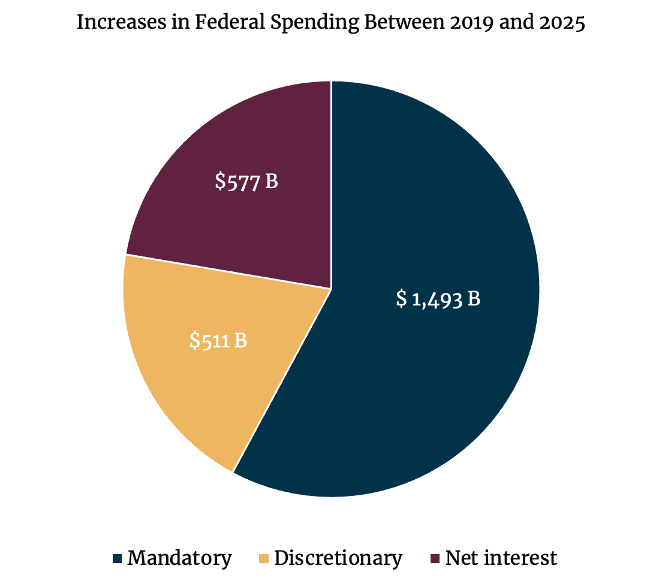
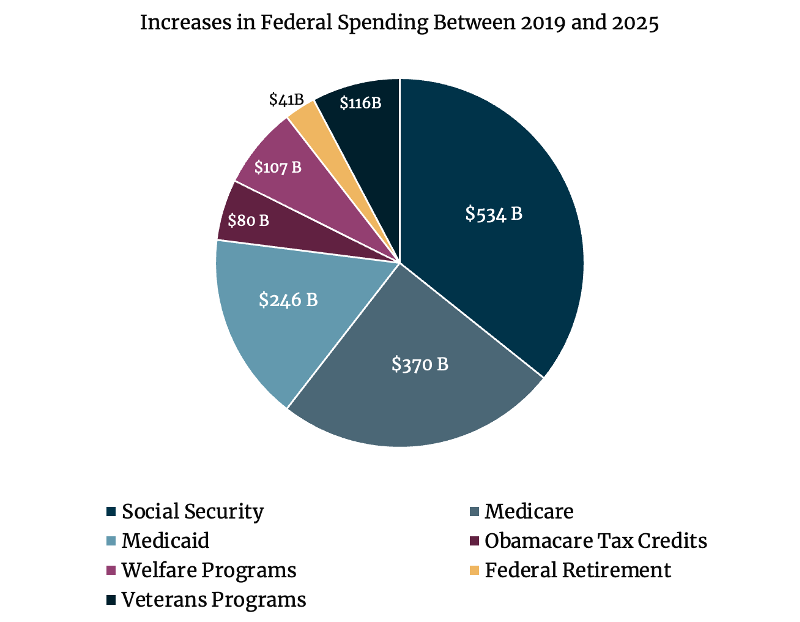
The most significant factor contributing to this has been the dramatic rise in spending and the costs associated with servicing the debt. Between 2019 and 2025, annual mandatory spending has increased by $1.4 trillion per year, with the largest increases associated with programs that are adjusted annually by inflation. Net interest costs are also more than $500 billion higher per year than they were before the pandemic as the average interest rate on the debt has increased from 2.49 to 3.37 percent, and the amount of debt has grown.
Source: Author’s calculations based on data from the Congressional Budget Office
Federal Revenues Are Higher Than Expected
Despite the 2017 tax cuts, federal revenues have grown significantly. In 2017, the federal government collected about $3.3 trillion in receipts.
[4] By 2025, this figure has climbed to an estimated $5.2 trillion.
[5] This growth has outpaced the Congressional Budget Office’s (CBO) early-2017 projection, which forecasted that federal tax revenues in 2025 would be around $4.7 trillion. Several factors help explain why revenues overshot these estimates, despite initial concerns that the Tax Cuts and Jobs Act (TCJA) might erode the government’s ability to generate sufficient revenue.
The labor market has been remarkably resilient. The years preceding and following the COVID-19 pandemic saw many Americans returning to work, higher nominal wages, and overall economic growth. Although government-imposed closures caused a sharp contraction in 2020 and 2021, the rebound in subsequent years was stronger than many early forecasts suggested. Growth in nominal GDP, in part driven by inflation, boosted tax receipts significantly.
Even as marginal rates were cut by the TCJA, changes to deductions, credits, and exemptions increased taxable income, particularly at the corporate level. At the same time, the TCJA discouraged corporations from moving assets overseas, thereby increasing domestic investment. Higher corporate profitability (especially in the technology, pharmaceutical, and large retailer sectors) also boosted corporate tax receipts. The stock market soared prior to the pandemic, which increased capital gains tax revenue. Expansionary monetary policy both before and during the pandemic helped boost equities, leading to robust capital gains that translated into more taxable income.
Government Spending Is Unsustainable
While revenues have grown, spending has grown even faster. In 2017, autopilot (or “mandatory”) spending totaled $2.5 trillion.
[6] This year, it is expected to exceed $4.2 trillion.
[7] Meanwhile, discretionary spending (the portion of the budget that Congress actively votes on year to year, including defense, education, and various government agencies), has increased from $1.2 trillion to $1.8 trillion. The largest increase has been in non-defense discretionary spending which is on track to be 58 percent higher in 2025 than it was in 2017.
As I reviewed in testimony before the House Oversight and Accountability Committee, “the key goal of the Biden-Harris Administration has been to grow the federal government… On virtually every metric that can be measured, the Biden-Harris Administration has successfully grown the size and scope of the federal government over the past four years… civilian government employees are at an all-time high. State and local government hiring has made up a disproportionately large part of the job creation since 2021 due to increased federal subsidies.”
[8]
As my colleagues Matthew Dickerson and Amelia Kuntzman have found, the policies of the Biden-Harris Administration increased federal spending by about $4.7 trillion relative to projections for fiscal years 2021 through 2024 made by CBO immediately prior to the enactment of the Biden-Harris agenda. These spending increases “were primarily driven by rising net interest costs, Medicaid expansion, Food Stamp benefit increases, higher Social Security costs, student loan debt transfers, bank bailouts, aid to Ukraine, union pension bailouts, increased veterans’ benefits, expanded Obamacare subsidies, increased transportation spending, ARPA stimulus payments, and the expanded child tax credit.” These “deliberate decisions to increase spending drove inflation, which in turn exacerbated autopilot spending.”
[9]
Even robust revenue growth has been insufficient to keep pace with the swelling spending, leading to continued annual deficits and higher national debt. This illuminates why the debt-to-GDP ratio has grown to nearly 100 percent.
The Rising Cost of Servicing the Debt
One of the most troubling surges in federal debt is the exponential rise in interest payments. In 2017, the federal government spent $263 billion to service its outstanding debt, a significant figure but one that was buffered by low interest rates.
[10] By 2025, net interest has risen steeply to $952 billion, surpassing what the government spends on national defense.
[11]
This near quadrupling in interest expense is driven by higher debt levels and rising interest rates. Several factors have driven these higher rates. First, the Federal Reserve pivoted from its historically accommodative stance to combat inflationary pressures in the post-2020 recovery. Second, the value of marketable debt has increased by $8.6 trillion over the past five years, which has outpaced its demand at lower rates. As the debt is rolled over and new bonds are issued at higher rates, the average cost of borrowing climbs, rapidly multiplying the burden of interest payments.
The additional $689 billion spent annually on interest, compared to 2017 levels, represents money that cannot be allocated to other priorities, nor can it be easily cut without jeopardizing the Treasury’s credibility.
The historian Niall Ferguson has warned that when a dominant world power dedicates more of its resources to servicing debt than to defending itself, it could signal the beginning of that power’s decline.
[12] With 2025 defense spending at $862 billion and interest payments at $952 billion, the United States finds itself at this critical mark. Although there is no immediate guarantee of decline, this cautionary note represents an inherent risk.
Further, unless the growth in spending is meaningfully reduced, it is very possible that the federal government could enter a debt spiral by the early-2030s. This is an especially significant risk today as debt capacity has eroded from 73 to 62 percent of GDP since 2017, and struggled to regain its pre-pandemic position because of the Biden Administration’s unnecessary stimulus spending.
Historical Comparisons and Future Implications
Placing the current debt-to-GDP ratio near 100 percent into historical perspective reveals the severity of the situation. The last time the United States approached comparable levels was during and immediately after World War II, when the nation was mobilized for a global conflict. In the postwar era, high growth rates along with limited long-term liabilities helped reduce debt ratios (e.g., two of the most significant contributors to the government’s fiscal imbalances, Medicare and Medicaid, were not created until 1965). The contemporary environment is quite different. Specifically, it is impossible to grow the economy by enough to reduce our debt burden without significantly reducing the growth in spending.
Over the long term, an economy with a high debt burden can still hobble along. Japan, for instance, has operated with debt well above 200 percent of its economy. However, the question for the U.S. is whether the composition of its debt and the global demand for its debt will remain stable. Historically, the dollar’s role as the world’s reserve currency and the status of its debt as a leading safe asset has allowed the United States to borrow more cheaply than other countries. As interest payments overshadow defense spending, it is very possible that an erosion of confidence in U.S. economic leadership is on the horizon.
Were foreign and domestic investors to perceive a significant increase in default risk or inflation risk, the interest demanded on Treasurys could increase even more, which would create a cycle of increased interest payments and higher debt that would be impossible to break from without significant fiscal reforms. For example, if the average interest rate that the U.S. paid to service its debt increased by 1 percentage point, it would increase spending on debt service by about $3.3 trillion over 10 years.
A Precarious Balance
From 2017 to 2025, the United States has undergone a dramatic fiscal transformation. Debt held by the public is at levels that have not been seen before during peacetime. Federal revenues are also higher than expected, having increased from $3.3 trillion to $5.2 trillion, but this has not been enough to limit annual deficits as spending has grown considerably. Consequently, the nation now devotes almost $1 trillion to servicing its debt, exceeding the amount spent on defense.
The implications are profound. On one hand, the United States remains the world’s largest economy, retains a reserve currency in the dollar, and continues to benefit from strong global demand for its debt. On the other hand, Niall Ferguson’s warning about a superpower spending more on interest than on defense serves as a stark reminder of history’s lessons. While crossing this threshold does not guarantee a loss of hegemony, it signals a vulnerability that policymakers would be wise to address. The country’s ability to manage its debt burden will shape its international standing and economic prospects for decades to come.
In the years since President Trump first took office, the American fiscal story has been one of robust revenue growth, even more robust spending, and alarming interest costs. Whether one views the developments of these eight years as necessary responses to crises or as evidence of administrative overreach, the result is an unprecedented burden on the nation’s finances. The choices made in 2025 about tax policy and spending priorities will determine whether this debt continues to climb.
Should the United States fail to address these rising costs, it risks not only the nation’s economic stability but also its ability to maintain a leading role in the world. However, if solutions to reduce the growth in spending, and especially long-term liabilities, can be found, the nation will emerge more resilient. The stakes could not be higher.