

Background: Current State of Play
At the time of writing, Congress and President Donald J. Trump have not yet reached an agreement on government funding for the annual appropriations bills for fiscal year (FY) 2026. House and Senate Republicans, alongside President Trump, have taken tangible, reasonable, and fiscally responsible steps toward keeping the government operational without increasing spending, while still allowing for further negotiations on toplines and policies to be included in the ultimate appropriations package. Using the 60-vote threshold, Senate Democrats have prevented this effort from advancing. If a deal is not reached by midnight on September 30, 2025, appropriations (annual discretionary funding) will lapse at the start of the new fiscal year at 12:01 AM on October 1, 2025. At such a point, a government shutdown would occur. This stems from the Congressional power of the purse in the Constitution:On September 19th, the House passed the Continuing Appropriations and Extensions Act, 2025 (H.R. 5371), a clean continuing resolution (CR) that would extend funding and avert a shutdown for seven weeks while negotiations continue. The Senate then considered the bill the same day and it failed to garner the necessary 60 votes for passage. The overwhelming number of Democrats opposed the bill, while a single Democrat in each chamber – Rep. Jared Golden (D-ME-02) in the House and Sen. John Fetterman (D-PA) in the Senate – joined Republicans in supporting it. This vote history is important, as it provides key context and a stark departure from past bipartisan vote tallies on CRs at the same funding level.“No Money shall be drawn from the Treasury, but in Consequence of Appropriations made by Law.”
Article I, Section 9, Clause 7
The Minority Leader’s Myth
Unfortunately, Congressional Democratic Leadership has blockaded the clean CR on the basis of misinformation in an attempt to increase their leverage and dramatically grow federal spending. Such an outcome would have detrimental impacts on the national debt and fiscal health of the United States. House Minority Leader Hakeem Jeffries (D-NY-08) claimed that the House-passed CR does not reflect President Biden’s final spending levels:“They are not the Biden spending levels. Let's be clear about that. The Biden spending level. That's another Republican talking point. The Biden spending levels were agreed to by President Joe Biden in the December continuing resolution. That's the bipartisan bill in December or not in March. That's the Trump spending level. And the notion that anyone would just accept the statement that those are Biden spending levels when it's very easy to take a look at the bill in December that was passed with bipartisan margins and signed into law by then President Joe Biden. And the bill in March that was jammed down the throats of the American people in a very partisan way and signed into law by Donald Trump. I don't accept that idea that it's the Biden spending numbers when the facts say exactly the opposite.”In reality, the facts “say exactly the opposite” of Leader Jeffries’s claims. Jeffries fails to follow the legislative history back through the tangled appropriations web of the past few years. There is only one conclusion to draw: the House-passed CR draws on the Biden spending levels.
Unraveling the CR Layers
President Biden signed into law a CR in December 2024 (PL 118-158). The December CR extended the previously enacted FY 2024 levels through March 14, 2025. This was the second CR of the year.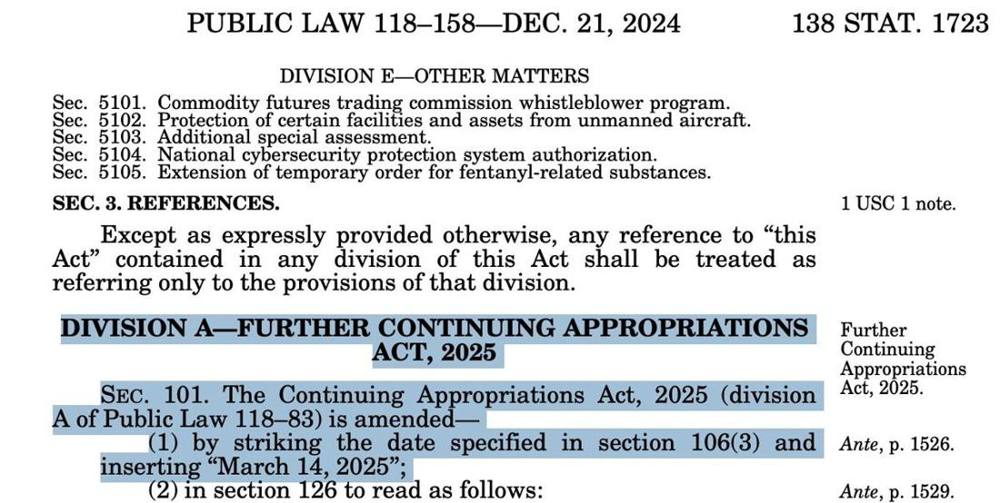 The December CR was a stop gap amending the earlier September CR, which was signed by President Biden into law on September 26, 2024, just days before the end of that fiscal year. The September CR, the Continuing Appropriations and Extensions Act, 2025 (PL 118-83) was the stop-gap measure that funded the federal government from October 1, 2024, through December 20, 2024.
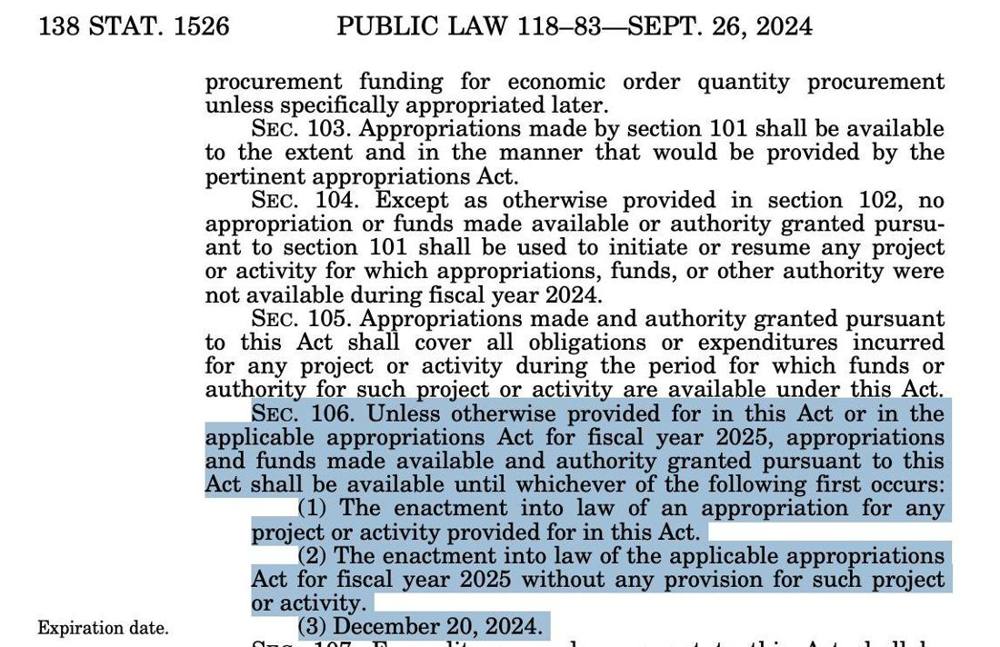 The federal government continued operating under the Biden-signed December CR, which itself was an extension of the Biden-signed September CR, until March 15, 2025. On that date, President Trump signed into law the March CR, the Full-Year Continuing Appropriations and Extensions Act, 2025 (PL 119-4).
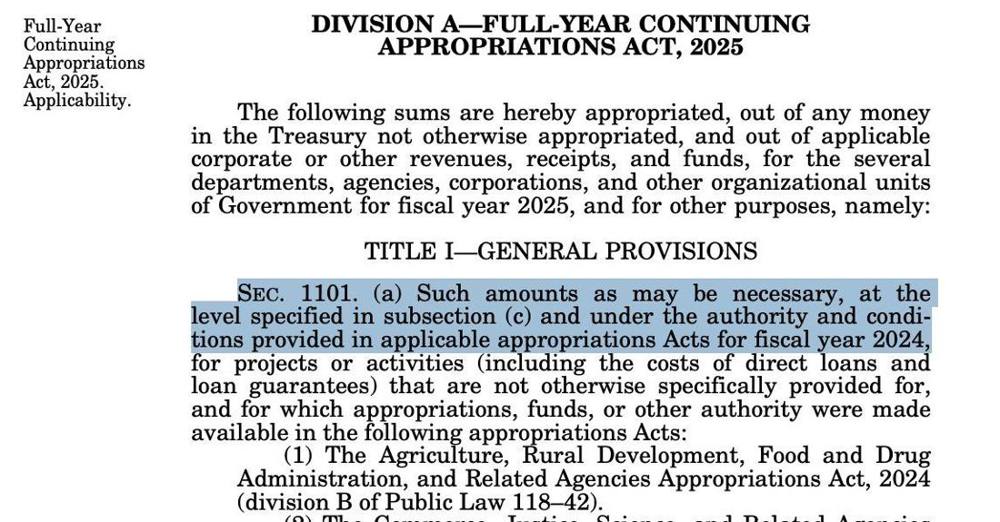 The March 2025 CR provided appropriations for the remainder of fiscal year 2025 at the fiscal year 2024 levels. The text of the law explicitly states this, and references previously enacted FY 2024 appropriations bills. Specifically, the March 2025 CR Jeffries refers to pulled forward levels enacted in the two FY 2024 minibuses signed into law by President Biden in March 2024 (PL 118-42 and PL 118-47). Notably, the March 2024 minibuses were the last “regular” appropriations levels enacted rather than a CR.
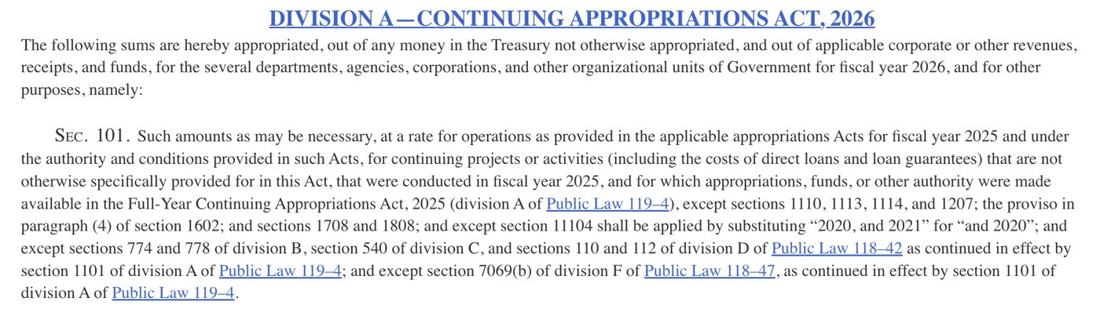 There can be no doubt that the current House-passed CR for fiscal year 2026 is written to President Biden’s fiscal year 2024 appropriations levels. This is made clear in Division A, Section 101, which explicitly references the prior CRs and minibuses.